
Mahony Maia Kiely Turns Red Desert Sand Into Women’s Faces
At Women in Arts Network, we talk a lot about what it means to make something visible. We look for artists who understand that showing is never neutral . that every mark is a decision about what gets seen and what stays buried.
For Faces, we expected intimacy. The close-up, the held gaze, the confrontation of one person looking at another and deciding what to reveal. We expected the skin-level. The recognisable. We did not expect someone who makes women’s faces in dirt and then lets the wind take them.
Mahony Maia Kiely is a selected artist for the Faces exhibition and from the moment her work reached us, we knew it would shift the way we think about this theme.
Mahony doesn’t paint faces. She pulls them out of the ground. Literally. She scratches women’s faces into soft red desert sand not canvas, not paper, the actual earth and then casts them in plaster before the wind gets to them. What comes out looks less like something she made and more like something the land was already holding. Like she just knew where to dig.
Her work goes everywhere sculpture, performance, fire spectacles, community ceremony, installation over thirty years of making in every form you can think of. But it always circles back to the faces. Always back to the dirt under her hands. She doesn’t have a studio in the traditional sense. She works under clotheslines. In creek beds. On whatever ground she’s standing on. With whatever she can find.
Mahony was only nineteen when she rode into Central Australia on the back of a motorbike. She cooked over campfires, slept in swags under these enormous skies, and somewhere in those early months she met Aboriginal elders who changed everything for her. She didn’t just meet them she actually listened. And something shifted in her understanding of what it means to belong to a place. It never shifted back.
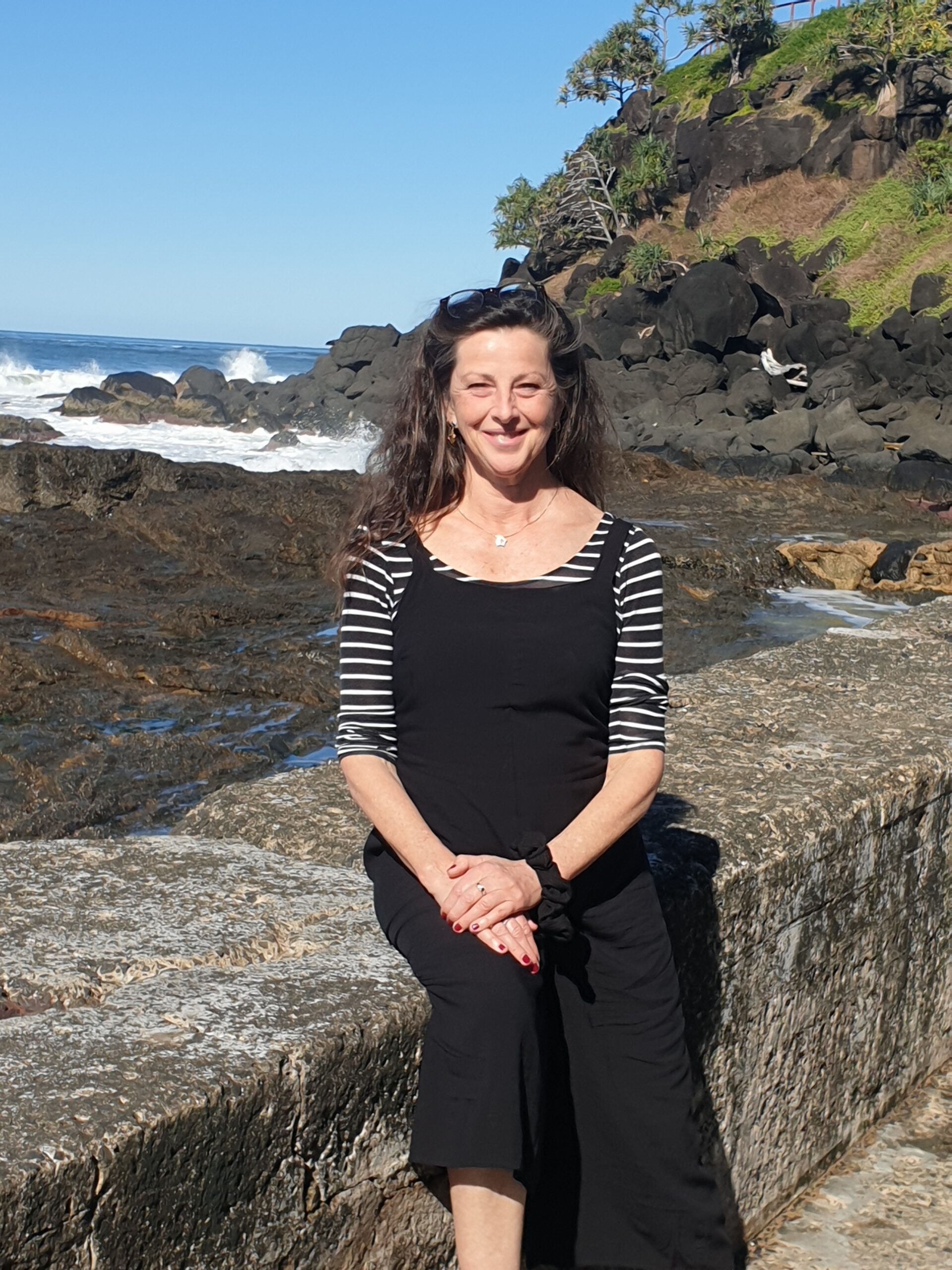
She fell in love with the land. Got pregnant. Stayed. And suddenly she was this young mum, raising twin girls on her own in the middle of the red centre, thousands of kilometres from any art school or gallery or anyone who could hand her a roadmap. So, she made her own. She enrolled in a local art diploma. Started experimenting. And one day and this is the part that gets us every time, she was standing at her clothesline in Alice Springs, laundry drying above her, and she started drawing faces in the sand at her feet. Women’s faces. In the dirt. Under the washing. An elder had once told her that the land holds stories, and if you’re lucky enough to hear them, you have to tell them. She took that literally. She’s still taking it literally.
The wind erased those first faces. Of course it did. But Mahony wasn’t having it. She started casting them in plaster catching them before they disappeared, locking them into these heavy, rocklike forms. And that was it. That was where the practice began. Not in a studio. Not from some grand artistic vision. From a woman alone in the dust who needed to make something that wouldn’t blow away.
Now let’s hear from Mahony, about scratching portraits into sand, about what the wind takes when you’re not looking, and what it means to spend a whole life deciding which faces are worth saving
Q1. Can you share your background and the path that led you into such a multi-disciplinary practice, spanning performance, sculpture, choreography, design, and community-led creation?
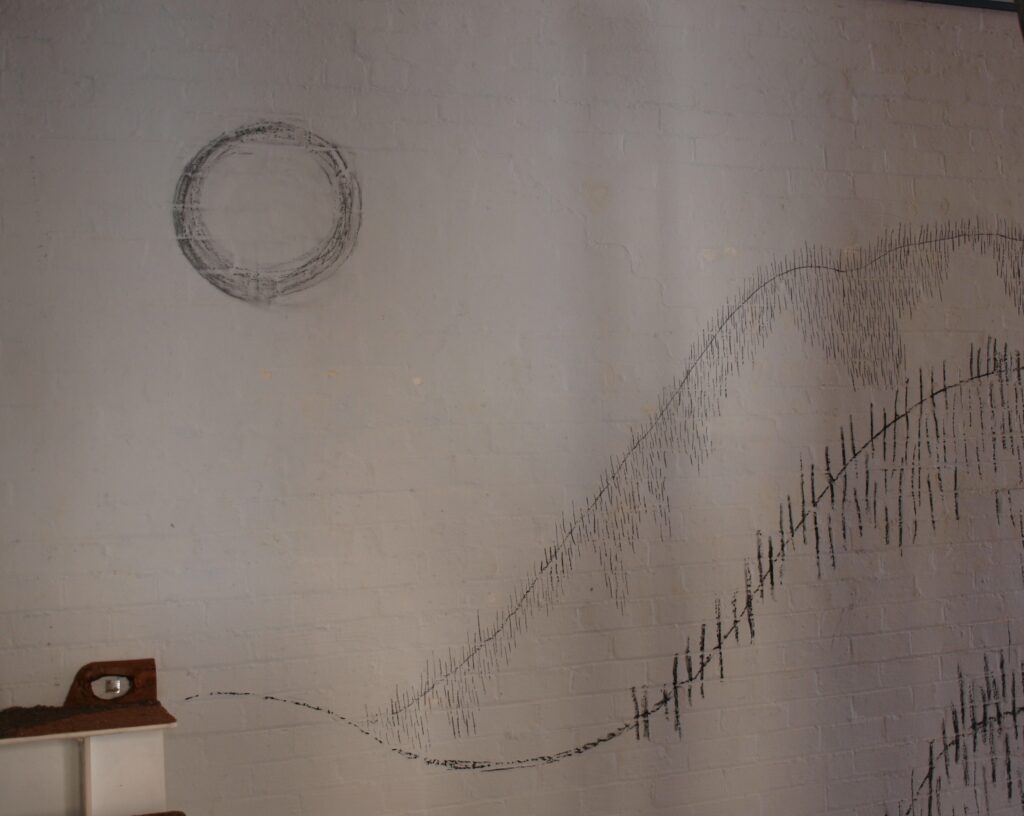
I was always a physical child so like so many of us, I learnt dance from a young age, AND started making things with whatever resources came to hand… I continued both practices into adulthood … Ballet, gymnastics and Traditional Irish dance as a child and teenager led to training in Physical Theatre as a young adult. I travelled to Central Australia, fell in love with the landscape and culture, got pregnant and stayed. As a young mother, I connected to the local arts community and became involved in local productions. Inspired to act, I moved to Melbourne to study physical theatre and drama then returned to Alice Springs, struggling with what I found to be a superficial life in Melbourne. I missed the colours and culture of the red centre. At one point I volunteered to work with visiting artist Neil Cameron on his community fire spectacle. I was excited by the fire and enthralled by how he engaged people from all walks of life in simple but meaningful spectacular events. His work felt powerful, so I joined his company, NCP, and began to work in communities and festivals around Australia. In parallel, I found myself raising twin daughters alone in the dusty heart of Australia. Miles from any performance school at that stage, I enrolled in a Diploma of Applied Art at the local Tafe. Inspired by the traditional Aboriginal practice of sand painting, I started drawing in the soft red sand under my clothesline. What emerged were women’s faces, ephemeral images wiped away by wind. I started to cast those images in plaster, trapping them into rocklike forms. I feel my practice in both movement/ performance and sculpture/ installation simply developed in response to, and as an exploration of, the three-dimensional world we all live in. I used what was in front of me, both as inspiration and materials for the artwork, and responded to what was around me. After years of working with NCP, three women artists joined me in a collective called Burning Sensations. When we made shows in community, I applied this same approach – respond to what we find and explore it. Together we sewed local people’s stories together to form shows, made with images borrowed from their lives.
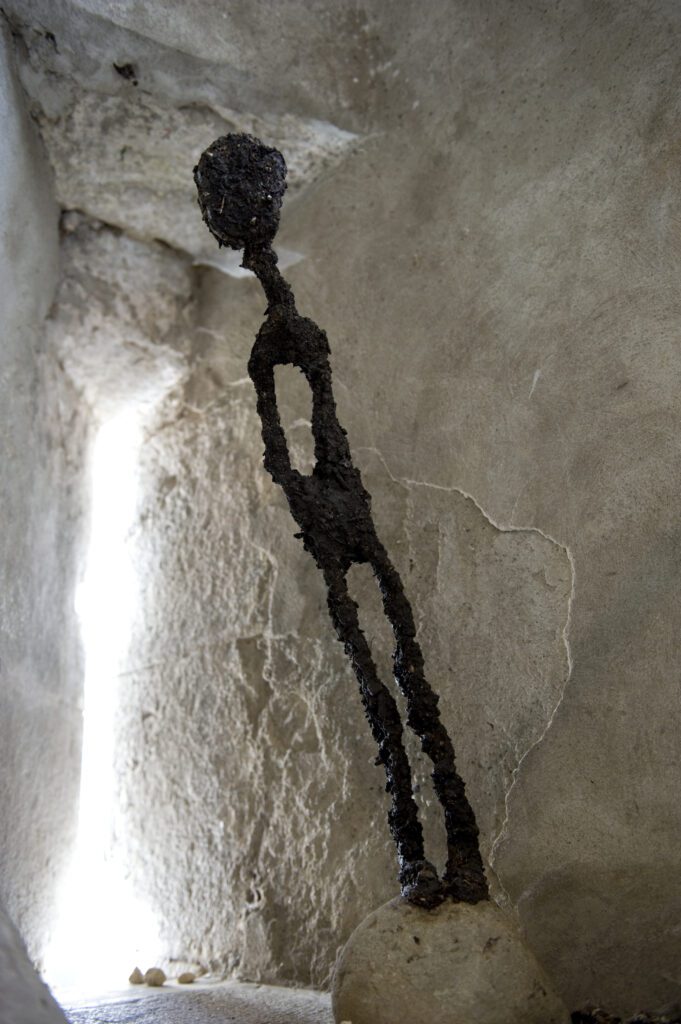
Q2. Your performance and sculptural works consistently explore your relationship to life on this land. How has that relationship evolved over time personally, politically, and artistically?
I arrived in Central Australia on the back of a motor bike, 19 years old and eager to see the world. Immediately I went to work with an outback tour company cooking over fires and sleeping in swags. I listened, met traditional people and learned. In awe of their sense of belonging I became deeply influenced by Aboriginal culture and its relationship to land. For me that found form initially in my drawings in sand – a far cry from the traditional sand paintings that predated the incredibly powerful dot paintings of today, but I understood from Aboriginal culture, that story (Tjukurpa) could be found in land, in sacred sites but also in the earth itself. By scratching images of women (trapped in domestic duty? in time?) I was probably trying to find myself/ my story. Around this time, I was told by an Aboriginal elder/ storyteller that ‘the land has a story to tell… if you listen with everything but your ears, you may hear it. If you do, you have a responsibility to tell that story’. I took on that responsibility and my interest shifted from my own story to listening for the stories of others and the land. When making performance work, I felt very aware always that we were living/ performing on Aboriginal land so always made sure to ask custodians for whatever area we were in, for a welcome (or, if no one was available, an appropriate story for that area). This is standard practise in many ways now – which is appropriate. In those early days, I was shocked to find, once I was working outside Alice Springs, that many people in Australia didn’t know much about Aboriginal culture. I felt privileged to have been schooled by elders and also felt a deep responsibility to, in turn, educate audiences (through experiencing art/ story). This may have looked like a political stance but it felt very personal to me. Artistically this led me to want to use natural/ elemental materials and to respect/ pay attention to the feel/ look and story of whatever land I found myself working in, including when I was working overseas.
Q3. Many of your large-scale works involve ritual, fire, light, and procession. What draws you to these elemental forms as tools for collective expression?
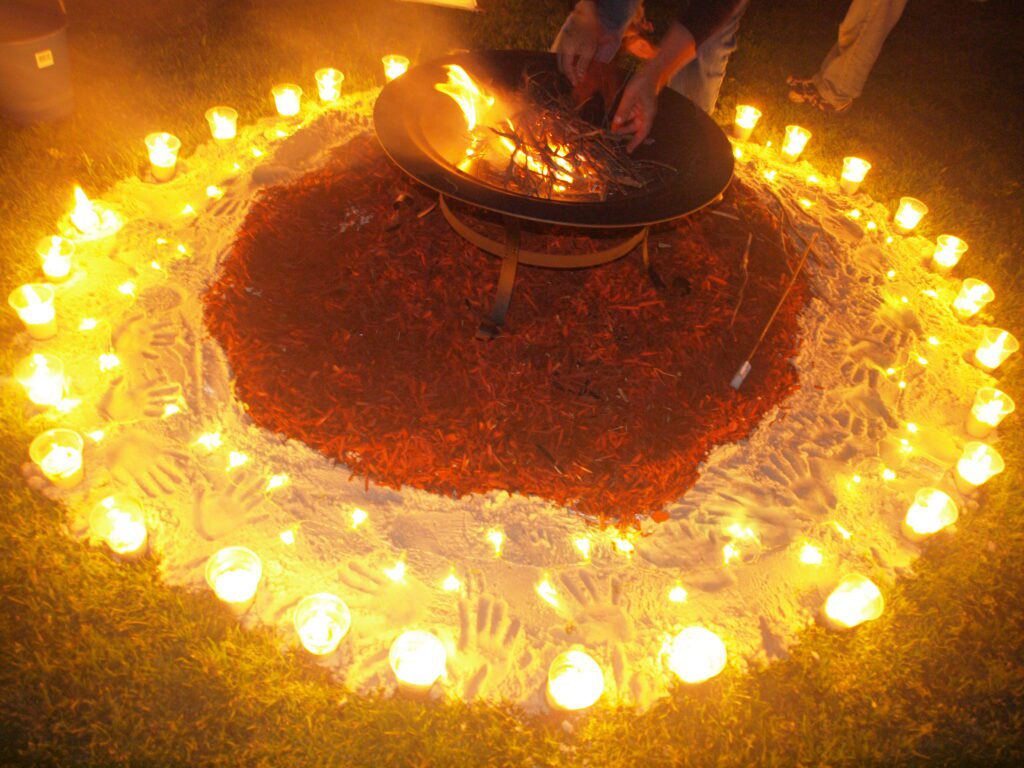
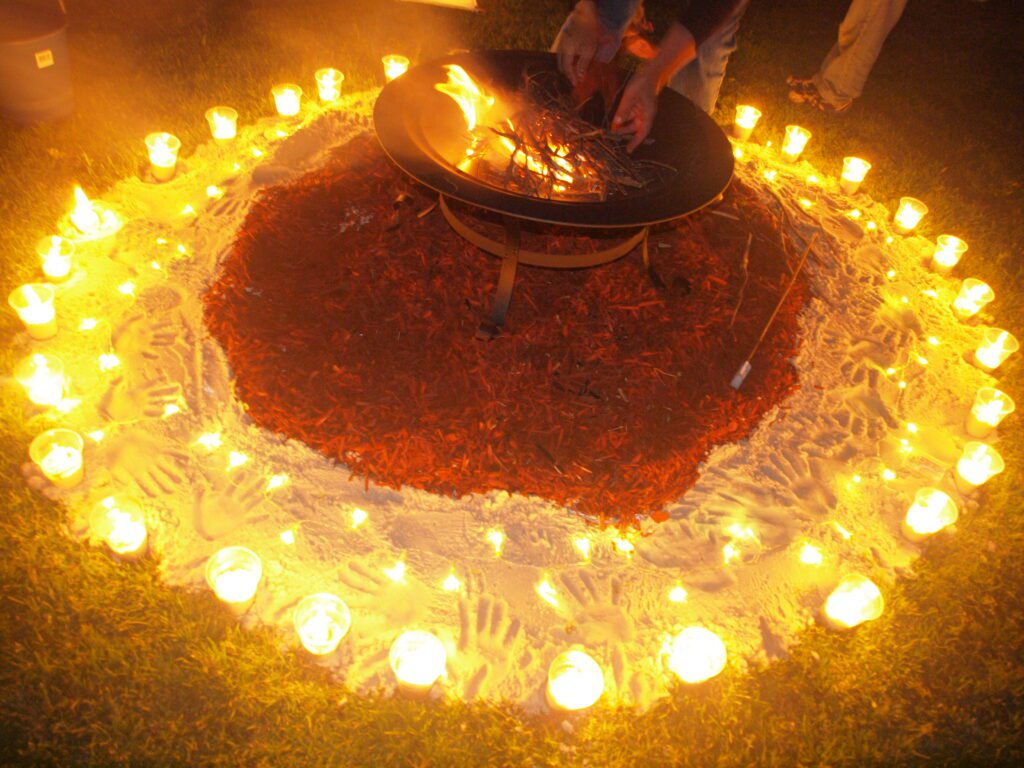
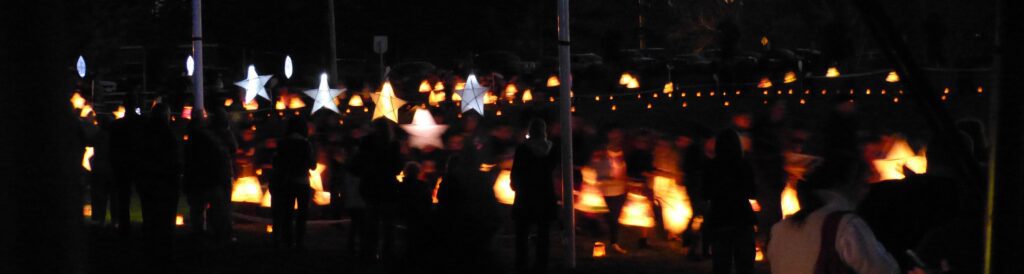
Nature is something we can all access regardless of age, ability, economic and cultural background. It’s free so working with the elements is poor theatre at its richest. Being influenced by Aboriginal culture/ relationship to land, led me to ask questions about my own cultural history – as a catholic of rebel Irish background, I was schooled in social justice and ritual. I rejected the Catholic’s patriarchal god and explored pre-Christian Celtic practices. Their use of symbols and the elements (Earth/ air/ fire/ water) alongside movement and voice in ceremony spoke to my experiences watching Aboriginal people in corroboree. While working with Neil Cameron (NCP) I learnt about scale and how to manage participation en masse, in parade and performance. Later, working in our collective, Burning Sensations, I found when working in cultural communities that using imagery from nature and elemental materials could cross language barriers, reach young and older people alike and engage audiences long enough for them to hear or see a story of their community or country that they may not have otherwise heard (this was particularly useful in country towns in rural Australia where people were often were unaware of their local Aboriginal history). But none of these ideas or practices are new. They are ancient and have been used around the world in one way or another. I was lucky to learn how to use them in contemporary settings.
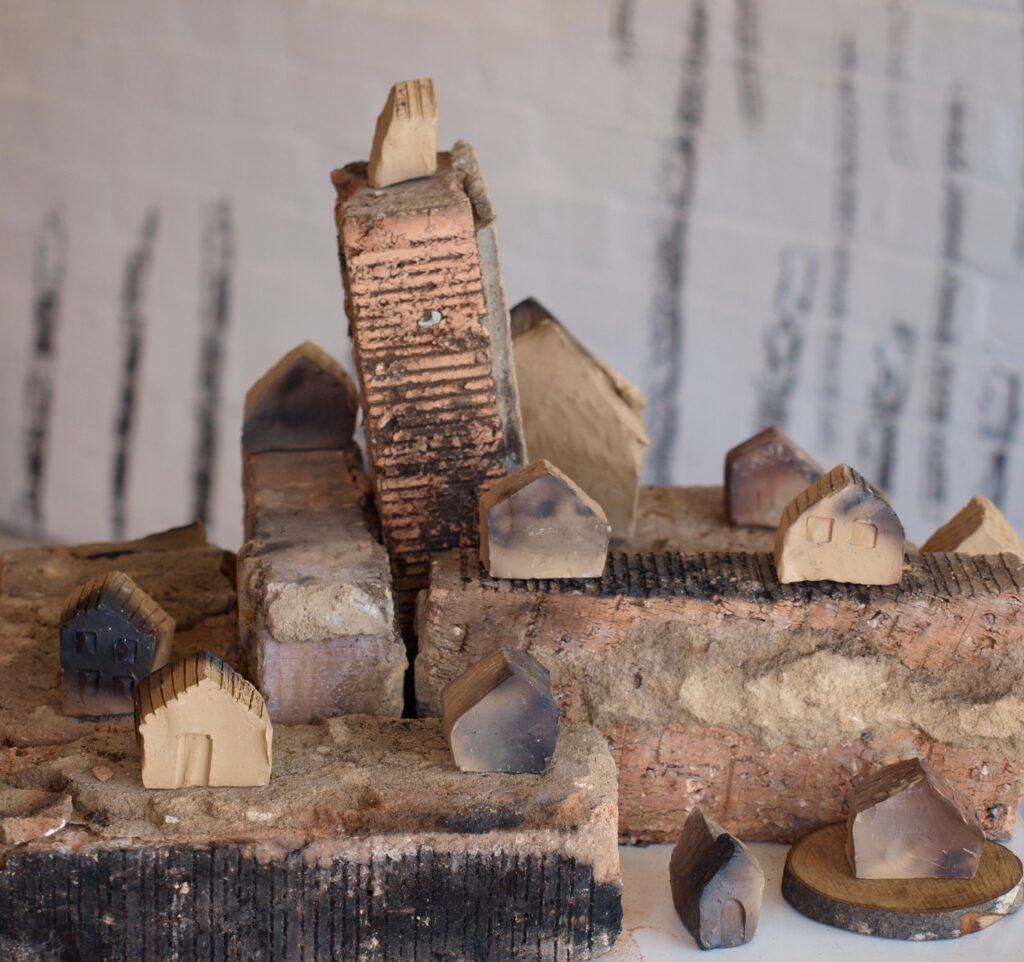
Q4. Your installation Aftermath and works like Resting Places suggest reflection, pause, and residue. How do themes of aftermath and memory function in your visual art?
Reflection, the art of and the act of, plays a huge role in my life. Unashamedly ADHD, I often forget to remember (in the moment) so the practise of reflection offers me an opportunity to revisit a moment, phase, situation or experience and to notice, ponder, perhaps analyse and often learn from the experience. Artmaking enables that reflection and reflection provides the emotional material for visual artmaking. For me, they’re inextricably linked when working visually. I find the opposite when Im moving or planning large scale processions or shows. In that work, I respond, to the moment, the land, the weather, participants and their stories and whatever resources or opportunities are available. Then I have to remember to reflect.
Q5. Your work often unfolds outdoors in landscapes, townships, and public spaces. How does place shape your creative decisions before you even begin designing?
I definitely need to feel/ see a place or site to understand how it could hold work. Dreadful with maps, I need to walk around potential sites to see/ understand where a parade may flow, how an audience may be accommodated, or perambulated, and where a show could be safely staged. Similar with indoor sites although the focus then may be more on where and how objects or pieces of work (including performance) could be installed. Alongside my personal response to place, I ask locals for their stories – Im interested in how it feels for them, seeking any significance (good and bad) it may hold especially if different elements of the community have differing relationships to that site. Stories colour our feeling of places
Q6. INTO THE LIGHT emerged from bushfire recovery contexts. How do you approach making art in spaces marked by trauma, grief, and resilience?
very gently… when working with communities or individual’s who have experienced trauma, I feel it is necessary to check my energy first… to be sure I’m feeling calm, open and able to listen easily and fully. I ensure my body language is warm and I seek permission frequently … permission to ask a question, permission to comment, permission to offer a reflection… People who have experienced trauma have often suffered a loss of control in some area of their life at some point and felt powerless so offering the slightest opportunity for them to make the choices can be helpful/ empowering… having said that, people can also become exhausted with decision making and need to be ‘held’ (for example, by a director) so I feel it’s about finding your way, listening deeply to them, and to your (my) intuition or inner self. Then, as the work develops, I share images/ ideas and check again, whether they resonate … as we get closer to the date of the event, the issues become more about logistics and safety so then I take charge, aiming to settle participants pre-show nerves with a sense of security.
Q7. Teaching and mentoring have been consistent threads in your career. How has working with emerging artists and students influenced your own practice?
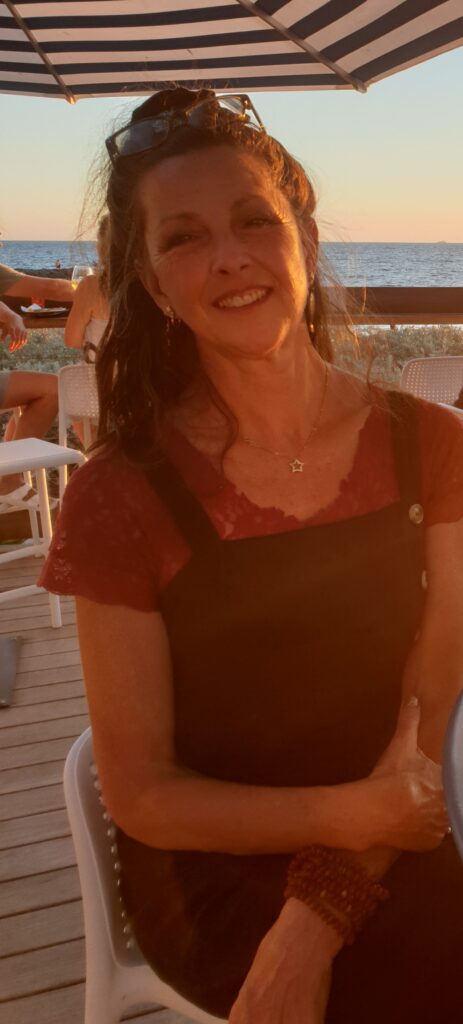
I don’t enjoy teaching (as it implies more control that I want to claim) but I love running workshops, sharing skills and practical techniques with others … as a workshop leader, I’m introducing people to materials and practices, some of which I learnt from others, and some of which I developed myself, but all of which I’m interested in and therefore eager to share. I love to see what others bring to the session, how they respond to the materials and play with content. I have learnt a huge amount from others while I’m supposedly teaching. Mentoring is another story – Im 63 and so very grateful for the opportunity to share my experience. I no longer want to run around an event site, but I’d love to NOT waste the many lessons I have learned over many years of preparing for and running around performance/ event sites.
Q8. Looking back, is there a project that fundamentally changed how you understood your role as an artist in community?
Working with the community in Whittlesea in the years following the 2009 bushfires showed me how art therapy techniques usually applied to individuals, COULD be applied en masse. I had always believed in the power of art/ storytelling/ performance making as a tool for community enlightenment (through entertainment) but I had not understood how powerful a collective process could be for individuals within it, in so many varied and individual ways. I now see art and especially participatory community art and/or art making as a healing tool that can be applied to the self – as a salve or salvation – AND to others, individually or in small groups or in very large groups (society and the world!?!) depending on the energy of the artist(s) involved and of course, the resources including funds, equipment and support.
Q9. How do you personally sustain yourself emotionally and creatively after years of holding space for others through art?
I’m not very good at that… I have become thoroughly burnt out at a couple of points and had to take time out to recuperate. In both cases I went inward and created my own work to help resolve then rest and recover. I left my job working with Whittlesea communities a year ago and am now in that same cycle – turning inward, reconnecting with my internal processes, plunging my hands into soil and casting images in the earth, again, making my own work.
Q10. Your work with Welfare State Theatre and later on international ceremonial events introduced you to spectacle as a communal language. How did those early experiences influence your later community-based projects in Australia?
I was definitely influenced by Welfare State Theatre both directly and indirectly. I worked with them briefly in the UK which was inspirational but their work was also the foundation upon which Neil Cameron Productions work was based, in regard to form and process. My time with Neil Cameron Productions shaped me as a young artist and equipped me to find my own way to work in, and with, communities.
I learnt invaluable skills that I could not have learnt elsewhere. I’m deeply indebted to both companies and in awe of all their artists.
Q11. What advice would you offer artists who want to work deeply with communities while remaining ethically grounded, creatively rigorous, and responsive to place?
I feel it is imperative to set aside your own agenda, your ego and your own artistic ideas to listen deeply to what people have to say, listen also for what they don’t say and/or for what they say without words… while also looking at/ listening to the land. Then understand your audience and use your skills to craft whatever you can from the material that has emerged, shaping it into a form/ format that an audience will appreciate/ hear/ see and learn from. If working with and in a community, I feel we are actually working FOR them, so their ideas and needs take precedence. In my view, the artist’s (creative producer’s) skill is to facilitate a creative process, manage logistics then draw it all together with beauty, grace and joy.
As our conversation with Mahony drew to a close, we found ourselves sitting with something that doesn’t really leave you once it lands.
Here’s a woman who had no roadmap. No art school waiting for her. No gallery connections. No one telling her she was an artist. She was a young mum standing under a clothesline in the middle of the desert, and she started drawing faces in the dirt with her bare hands. That’s it. That’s where it all began.
And honestly, there’s something in that for all of us.
Because how many of us are waiting for the right moment? The right tools? The right space? The right permission? Mahony didn’t wait for any of it. She used what was in front of her. Red sand. Plaster. Fire. The ground beneath her feet. She didn’t have the luxury of perfect conditions she had two daughters, a clothesline, and the dust. And she made anyway.
She listened when an elder told her the land holds stories. She didn’t overthink it. She didn’t turn it into a manifesto. She just started listening. And she hasn’t stopped. For over thirty years, in every community she’s entered, on every piece of ground she’s stood on, she’s listened first. For what people say. For what they don’t. For what they can’t.
That kind of patience is rare. That kind of humility is rarer.
And when she burned out because she did, more than once she didn’t perform recovery. She went quiet. She went back to the soil. She put her hands in the earth and started making faces again. Not because she had a plan. Because her body knew what it needed before her mind caught up.
At 63, she’s still making. Still listening. Still pulling faces from the land.
If there’s one thing Mahony’s journey reminds us, it’s this you don’t need permission to begin. You don’t need perfect tools or perfect timing. You need the courage to work with what you have, where you are, right now. And if the wind comes and takes it? You make it again. That’s the whole lesson. You make it again.
