This Artist Turns a Canopy of Flowers into a World of Hidden Emotions │ Belén Hernández
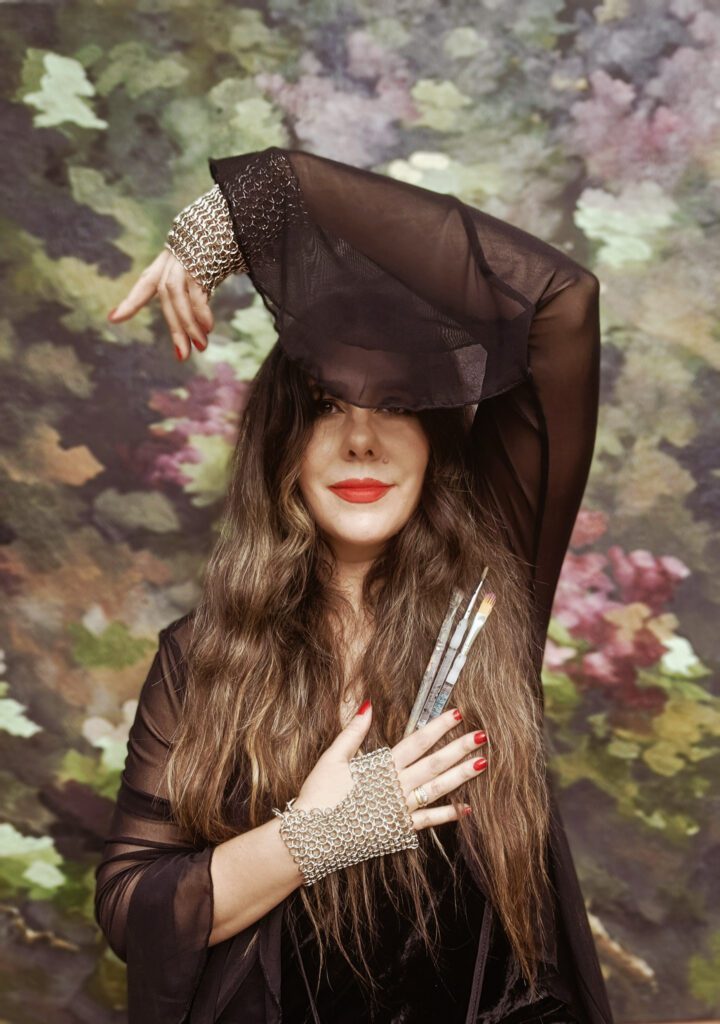
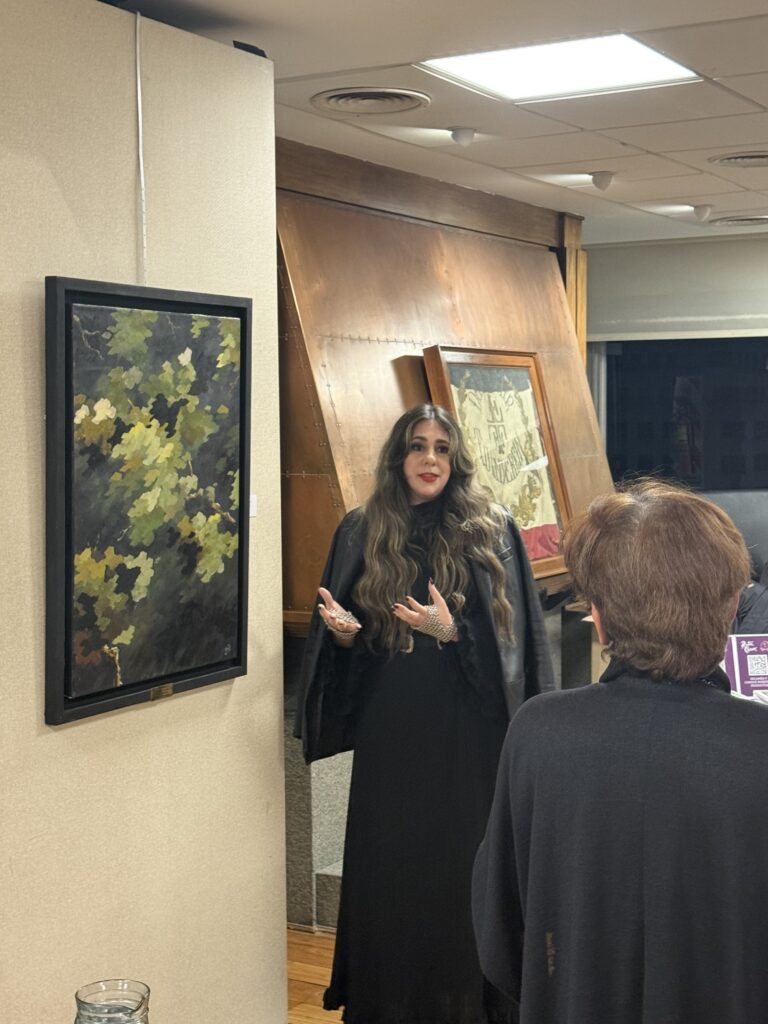
At Women in Arts Network, Spring Through My Eyes gathered artists who each turn inward to find their own language for memory, healing, and renewal. Belén is one of the selected artists whose paintings become portals layered works of colour, poetry, and spirit that carry the viewer somewhere just beyond the visible.
Belén is a Uruguayan artist based in Montevideo who paints under the name Belén entre Mundos Belén between worlds and few names have ever fit an artist so completely. She does not remember learning to paint or draw. It simply happened, she says, as naturally as walking, because it came from her roots.
She grew up in a home where visual and written art were everyday currency, a gift from both her parents, and yet in her youth she turned toward law a profession she loves and has practiced for more than fifteen years. It was only after her father’s passing that she chose to reclaim her artistic inheritance, seeking a fusion of the visual, the poetic, and the spiritual. From that long process of self-exploration, Belén entre Mundos was born.
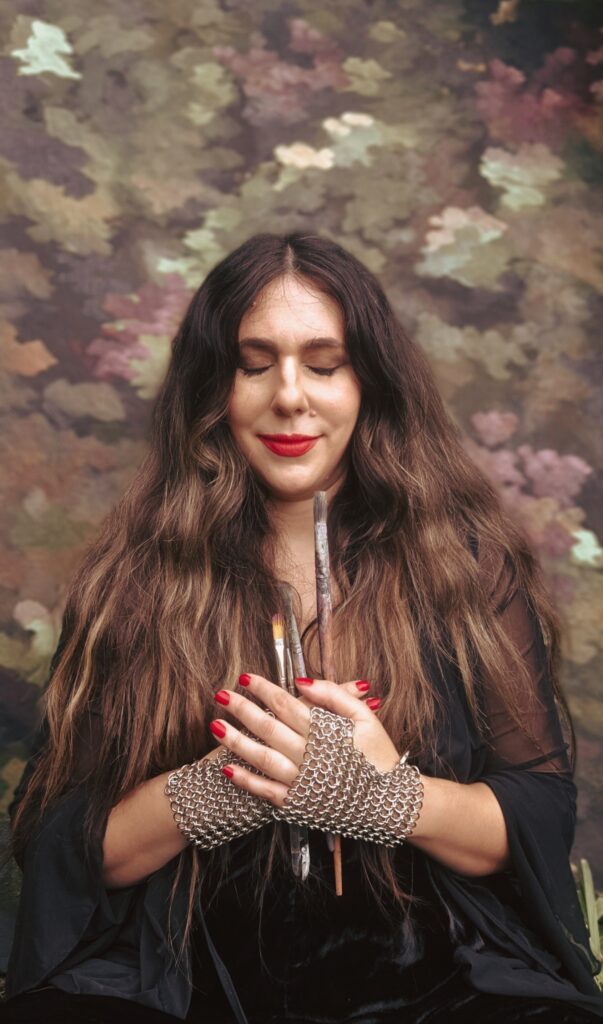
For Belén, a painting is never simply a painting. It is a portal. She creates, in her own words, to remember who she is and to help others walk the same path and each work becomes a vibration translated into color, essence, and word. There are three elements woven through everything she makes: the spiritual, the visual, and the poetic. Seen from a distance, a piece may offer only color and form.
But step closer, and you find a channelled message engraved on a small bronze plate. Come closer still, and you can almost feel the Bach flower essences she blends into the paint itself, chosen to carry a particular energy into the work. Each creation, she says, is an experience in layers: first it is seen, then it is read, and finally it is felt.
Her materials follow that same spirit of openness. She works with mixed techniques sometimes the classic canvas, sometimes linen or silk chosen for the way they hold texture and movement, often a base of relief built up to give the surface depth and body before she ever begins to paint.
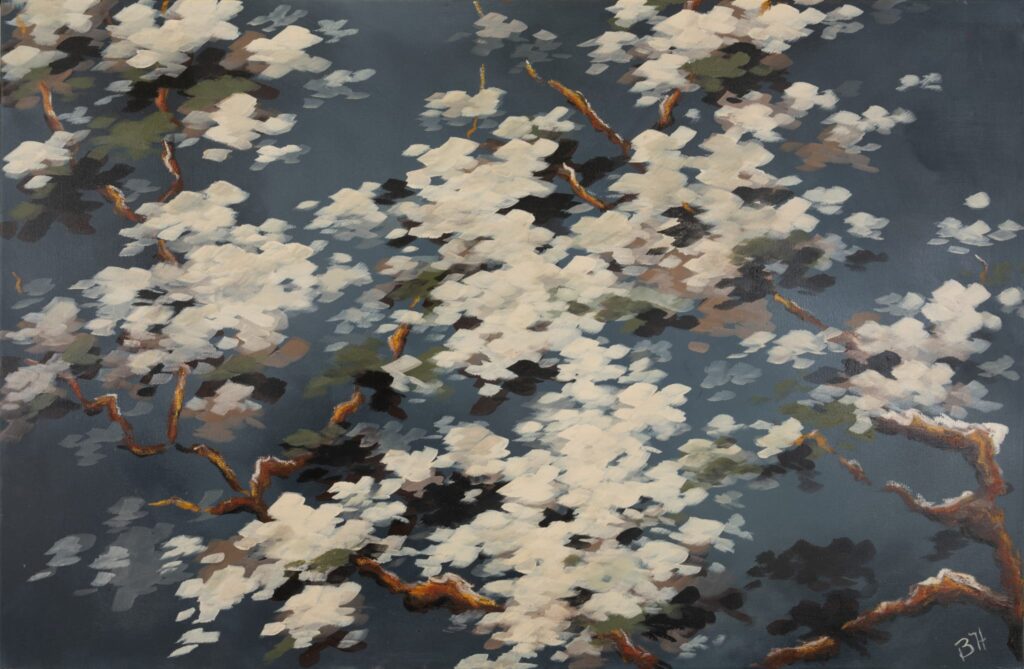
Acrylic, oil, and oil pastel run through nearly all of it. For Belén, technique is not a fixed method but an expanding language, always in service of whatever the work needs to reveal.
And beneath all of it lie her roots. Her father once told her that whoever does not cultivate the art of their roots kills the very spirit from which they bloom and so, quite literally and symbolically, she has spent this chapter of her life cultivating hers.
Nature is everywhere in her work, though never as mere description: trees, flowers, leaves, and open landscapes become the vocabulary through which she speaks of ancestry, transformation, and belonging. Her paintings are, in the end, bridges attempts to carry something from that other, unseen world into this one, and to reflect back to each viewer exactly what they need to see, feel, or remember.
Now, let’s get to know Belén Hernández Pérez through our conversation about intuition, nature, painting, poetry, spirituality, and the unseen worlds that continue to shape her artistic practice.
Q1. Belen! can you share how your father’s passing reshaped your return to art and your sense of self?
While my father’s passing was the event that ultimately brought me back to art, the journey really began much earlier, in 2015, when I was 27 and traveled to Europe for the first time on my honeymoon. Up until that point, my life had largely been shaped by survival and by meeting other people’s expectations. I became a mother at 19 while studying law, graduated at 22, and soon after began working at the largest law firm in my country. Looking back, I often describe that period as living on autopilot.
I was moving forward, achieving goals, but I had lost connection with myself. Everything shifted when I arrived in Scotland. Something awakened in me there, and I found myself crying for days without fully understanding why. At first, I thought it might be connected to the memory of a past life. With time, I came to see it differently: it was not a longing for another life, but a realization that I was not fully living this one. That experience initiated a process of deep introspection that continues to this day. Through that journey, I explored spirituality, meditation, intuition, and inner healing.
The tools and perspectives I discovered became the foundation of my artistic practice long before I picked up a paintbrush again. My father’s death was the catalyst that finally returned me to art, but art itself became the language through which all those years of inner exploration could be expressed. In that sense, reclaiming my artistic inheritance was not only about reconnecting with him—it was also about reconnecting with the part of myself that had been waiting, patiently, to be remembered.
Q2. The name Belén entre Mundos speaks of living between worlds. What inspired it?
In many ways, I have lived between worlds my entire life. There is the visible world—the one we all shareand then there is another world that I encounter when I close my eyes, meditate, dream, or turn inward. I still don’t know exactly what that place is. Whether it is imagination, intuition, memory, spirit, or something else entirely, I have learned to trust it. That is where the name Belén entre Mundos comes from. It reflects the space I inhabit as both a person and an artist: somewhere between the known and the mysterious.
The connection to my art is profound because my work essentially comes from that other world.
When I was younger, I could only paint from references. My strengths were realism and drawing, and I actually rejected abstract art. I didn’t understand it and didn’t feel connected to it. After my father died, however, I found myself unable to return to that way of creating. It was as if something had been blocked. The techniques I had relied on for years no longer felt available to me. So I began painting differently. Instead of trying to reproduce what I could see, I started painting what I could feel. I painted emotions, symbols, visions, fragments of dreams, and images that emerged during meditation.
I worked with very few references and often without a clear plan. The process felt chaotic at first, but it was also liberating. What emerged from that exploration became the foundation of my artistic voice. The abstract language I once resisted became the only language capable of expressing what I was experiencing. My paintings are, in many ways, translations—attempts to bring something from that unseen world into this one.
Q3. Your paintings are often accompanied by poetry or haiku. How do writing and painting influence each other?
Writing is deeply connected to my artistic practice, but it also carries a personal significance. If painting is the inheritance I received from my father, writing comes from my mother. As I rediscovered myself as an artist, it became important for me to honor both sides of my lineage—the visual language I inherited from my father and the written one I inherited from my mother.
Because of that, poetry and painting have gradually become inseparable parts of the same creative process. Sometimes an image arrives first and the poem emerges afterward, helping me understand what the painting is trying to say. Other times, the words come first and wait patiently for years until I am emotionally ready to translate them into a visual form. In fact, there are poems I wrote long ago that still do not have a painting. I know they will eventually, but some stories require their own timing. I don’t see writing and painting as separate disciplines. To me, they are simply different languages expressing the same thing.
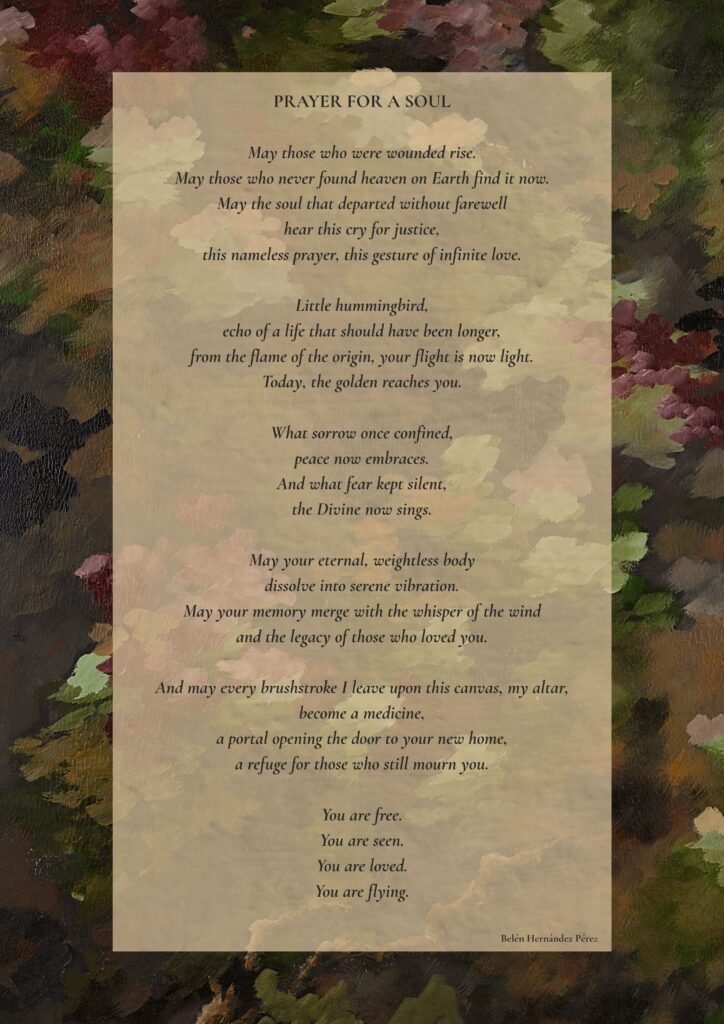
One speaks through images, textures, and color; the other through words and rhythm. This relationship becomes especially meaningful in my commissioned work. When creating a piece for someone, I try to connect with the message that person may need to receive at that moment in their life. The painting is one part of that process, but not the only one. Alongside the artwork, I often create a written reflection or message that accompanies the piece. In that sense, both the visual and the written elements become vessels for the same intention: translating something deeply felt into a form that can be shared.
Q4. Nature is central to your work. What draws you to it as a visual language?
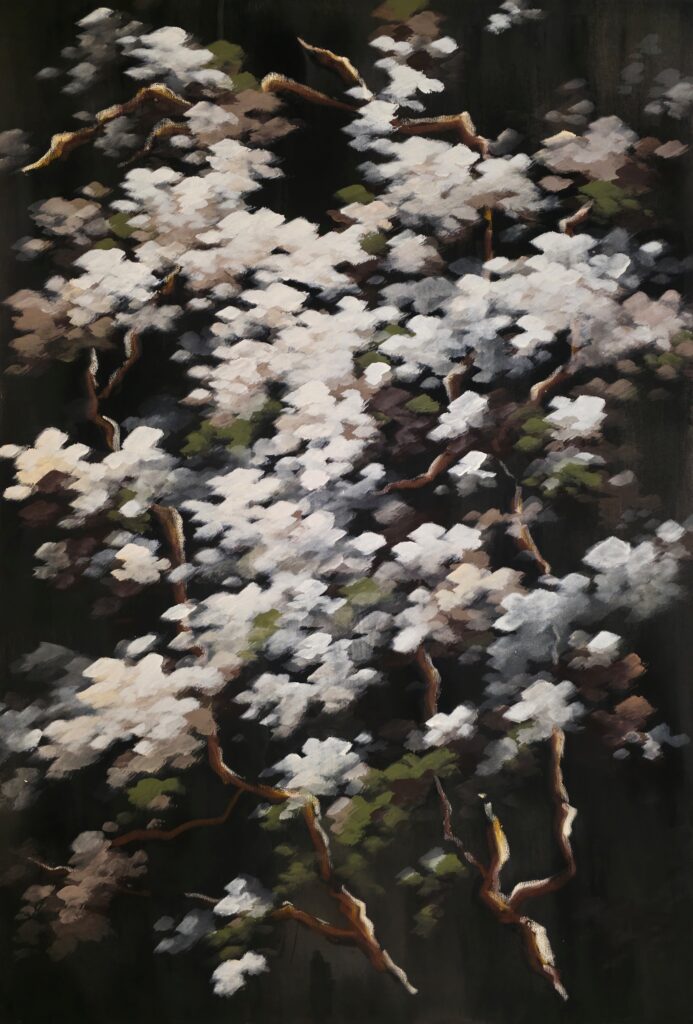
Nature appears constantly in my work because it is what I most often encounter in the inner landscapes that inspire my paintings. When I meditate, dream, or enter a contemplative state, I rarely see cities, buildings, or human-made environments. Instead, I encounter trees, roots, flowers, branches, water, and open landscapes.
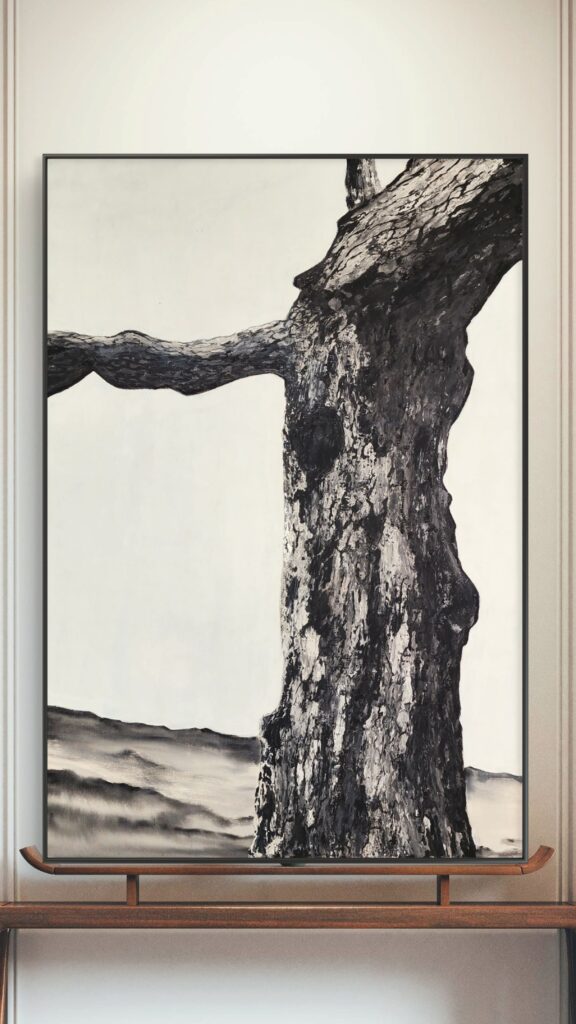
For reasons I still do not fully understand, nature seems to be the language through which those experiences communicate with me. At the same time, I am not interested in depicting nature literally. What attracts me is its symbolic power. A flower can become a state of consciousness. A root can represent ancestry, belonging, or healing. A landscape can express an emotional journey. This symbolism becomes even more evident in my series of tree trunks. Many viewers notice that they resemble sculptures or even human bodies. I see that too.
Although they emerge as trees, they often feel like portraits of inner states, human experiences, or aspects of the soul. They stand between the human and the natural, as if the two were never truly separate. I am still discovering why these forms appear the way they do. What I do know is that they arrive with a sense of presence.
They feel less like objects and more like beings. Perhaps that is why nature has become such an important visual language for me: it allows me to explore human experiences without being confined to human forms. Through nature, I can speak about grief, transformation, memory, resilience, and connection in a way that feels both deeply personal and universally understood.
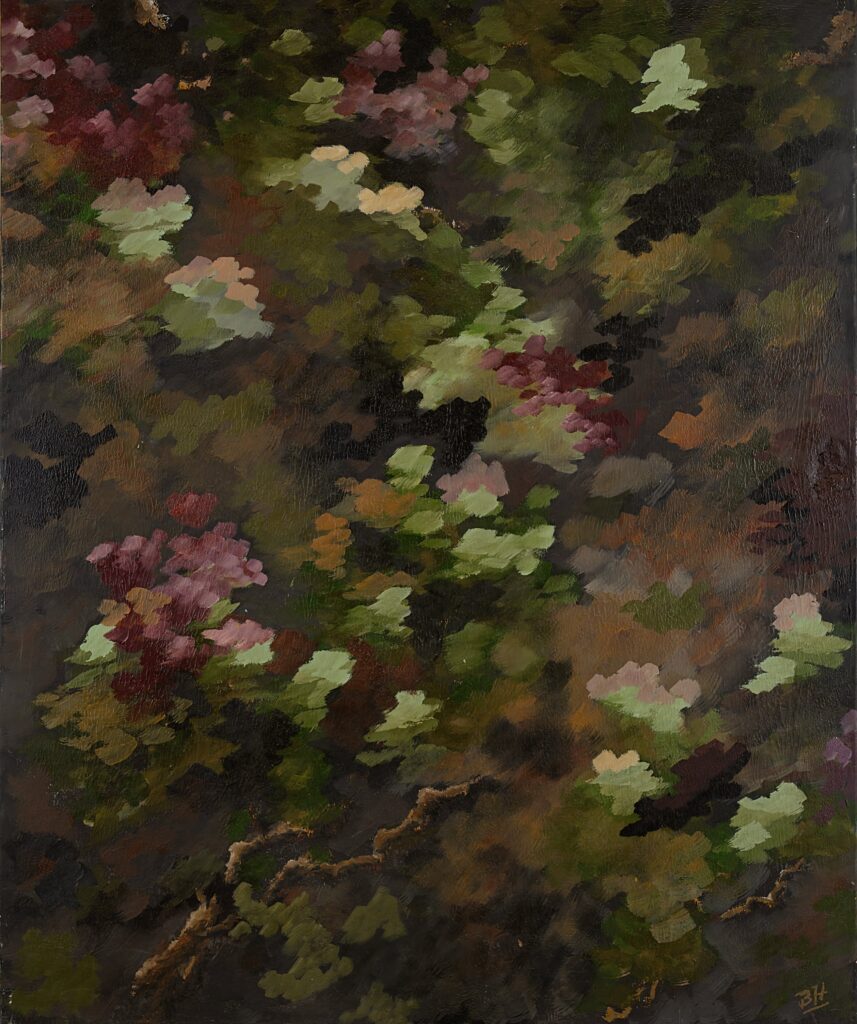
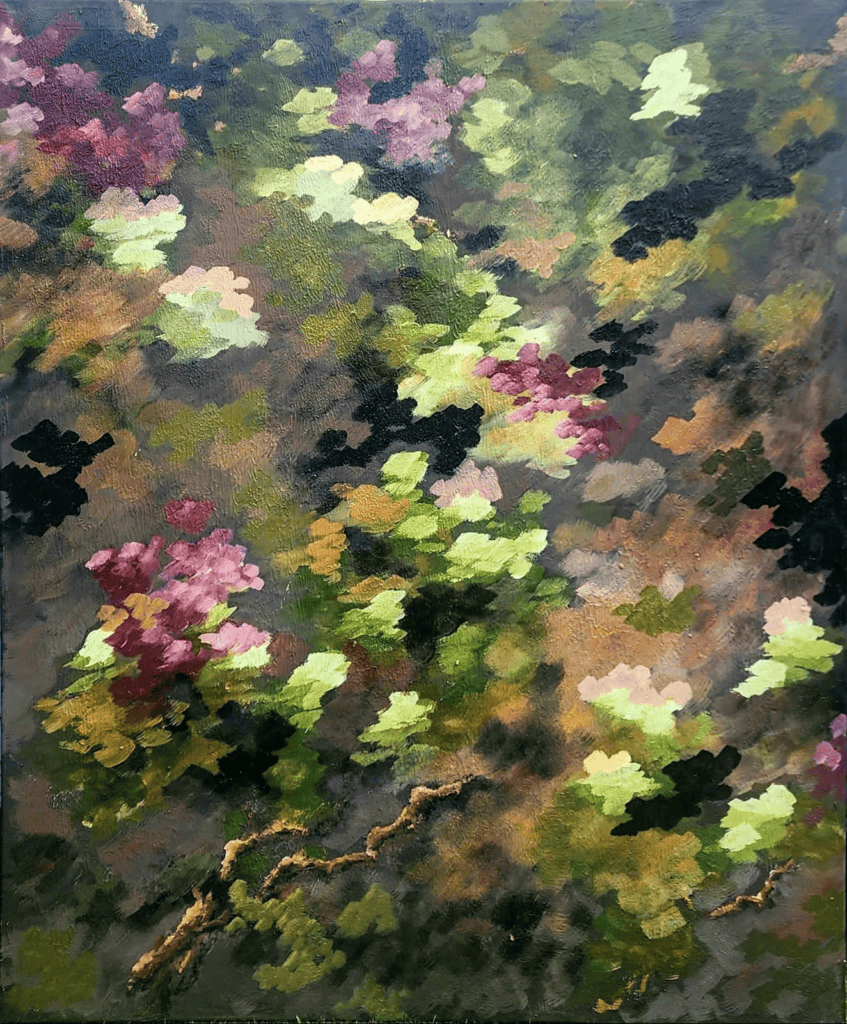
Q5. What inspired Eco del Bosque Escondido, and why is it important to your journey?
Eco del Bosque Escondido holds a very special place in my artistic journey because it was the first painting that fully embodied the creative process I continue to use today. It was the first work in which all the elements that now define my practice came together: painting from intuition rather than reference, working from inner experiences and emotions, incorporating Bach flower essences into the process, and accompanying the artwork with poetry. It was also the first piece I shared publicly on social media and the first one I sold.
The “hidden forest” of the title is both an inner and an outer landscape. It represents those unexplored regions of ourselves that exist beneath the surface of daily life, waiting to be rediscovered. Looking back, I can see that this painting established the foundation for everything that followed. It marked the moment when I stopped trying to paint only what I could see and began trusting what emerged from within. In many ways, Eco del Bosque Escondido was the birth of the artistic language that would later become Belén entre Mundos.
Q6. What do flowers allow you to express emotionally or symbolically?
Flowers appear throughout my work, but I don’t see them as flowers in the traditional sense. To me, they are manifestations of an energy that I encounter during meditation, dreams, and inner exploration. That’s why they often feel alive. They are also connected to my use of Bach flower remedies, which accompany my creative process.
Each painting explores a particular emotional landscape. If a work deals with guilt, for example, I may incorporate Pine the Bach flower associated with self-forgiveness or even take the remedy myself while creating. In that sense, the flowers become both symbols and carriers of emotion: visible expressions of something invisible trying to emerge into form.
Q7. Do you see creativity as a form of self-expression, self-discovery, or both?
I see creativity as both self-expression and self-discovery. Through creating, we reveal who we are, but we also uncover parts of ourselves that we didn’t know existed. More than ever, I believe creativity is one of the qualities that makes us uniquely human. Artificial intelligence learns by identifying, replicating, and refining patterns. Humans can work with patterns too, but we also have the freedom to break them. And it is often in that rupture in the unexpected, the imperfect, the unconventional—that something truly original emerges. In a way, AI evolves by reproducing patterns, while human beings evolve by breaking them
Q8. How important is it for viewers to bring their own stories into your work?
Interpretation is very important to me, and one of the most rewarding parts of exhibiting my work has been seeing how differently people connect with the same painting. Viewers often bring their own memories, emotions, and experiences into the work, and I love that there is space for those personal readings to exist. At the same time, my paintings are created from a very conscious and intentional place. Although I leave room for interpretation, I can usually identify the message, emotion, or inner process that inspired a particular piece.
That is why many of my works are accompanied by poems, and why my commissioned pieces often include a written letter or reflection for the collector. In a way, the artwork exists in two worlds: the meaning that inspired its creation, and the meaning that each viewer discovers within it. Both are equally valid, and the dialogue between them is what makes art so powerful.
Q9. When someone commissions a piece, you take time to learn about their story. How does that connection shape what appears on the canvas?
Human connection is at the heart of my commissioned work, but it can take different forms. Sometimes I spend time speaking with the person, learning about their story, their challenges, or what they hope the artwork will represent. Other times, especially when the piece is intended as a gift, I may receive nothing more than a name. Interestingly, some of my favorite commissions are the ones created “blind.” In those cases, I work intuitively with very little information and allow the imagery, emotions, and written messages to emerge naturally.
Later, I have the opportunity to validate whether what appeared on the canvas and in the accompanying text resonates with the person’s actual experience. I find that process both fascinating and humbling. It challenges me to trust my intuition and pushes me to grow as an artist. Whether I begin with a detailed conversation or simply a name, my goal is always the same: to create a piece that feels deeply personal and meaningful to the person receiving it.
Q10. Success is often measured by visibility and recognition. How do you define success for yourself today?
Success means something different to me today than it once did. Of course, I value visibility and growth, and I would love my work to reach more people. But I have consciously chosen a slower path. Because my career as a lawyer gives me financial independence, I have the freedom to create without chasing trends, algorithms, or market expectations. Coming from a profession that is almost entirely driven by goals, performance, and traditional measures of success, this part of my soul chose something different. It chose a quieter, more authentic path—one that feels more aligned with who I truly am.
That doesn’t necessarily mean I follow all the conventional rules of the art world or the way professional artists are expected to build their careers. Perhaps one day that will change. But for now, this balance allows me to create honestly, at my own pace, and with complete creative freedom. If recognition comes as a result of that, I welcome it. But the greatest success, for me, is preserving the freedom to create on my own terms.
Q11. Do you think modern audiences are becoming more open to art that speaks to emotional or spiritual experience?
Absolutely. In fact, one of the biggest surprises of my artistic journey has been discovering who responds to my work. When I began sharing my art in 2025, I assumed my audience would mostly be people over 40, perhaps because the themes I explore—introspection, symbolism, emotional healing, and spirituality—are often associated with later stages of life. Instead, I found a large and engaged audience between the ages of 18 and 25. Interestingly, they are often the most open to what I do. They may not always interpret the work in the same way I do, but they are genuinely curious. They are willing to explore symbolism, ask questions, and engage with emotional and spiritual themes without immediately dismissing them.
I think there is a growing desire for experiences that feel meaningful and authentic. In a world that is increasingly fast, digital, and driven by constant stimulation, many people seem to be searching for deeper forms of connection—with themselves, with others, and with something larger than themselves. Art can be a powerful bridge to that experience.
Q12. What advice would you give someone who feels called to a creative life but is afraid it’s too late to begin?
I often say that I am a lawyer by profession, but an artist at heart. If that resonates with someone, my advice is simple: start. Not because it is easy, but because ignoring that calling rarely leads to fulfillment, no matter your age. Many people believe they need more training, more confidence, or more certainty before they begin.
But in my experience, the impostor syndrome never disappears beforehand. It fades through action. By creating the website, sharing the work, opening the social media account, showing the paintings—even the ones you are not completely happy with.
You learn by doing. You gain confidence by doing. You discover your voice by doing. No course, book, or certification can replace that first step. The only way to become an artist is to create, and the only time it is truly too late is when you convince yourself not to begin.
There is a phrase from our conversation with Belén that we have not been able to set down the idea that some part of us sits waiting, patiently, to be remembered. Her whole journey is, in a sense, the story of answering that quiet summons: of a life lived on autopilot until something cracked open, and of the long, deliberate work of finding her way back to herself.
That she found that way back through art, and specifically through her father’s inheritance, makes it all the more moving.
What stays with us is the way she treats painting as translation the patient act of carrying something from an unseen world into this one. She does not paint what stands before her; she paints what she feels, what surfaces in dreams and meditation, what has no obvious shape until she gives it one.
In a culture that prizes the literal and the immediate, there is something quietly radical in an artist who trusts the invisible, and who lets a tree become a portrait of the soul, a flower a state of consciousness, a root a whole lineage. Her work reminds us that the most important things are rarely the ones we can point to directly.
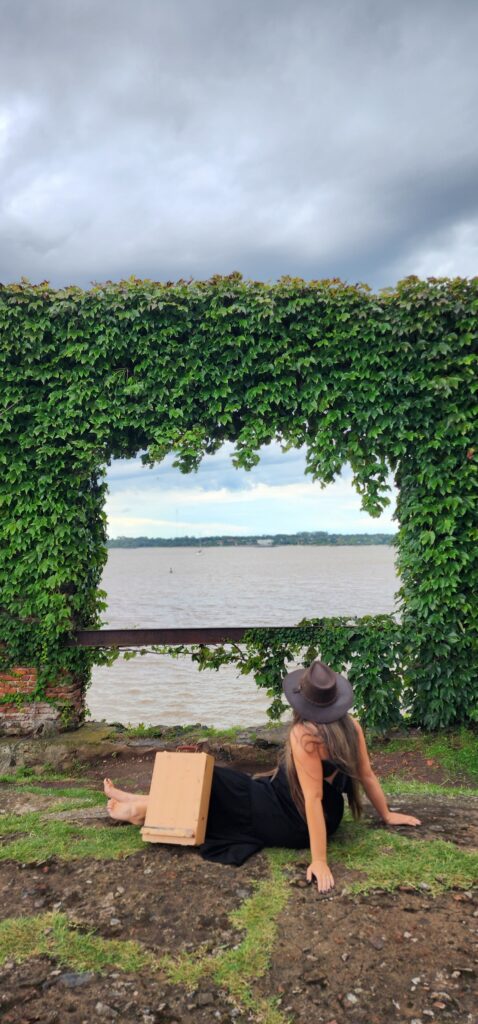
For artists, her story carries a lesson worth holding close, especially for anyone who fears they have left it too late. She is, in her own words, a lawyer by profession but an artist at heart and her advice is simply to start.
Not because it is easy, but because the impostor syndrome so many wait to outgrow never truly disappears beforehand; it fades only through action. Through making the website, sharing the work, showing even the paintings you are not sure of. You do not find your voice and then begin. You begin, and the voice arrives. The only moment it is genuinely too late, she says, is the one in which you talk yourself out of starting at all.
For art lovers and collectors, Belén’s work offers a rare kind of encounter. Her paintings hold meaning in two worlds at once the intention that inspired them, and the entirely personal reading each viewer brings and she welcomes both as equally true. Many arrive accompanied by a poem or, in the case of her commissions, a written letter created just for the person receiving it, so that the work becomes not a decoration but a message meant to be felt. To live with one of her pieces is to keep a doorway to that other world close at hand symbolic, healing, and quietly alive.
Follow Belén entre Mundos through the links below and step into the world between worlds for yourself.
