
How Juniper Sikora Builds an Interdisciplinary Practice Around Water
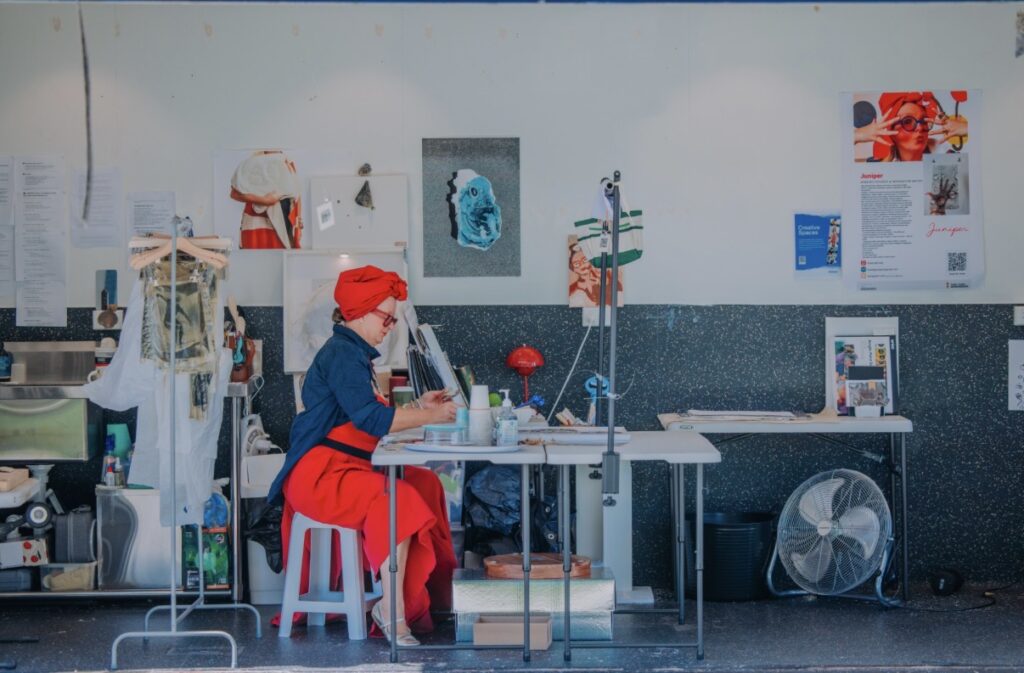
At Women in Arts Network, for our Love, Life and Everything She Creates exhibition, we received submissions from all over the world. Painters, sculptors, photographers, textile artists, mixed media artists, every kind of creative practice you can imagine, each one responding to the theme in their own way.
Juniper Sikora was one of them and the moment we opened her submission we had to stop and read it again because we genuinely weren’t sure if we were looking at art or science or something that doesn’t have a name yet.
Juniper is a selected artist for the Love, Life and Everything She Creates exhibition and what she does is hard to pin down in the best possible way. She drops microphones into creeks to record sounds nobody’s listening to. She collects water from specific locations and makes bioplastics with it so that traces of the actual place physically exist inside the artwork.
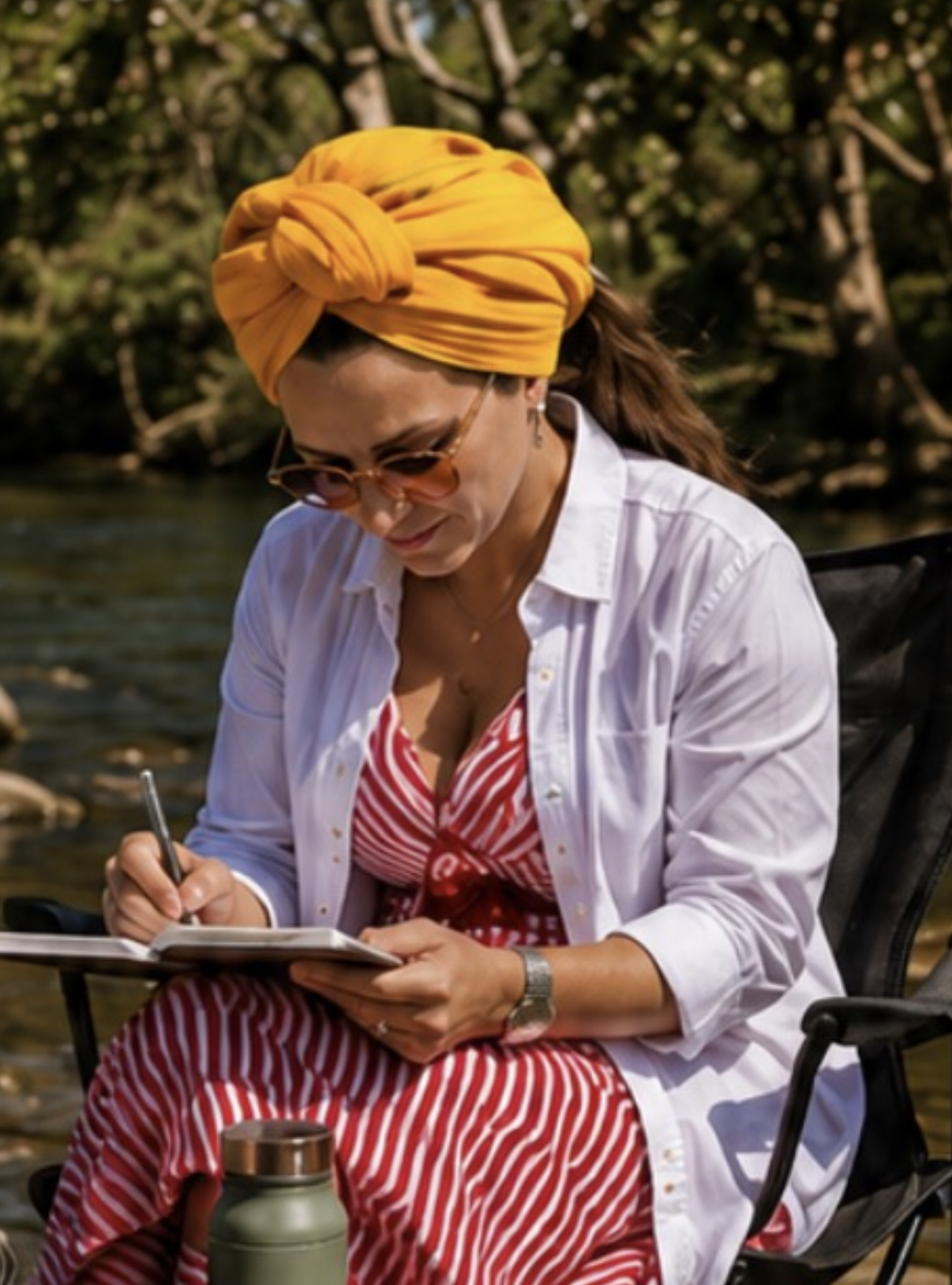
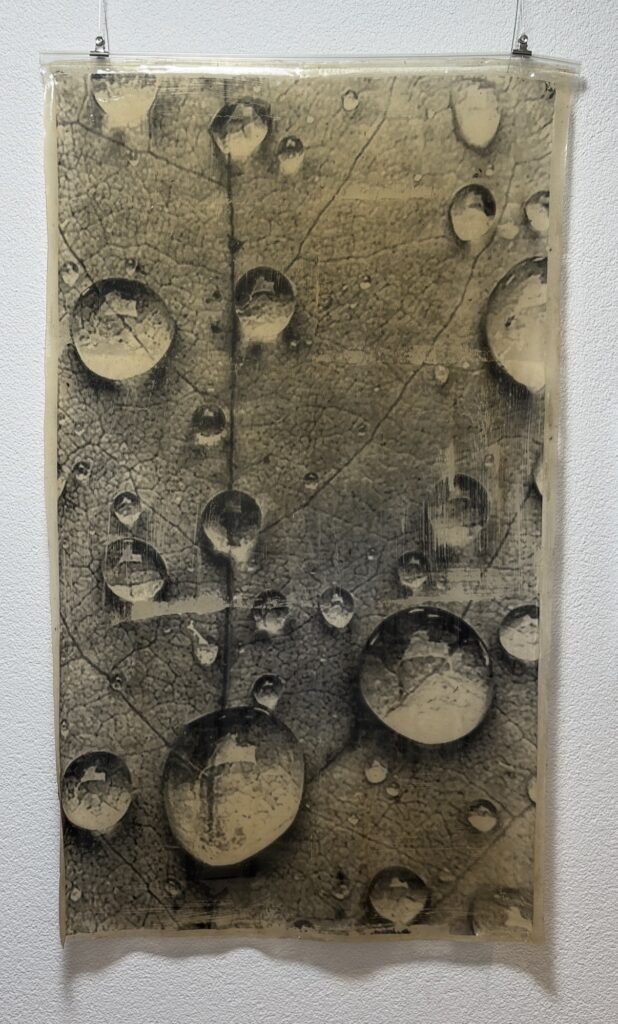
She photographs water droplets and writes field notes and builds installations where people can touch and listen and investigate rather than just look. All of it is different and all of it is asking the same question. What happens when you slow down enough to actually notice something you’ve seen every day of your life but never really paid attention to.
Her material is water. Not as a thing to paint. As a collaborator that has its own opinions about what the work should become. She makes bioplastics that curl and shrink and respond to humidity and keep changing after she thinks they’re finished because the material doesn’t obey the plan and she’s learned to love that about it. She used to fight the unpredictability. Now the unpredictability is where the work gets interesting.
She’s building something called the Water Response Atlas, a growing archive of encounters with water, photographs and recordings and samples and observations, and the longer she works on it the more she realises it’s not really about water at all. It’s about attention. Each entry says the same thing. I stopped here. I noticed. I listened.
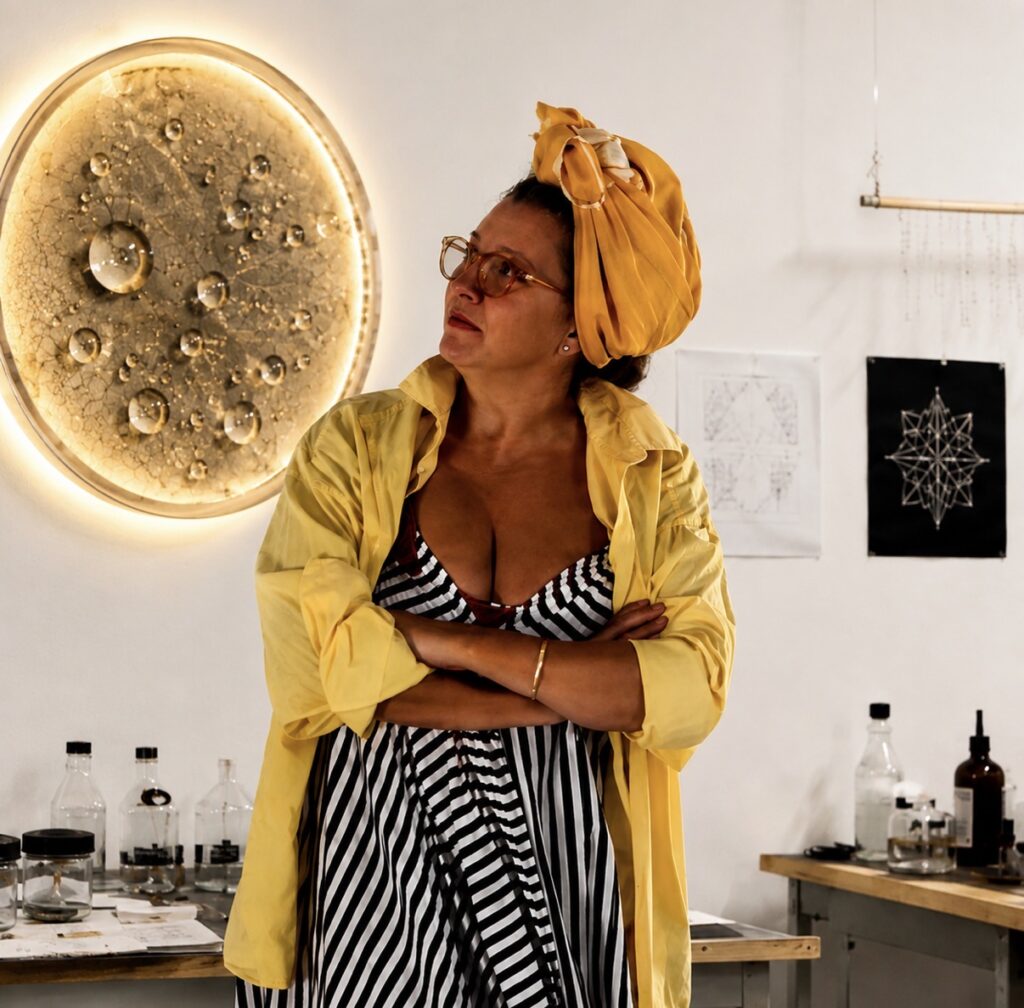
She calls herself a relentless observer and once you’ve spent time with her work you understand why. This is someone who can stand beside a creek and wonder what it sounds like from underneath and then actually go find out. Someone who looks at a puddle and asks what minerals are in this and where did this water travel before it got here.
Someone whose curiosity is so stubborn and so wide and so genuinely joyful that it’s turned into a practice spanning photography, sound, installation, bioplastics, field research, and participatory experiences without ever losing its centre.
Now let’s hear from Juniper, about listening underwater, making art from creek water, and why the thing you walk past every day might be the most extraordinary thing you’ve never noticed.
Q1. Juniper, for someone discovering your work for the first time, how would you introduce yourself and your practice?
I’m an interdisciplinary artist, researcher and relentless observer. I’m fascinated by the things we encounter every day but rarely truly notice particularly water. My practice moves between photography, bioplastics, sound, installation, field research and participatory experiences. Increasingly, I think of the landscape as part studio, part collaborator and part question. I collect water, listen beneath its surface, photograph it, make materials with it, document the places it moves through and follow what happens when I allow the material or environment to influence the outcome.
At the moment, much of this is coming together through the Water Response Atlas, a growing artistic archive of encounters with water, and the Water Listening Lab, which invites other people into that process of curiosity and attention. But I’ve begun to realise that although I make work with water, water isn’t really the whole subject.
Attention is. I’m interested in what happens when we slow down enough to encounter something familiar as though we have never seen — or heard — it before. Because perhaps we don’t always need to discover somewhere new. Sometimes we need to learn how to see where we already are.
Q2. What has helped you protect your curiosity throughout your artistic journey?
I think I’ve protected my curiosity by refusing to become embarrassed by wonder. I still want to ask the seemingly ridiculous questions. What does water remember? What does a creek sound like underwater? What happens if I put this material into that one? What might be happening here that I cannot see? And sometimes my favourite question is simply: “What happens if…?”
That question has taken my practice into places I could never have planned. I also deliberately leave room for things to go wrong. A material warps. Salt crystallises. An image transfers imperfectly. A recording captures something I wasn’t listening for. I used to think those moments were failures. Now I often think they are the moment the work starts talking back. One of the biggest shifts in my practice has been moving from trying to make materials obey an idea to becoming curious about their response. Water has reinforced that enormously. It does not obey the plan. And I love that.
Curiosity, for me, is less about finding answers than remaining receptive enough to recognise when something unexpected is worth following.
Q3. What draws you to materials that change, react, or carry traces of time?
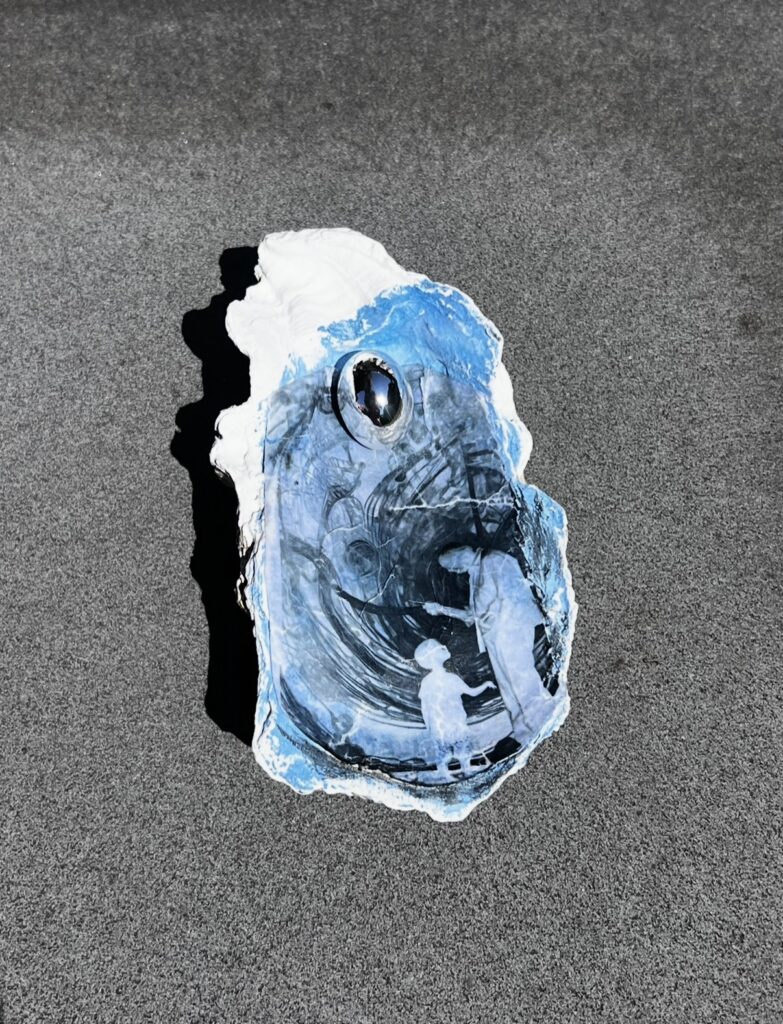
Because they refuse to pretend that nothing has happened to them. I’m deeply attracted to materials that behave almost like witnesses. They absorb, stain, shrink, crystallise, decay, distort, preserve impressions or respond to their environment. They make time visible. Memory foam holds the temporary impression of a body. An oyster shell carries evidence of growth and its marine environment.
A bioplastic can change according to humidity, temperature, water and the substances embedded within it. Water itself carries minerals, sediments, pollutants, organisms and traces of the landscapes it has travelled through. I’m interested in that idea of material memory — not necessarily memory in the human sense, but evidence that an encounter occurred.
That has also changed the way I think about imperfection. A mark, bubble, residue or unexpected reaction doesn’t necessarily contaminate an artwork. Sometimes the contamination is the information. I don’t want materials to be silent supports for an image or idea. I want them to have agency within the work. Perhaps that is what draws me to unstable materials most: they remind us that nothing is actually static. We change things by touching them. And they change us in return.
Q4. What interests you about creating work experienced through more than sight?
I don’t think we experience the world through one sense at a time, so I’m increasingly reluctant to make work that asks people only to look. There is something very different about hearing water from beneath its surface, touching a material, feeling vibration through the body, or discovering another layer of an artwork through technology. The encounter becomes embodied rather than purely visual. What fascinates me is that these different senses can also reveal things that sight cannot.
A hydrophone lets us enter an acoustic world that has always existed but is usually inaccessible to us. Magnification changes scale. Sound changes proximity. Touch changes our relationship to material. Technology can reveal layers rather than simply add spectacle. I want people to move from being spectators to becoming participants in an encounter.
Ultimately, I’m interested in creating moments that interrupt the speed at which we normally experience the world. If someone leaves one of my installations noticing differently — listening to a creek, looking more closely at a shell, wondering what exists beneath the surface — then the artwork has travelled beyond the gallery with them.
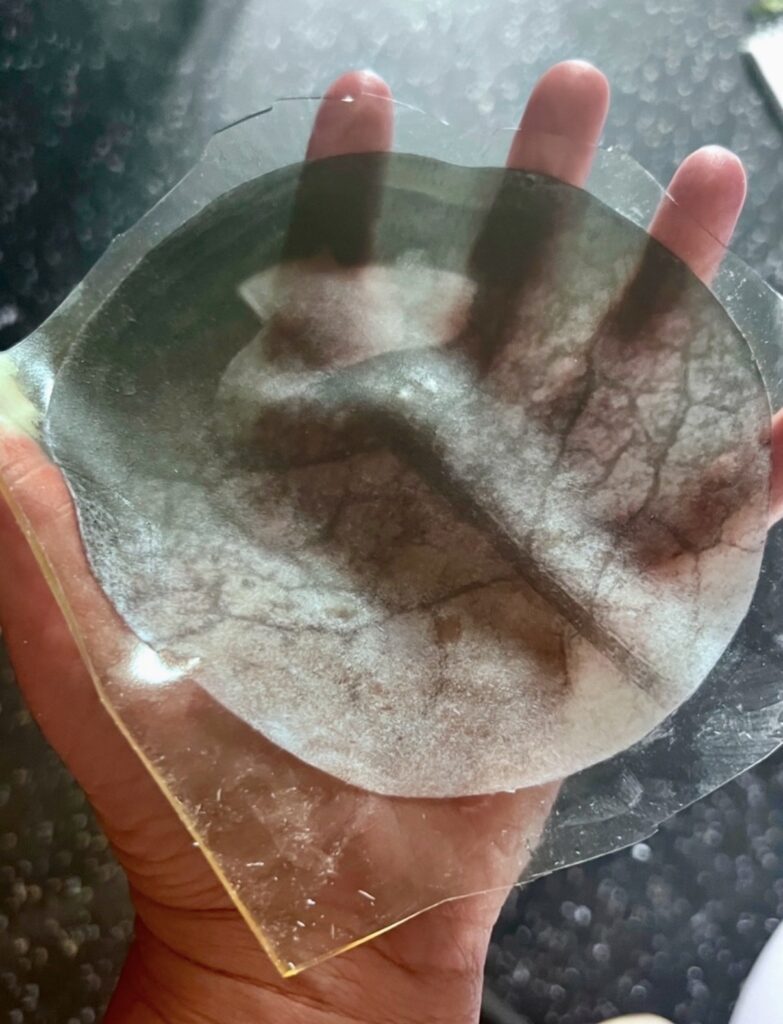
Q5. What possibilities have bioplastics opened up in your practice?
Bioplastics changed my practice because they stopped behaving like a surface and started behaving like a collaborator. I can introduce water collected from a particular place, botanical material, minerals, pigments, photographs or other traces into the material itself. Suddenly the artwork doesn’t simply represent a place — something of that place can physically exist within it. That distinction became incredibly important to me.
Traditional materials often come with an expectation of stability and preservation. Bioplastics challenge that. They can curl, shrink, become translucent, respond to humidity, develop bubbles or imperfections and continue changing after I think I have finished making them. Initially, I tried to control those behaviours.
Eventually I realised the response was often more interesting than my original intention. That taught me something fundamental about my practice: the material doesn’t have to obey me for the artwork to succeed. Bioplastics gave me permission to make work that remains alive to change where uncertainty, impermanence and material response aren’t problems to eliminate, but part of the meaning.
Q6. What first made water something you wanted to investigate so closely?
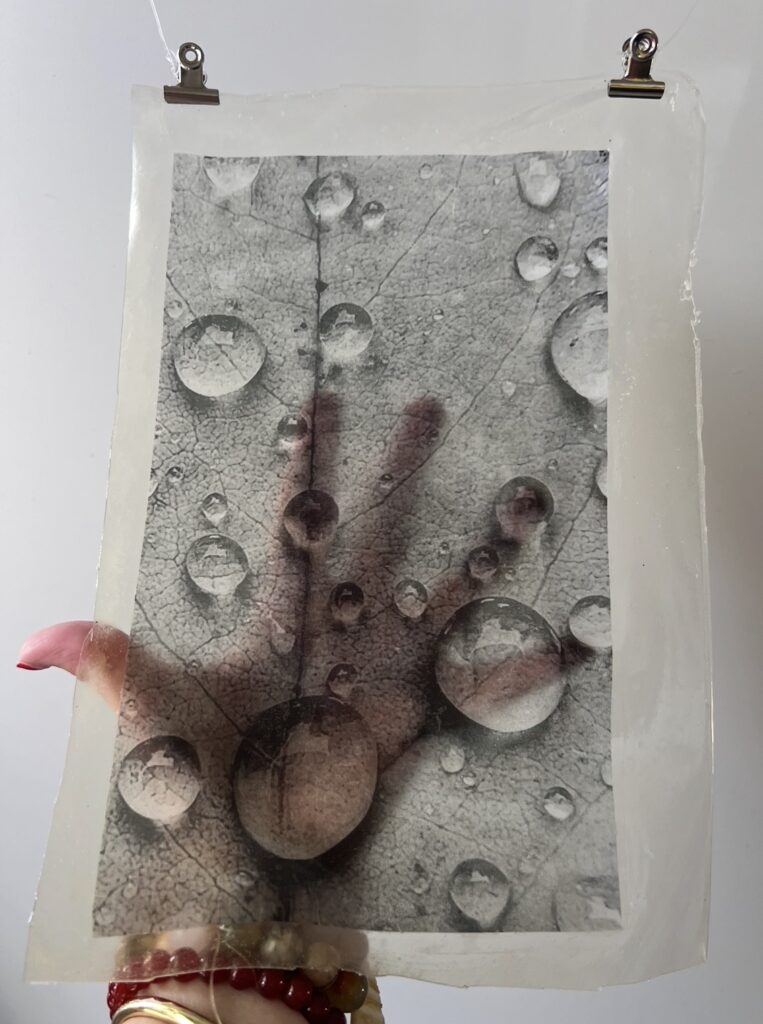
It began with the strange realisation that something I had encountered every day of my life remained almost completely mysterious to me. I knew what water looked like. But had I really looked at it? What did the water at Miami Beach contain that the creek did not? What happened when rain entered a canal? What did those places sound like beneath the surface? Could water from different locations behave differently within a material? And what might those differences reveal? Once I started asking those questions, water became almost inexhaustible.
I began collecting samples, photographing droplets, making bioplastics with water from specific places, writing field observations and, more recently, listening underwater and exploring ecoacoustic recording. The closer I look, the larger the subject becomes. And somewhere along the way I realised that the Water Response Atlas isn’t only an archive of water. It is becoming an archive of attention. Each sample, photograph, recording and observation says: I stopped here. I noticed this place. I listened. That feels increasingly important to me in a world moving very quickly past itself.
Q7. What kind of experience do you hope to create through The Whisper Within?
I love the tension between those two words: laboratory and sanctuary. A laboratory asks us to investigate. A sanctuary gives us permission to slow down. The Whisper Within sits somewhere between them. I want people to enter with curiosity rather than with instructions about what they are supposed to feel. There are things to discover, listen to, touch and investigate, but there is also space simply to be present. For me, that is important because curiosity and contemplation are not opposites.
Sometimes the deepest observation happens when we stop trying to reach a conclusion.
I’m interested in creating an environment where technology doesn’t demand attention but quietly facilitates it; where sound, material and sensory experience encourage people to become aware of their own bodies, memories and responses. I don’t necessarily want someone to leave saying, “I understood the artwork.” I’d rather they leave carrying a question they didn’t have when they entered.
Q8. What should artists protect about the human experience of making and encountering work?
Wonder. Imperfection. Touch. Slowness. Uncertainty. Technology can do extraordinary things, and I’m fascinated by its possibilities. But I don’t want technology to remove the very things that make an encounter meaningful. For me, technology is most interesting when it helps us notice something rather than when it becomes the thing demanding to be noticed. A hydrophone can let us hear an invisible underwater world. NFC or augmented reality can reveal another layer of an object.
Technology can extend our senses and connect experiences across places and time. But the question I keep returning to is: what does this allow a human being to experience that they couldn’t experience before? If technology makes us more attentive, curious, connected or astonished, I’m interested. If it simply makes something more impressive, I’m less interested. As artists, I think we should protect the messy, sensory, vulnerable part of making — the part where we don’t know exactly what will happen. Because efficiency can produce extraordinary things. But efficiency and meaning are not the same thing.
Q9. How do you balance a clear social message with room for interpretation when addressing ageism?
I try not to tell people what they are supposed to think. With subjects such as ageism, there can be a temptation to make the message so explicit that the artwork becomes an argument. I’m more interested in creating an encounter where someone recognises something — perhaps in the work, perhaps in themselves. I can establish the conditions: the material, the body, the language, the absence, the trace.
But I want to leave enough space for the viewer to bring their own history into that encounter. That ambiguity doesn’t weaken the social question. Sometimes it makes it harder to escape. Ageing, visibility, beauty, value and identity are not abstract ideas. We carry experiences of them in our own bodies. I think art can open a door that explanation sometimes closes. I don’t need everyone to arrive at the same answer. I want the work to make the question difficult to ignore.
Q10. What do emerging multidisciplinary artists misunderstand about developing a cohesive practice?
That cohesion has to come from using the same medium. I spent a long time thinking that if I moved between photography, installation, materials, sound and technology, I somehow needed to explain why I wasn’t choosing one. Eventually I realised that the medium isn’t necessarily the thing holding a practice together. The questions are.
If you’re genuinely following the same curiosity, one question might require a photograph and another might require sound, sculpture, a field experiment or an experience involving other people. Cohesion comes from recognising the questions you cannot stop asking.
For me, those questions continually return to memory, material response, perception, water, attention and what becomes visible when we look differently. Once I understood that, interdisciplinarity stopped feeling like something I needed to justify. The question became the practice. The medium became the language I chose to ask it in.
Q11. How has your interdisciplinary practice changed what success means to you?
Success used to feel much easier to measure: finish the artwork, exhibit it, sell it, receive recognition.
Those things still matter. Artists need opportunities, audiences and sustainable careers. But my definition has expanded. Now I think success can also be discovering something I didn’t know yesterday. Making an experiment that changes the direction of the work. Standing beside a creek and hearing something I have never heard before.
Watching a child become completely absorbed in examining a shell. Having someone leave an experience and notice their own environment differently. Increasingly, I’m interested in building a body of inquiry rather than simply a body of work. The Water Response Atlas has made that particularly clear to me. I don’t know exactly where it ends — and I no longer think I need to. Perhaps success is creating a practice with enough depth that you can spend a lifetime following its questions. And right now, I feel as though I am only just beginning.
Q12. What advice would you give artists whose work doesn’t fit into one medium or category?
Stop trying to make yourself smaller so that your practice is easier to describe. I wish someone had said that to me earlier. You don’t necessarily need to choose between being a photographer, sculptor, installation artist, sound artist, researcher or technologist. Those are mediums and methods. They are not the limits of your curiosity. Instead, ask yourself: What is the question I keep returning to? What am I unable to stop noticing?
Follow that. Learn whatever language the question requires. If it needs sound, learn sound. If it needs science, talk to scientists. If it needs code, material experimentation, fieldwork, writing or something you don’t yet know how to do — become a beginner again. There is enormous freedom in allowing yourself not to know. Your responsibility isn’t to fit neatly into a category. It is to make the work that only your particular combination of curiosity, experience and ways of seeing could make.
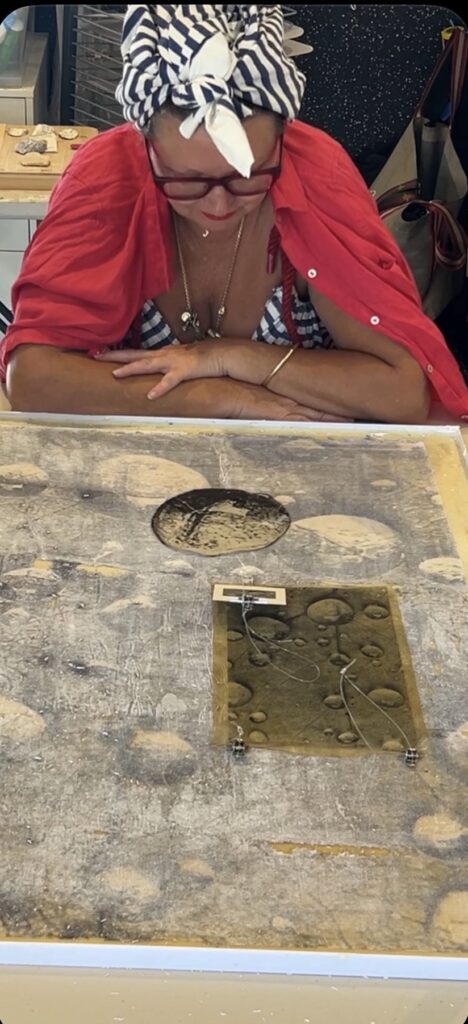
As we wrapped our conversation with Juniper, we realised she’d changed something in us without trying to. Not our opinion about art. Our opinion about paying attention.
Because how many of us actually pay attention anymore. To anything. We scroll past everything. Walk past everything. Live next to creeks and oceans and rain and puddles and never once wonder what’s actually happening in them. We’ve gotten so used to moving fast that we’ve forgotten what it feels like to stop and actually notice something and let it surprise us.
Juniper’s whole practice is a refusal to live that way. And spending time with her work makes you refuse it too, at least for a minute. You walk away from her installations and suddenly the ordinary world looks less ordinary. Not because it changed. Because you did.
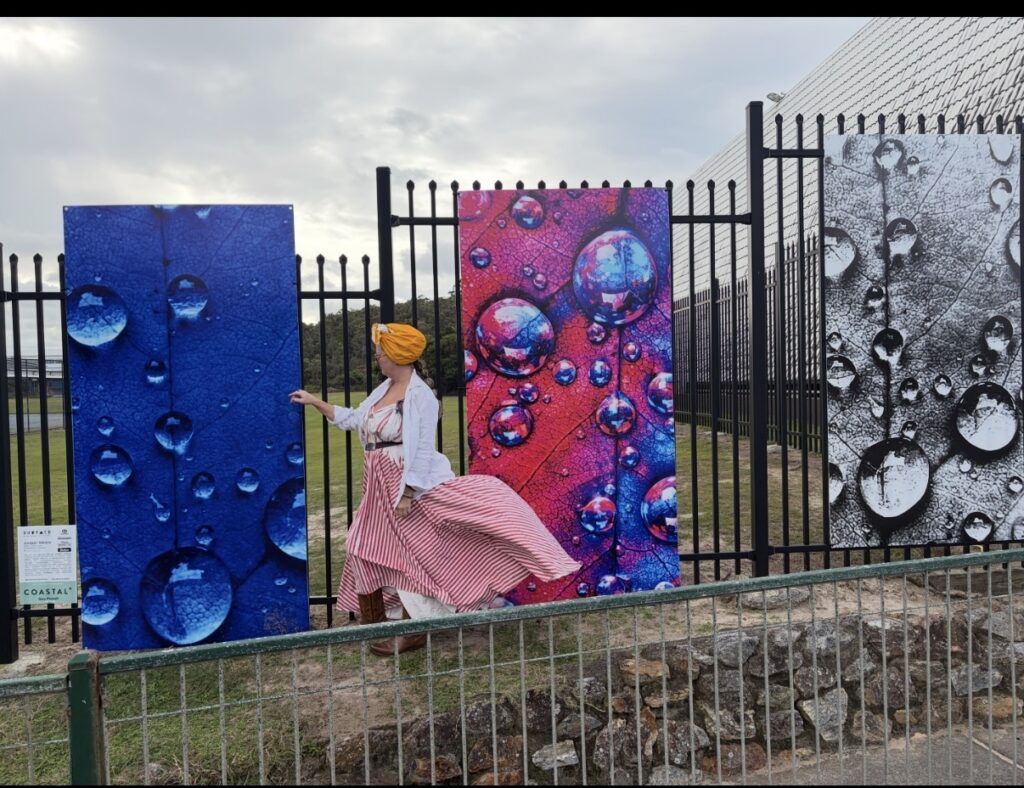
That’s rare. Most art gives you something to look at. Juniper gives you a different way of looking at everything. And that gift doesn’t end when you leave the gallery. It follows you home. It follows you to the creek.
It follows you to the kitchen sink. It makes you curious about things you’d stopped being curious about and that reawakened curiosity is worth more than most things hanging on walls right now.
For anyone thinking about her work, that’s what you’re investing in. Not a fixed object. A living practice that carries actual traces of actual places inside its materials. Work that keeps responding to its environment because it was made by someone who believes nothing is ever really finished and the most interesting moment is usually the one nobody planned for. That kind of art doesn’t fade into your wall. It keeps asking you questions. And the questions keep getting better.
To follow Juniper’s journey and see more of her work, find her through the links below.
