This Artist Reimagines Calligraphy as Contemporary Abstract Art │ Gaëlle Étémé
At Women in Arts Network, for our Love, Life and Everything She Creates exhibition, we received work from artists all over the world interpreting love and life and creation in ways that moved us and challenged us and made us think. And then Gaëlle Étémé’s submission arrived and it didn’t do any of those things. It did something else. It made us go quiet.
Gaëlle is a selected artist for the Love, Life and Everything She Creates exhibition and honestly we still don’t have the right words for her work which feels appropriate because her whole practice exists in the space where words run out and something else takes over.
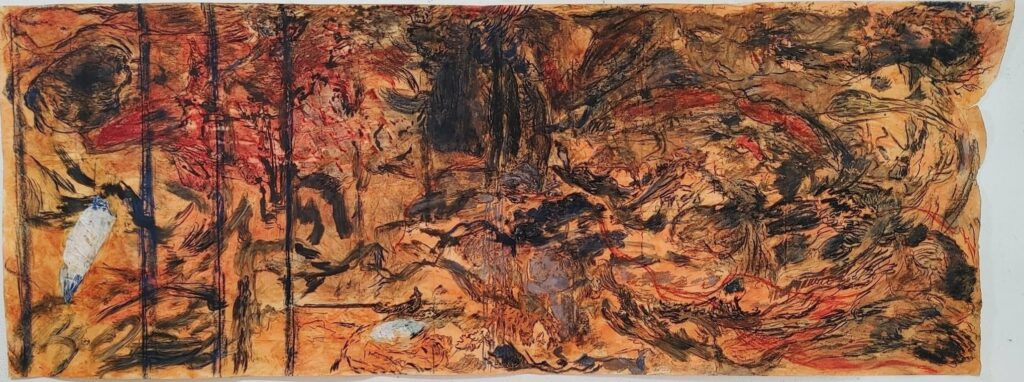
She works in Indian ink, charcoal, pastel, collage, and textile. Moves between abstraction and figuration in a way that doesn’t feel like switching between styles but like watching something breathe in and out. There’s a calligraphic rhythm running through everything she makes, a musicality in the gesture, a sense that the marks on the surface arrived rather than being placed there by a hand with a plan.
She didn’t come to art through art school or training or any path you’d expect. How she got here involves sociology and Cameroon and fables and forests and a year of drawing lines day and night and a depression that nearly ended everything and a rejection that turned out to be the beginning of everything else. That story is hers to tell and we’ll let her tell it because the way she describes her journey is as extraordinary as the work itself.
What we will say is this. There are artists who make work. And then there are artists who say they don’t make anything at all, that they accompany creation, that the brush already knows where it’s going and their job is just to follow without interfering. Gaëlle is the second kind. And standing in front of her work you believe her completely.
Now let’s hear from Gaëlle, about lines that become languages, about following the brush instead of leading it, and why the most honest art might be the kind that arrives before you’re ready for it.
Q1. Can you share a little about your background and how your journey as an artist began?
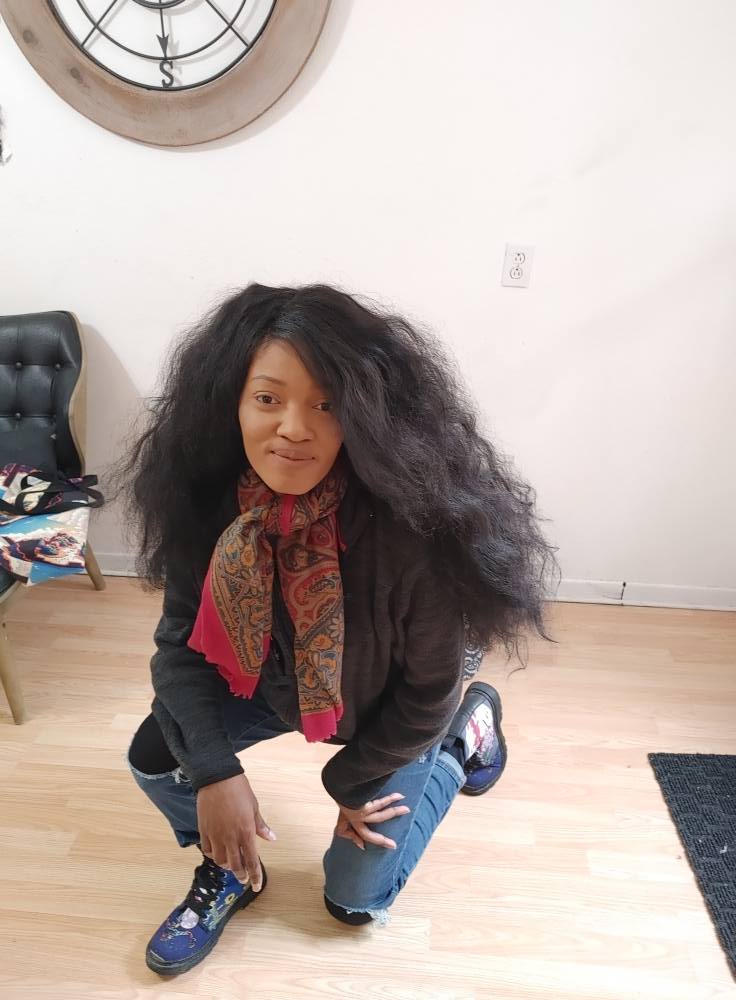
I came to art through theory and metaphysical speculation. At the time, I was enrolled in a doctoral program in sociology, and I had completed my master’s degree, also in sociology, on the hair of African American women. I analyzed how, through their personal narratives from the post-Jim Crow era in the United States, they attempted to reinvent the notion of taste, opening up new mythological speculations. I was profoundly changed by this experience because the historical and social experience of hair that she recounted was very different from my own, coming as I do from Cameroon.
But above all, thanks to their stories, I reconnected with a very important aspect of my culture: the mediating capacity of objects, their ability to speak. I reconnected with the Fable of the World and began to question language, mental concepts, ideas, and philosophical axioms as geometric forms. What followed were years of doctoral wandering, as I didn’t yet realize I had entered the field of creative research. I was experimenting academically, but my discourse was opaque.
Guided by myself, by a force I couldn’t explain, I returned to the study of the origins of alphabets. I relearned how to draw lines to understand how one could be an object, how a table thinks. Frantically, day and night, I drew lines for a year until I invented my own graphic language, “the alphabet of suffering.” Later, still just as lost, I entered the field of creative research in literature, trying to reconcile my calligraphic research with a reflection on the speculative autonomy of objects.
Fortunately, the university rejected me, telling me I wasn’t up to scratch. I had a very serious depression and found myself. That was two years ago. The paintbrush has never left me. I learned everything from the clouds. I am truly grateful for this rejection because today I speak, or rather, something now speaks, and I listen to it.
Q2. You describe your practice as a way of creating a “territory of a Self.” What does that idea mean to you as an artist?
It’s an interesting question because I initially began working on small formats, using paper to trace calligraphic lines, each motif conceived as a concept or the module of a linguistic equation whose territory was the sheet of paper. For me, it has always been obvious that the sheet possesses a profound, dreamlike spatial quality that carries the potential for discourse. This discourse consists of words, lines, dots, light, and colors all of these are concepts for me, and they are variations of singularities, like human beings. Color has an autonomy. So when I speak of the self and the territory of the self, it is never about human subjectivity. For me, human subjectivity does not exist.
We are accidents of language, extensions of lines, dots, and colors that seek to establish a domain of truth on a territory reality as artificial as a sheet of paper.
What is interesting is the depth of this territory, which reflects the depth of a quest for the sign in search of its own grasp as reality. It’s a void that spins on itself.
Q3. You work with Indian ink, charcoal, pastel, collage, and textile. What draws you to moving between such different materials?
It’s an inner journey, always this notion of space. It can’t be explained. I create, or rather, I accompany creation, because I don’t believe the artist creates. In my case, I think the sign already knows what it wants to say and how it should be said. It’s what we might call instinct. So I work like that. I never have a plan, I never make a sketch; it’s something I don’t understand.
I only know if I’ve arrived at the right word; I don’t know if it makes sense or if it’s because I’m self-taught. I follow the path and especially the melody that accompanies it, because calligraphy is musical; the gesture has a rhythm, a breath, and I consider my work both as a musical composition and, above all, as a calligraphic territory.
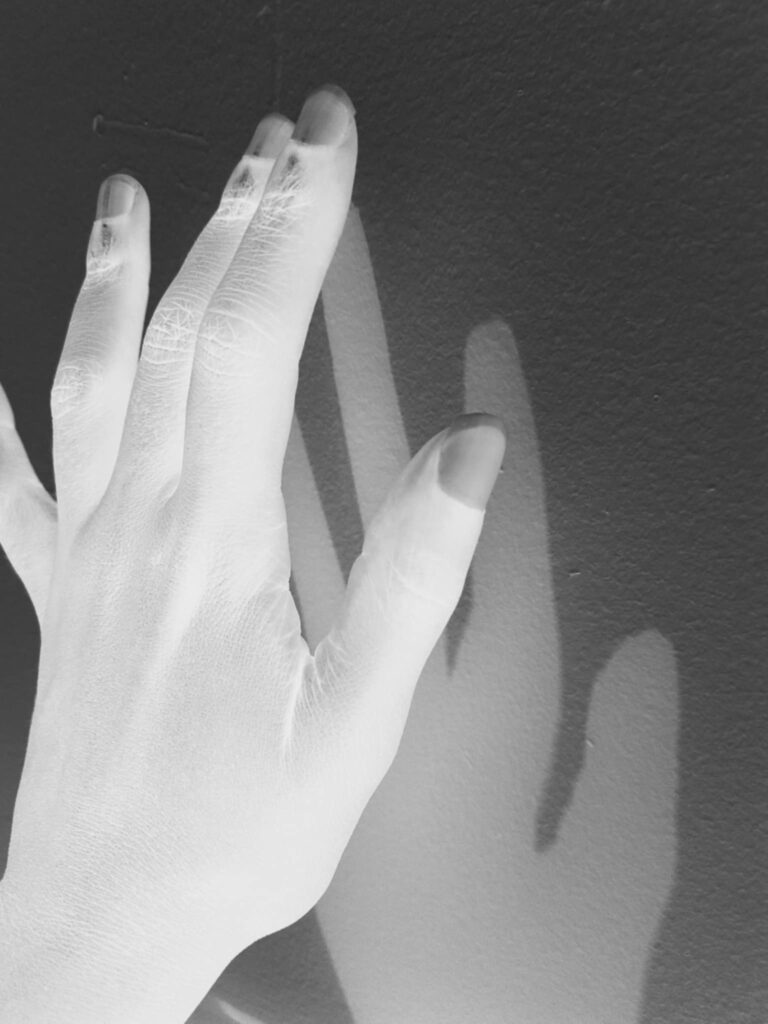
Q4. Your work Le monde des Beti connects with your Central African heritage. How did you approach bringing cultural memory into this work without simply documenting it?
It’s funny that you mention this work because it no longer technically exists. As I was saying, my work is very organic, rooted in a kind of abstract territory, which is a sort of mentality of the sign. And what’s exhausting is that the work is written through a structure of narrative layers. “The World of the Beti” was therefore one of these stages of a work that has changed, trying to open a path within me. It’s curious; I grew up with fables when I was young, before leaving my country at 14 for France.
I hear the volume of the fable through the rocks, the trees. It’s not something I need to “document” because memory isn’t objective, and my work doesn’t seek to establish a historical or memorial discourse in the sense of a quest for identity as it’s commonly understood. It’s a conversation with things, and it’s very personal. It’s truly a mode of attention and can open up a flash, a memory, like here, briefly, I had a memory of my village; which I must have visited only two or three times before I was 10, but one scene has remained in my memory:
I’m a child, I’m in the forest, there are other children, my grandmother or an adult isn’t far behind, and I’m running along a winding path. We were going to fetch water from a river, I think. We had never taken this path before, yet it seemed to me that I knew it. In calligraphy, it’s the same thing. You can’t explain it, a path opens up, you follow it.
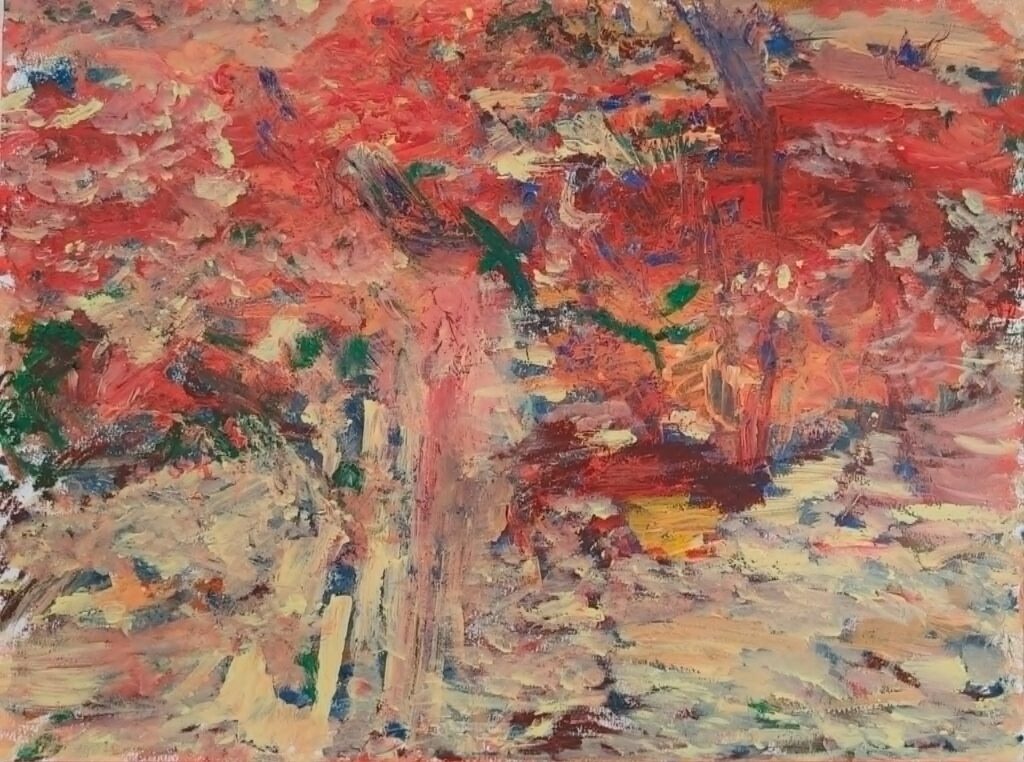
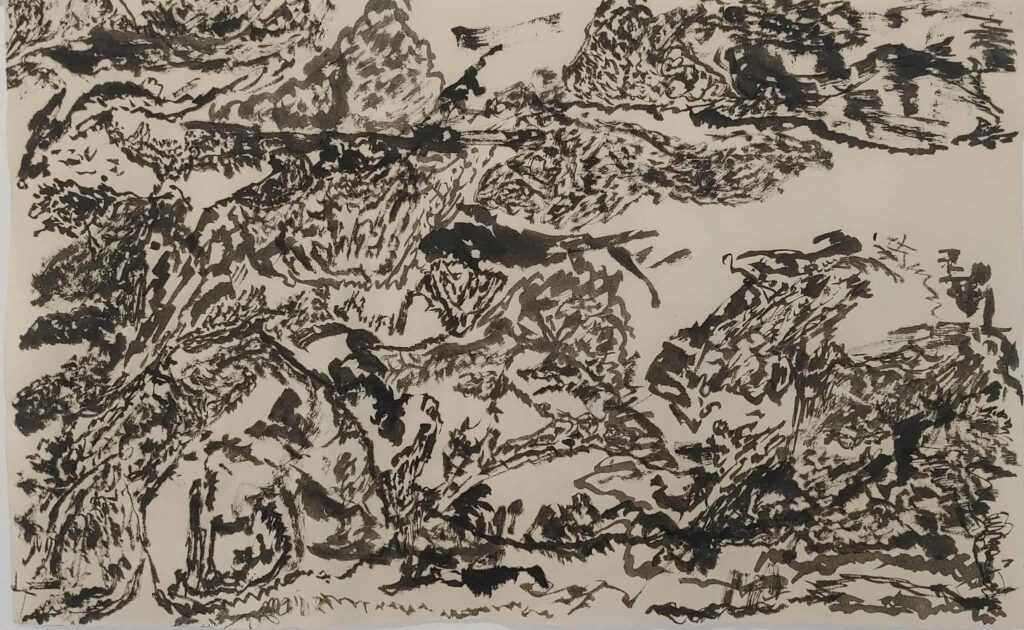
Q5. You have been experimenting with calligraphy and Chinese ink on paper. What interested you in using writing as visual material rather than only as language?
Hmm, because things speak for themselves. That’s all I can say.
Q6. Some of your recent work moves between abstraction and figurative painting. What makes you choose one approach over the other?
Once again, I don’t really choose. I simply follow a frenetic rhythm, the dictates of color, the imperative to lay lines on forms that appear abstract. All of this is a semiotic conversation, and subjectivity is accidental for me. If I told you I was incapable of voluntarily producing representation, would you believe me? I don’t choose at all. Things speak, resolve problems that deviate or turn away from my intention. I can never grasp things through willpower; as soon as I try, it’s corrupted, and I feel like I’m contaminating myself. I can no longer move forward or understand myself.
That’s why I say I am profoundly a calligrapher. A calligrapher’s brush is open to the pronouncements of the heavens. It’s a relationship of ecstasy, and my painting is part of this tradition, like Ryokan’s, for example. That of the calligraphers, or so-called “mad” monks, intoxicated by their gesture. Everything is done in a continuous movement. It was the calligrapher Mi Fu who said that the calligrapher’s gesture is like the movement of fire in the ashes of a stroke. For me, if abstraction is fire, the figuration that appears within it is the ashes.
Q7. You have compared your creative gesture to musical composition. How does music influence the way you make marks?
I smile with pleasure because calligraphy is a musical gesture, even a dance. Painting is exactly the same, since it relies on the spirit of the painter’s breath, their spiritual capacity to ask questions and surrender to the Immensity. Every musician knows this yearning for the sacred and the search for depth. I’m also a composer and playwright; for me, it’s somewhat natural. Often, when I’m stuck, or when my mind is filled with certainties or unethical feelings—anger, jealousy (thankfully much less often)—or when
I feel I haven’t been a good person to others or to myself, it’s always singing that saves me. I hum, again and again, until I reach a kind of surrender. When I paint, I sing; to compose, I need to paint. It seems that if your voice is sincere when you sing, you can find your way back to the brush. I don’t know if that makes sense. At least that’s how I understand myself.
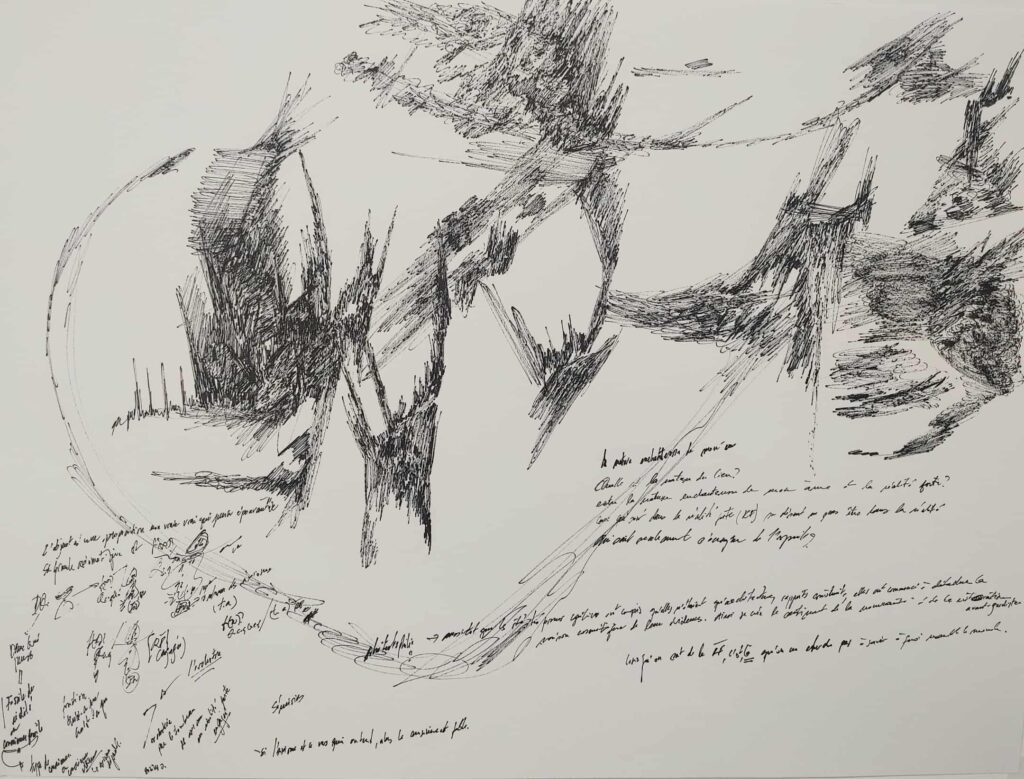
Q8. Do you see your work as preserving existing stories, questioning them, or creating new ones from them?
LOL, that’s a real trick question. I have absolutely no idea.
Q9. Your practice moves freely between different mediums and visual styles. Do you think the art world’s focus on having a recognizable style can sometimes restrict artists?
Yes, that’s for sure. Rather than talking about styles, I think that regardless of the medium, there’s a palette, a cosmic universe of questions that are built and interact with each other. The most important thing for me, or at least my hope, is that this cosmos isn’t closed. On the contrary, that it even implodes. Because that’s life. It’s normal to move from one territory to another; after all, everyone is a seeker on this earth, and no one has a privileged position. That’s why I’m very wary of the notion of identity.
Q10. As your work continues to develop between abstraction, figuration, calligraphy, and mixed media, what direction are you most interested in exploring further?
Lol, again. I have no idea. I don’t know what tomorrow will bring. I’m learning to live with this uncertainty of self. It’s often painful, but I don’t know any other way. Honestly, I don’t know. It’s what the brush says that counts, and right now I’m trying to be really careful about what I say. Every day I learn, I get up, and I’m grateful for the happiness I experience.
Please attach image 5 below.1 response
As we wrapped our conversation with Gaëlle, we found ourselves thinking about something we rarely think about after talking to an artist. Not the work. Not the technique. Not the story. The silence. The quality of silence that exists in someone who has stopped trying to control what comes through them and just lets it come.
Most artists we interview can tell you exactly what their work is about. Gaëlle can’t. Not because she doesn’t understand it. Because understanding it in the way we usually mean would require pinning it down and pinning it down would kill whatever’s alive in it.
And we respect that more than we can say. In a world that demands artist statements and elevator pitches and neat explanations for everything, Gaëlle’s refusal to explain is its own kind of honesty. The work speaks. She listens. That’s the whole practice.
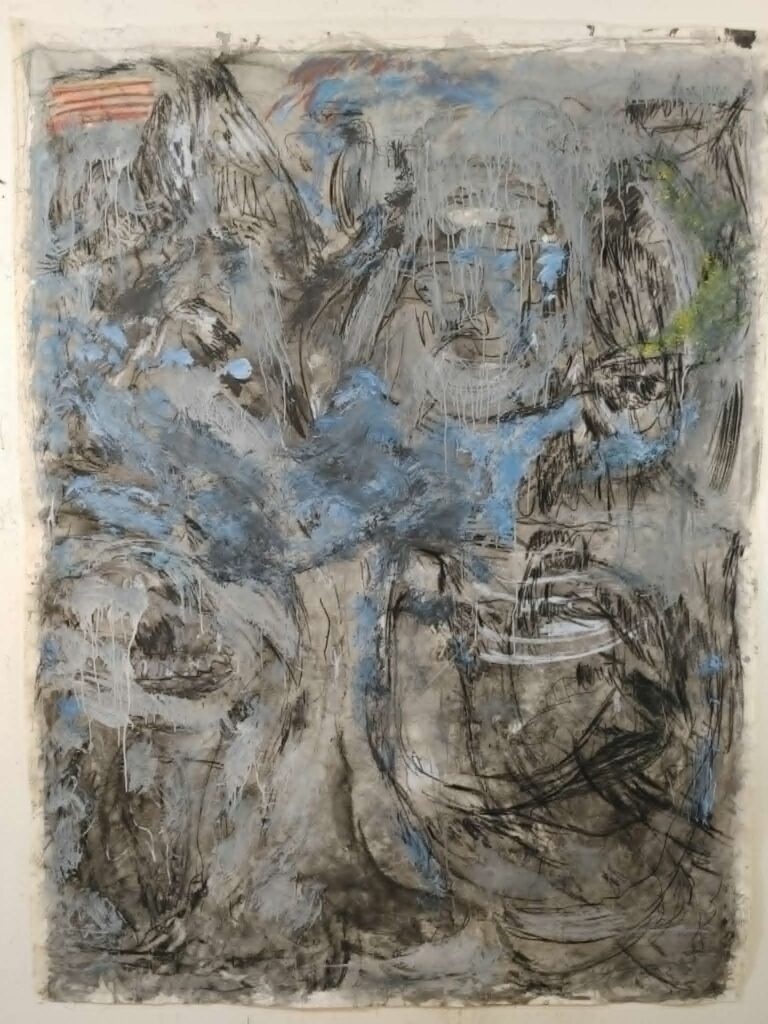
“Je” n’ai pas d’ici: le pays du rêve (“I” have no place here: the land of dream), 2026, 222 X 167 cm, Mixed Media on Textile Canvas
Her path to getting here is one of the most unusual we’ve ever encountered and we deliberately didn’t share the details because that story deserves to be heard in her voice not ours. But we will say that what she’s been through, the searching and the breaking and the rebuilding, all of it is in the marks she makes.
Not as autobiography. As energy. As the quality of a line drawn by someone who has genuinely surrendered to the process and isn’t performing surrender but living it.
For anyone thinking about her work, here’s what we’d say. You are not going to be able to explain a Gaëlle piece to someone who asks about it. You’re not going to have a tidy answer for what it means or what it’s about. And that’s exactly why it belongs on your wall. Because it will be the one piece in your home that refuses to be reduced to a sentence. The one that means something different every time you look at it. The one visitors stand in front of longest without speaking. That kind of art is rare. The kind that makes a room quieter just by being in it.
To follow Gaëlle’s journey and see more of her work, find her through the links below.
