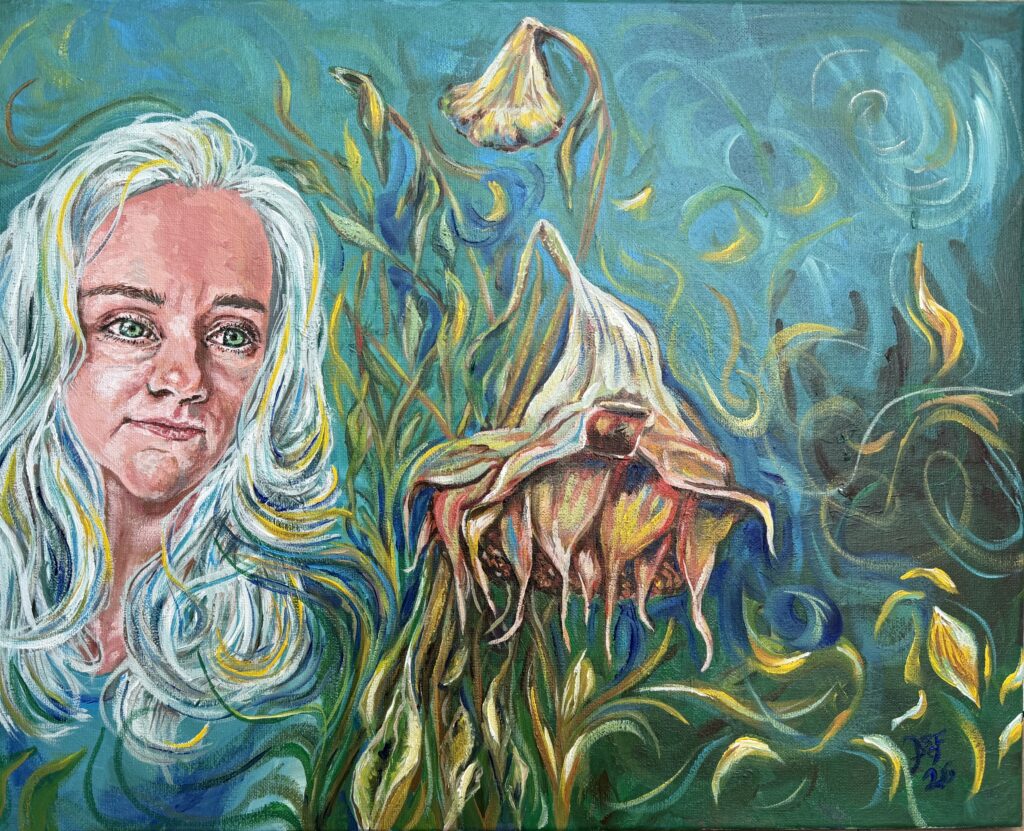
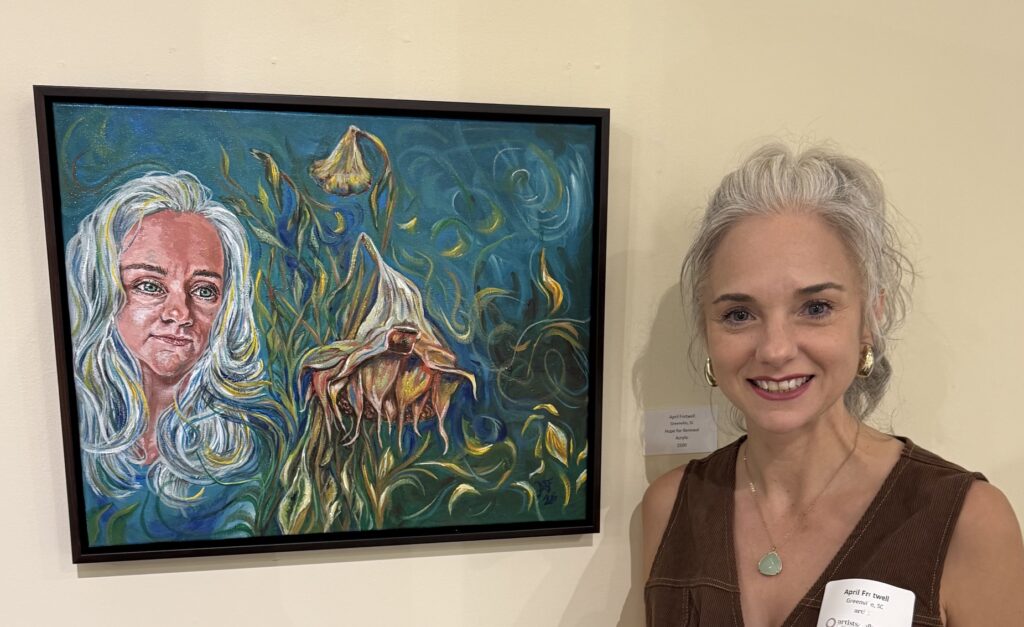
At Women in Arts Network, our Portraits exhibition set out to explore everything a face can hold, not just how a person looks, but the memories, the emotions, and the quiet stories living behind it. Each of our selected artists answers that in her own way. For April Fretwell, a portrait is never only a portrait. Look closely at her faces and you’ll find whole landscapes hidden inside them, sunflowers, deep blues, trailing vines, each one a small clue to what’s going on underneath. Her work asks you to look twice, and then to feel.
April’s art is deeply, openly personal. Lately, she’s been painting her way through grief and loss, turning hard memories into tender, symbolic figures, a face against a seascape, a sunflower opening in a wash of cool, quiet colour. She says it almost feels like crying as she paints, and for her, that’s exactly what it is: a way to cope, to heal, and to find the comfort she’s always drawn from nature.
In her hands, a portrait becomes a kind of inner landscape, where sadness and hope sit right beside each other. Her need to make things goes all the way back to childhood. She was always drawing, building, sculpting, and crafting with whatever she could get her hands on, simply because she had to.
Her parents and grandmother believed in her and kept the little drawings and paintings she made as a girl, and it was that quiet faith in her that first made her think, maybe I really could be an artist one day.
She works mostly in acrylic, and her surfaces feel alive, built up in layers of colour, with deep darks and little flecks of white that make everything seem to sparkle. But it wasn’t always this free. In her twenties, she painted so tightly and in so much detail that she nearly lost her love for it.
Learning to loosen up, to let the paint settle instead of forcing it, was how she fell back in love with making art, and that looseness is exactly what gives her work its warmth today.
Hope for Renewal; 2026, 16″ x 20″, acrylic on stretched canvas
She’s endlessly curious, too. As an art teacher, she’s always picking up new mediums, and she loves bringing them into her own work, weaving, embroidery, woodburning, woodworking, always looking for fresh ways to “draw” and leave her mark.
Right now she’s trying to bring her woodwork and her tapestry weaving together, a challenge she clearly loves, and she can feel her painting slowly drifting toward something more dreamlike and surreal.
Now let’s hear from April about the childhood that made her an artist, how she builds so much depth and texture, why her portraits hold whole landscapes inside them, and her advice for anyone still trying to find a direction that feels like their own.
Q1. April, let’s start at the beginning. What first drew you toward art, and when did creating become an important part of your life?
I was first drawn to art as a young child. I was always drawing, building, sculpting, and crafting whenever I could, using whatever materials were available to me. I had to have that outlet—I had to make things! My mom and dad really encouraged me to create art and always supported me! My parents and grandmother (maternal) saved so many drawings and paintings I made as a young child, so that really gave me this feeling of “Hey, you can be an artist one day!”
Q2. Your acrylic work creates a sense of depth through layers of colour, fine lines, and texture. How do you achieve this effect, and how much comes through experimentation?
I really enjoy layering colors and values to create depth, texture, and a sense of expression in my paintings. Honestly, the layering process helps me to not be such a perfectionist–when I was in my twenties, I painted with such detail that I sort of lost my love of painting and I had to get that back by loosening up in my mark-making style.
I often work from a medium value as a canvas wash and then layer up to the lighter values as a work a subject. I also like to add touches of really dark values and also thick white specs/lines toward the end of a painting to create crispness. I want make my subject matter to kind of sparkle. I find that lately, I have to slow myself down to let the paint settle so I don’t overwork it and it still has that textured “painterly” quality.
Q3. Your portrait against a blue seascape brings together portraiture and landscape. What led you to combine these elements?
I wanted to tell a story with this portrait, so I decided to paint a landscape for the background–I wanted it to show my inner emotions that reflects my journey through life going through tough times and finding hope in the good times.
I find such peace and comfort in nature, so the landscape represents those feelings for me when combined with the uplifting expression on my face.
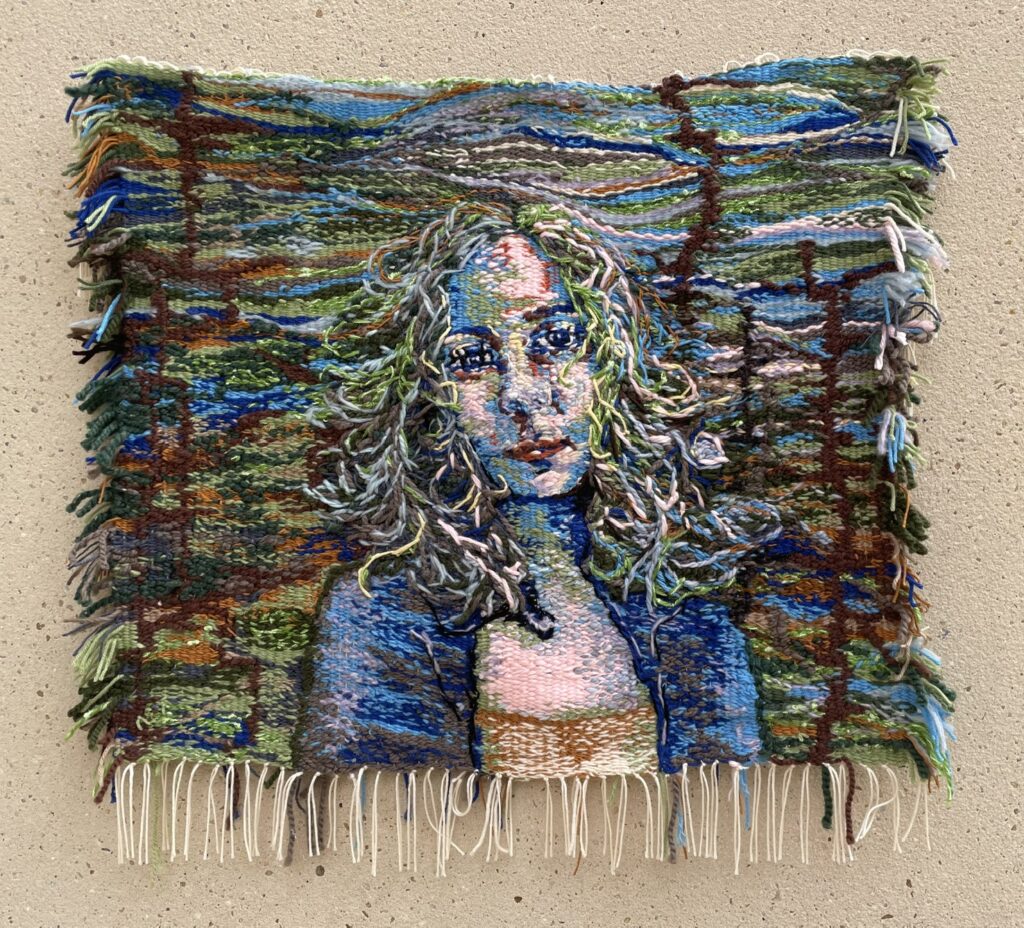
Rest, Psalm 23:2; 2026; 30″ x 32″; tapestry weaving with concurrent embroidery
Q4. You often transform ordinary materials into something unexpected. What excites you about experimenting with different surfaces and techniques?
As an art teacher who is a working artist as well, it’s part of my job at school to learn and teach new mediums. Textiles and crafting methods have become an important part of what I teach every year in my Crafts 1 and Crafts 2 classes. I like to experiment with ways to bring textiles and crafts into my artwork to keep things fresh and keep me enjoying making art. As I said before, I used to be only a very tight and detailed artist, which really burned me out.
With this combo process I do now, I can rethink my artwork–it still normally leans heavily toward drawing and painting, but now I can use other materials to portray subjects. I’m trying to figure out new ways to “draw” or make my mark with weaving, embroidery, woodburning, etc.
One of my goals for this year is to combine my woodburning and woodworking art with my tapestry weavings–I have to gain more experience with the tools and experiment with attaching the different pieces together. It’s a good challenge and I think it will pay off in the end!
Q5. You explore both recognisable figures and abstract forms. How do you decide which direction a piece should take?
For me, the level of abstraction comes with an idea behind a piece. If I want a landscape worked into a portrait, but I’m trying to represent grief or sadness, I might add willow trees or a dying flower or vine of some sort. If I’m wanting to focus more on the symbolism of color or just for composition’s sake a strong color scheme, I’ll let the abstraction of the colors in a face/figure do more of the talking.
I also like to enhance my subjects by adding lines and other elements to create movement and energy. Some parts of my pieces are very abstracted while other parts are pretty representational and traditional–I see myself moving into more of a Symbolism or Surrealism direction currently.
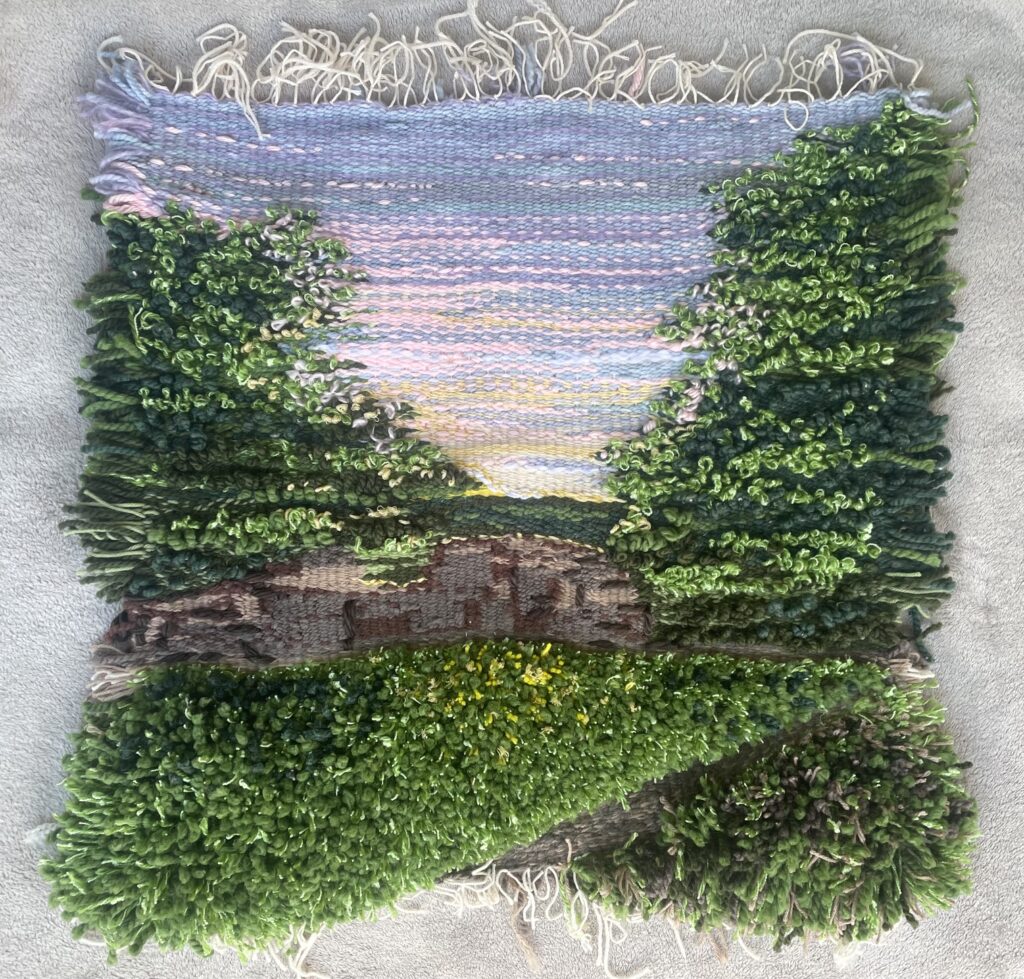
Views from the Swamp Rabbit Trail: Evening Tranquility; 2025; 30″ x 30″; tapestry weaving
Q6. How do personal experiences and memories influence the images and forms that appear in your work?
Absolutely, my experiences and memories heavily influence my artwork! Lately, I’ve been exploring grief and loss through heavily symbolic figural paintings. I have been using sunflowers a lot, as far as recognizable images I combine with portraiture. I also have been using a lot of cool colors to represent sadness and loss and grief. It’s been a healing process for me.
It’s almost as if I’m crying as I paint–I know that sounds melodramatic, but it’s really the case for me. I have experienced a significantly difficult family situation in recent years and I am using art as a way to cope with it.
Q7. Is there a particular piece or medium that challenged you to work in a completely different way?
When I began working with woodburning and wood carving, I had to completely change my approach to drawing–it’s all about how I’m holding the tools, the amount of heat or power I’m using, the type of wood I’m working on, etc. It’s humbling and challenging, so it’s really a good way to force growth in myself!
Q8. What are you currently experimenting with, and what would you like to explore further?
I’m currently experimenting in two different ways–the combination of woodworking with tapestry weaving and also symbolism/surrealism in painting. For woodworking, my main need is to get better with the tools and at knowing what tools are appropriate for each part of the process.
That process makes me so angry at times and it makes me wish I had skills as a carpenter! For my painting, it’s a matter of making studio time happen as much as possible–I have to stay with the flow of a painting or I’ll lose it. I have to be sure I’m using the right brush for what I’m trying to accomplish. I’m a lot more thoughtful and methodical now than I was when I was a young painter and that’s a good thing.
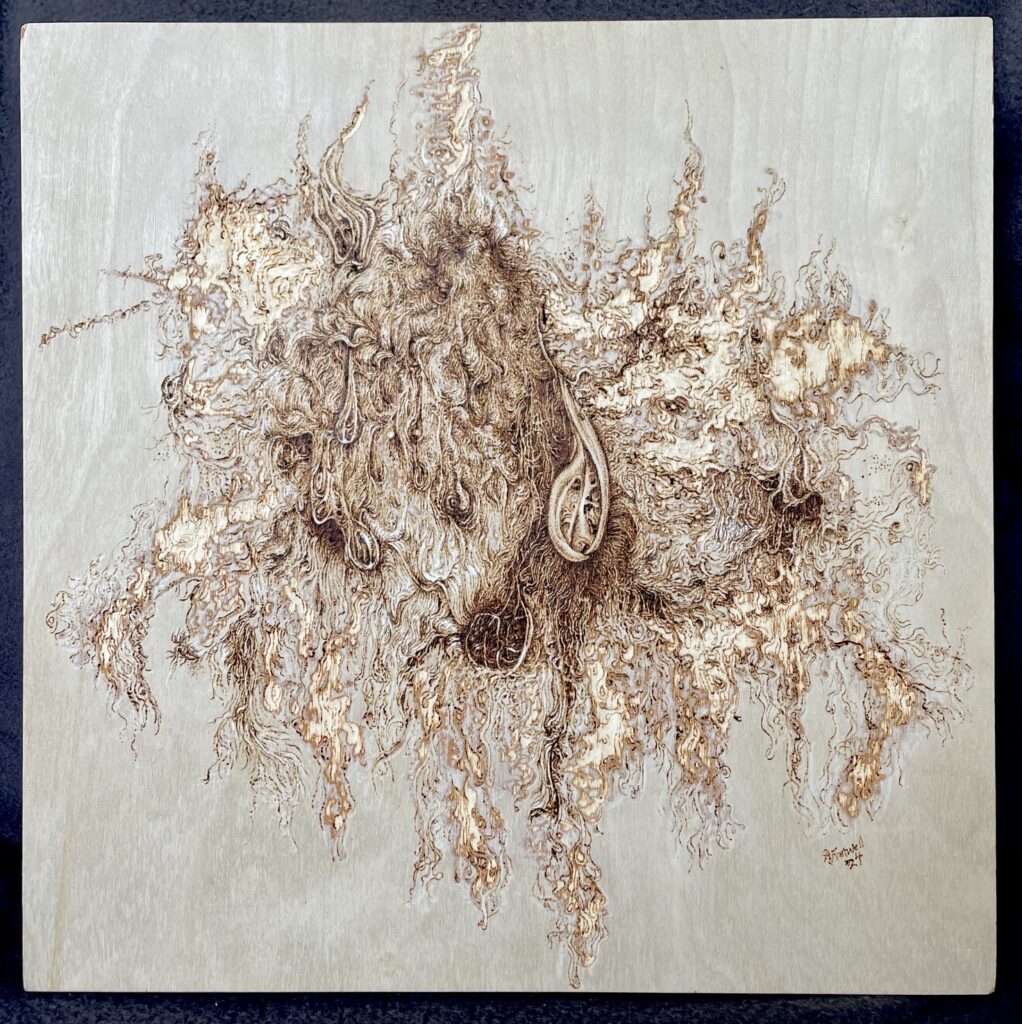
Decompose, 2024, 12″ x 12″, woodburning with ink, sanding/grooving with Dremel tool
Q9. How do you personally define success when your work aims to create both beauty and deeper emotional reflection?
I define success by three things–enjoyment, successful communication, and positive reception. I want to love what I’m doing, even it’s not enjoyable when I’m failing in a process and have to start over–I have a sense of achievement when I master something or learn a new, better way to do it and that’s really satisfying.
When I am told by someone else that they see what I was trying to communicate in my work, that is so rewarding. Then, obviously, when my work is received well by my peers and is accepted into exhibitions, that is definitely a positive thing and makes me feel like I am going in the right direction. However, just like I tell my students, you don’t always get into juried shows or win awards, but that does not mean your art piece isn’t successful. It’s a balance.
Q10. What advice would you give artists working across different mediums while trying to find a direction that feels distinctly their own?
Keep trying new approaches and keep experimenting until you find a process that works for you. That is what I had to do and I’m still doing that. If you just do what is safe, you won’t grow and then you’ll stagnate and that means you’re now regressing (in my opinion). Make are for you–if it resonates with you, it will resonate with someone else!
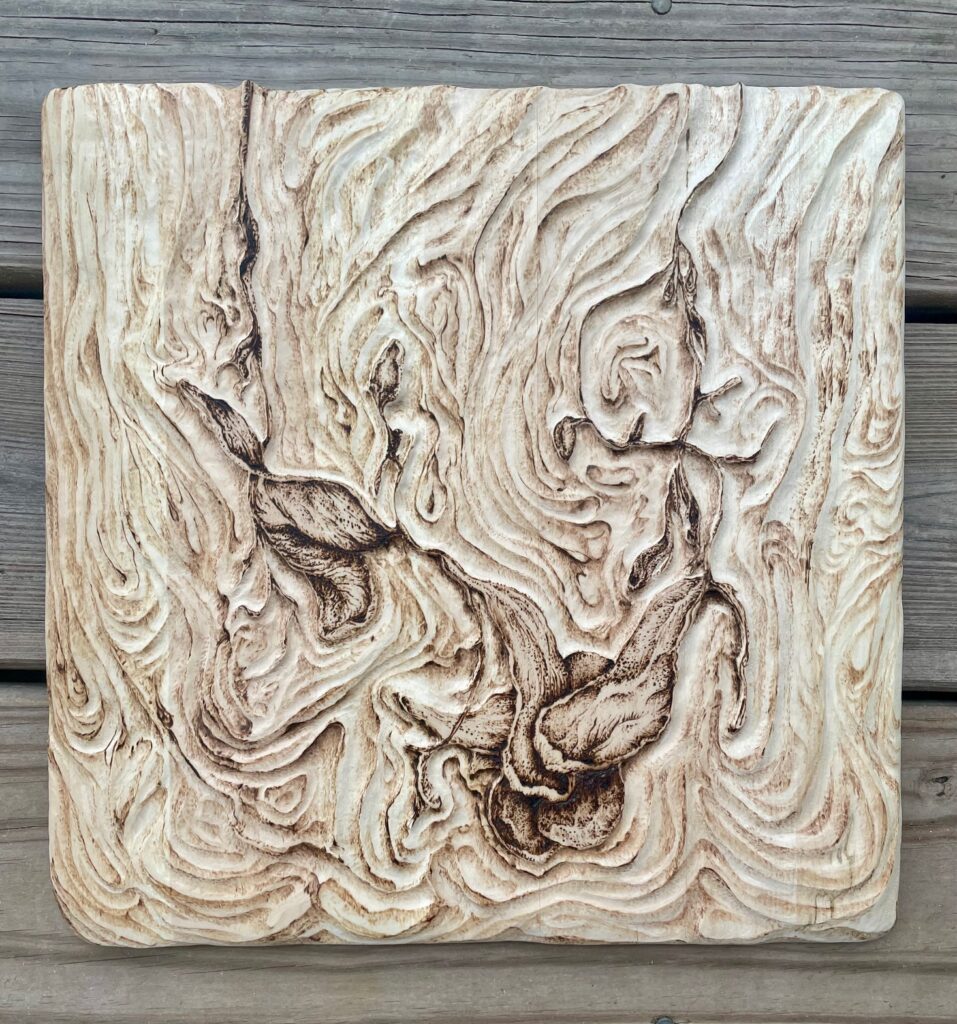
Summer’s End; 2024; 12″ x 12″; woodburning, carving, sanding on basswood
As our conversation with April came to a close, we kept thinking about how art can carry us through the hardest parts of life. For centuries, people have turned to the portrait to hold onto something, a face, a feeling, a moment. But April reminds us that a portrait can do something even quieter and more personal: it can become a place to put the things we can’t quite say out loud.
Her paintings aren’t really about likeness. They’re about what’s happening inside. By weaving landscapes, flowers, and colour into her faces, she turns each portrait into a kind of map of her own emotions, grief and sorrow, yes, but always with hope somewhere in the frame.
There’s something brave about making art this honest, and something comforting too. She isn’t hiding the hard parts of life; she’s giving them a shape, and in doing so, helping the rest of us feel a little less alone in ours.
There’s a bigger truth running through her work, one that feels especially needed right now: that making art can genuinely heal. For April, painting has been a way to cope, to grieve, and slowly to find her way back to comfort and hope. And she refuses to stand still, always reaching for new materials and new ways to make her mark, because she knows growth comes from staying curious and taking risks.
In a world that so often rushes past its own feelings, there’s something quietly powerful about an artist who sits with hers, and turns them into something beautiful.
For art lovers and collectors, April’s work offers something rare and genuinely moving. Rich in texture, colour, and feeling, her portraits reward a slower, closer look, the kind that lets all those hidden details, the sunflowers, the seascapes, the small symbols, begin to speak. To live with one of her paintings is to live with a piece of someone’s heart, and a gentle reminder that even our hardest seasons can be turned into something full of meaning and hope.
Maybe that’s the quiet gift of a portrait like April’s: it shows us that a single face can hold an entire inner world, storms and sunlight both. She may begin with a figure and a feeling, but what she’s really offering is proof that even out of grief, something tender, honest, and hopeful can grow.
Follow April Fretwell through the links below and explore more of her work and creative journey.