
If You’re Scared of Being Limited as an Artist! Read This I Stephanie Swilley
Women in Arts Network wasn’t created to fill a gap. It was created because we got tired of watching talented women disappear into the noise. We built this platform because we knew the art world needed more than another directory. It needed a space where women could actually be seen, where connection wasn’t transactional, where support felt real and reciprocal.
This isn’t a platform that just lists names and portfolios. It’s a living, breathing community of writers, podcasters, gallerists, curators, and artists who refuse to stay isolated. Women across continents finding each other, collaborating, celebrating wins, and holding space for the hard days. It’s messy and honest and powerful, and it works because everyone here understands one thing clearly. We rise together, or we don’t rise at all.
Our directory isn’t just profiles and images. It holds entire creative lives. Portfolios, exhibition histories, the stories behind the work, the journey that brought someone here. You can search by medium, by location, by style, and actually discover artists whose work stops you in your tracks. Whether you’re looking for the right collaborator or ready to step into the spotlight yourself, this is where it happens.
What makes this community different is simple. It’s real. The support isn’t performative. The connections aren’t superficial. Women here understand what it’s like to fight for space, to doubt yourself, to keep creating even when it feels impossible. Because we’ve all been there, we show up for each other not just professionally, but personally too. And we’re not just local. This network spans continents, bringing together voices and visions from everywhere, giving artists access to audiences and opportunities they would never reach alone.
Recently, we opened submissions for a virtual exhibition exploring the theme of Birds. We wanted to see how artists would interpret it, what birds meant to them, what they symbolized, what stories they carried. The work that came in was astonishing. Migration and freedom. Fragility and resilience. Solitude and flocking. Every submission revealed something different.
Then Stephanie Swilley’s work arrived, and we couldn’t look away.
There was something about the way she approached birds. Not as subjects, but as metaphors for something much bigger. Her work felt like it was asking us to rethink everything we thought we knew about connection, care, and what it means to be part of something larger than ourselves. It wasn’t loud. It didn’t demand attention. It quietly insisted we slow down and feel.
We selected Stephanie for the exhibition, but we wanted more. We wanted to understand how someone builds a practice this deliberate, this rooted in the belief that art can genuinely shift the way we see each other and the world.
So before you hear from Stephanie directly, here’s what you need to know about her.
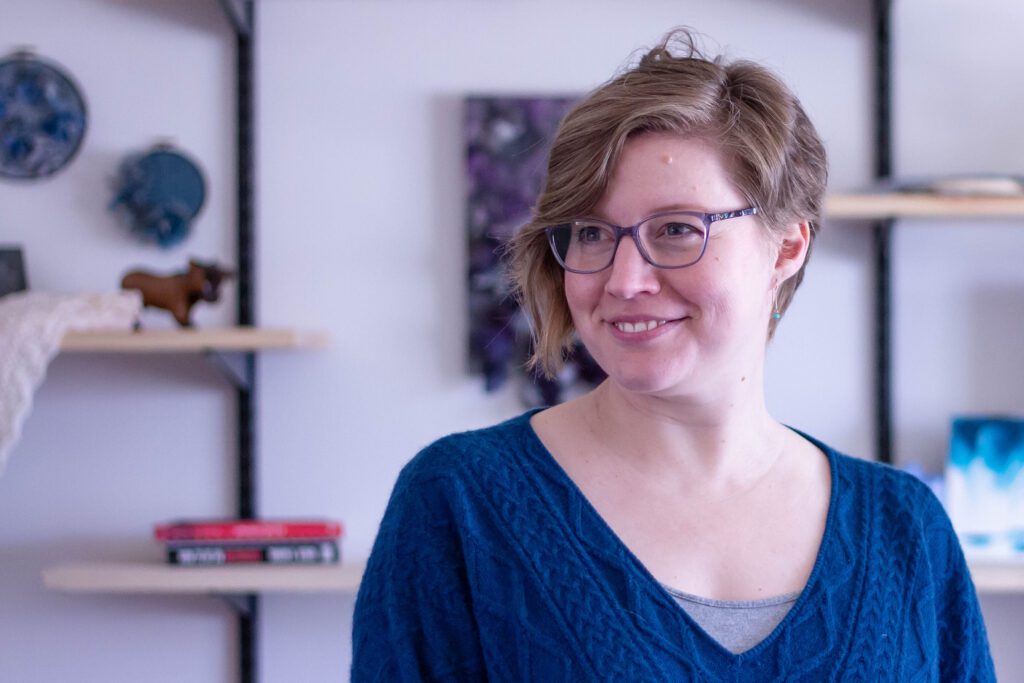
Stephanie Swilley lives in Northern Iowa and describes herself as community taught, a term that feels truer than any formal label. She didn’t learn art by sitting in classrooms. She learned it by watching how roots tangle underground, how whales protect their pods, how starlings move like one mind. She learned from books, poetry, and the people around her. She learned by paying attention to the systems that hold us together and the ones that tear us apart.
Her work moves between abstraction and abstract realism because she refuses to be pinned down. She speaks openly about a visceral fear of being boxed in creatively, mentally, spiritually. Because of that, she doesn’t limit herself to one style or one medium. Paint, paper, plaster, whatever the idea demands, she follows where it leads. Her loyalty isn’t to technique. It’s to truth.
She has been recognized in juried shows across Illinois, Indiana, Kansas, and Iowa. Her work has appeared in international publications. But accolades aren’t what drive her. What drives her is the belief that beauty can be a tool for change. That art can remind us we are interconnected. That creating something honest and tender is itself an act of resistance.
Stephanie donates part of every sale to mutual aid, the ACLU, Donors Choose, and the National Parks Conservancy. For her, there is no separation between making art and making the world better. They are one and the same.
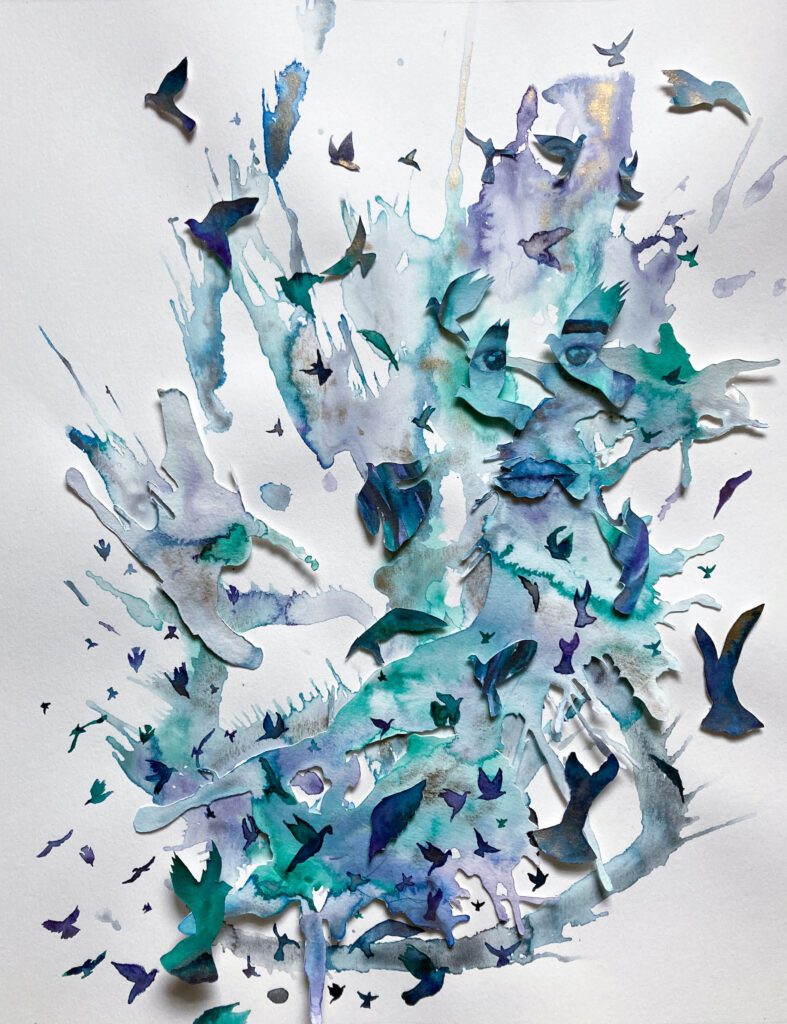
When you look at her work, you’re not just seeing something beautiful. You’re being invited into a conversation about interdependence, about what happens when we remember we belong to each other, about the systems of care that already exist if we are willing to notice them. She weaves faces into flocks, hands into root systems, human tenderness into ecological patterns because she wants us to see ourselves as part of the whole, not separate from it.
Stephanie doesn’t want to give you answers. She wants to start a thought, spark a question, make you feel something unexpected. Her work is a glimmer. A moment where you stop and think, maybe I’ve been seeing this all wrong.
Now, let’s hear from Stephanie herself. Her process, her philosophy, and the quiet activism running through everything she creates
Q1. How do the natural world and literature influence the way you approach a new piece, and how do you decide which medium will carry an idea best?
In my world, every moment is a learning moment. It’s simply a matter of whether we have the capacity and desire to notice. Nature offers metaphors I can feel in my body: the entwining of roots, the choreography of starlings, the patience of winter. Literature (both fiction and nonfiction) offers insight into humans, animals, and systems. When an idea arrives, it’s usually rooted in something I’ve noticed in the world—something that I think our culture has forgotten—and I spend time with it almost like a conversation, asking how to share it with others. Some ideas ask for softness and transparency, others need weight or texture. And while I like to work big, some ideas need to be diminutive to capture the meaning. My materials, size, and techniques become extensions of the idea itself. The question I return to again and again is not “How do I want to express this?” but “What form does this idea need in order to be understood and felt by someone else?”
Q2. Your work often moves between abstraction and abstract realism. How do you decide when to let a piece remain ambiguous versus more representational?
Truly, I’m not sure how much of that decision is made consciously, but again, more by feeling what the idea needs. Some ideas are more concrete in metaphor and others more ephemeral. I think the more concrete the idea, the more realism pulls through. I recently created a series of minis that are not abstract at all, “Glimmers in Nature,” because I wanted people to remember that wonder and joy are all around them just waiting to be seen.
Q2. Community care and ecological respect are central themes in your work. How do you translate these values into visual experiences for viewers?
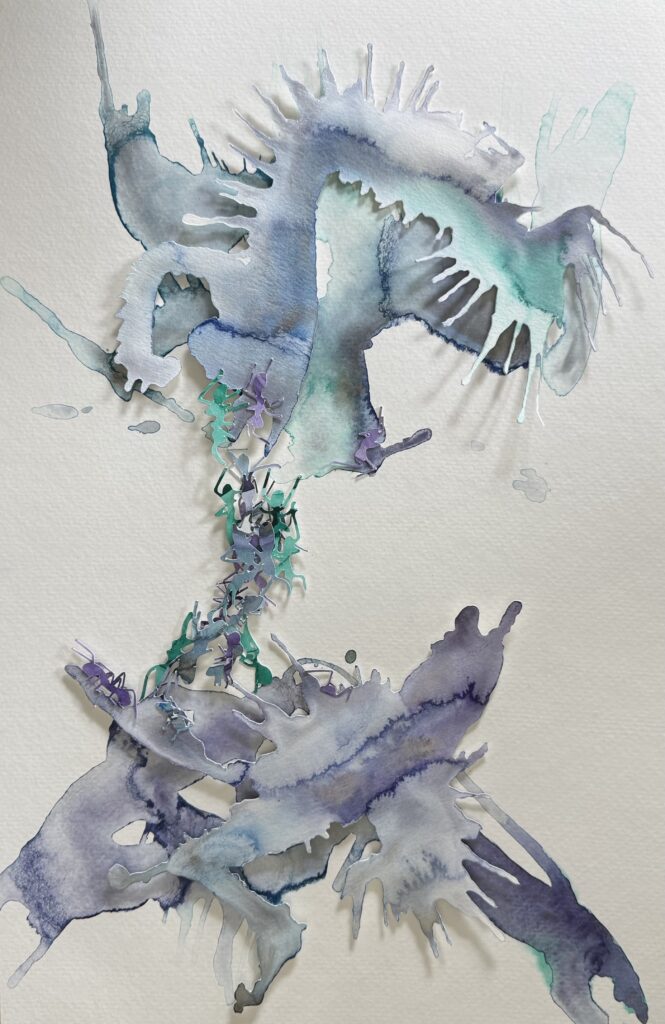
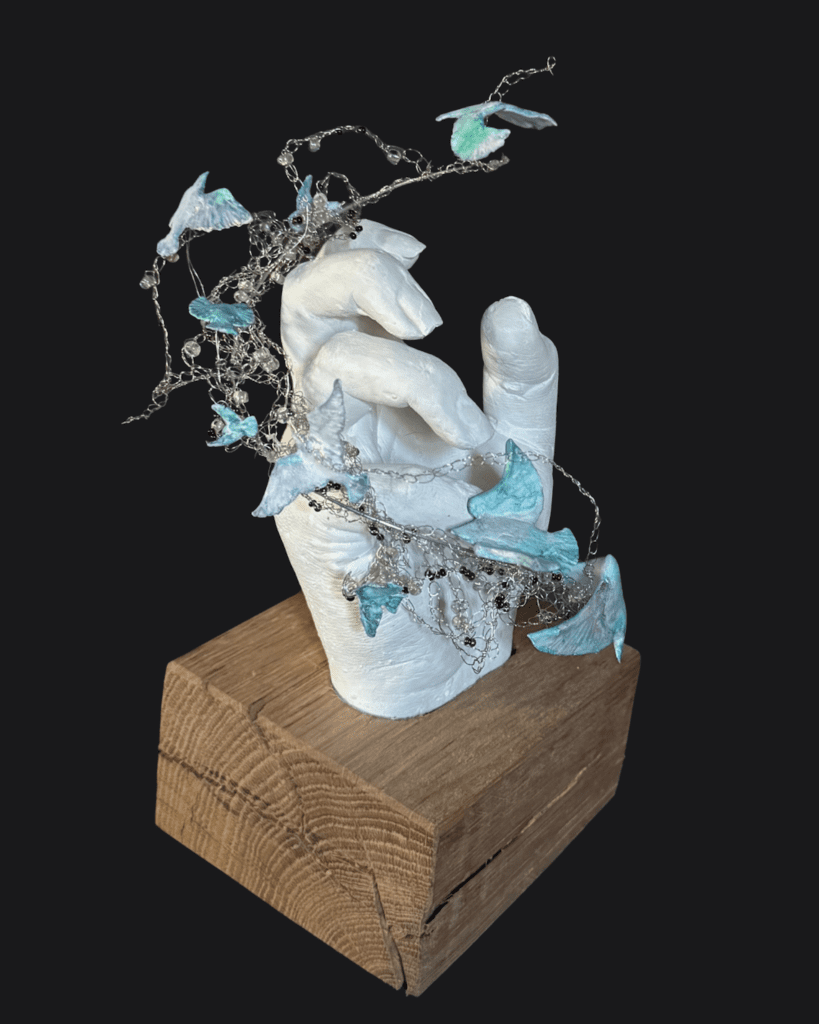
I begin by looking to the natural world for structures of care murmuration’s, root systems, ant colonies, shoals of fish—patterns that reveal how living things move, think, and survive together. Those formations become visual metaphors for the ways humans also depend on one another, even when we forget. I often incorporate faces or hands within these larger formations, almost like they’re emerging from the collective. Faces hold so much of our humanity, and hands are symbols of reaching, offering, and being in relation. The work becomes a meeting point between the ecological and the human neither one overtaking the other. I’m asking viewers to notice themselves inside these systems, not outside them. If someone sees a face within a flock of paper birds, or a hand support an ant bridge, it’s a gentle reminder: the way we care for each other is part of the same network that holds the forest, the ocean, and the sky.
Q4. Your practice seems guided by exploration rather than limitation. How do you navigate moments of uncertainty or experimentation in your creative process?
For me, uncertainty is part of the work. I have aphantasia, so I never know how a piece will come together until it’s actually doing so. Some concepts take over a year of exploration before I find the right combination of medium, scope, and technique, and others arrive almost fully formed. I try to trust the timing of each idea rather than forcing a resolution. Experimentation can be frustrating and even disappointing, but I’ve learned that those moments are often where something new becomes possible. A friend once told me to treat mistakes as if they were intentional, and that advice changed everything. Now, when something doesn’t go the way I imagined,
I don’t always start over I try reimagining the work around what just happened. Sometimes the “wrong turn” becomes the most meaningful part of the piece.
Stephanie Swilley
Q5. Several of your works have been recognized in juried exhibitions and publications. How does public acknowledgment shape your perspective on your practice, if at all?
It’s always validating to know that the work is resonating with others—especially because my priority is communicating with others. When a juror or publication recognizes something in the work, it reinforces the idea that these themes of connection and interdependence are being felt beyond my own studio. That means a lot. At the same time, I’ve never been in this for the traditional artist’s path or a particular kind of recognition. My motivation has always been about communicating something that might help people see themselves and one another more clearly. Awards and publications don’t define the work, but they do remind me that the conversation I’m trying to have is reaching people, and that’s what matters most.
Q6. Donating a portion of sales to causes like the ACLU and National Parks Conservancy suggests a link between your art and activism. How do you see your work contributing to broader societal conversations?
There’s absolutely a link. I believe deeply in the power of aesthetic force, the idea that beauty itself can shift how we think, feel, and act in the world. My work is a form of activism because it is rooted in care, reciprocity, and the belief that we belong to one another and to this planet. When I donate a portion of sales to organizations doing essential social and ecological work, it’s one way of extending that belief beyond the studio into real-world action. For me, the art is only one part of the conversation. The deeper intention is about returning to the beauty of community, shedding the narratives of late-stage capitalism and White supremacy culture that tell us we are separate or competing or unworthy. I want my work to help us remember a different way of being—a way aligned with nature, mutuality, and collective well-being. If someone encounters my work and feels even a small shift toward compassion or connection, then that is activism, too.
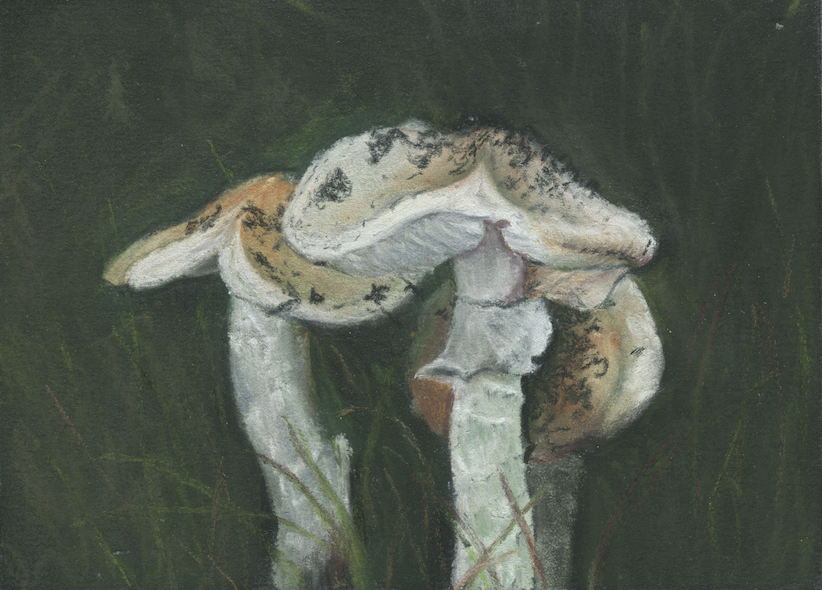
As the conversation drew to a close, I was just thinking about this question: what if art, and even our understanding of ourselves, needs to be seen differently?
Stephanie doesn’t make work to be admired from a distance. She makes it to pull you closer, to make you uncomfortable with the illusion of separation we’ve built around ourselves. Her practice is a direct challenge to the myth that we are individuals first, community second. She’s saying the opposite: we are always community. We are root systems and murmuration’s and whale pods. We just forgot.
What’s striking isn’t just her commitment to metaphor, it’s her refusal to let metaphor stay abstract. She takes the lessons nature teaches us about survival, care, and interdependence, and she translates them into visual language that forces us to confront our own isolation. When you see a face emerging from a flock of birds, it’s not poetic for poetry’s sake. It’s a mirror. It’s asking: Where do you see yourself in this system? Are you participating in care, or pretending you can exist outside of it?
There’s something radical in the way Stephanie works. She has aphantasia, she can’t visualize the final piece before she makes it. Most artists would find that terrifying. Stephanie treats it as freedom. She doesn’t impose her vision on the work. She lets the work become what it needs to be. That surrender, that trust in process over control, is the same philosophy she’s advocating for in the content of her art: let go, trust the system, participate in reciprocity instead of domination.
And here’s where her practice becomes more than just beautiful it becomes urgent. She’s not making art in a vacuum. She’s making it in a world built on extraction, competition, and the lie that we can survive alone. Her work is activism not because it preaches, but because it models a different way. It says: look at the forest, look at the flock, look at the colony this is how life actually works. Care isn’t optional. Connection isn’t soft. It’s survival.
The fact that she donates proceeds to mutual aid and environmental organizations isn’t a side note, it’s proof that she lives what she paints. Her entire practice is an ecosystem. The making, the sharing, the giving back, it’s all one gesture of care extending outward in concentric circles.
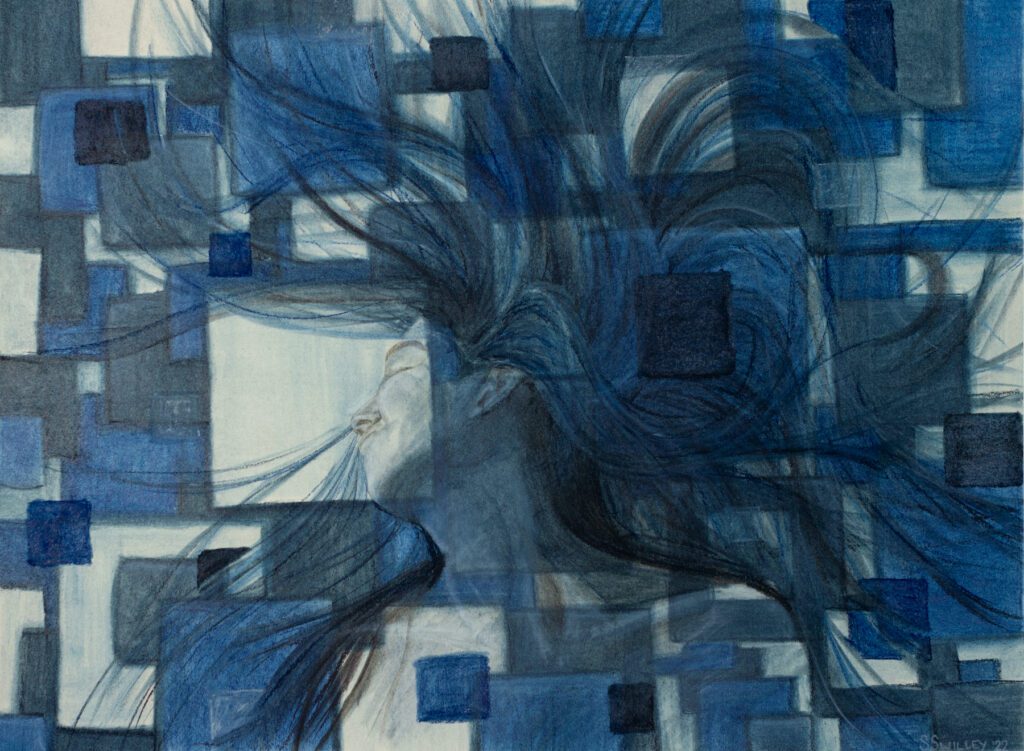
What Stephanie teaches us not through instruction, but through example, is that art doesn’t have to choose between beauty and purpose. It can be both. It should be both. And that the aesthetic force she talks about, the power of beauty to shift how we think and feel, is only as strong as our willingness to let it change us.
Her work asks us to remember something we’ve been conditioned to forget we are not separate. Not from each other, not from the earth, not from the systems that sustain us. And once we remember that everything changes, how we create, how we care, how we live.
Follow Stephanie Swilley to experience art built on care, reciprocity, and the radical idea that we are never meant to be alone.
