
How Do You Write About Women’s Lives Without Explaining Them I Cristina Jantic
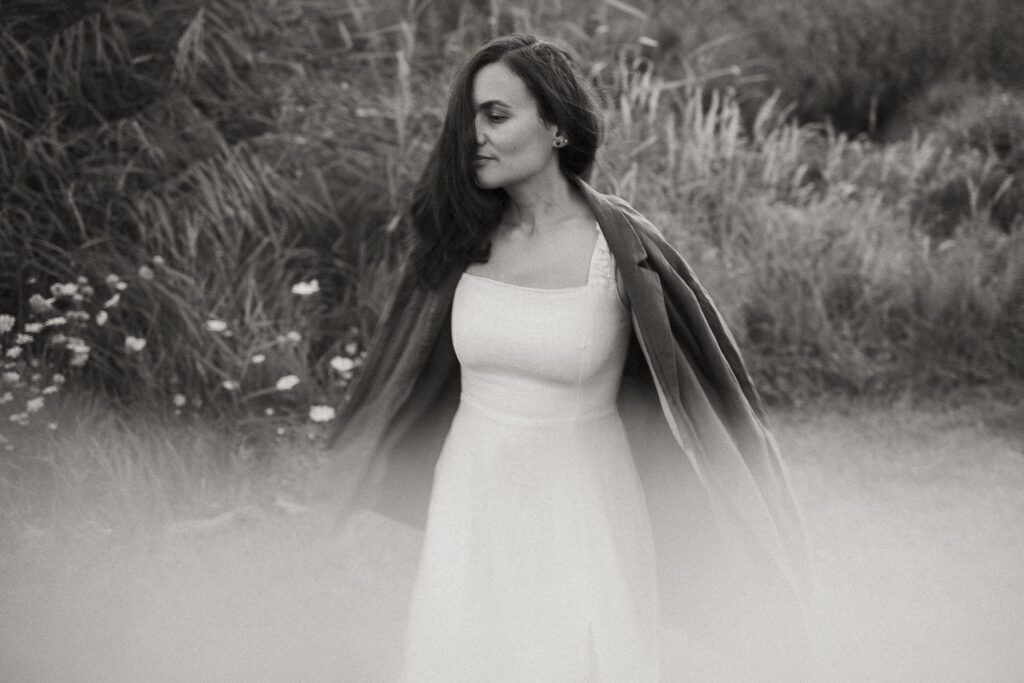
At Women in Arts Network, we’ve learned something over the years. The work that stays with you longest is almost never the loudest work in the room. For Faces, that proved true again. Because the piece that kept pulling us back wasn’t oil or acrylic or sculpture. It was digital art made in walnut tones and sepia and muted vintage greys by an artist most people would scroll right past if they weren’t paying attention. And that’s sort of the whole point of what she does.
Cristina Jantic is a selected artist for the Faces exhibition and everything about her work is a dare. A dare to slow down. A dare to actually look. A dare to feel something in a world that’s trained us to keep moving.
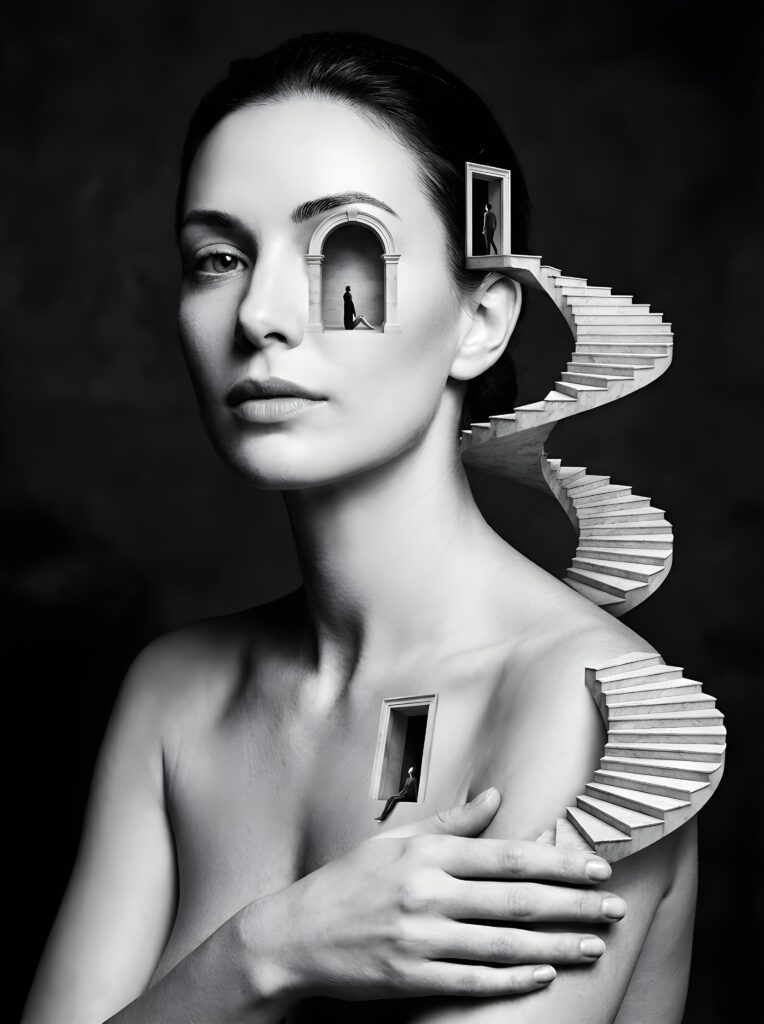
She’s a digital visual artist who works with walnut grading, black and white, sepia, muted peach, grey, and softened vintage tones. And if you think that sounds subtle you’re right. It is. Deliberately, precisely, ruthlessly subtle. Because Cristina isn’t interested in grabbing your attention. She’s interested in what happens after you give it.
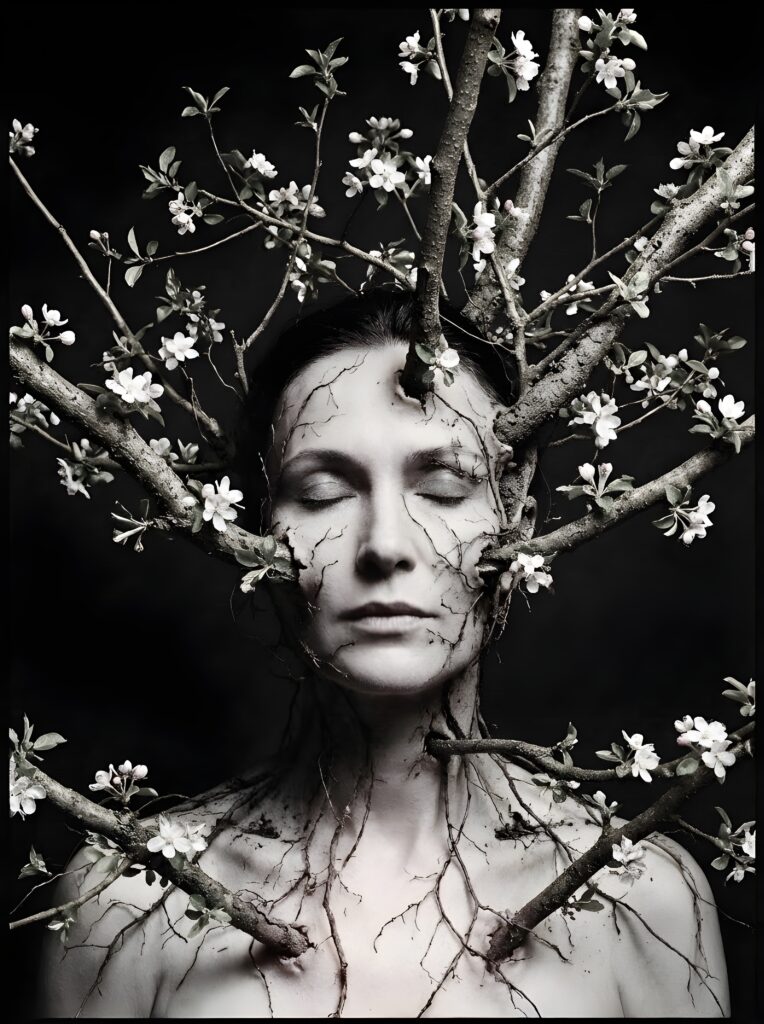
Her tones don’t shout. They settle. They slow your eyes down until you’re not looking at a screen anymore, you’re sitting inside a feeling. Walnut carries warmth and depth. Black and white strips everything back to bone. Sepia connects you to time, to history, to the long quiet line of women who carried things before you and never got to talk about it.
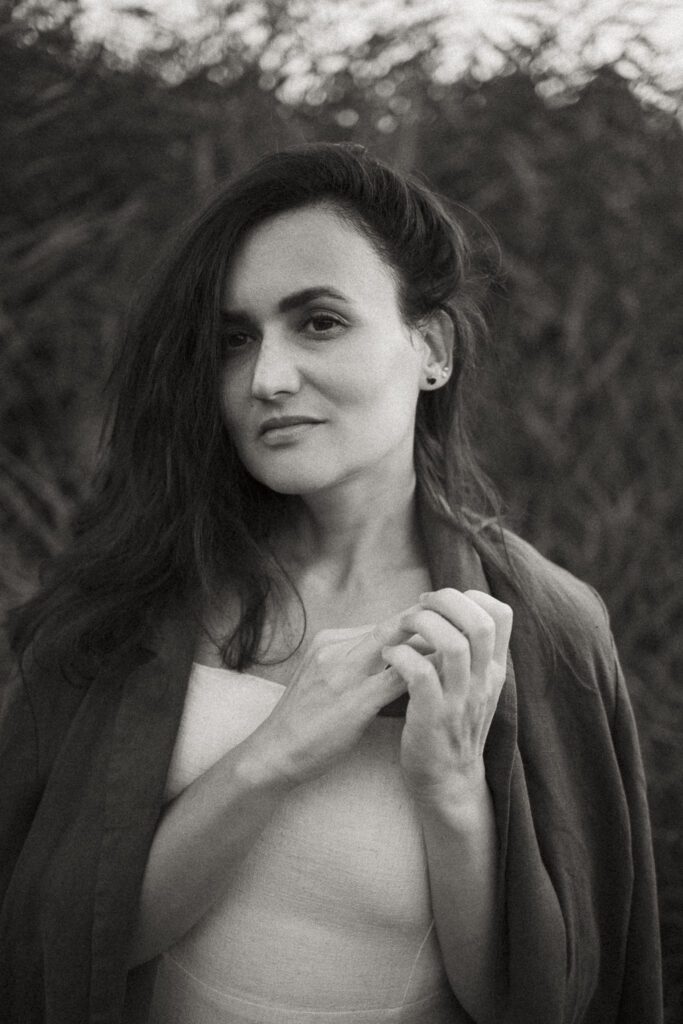
That’s what her work is about. Not women as subjects. Women as weight-bearers. The invisible emotional labour, the constant holding, the way you can spend a lifetime being strong for everyone else and slowly vanish from your own story without anyone noticing. Cristina doesn’t explain any of that. She makes you feel it through colour and tone and composition and this deliberate, almost painful restraint that leaves just enough space for your own experience to walk in and sit down.
Her visuals and her language work as one thing. Not image and text. One unified experience where the tone holds the emotion and the words give it shape and neither one exists without the other. She’s said what she creates is meant to be felt first, understood later, and carried inward rather than explained. That’s not a clever artist statement. That’s literally what happens when you spend time with her work.
She started young. Notebooks full of handwritten fragments since her teenage years, none of it meant for anyone’s eyes but her own. That raw, private practice is still the foundation. Everything begins on paper, by hand, before it moves into the digital space. She says the paper is for truth and everything after that is shaping. That honesty at the root of her process is what makes the finished work land the way it does.
Over time she started creating for other women. Specifically the ones who recognise themselves in silence, in unspoken weight, in the stuff that piles up year after year while you keep saying I’m fine. Her platform Her Books in Ink exists for that woman. The one everybody leans on and nobody leans back toward.
She told us her early work was reactive and urgent and pushed against things. Now it stands within things. Calmer. More rooted. The work holds instead of fights. And that shift is everything. Because holding is harder than pushing. Holding requires you to stay present with the heavy thing instead of throwing it. And that’s exactly what Cristina’s art asks you to do.
Now let’s hear from Cristina, about walnut ink and vintage silence, about the weight women carry without anyone seeing about digital art that feels more real than anything you can touch, and why the quietest work in any room is usually the one that follows your home.
Q1. Could you tell us a bit about your background and how your practice with ink and writing began, before Her Books in Ink took shape?
From my teenage years, writing by hand was how I stayed in dialogue with my inner world. I filled countless notebooks with poems and fragments that were never meant to be seen, they were simply responses to how I felt the world around me. Ink allowed me to slow down, to listen, to translate emotion into form without rushing toward meaning or resolution. That way of working has remained unchanged. Even today, everything begins on paper. I write first by hand, allowing thoughts and sensations to move freely and honestly. Only when a text asks for structure, clarity, and the responsibility of becoming a book do I move into the digital space. The screen is for shaping; the notebook is for truth. Over time, my work shifted from the personal to the collective. The five-book series shared on HER BOOKS IN INK is dedicated to a specific niche of women… women who recognize themselves in silence, in inner weight, in experiences that often remain unspoken. My writing today is shaped by women’s lived realities: by what has been carried quietly for generations, by emotional labor, by endurance that rarely receives language or acknowledgment. Change exists, but it unfolds slowly, and still far from where it needs to be. At the heart of my practice is a deep commitment to women’s well-being. I write for those who feel the resonance rather than seek instruction; women who recognize a genuine approach and allow themselves to be moved or inspired by it. My poems speak to the feminine inner landscape, and when they are visualized, they become something alive, a meeting point between language, body, and presence.

Q2. Your use of materials such as homemade walnut ink reflects a deep engagement with process. How did your relationship with these materials develop over time, and how do they shape your practice as a writer and visual artist?
My material and visual choices are less about technique and more about resonance. I work with walnut grading, black and white, sepia, muted peach, grey, and softened vintage tones because each message asks for its own form. I don’t approach visuals as decoration, but as an extension of the text, a way to hold the emotional weight of what is being said. These muted palettes slow the eye. They invite stillness. They create space for reflection rather than consumption. Walnut tones, in particular, carry a sense of depth and roundness, something grounded, organic, and lived-in. Black and white removes distraction. Sepia and vintage hues bring a sense of continuity, reminding us that what women carry today is connected to centuries of unspoken experience. The vintage language of the page is intentional. It reflects how women have been underestimated, overlooked, and expected to endure quietly for generations. Rooting back into these tones is a way of honoring that lineage while reclaiming it staying true to what has always been felt, even when it had no language or visibility. My writing moves in the same rhythm. It is somatic, philosophical, lyrical, and slow. It speaks through metaphor rather than instruction, through sensation rather than argument. The visuals and the words work together to underline the roundness of the feminine experience: its depth, its continuity, and its quiet power. What I create is meant to be felt first, understood later, and carried inward rather than explained.
Q3. Your art often explores the tension between “softness” and “strength.” How does that idea inform your choice of composition, gesture, and line?
For me, softness and strength are not opposites, they are in constant conversation. That tension shapes how I compose, how gesture appears, and how line is allowed to move or pause. I’m drawn to compositions that feel contained yet open, where nothing shouts, but everything holds. Space is as important as form; silence carries as much meaning as mark. Gestures in my work are rarely dramatic. They tend to be minimal, restrained, sometimes almost still. That restraint is intentional. Softness lives in the subtlety in a lowered gaze, a curved posture, a line that bends rather than cuts. Strength emerges through endurance and presence, through what remains steady rather than what asserts itself. Line plays a similar role. I avoid sharpness unless it is necessary. I’m interested in roundness, continuity, and flow lines that echo breath and bodily rhythm. When a line breaks, it does so gently, allowing space for interpretation rather than rupture. This is how strength appears in my work: not as force, but as the ability to hold complexity without collapsing into hardness. Softness, in this sense, is not fragility. It is a form of intelligence, one that listens, absorbs, and persists. Strength is what allows that softness to exist without being erased. My compositions live in that in-between, where the feminine experience unfolds with quiet authority.
Q4. As a visual artist, have you experienced a moment when the physical qualities of a material shifted the course of a piece in an unexpected way?
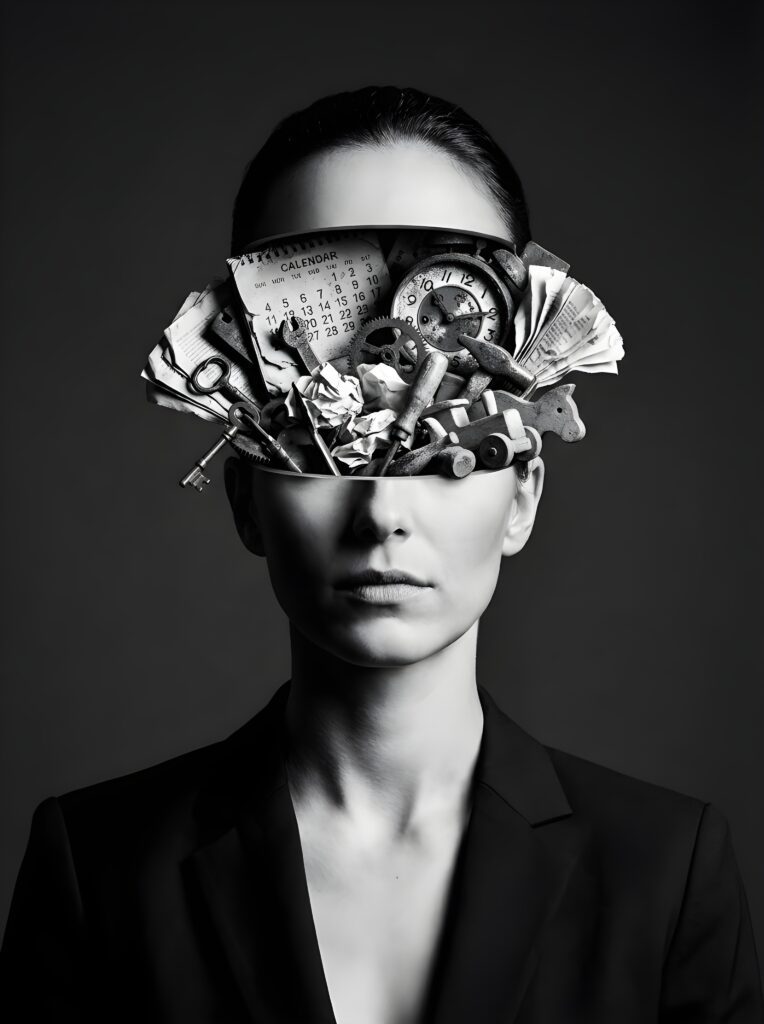
Yes, this happens often, and I’ve learned to trust it rather than correct it. I might enter the studio with a clear idea in my head: a sentence, a direction, a visual mood I think I want to follow. But once I begin writing by hand, the text often starts to move elsewhere. The rhythm changes, the words soften or deepen, and suddenly the piece asks for something different than what I planned. I’ve come to understand that this shift isn’t a mistake; it’s the moment when the work becomes honest. The same happens with visual choices. I may think I know which color grading or tone fits a piece, but while working, something feels slightly off. A shade becomes too loud, too distant, too controlled. In those moments, I allow myself to change course — to choose a different palette, a quieter contrast, a vintage softness that resonates more truthfully with the emotional wave I’m in. The final visual often surprises me, because it reflects how I felt in that precise moment rather than how I imagined the piece should look. These moments of surprise have shaped my practice deeply. They remind me that the work is not about executing an idea perfectly, but about listening to material, to emotion, to timing. When I allow the process to lead, the piece finds its own direction, one that feels alive, present, and aligned with the inner state it carries.
Q5. Many people encounter your work through social media before holding a physical book. How do you think the digital vs. tactile experience of your work affects reception?
That distance between the digital and the tactile is something I’m very aware of, and I see it as a transition rather than a loss. On social media, the work arrives first as an atmosphere. People encounter fragments: a line, a tone, a visual rhythm. It’s a more immediate, intuitive meeting. The digital space allows the emotional core to travel quickly, often reaching women who recognize the feeling before they understand why. In that sense, the screen becomes a doorway, not the destination. The tactile experience is different. Holding a physical book slows everything down. The weight of the pages, the texture, the pacing of turning from one page to the next all invite a deeper kind of presence. The words are no longer passing by; they ask to be stayed with. Meanings settle differently when the body is involved, when reading becomes a physical act rather than a fleeting encounter. I don’t see one as superior to the other. The digital experience opens the conversation; the tactile one deepens it. Social media introduces the emotional frequency of the work, while the physical book allows that frequency to root, expand, and linger. Together, they mirror how my practice works overall, moving from intuition to embodiment, from feeling to form.
Q6. Do you have rituals or habits in your studio a way of preparing materials, setting space, or orienting your mind that help you enter creative flow?
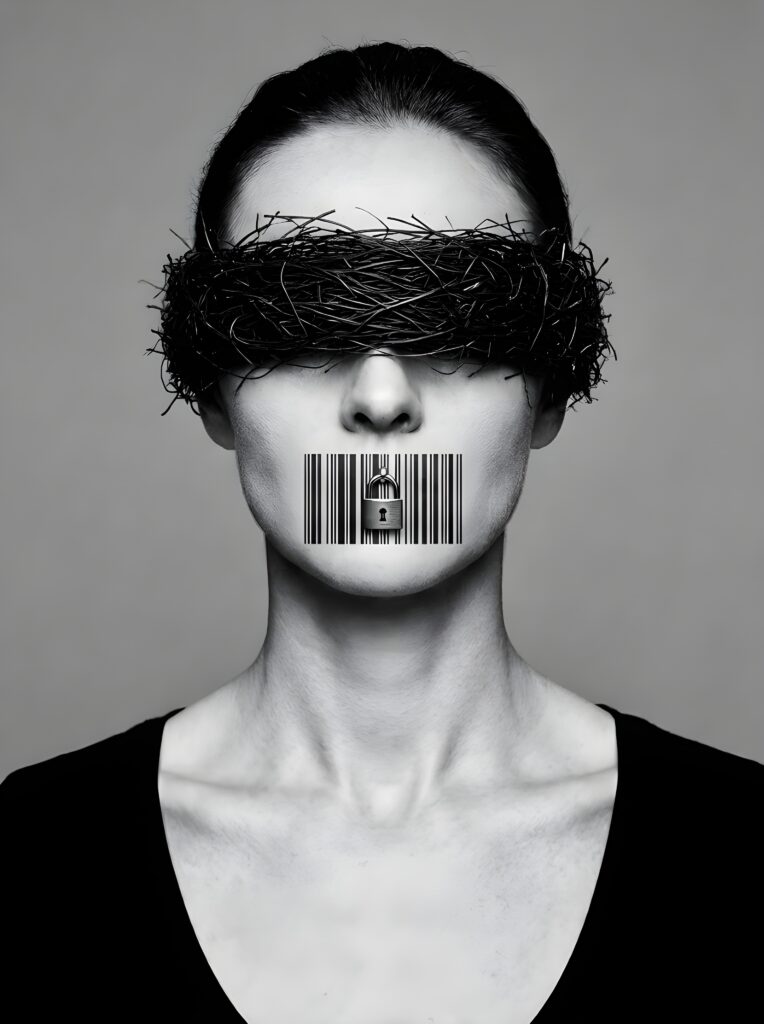
Yes, and they begin before I ever enter the work flow. I start my day with somatic yoga or Pilates, followed by a short meditation. This helps me come back into the body before moving into words or images. It grounds my attention, softens internal tension, and creates a sense of alignment that carries into the rest of the day. Only after that do I begin working usually with the window open, letting air, light, and sound remind me that the work is part of a larger rhythm, not separate from life. In the room itself, I keep things simple. I clear the surface, sit with the materials for a moment, and allow myself to arrive without urgency. I don’t believe in forcing creativity into a schedule shaped purely by productivity. Inspiration comes to me in waves, sometimes strong and immediate, sometimes quiet and delayed. I’ve learned to listen for those waves rather than push against them. When the body feels receptive, the work flows more honestly. When it doesn’t, I wait. This way of working protects the integrity of the process. It allows the writing and visuals to emerge from presence rather than pressure, and it keeps the practice connected to what it’s meant to serve: depth, truth, and a living relationship with what wants to be expressed.
Q7. Looking back at your initial creative explorations, how have your themes and material approach evolved?
When I look back at the handmade books that lived inside my notebooks, I see a different energy and a different kind of truth. Those early works were more rebellious, sometimes sarcastic, more impulsive. They carried urgency and resistance. They weren’t concerned with cohesion or longevity, they existed to release something, to challenge, to speak back. What hasn’t changed is the core language. I’ve always worked through metaphor. Even in those early pages, meaning arrived symbolically rather than directly. Lyrical thinking has been my natural way of understanding and expressing the world, long before I knew how to name it as a practice. What has shifted over time is purpose and grounding. The work no longer pushes against something; it stands within something. The gestures are calmer, the tone more deliberate. I don’t feel the need to prove intensity or depth anymore. The language trusts itself. The metaphors have more space. The work has matured into something that holds rather than reacts. Those early notebook-books still matter to me. They hold a rawness and freedom that belongs to that time. The work I make now carries that same poetic philosophy, but with a steadiness that comes from experience, less reactive, more rooted, and oriented toward continuity rather than expression alone.
Q8. What creative questions or uncertainties are you currently exploring themes or processes that feel unresolved or open?
Lately, the questions that stay with me are less about form and more about weight, the kind that accumulates quietly over time. I keep returning to women’s lives as they are actually lived: the constant holding, the layering of roles, the expectations that ask for adaptability at the cost of self-recognition. I’m sitting with the reality that inequality hasn’t disappeared; it has simply changed its language. In many places in the world, women are still underappreciated, underprotected, and expected to carry responsibility without visibility or acknowledgment. Even where progress exists, the pressure to be everything: capable, available, emotionally stable, productive, nurturing remains heavy. What feels unresolved to me is how easily a woman can lose contact with herself while meeting these expectations, how normal that disappearance has become. In my work, I’m exploring what it means to stay present inside that weight rather than escape it or aestheticize it. How does a woman remain intact while holding so much? Where does identity live when it is constantly shaped by what is needed rather than what is true? These are not questions I’m trying to answer definitively. They are questions I return to again and again, allowing them to inform the tone, the pace, and the restraint of the work. What feels most alive right now is this tension between endurance and self-erasure and the quiet, often invisible effort it takes for women to remain rooted in themselves within systems that still ask them to bend first. I’m less interested in resolution than in staying with that complexity, giving it language, image, and space to be felt rather than solved.
Q9. What advice would you give to emerging artists who want to make thoughtful, tactile work that invites attention and reflection in a world moving ever faster?
I would encourage them to stay close to themselves before trying to reach outward. Thoughtful, tactile work doesn’t come from speed or visibility; it comes from listening, to the body, to intuition, to what keeps returning quietly even when no one is watching. Not every message is meant for everyone. Trying to please the masses often flattens the very qualities that make work resonant. What matters more is staying rooted in one’s own rhythm and uniqueness, trusting that the work will find the people who truly need it. Depth has its own way of traveling. Following your gut is not a romantic idea; it’s a practical one. It protects integrity. It allows the work to grow organically rather than being shaped by external demand. In a world that moves fast, choosing slowness, care, and presence is already a form of resistance. The most meaningful work doesn’t ask for attention, it invites it. And that invitation becomes possible when an artist remains honest, patient, and faithful to their own inner language.
As our conversation with Cristina drew to a close, we kept thinking about all the women who are going to see her work and feel something crack open that they’ve been holding shut for years.
Because that’s what Cristina does. She doesn’t make art that tells women what they’re feeling. She makes art that shows them they were right about what they already knew. That the weight was real. That the carrying was real. That the years of showing up and holding it together and smiling through it and never once being asked how are you actually doing, all of that was real. And someone finally made it visible.
And honestly that visibility is everything. Because the most exhausting part of carrying something heavy isn’t the weight itself. It’s carrying it while everyone around you acts like it doesn’t exist. It’s doing it so gracefully that people mistake your survival for ease. Cristina’s work breaks that illusion. Gently. Quietly. In walnut tones and sepia and muted greys that don’t shout but won’t let you look away either.
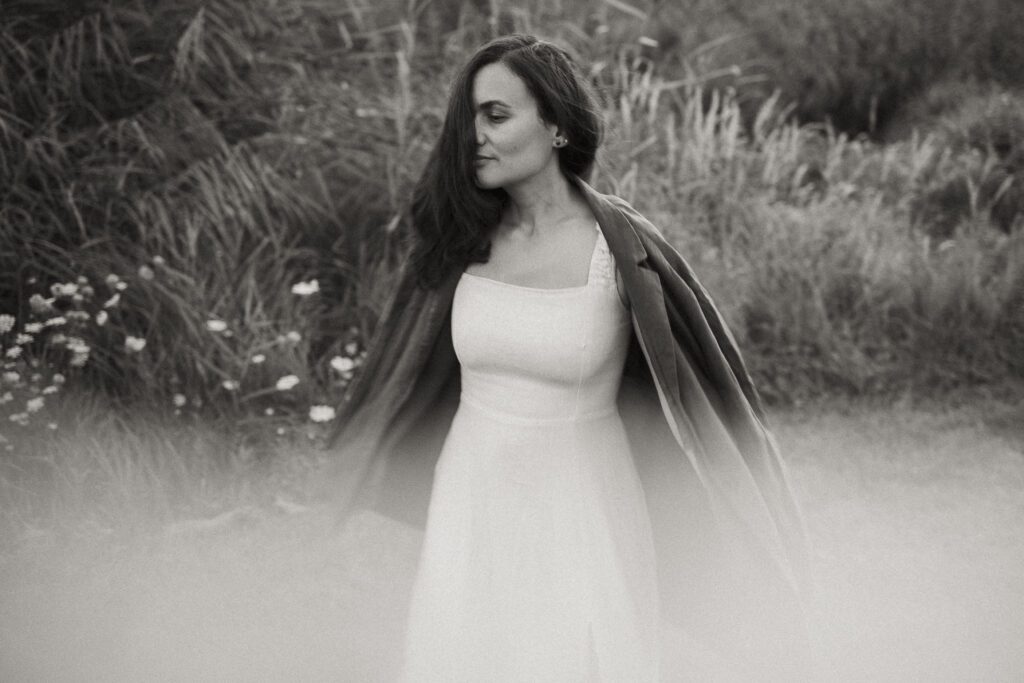
There’s something deeply powerful about an artist who chooses to honour what women carry instead of explaining it. Who trusts that the feeling is enough. Who creates space where a woman can look at a piece of art and for the first time in a long time feel genuinely seen. Not analysed. Not celebrated in some generic empowerment poster way. Seen. The way you feel seen when someone looks at you and just knows without you having to say a single word.
She told us her early work used to push against things. It was urgent and reactive and rebellious. And now it holds. And that shift matters more than she probably realises. Because that’s what women do isn’t it. We start out fighting. Fighting to be heard, fighting to be seen, fighting to be taken seriously. And then at some point, if we’re lucky, we stop fighting and start holding. Holding ourselves. Holding each other. Holding space for the truth of what our lives actually look like when nobody’s performing.
If Cristina’s work reminds us of anything it’s that women don’t need louder art. They need art that’s honest enough to sit in the silence with them. Art that doesn’t try to fix the weight or explain the weight or turn the weight into something inspirational. Art that just says I see it. I feel it. You’re not making it up. And you never were.
To follow Cristina’s journey and see more of her work, find her through the links below.
