
How painting flowers & boats in her sketchbook became Reihaneh Shahali way back to herself
At Women in Arts Network, for our Landscapes and Places exhibition, we received work filled with grand scenery, dramatic skies, and carefully painted locations from around the world. And then there are artists who approach place more quietly. Artists who understand that sometimes what people connect to most is not the scale of a landscape, but the feeling of being inside it.
That’s what stayed with us when we came across this work. She is a selected artist for the Landscapes and Places exhibition, and her paintings carry a kind of softness that feels lived in rather than staged. Old streets, boats resting near the water, figures beneath cherry blossoms, flowers left open enough for the paper to breathe around them. Nothing feels forced to impress you immediately. The work unfolds slowly.
And maybe that comes from the way painting entered her life in the first place. Although she works professionally as a software developer, art has quietly stayed beside her for years. As a child she took art classes, experimented with different mediums, and kept returning to creativity whenever life allowed space for it.
But it wasn’t until after university, in 2020, that she decided to truly take painting seriously. A small but important moment came when her husband gifted her her first watercolor palette, the same one she still keeps today. That gift became the beginning of something much larger.
Since then, watercolour has become her language. Not because it allows control, but because it doesn’t. She understands that watercolour works best when you stop trying to overpower it. The white space matters as much as the paint itself. The atmosphere matters more than perfection. And over time, her work has shifted from focusing on technique to focusing on feeling.
That shift changes everything. Because when you look at her paintings now, what stays with you isn’t just the location. It’s the mood. The sense of calm in a quiet street. The warmth of figures standing together. The feeling that you’ve somehow been in this moment before, even if you haven’t.
Now let’s hear from her, about sketchbooks and city streets, about watercolor and letting the paper breathe, and about why the paintings people connect to most are often the ones that leave room for their own stories inside them.
Q1. Can you share your background and the path that eventually led you toward art? Were there particular moments, environments, or people in your life that quietly shaped your creative instincts early on?
Although I work as a software developer, art has always been a passion of mine. As a child, I took many art classes and experimented with different techniques and mediums, but it remained a hobby for many years. In 2020, after graduating from university, I decided to take my interest in art more seriously and began focusing on watercolor. A special turning point was when my husband gifted me my first watercolor palette – one I still keep today – which encouraged me to pursue my dream. From then on, I started taking classes, learning through videos, and sharing my artwork and progress.
Q2. You paint a real range of subjects old European streets, figures, flowers, boats, landscapes. Is there a thread that connects all of those for you, or do you just follow whatever catches your eye?
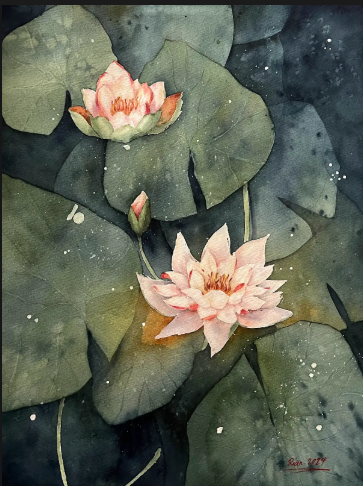
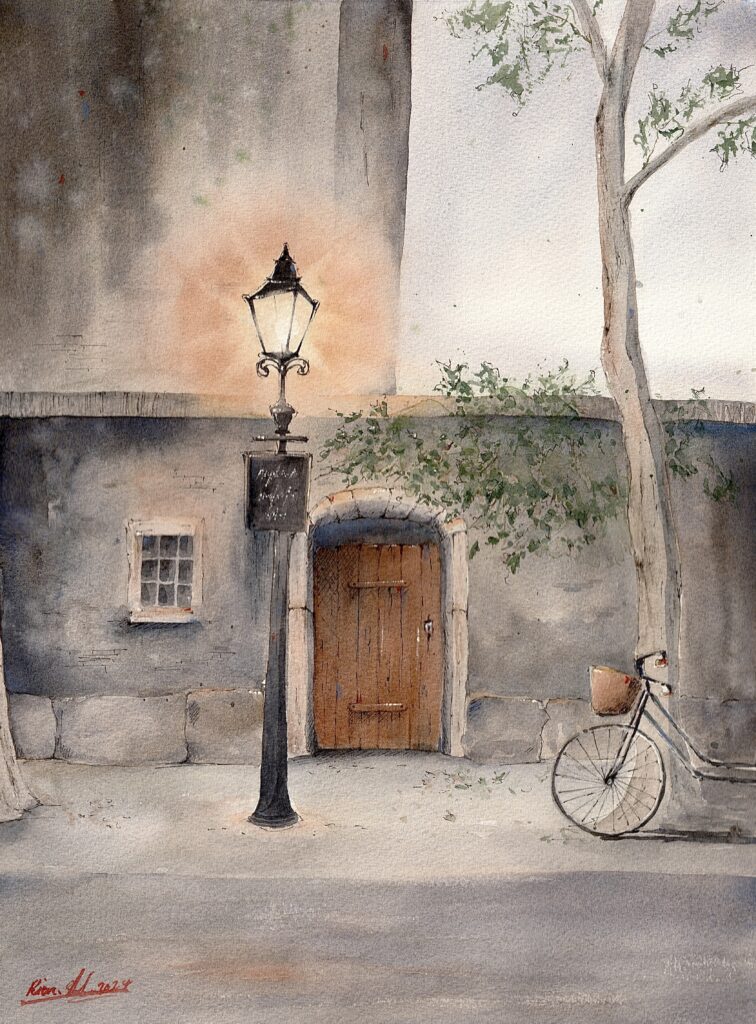
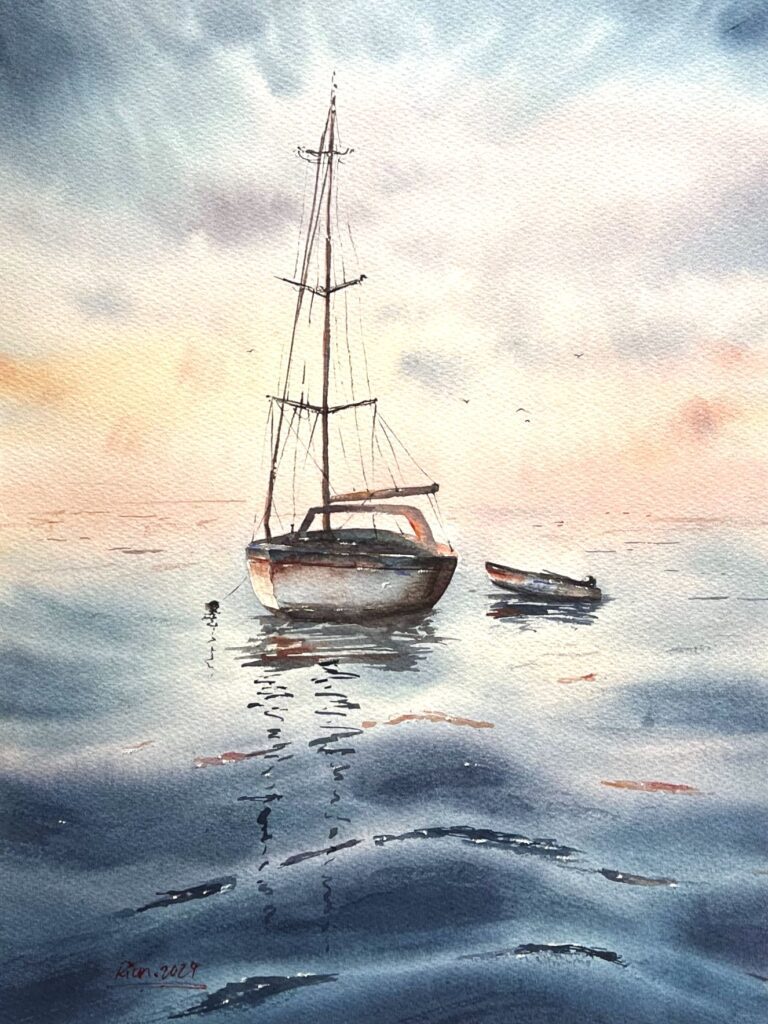
I like to challenge myself by painting a variety of subjects. My comfort zone is usually flowers and boats. They feel calming and allow my mind to relax. Cityscapes help me practice composition and perspective, and adding figures brings life and meaning to a painting. I don’t feel the need to choose only one path. Exploring different subjects keeps the process exciting, and I enjoy the experiences that come from trying new things.
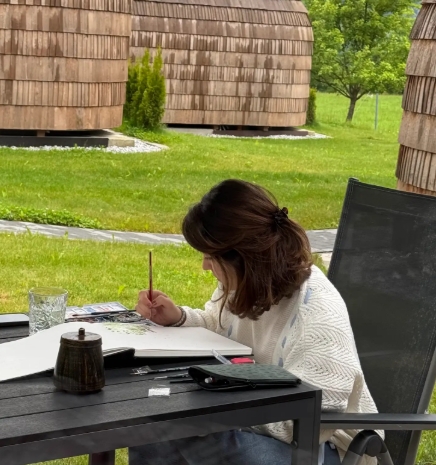
Q3. You seem to work a lot from your sketchbook, painting on location or from life. What does painting in a sketchbook give you that working on a full sheet at a desk doesn’t?
I enjoy both approaches, and it often depends on my mood and the time I have. When I feel confident and ready for a challenge, I like to work on a larger sheet and fully commit to the painting. At other times, especially when my schedule is busy, my sketchbook becomes the perfect place to keep practicing, capturing ideas, and staying connected to painting.
Q4. Your figurative work like the couple under the cherry blossoms or the woman by the window feels more emotional than your landscapes. Do figures ask something different from you as a painter?
I believe figures bring a special sense of life to a painting. While landscapes can be beautiful on their own, adding figures often helps viewers connect more emotionally to the scene. People can imagine themselves in that moment or create a story around what they see. Figures make a painting feel alive, they give viewers something to relate to, something to talk about, and a way to step into the world of the painting.
Q5. Could you walk us through a typical sketching or painting session? What does that creative moment look like from the first mark on the page to the final layer of color?
It usually starts with an idea or a feeling I want to capture. I then look for inspiring photos to help me find the right mood and atmosphere. Sometimes I make a small overall sketch to explore the composition before moving on to the main drawing. Once the sketch is ready, I begin painting. Because I work with watercolor, the painting process itself is often quite quick. In many ways, the preparation – finding the idea, mood, and composition – is the most time-consuming part of the whole process.
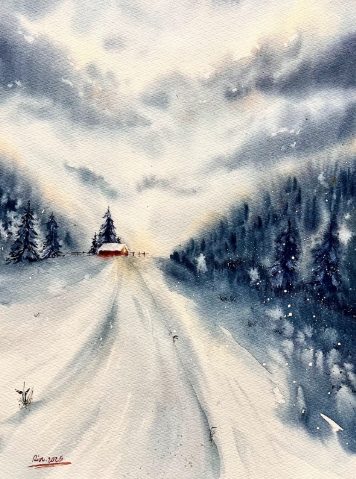
Q6. Colour plays a big role in your work, but you also let the paper breathe a lot. How do you know when to stop when there’s enough paint and enough white space?
This is actually one of the hardest parts of watercolor. I try to be very careful when adding details, because watercolor needs space to do its own magic. Too much control or too many details can easily take away the freshness of a painting. To decide when to stop, I try to step back and look at the whole painting rather than focusing on small areas. Viewing it from a distance helps me see the balance between color and white space, and that usually tells me when the painting has enough.
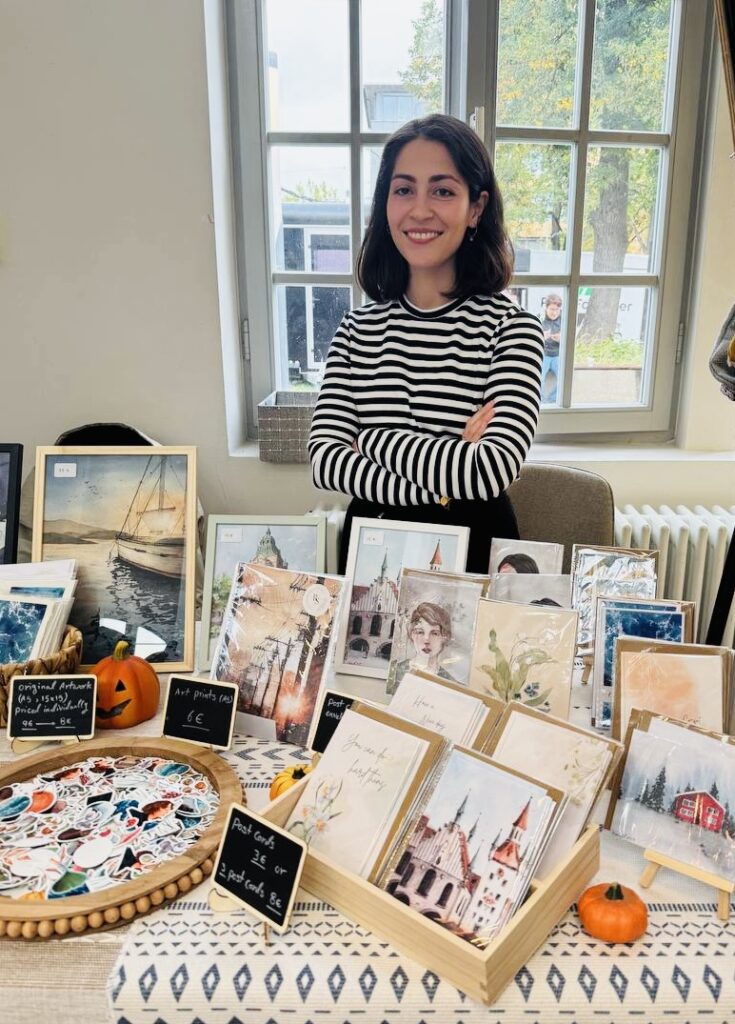
Q7. You show your work at local art markets like the Kunst & Design Markt in Nuremberg. What’s it like standing next to your paintings while strangers react to them in real time?
It’s both fascinating and a little nerve-racking at the same time. When you stand next to your paintings, you see people’s reactions immediately. Some people are drawn to the work and take time to look closely, others admire it, and sometimes people simply pass by without noticing it. But the most rewarding moments are when someone truly connects with a painting.
Seeing that reaction in real time – when a piece speaks to someone – is a very special feeling.
Q8. When someone buys a print of your work and hangs it in their home, do you think about what that painting means to them versus what it meant to you while making it?
That’s one of the most magical things about art. Sometimes people see something in a painting that I never expected, and it shows how differently everyone connects with an image. I once had a customer who bought a painting of two birds at the market. Later, she messaged me to order another bird painting for her newborn baby. It was beautiful to realize that she saw her family reflected in my artwork. Moments like that make sharing art feel very special.
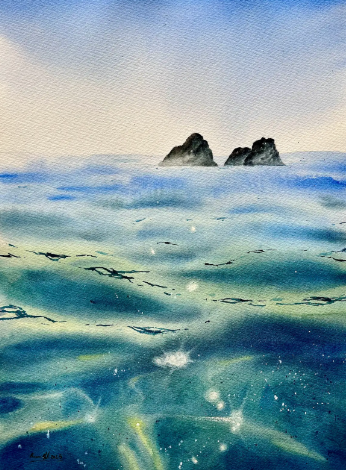
Q9. When you look back at your earlier work, what differences do you notice not just technically, but emotionally or conceptually?
When I look back at my earlier work, I notice that I was much more focused on technique, trying to control the medium and improve my skills. Over time, my focus has shifted. Now I think more about the mood of a painting and the feeling I want it to create when it’s finished. The emotional atmosphere has become more important to me than perfect technique.
Q10. Artists often go through periods of doubt or creative block. How do you navigate those moments when inspiration feels distant?
When this happens, I try not to force it. I believe it’s important to give myself time to rest and step back for a while. I want painting to remain something that feels joyful and natural, not something that comes with pressure. Usually, after taking a little break, the inspiration returns on its own.
Q11. If you could speak to your younger self who was just beginning to draw in a sketchbook, what advice or reassurance would you give them today?
I would tell her not to compare herself to others, but instead to focus on her own progress. The most meaningful comparison is with who you were yesterday. Growth happens slowly, and what really matters is continuing to learn and improve in your own way.
As our conversation drew to a close, we found ourselves thinking about the quietness of her work.
Not quiet in the sense of being small, but quiet in the way certain places stay with you long after you’ve left them. A street you walked through once. Light coming through a window at the right time of day. The feeling of sitting somewhere peaceful without realizing, in the moment, that you’d remember it later.
Her paintings carry that kind of feeling. And maybe that’s why people connect to them so personally. Because she leaves space for them to. The figures aren’t overexplained. The landscapes aren’t overcrowded with detail. The watercolor is allowed to breathe, and because of that, the viewer gets to enter the painting instead of just looking at it.
We kept thinking about the story she shared of someone buying a bird painting because it reminded them of their family. That says everything, really. Once a painting leaves the artist, it starts becoming part of someone else’s life. Someone else’s memory. Someone else’s home. And her work feels made for that kind of living.
For collectors or anyone building a home with art inside it, these are the kinds of paintings that settle into a space naturally. They don’t overwhelm a room. They soften it. You notice different things depending on the day you’ve had or the mood you’re in. Sometimes it’s the colour. Sometimes it’s the stillness. Sometimes it’s simply the feeling that the painting gives you somewhere calm to return to.
That kind of work lasts longer than trends do. And artists who understand atmosphere this intuitively, who know how to create emotion without forcing it, are always worth paying attention to.
To follow her journey and see more of her work, find her through the links below.
