
Alexa Kleinbard’s large-scale oil paintings bring every species of a habitat into one emerald composition
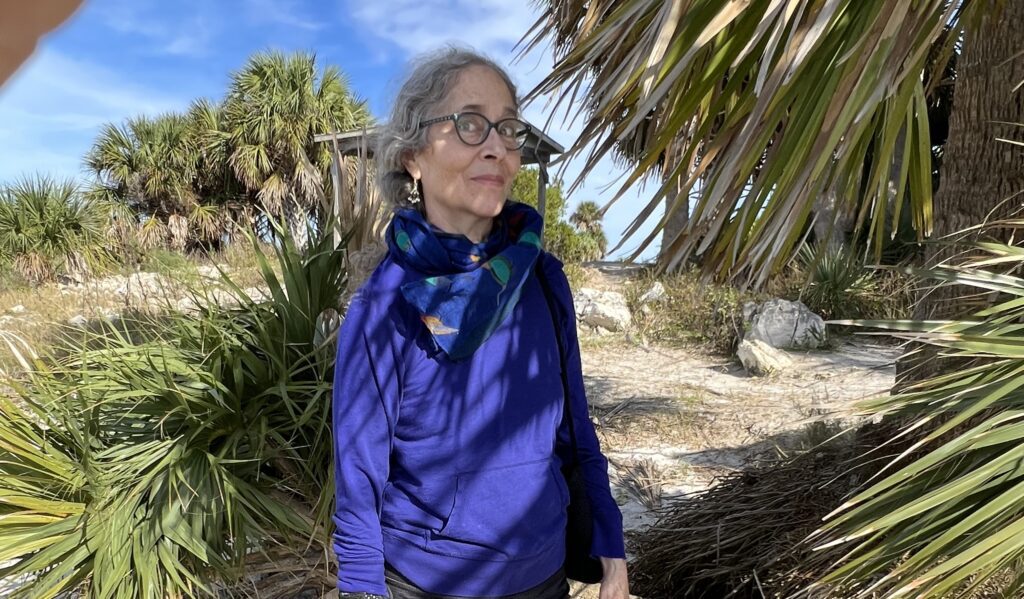
At Women in Arts Network, Flora and Fauna introduced us to artists whose work reminds us that nature is never made up of isolated parts. Every flower, bird, insect, tree, and stream exists within a larger web of relationships, each depending on the other to thrive.
Alexa Kleinbard is one of the selected artists whose vibrant paintings celebrate that interconnectedness, transforming forests, wetlands, and wild landscapes into living ecosystems filled with movement, colour, and hope.
For more than four decades, Alexa has been painting the natural world not simply as a collection of plants and animals, but as a living community where every species plays a role. Her large, immersive paintings are filled with native flowers, pollinators, birds, mammals, waterways, and ancient trees, each woven together to reflect the delicate relationships that allow ecosystems to thrive.
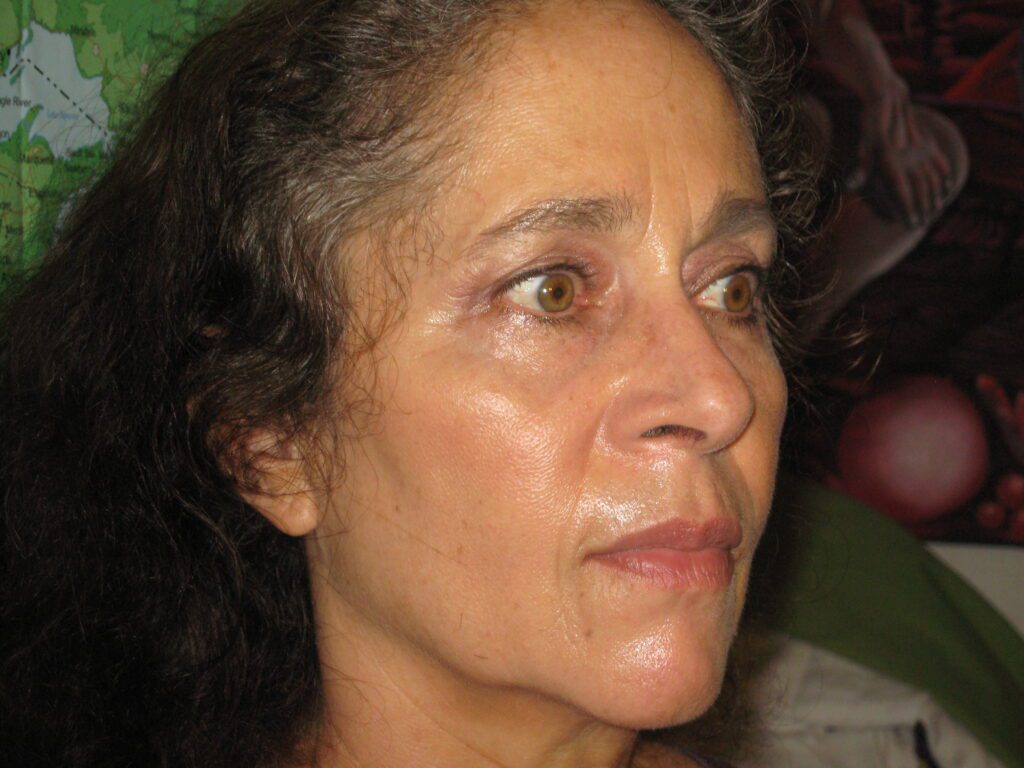
That way of seeing the world didn’t begin in the studio. It began in childhood, surrounded by gardens, beehives, migrating birds, and open fields, where she spent hours watching bees move from flower to flower and listening as her father introduced her to the plants growing around them.
Those early experiences taught her to see nature as a place where everything is connected, a belief that continues to shape every painting she creates.
Before beginning a new body of work, Alexa spends time researching habitats, visiting forests and wetlands, and filling sketchbooks with observations of the plants and wildlife she encounters.
Rather than focusing on individual species, she builds entire ecosystems on the canvas, inviting viewers to experience nature as a living network where every flower, insect, bird, and tree contributes to the health of the whole.
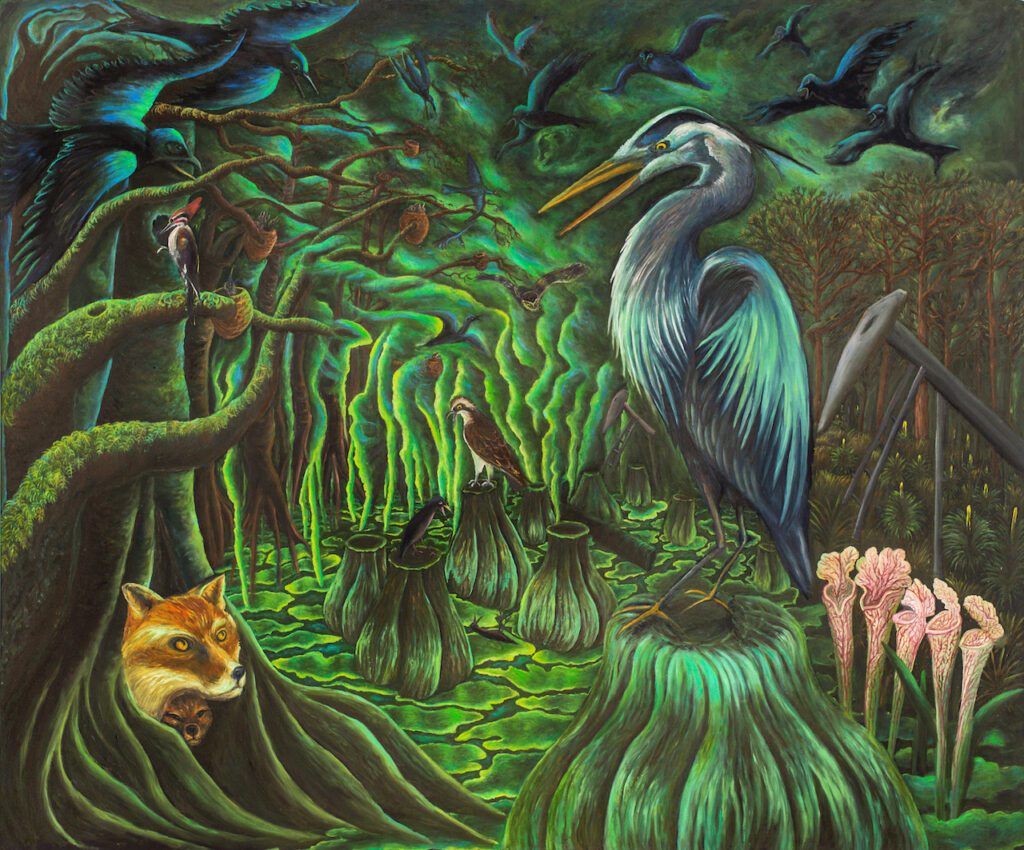
While environmental concerns remain central to her practice, Alexa chooses to communicate through beauty rather than fear. Her luminous colours and dreamlike landscapes celebrate what still exists and what is still worth protecting.
She believes that when people form an emotional connection with the natural world, they become far more willing to care for it. Through her paintings, she hopes not only to inspire admiration but also to encourage a deeper sense of responsibility for the living world we all share.
Now, let’s get to know Alexa Kleinbard through our conversation about biodiversity, environmental stewardship, forests, wildlife, and the enduring power of art to inspire care for nature.
Q1. Alexa, can you share a little about your journey and what first inspired your connection with nature?
On our 4 acres of rolling land we had bee hives my brother managed and huge flower and vegetable gardens we all loved. As a child I would watch the bees go flower to flower buzzing and wiggling. I loved to watch the butterflies lighting onto all the flowers also. My other early memories are of smelling the different flowers and my father telling me their names. These were my earliest memories of the natural world that led me to make little nature stories.
Q2. Was your connection to plants, animals, and the land something you inherited, or did it grow over time?
I believe my father’s love of flowers and following him in the gardens created in me my love of the natural world. We also had so many different animals and flocks of birds land on our fields. Back then deer, pheasants, grouse, raccoons, and migrations of robins and other migratory birds covered our fields. I would cut their shapes out of cloth and make stories.
Q3. Your work uses beauty to explore environmental issues. Why is beauty important to that conversation?
There is so much beauty in the natural world. I always aim to show the incredible glowing gorgeousness of what we must protect in the garden of biodiversity. We are one with nature. We are of Mother Earth and all the life here on earth. Our greatest mission should be to protect our mother and all she has brought forth.
I feel people are more likely to vote to protect their environment if the life in means something to them through its natural beauty and its importance for their living healthy lives. If you pollute your land and water it not only harms all of nature but it hurts humans causing cancer and other diseases. If you over develop you hurt your environment too.
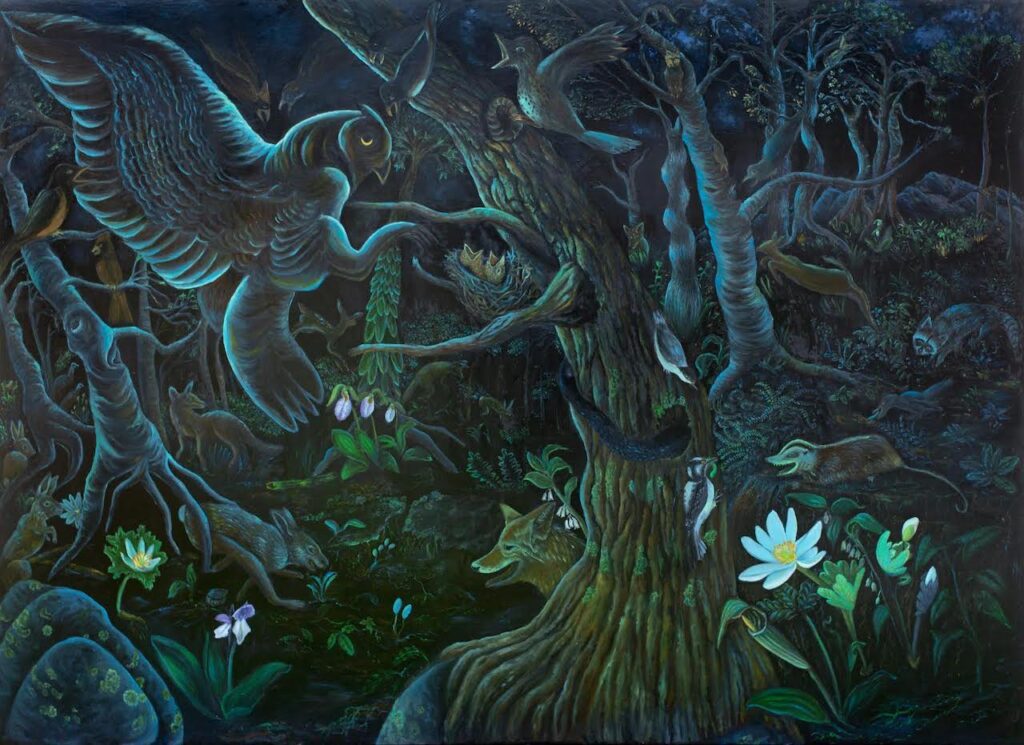
Q4. Birds, flowers, and other wildlife often appear together in your work. Why is it important to show nature as an interconnected whole?
I research through reading and being out in the natural world specific habitats with all their attending species that envelop and become the narrative of the space they are in. I want the viewer to experience the energy and connection of all life in that environment.
With this hopefully the viewer will be moved to feel the electricity of all life, flowers , medicinal and native species and wildlife, insects to birds and want to preserve their habitats restricting development which causes extreme loss for these species.
Q5. You spend a great deal of time observing forests, wetlands, and mountains. How does being in those places shape your paintings?
I do many studies of specific environments before starting usually doing many drawings. They will then become part of a finished drawing which becomes the basis for the final painting. I always start with a series like TWILIGHT IN THE GARDEN. I will work on it till I feel the series is completed. Then another catalyst like listening to the returning migrations in the mountains puts a new body of paintings.
Q6. In works like Sanctuary of the Mother Tree, trees feel like living communities. What draws you to that idea?
I have read so much about how trees protect their communities in the forest especially how the mother trees watch out for their forests. Native peoples learned by watching the trees in the forest. The early indigenous peoples were maternal cultures with the earliest democracies. They learned if you protect your communities, they will stand stronger.
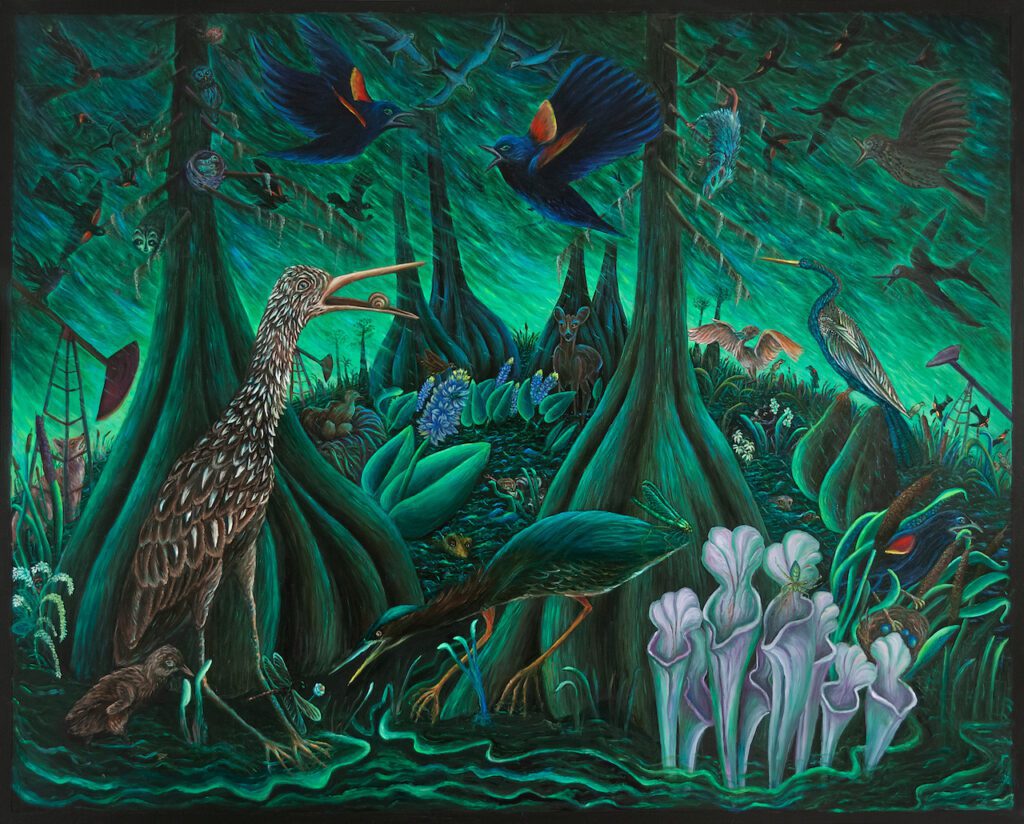
Q7. Your paintings suggest that all life is connected. Why do you think people still struggle to see themselves as part of nature?
Many humans unfortunately have big egos that make them want power over others. This is more male dominance. They, like the men in power, now want to make more and more money They only care about being rich and powerful. They allow chemical companies to pollute our air and water and kill all wildlife by taking over forests and selling our national parks to the highest bidder. They don’t care about the natural world only what makes them more money and power.
Q8. Do you think people protect what they love, or do they first need to understand it before they can love it?
I think some people protect what they love and others have to be taught.
Q9. Has the art world become more engaged with environmental issues in recent years?
It clear to me more artists feel the danger in the world today as we loose more and more biodiversity. It’s alarming. We have to elect good stewards of our environment. I believe we have to raise the alarm!
Q10. After years of advocating for nature through art, what still makes you believe creativity can inspire change?
Throughout history early times until today artists have inspired change through their works. One can go through history in our museums and find great art that created change through their art, writing and music.
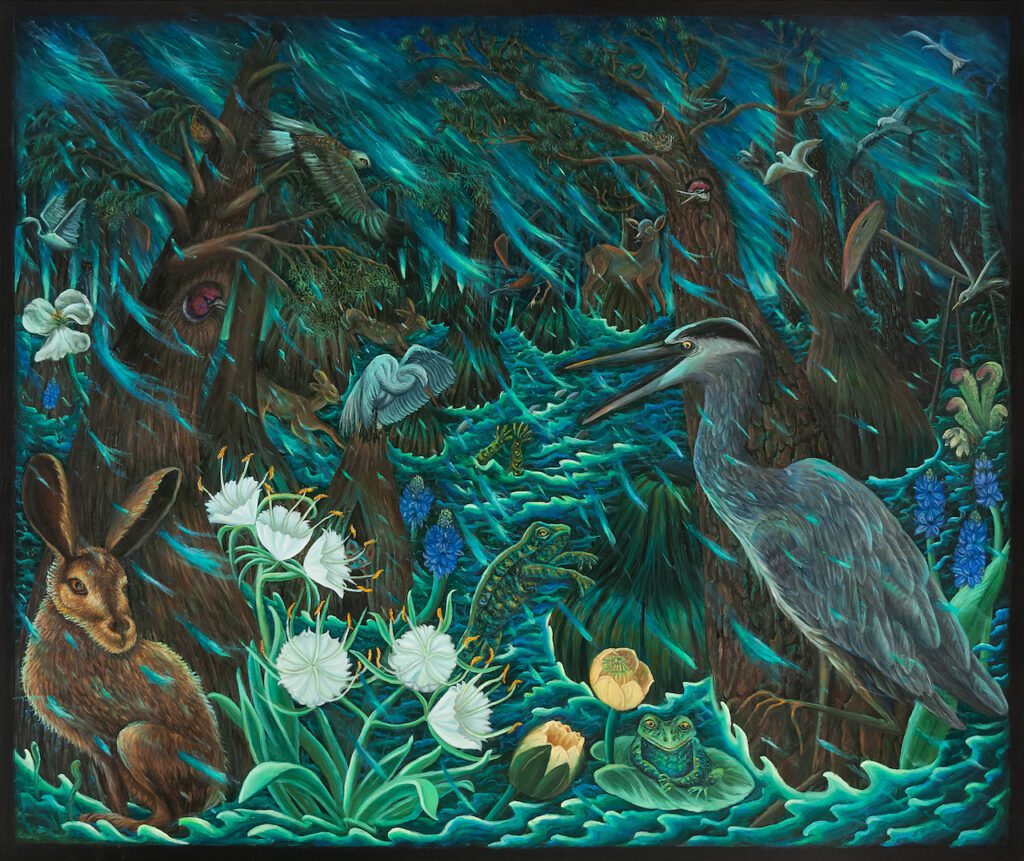
Q11. Has your definition of success become more about impact than recognition?
My definition of success is connected to works that inspire people to see the living world.
Q12. Looking back at your younger self, what would surprise her most about the artist you’ve become today?
I think she would be surprised how alive her work has become as a living painting.
Q13. What gives you hope when creating work about habitats and species that are under threat?
What gives me the most hope is when I show my work and talk to audiences people really are moved and they care about preserving and protecting the environment. They understand that who they vote for locally and nationally makes a huge difference.
Q14. What advice would you give artists who want their work to inspire change while remaining beautiful and hopeful?
My advice to emerging artists is to follow their hearts for what they care deeply about, and try to make something that people want to protect.
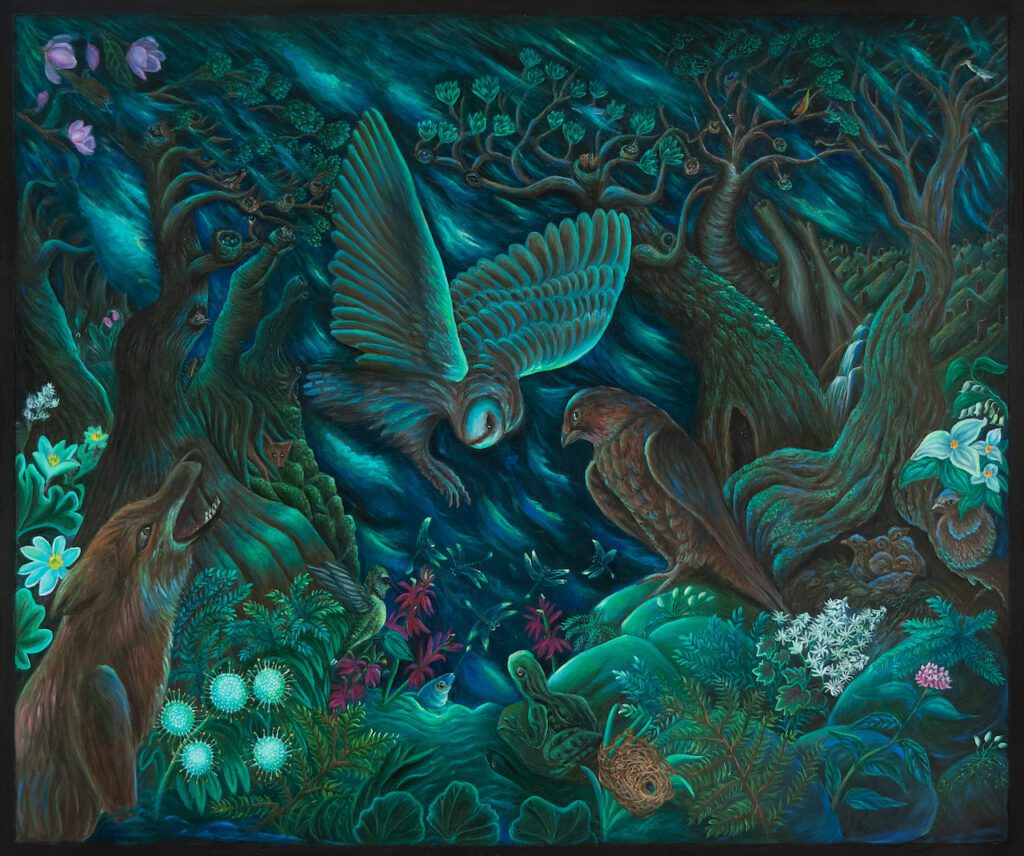
As our conversation with Alexa came to a close, we found ourselves thinking about the word belonging. Nature has never been a collection of separate parts. Every ecosystem is built on relationships, between trees and fungi, flowers and pollinators, rivers and forests, birds and the habitats they depend on.
Remove one piece, and countless others begin to change with it. The more we learn about the natural world, the more we realise that its greatest strength lies in connection.
Perhaps there is something we can learn from that. Modern life often encourages us to think in terms of individuals, but nature constantly reminds us that survival has always been a shared effort. Nothing thrives alone. Every living thing contributes to something larger than itself, creating a balance that has taken thousands of years to evolve.
That idea runs quietly through Alexa’s work. Her paintings don’t ask us to admire a single flower or a single bird in isolation. Instead, they invite us into living communities where every species has a place and every form of life matters.
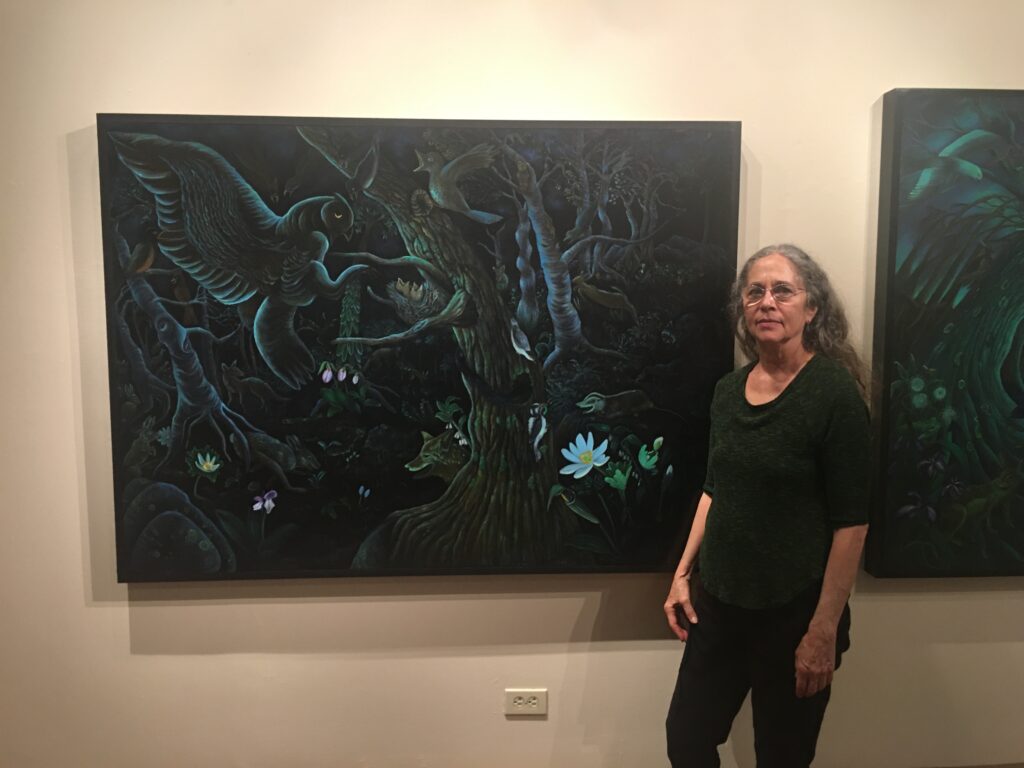
The more time you spend with her paintings, the more those connections begin to reveal themselves, encouraging you to move through the composition the same way you might move through a thriving forest discovering something new with every glance.
There is also something hopeful about choosing beauty as a starting point. Environmental conversations are often shaped by urgency, and rightly so. But beauty has its own remarkable ability to inspire care. When we form an emotional connection with a place, we begin to value it differently. We don’t protect only what we understand we also protect what we have learned to love.
For collectors and art lovers, Alexa’s paintings offer more than vibrant celebrations of biodiversity. They become reminders that nature is alive with relationships we are part of, whether we notice them or not. Their richness continues to unfold over time, inviting repeated viewing and revealing new details, just as every walk through the natural world offers something we missed before.
Perhaps that is what stayed with us most after speaking with Alexa. The living world isn’t asking us to stand apart from it. It is reminding us that we have always belonged to it.
Follow Alexa Kleinbard through the links below and explore more of her vibrant celebration of the natural world.
