
Mónica Nicolau Creates Art That Changes from Daytime to Nighttime
At Women in Arts Network, for our Love, Life and Everything She Creates exhibition, we’ve seen love expressed in paint and ink and charcoal and wool and clay. And then Mónica Nicolau sent us love stitched into cotton fabric with a sewing machine and we realised we’d been thinking about surfaces too flatly.
Mónica is a selected artist for the Love, Life and Everything She Creates exhibition and her textile art exists in a space between painting and sculpture that most artists don’t even know is there. She works with commercial cotton fabrics, cuts and assembles them into compositions, paints directly onto the surface with oil when she needs to, and then quilts the entire thing with free-motion machine stitching that turns a flat surface into something with dimension and movement and a life of its own.
She trained as a graphic designer with a specialty in art history. Painted for years. And then something happened in a gallery in New York City that made her rethink everything about what her hands were supposed to be making.
We’ll let her tell you that story because the moment she describes walking in and seeing textile art for the first time is one of those before-and-after moments that changes an artist’s entire direction.
Her subjects move between nature and the human form. Butterflies and macaws and sunflower fields and fire tornados and family trees with roots that represent daughters. All of it stitched and quilted and painted into fabric with the kind of care that makes you lean in close and then lean in closer because there’s always more happening in the surface than you first thought.
She started making art because she needed something that was hers after becoming a mother. Something separate from everyone else’s needs. And what she found in textile art wasn’t just a medium. It was a language that could hold things paint on canvas couldn’t hold.
Now let’s hear from Mónica, about stitching love into cotton, about the gallery that changed everything, and why the most alive surface in this exhibition might be the one that never looks the same way twice.
Q1. Monica, can you take us back to the beginning and share how your journey as an artist first started?
Since I was a young child I wanted to be an artist because I enjoyed drawing and painting so much. I studied graphic design at university with a speciality in art history. After having children I needed to do something for myself that was separate from my life as a mother, so I decided to pursue my lifelong dream of doing art. I started taking painting workshops to learn different techniques like pencil, charcoal, watercolour, acrylic and oil.
During that time I realised I didn’t want to copy the works or styles of the old masters; I wanted to make my own art inspired by nature and the human form, as I have always felt very passionate about those subjects. I painted for a long time, and I exposed my work which at the time was in a completely figurative and realistic style. After a while, I felt it stopped being challenging; so I changed direction and started working more abstractly and with fabrics, to express what I truly felt and wanted to communicate through my work.
Q2. You began your career as a graphic designer before dedicating yourself to textile art. What inspired that transition?
In 2012 I went on holiday to New York City and I found an art gallery that showcased only textile art. When I saw the artwork there I was amazed, and I felt I had found the perfect technique for me to develop my creativity and express my ideas, feelings, and emotions to share them to the world.
I also found a way to mix and apply my previous knowledge and techniques with textiles. When I created my first artworks with textiles I was surprised to see how they produced such a range of different sensations and feelings to the viewers. This was a confirmation for me to carry on my path as an artist with textile art.
Q3. You’ve explored painting for many years before focusing on textiles. What did fabric allow you to express that canvas couldn’t?
Textiles are an incredible tactile experience. They involve not only the sense of sight, but texturally because they are sewn and quilted, the fabrics and stitches create volume. The artwork isn’t flat but full of dimension, and any light that surrounds the work creates shadows which makes further movement on the work.
So I feel as if my work comes to life with these changes. A client once told me that she loved the artwork she had bought from me because it looked so different during daytime and nighttime. She felt that she discovered new things in it everyday because the shapes changed according to the light it received throughout the day.
Q4. Your artwork Family Tree explores ideas of connection and belonging. What inspired this piece?
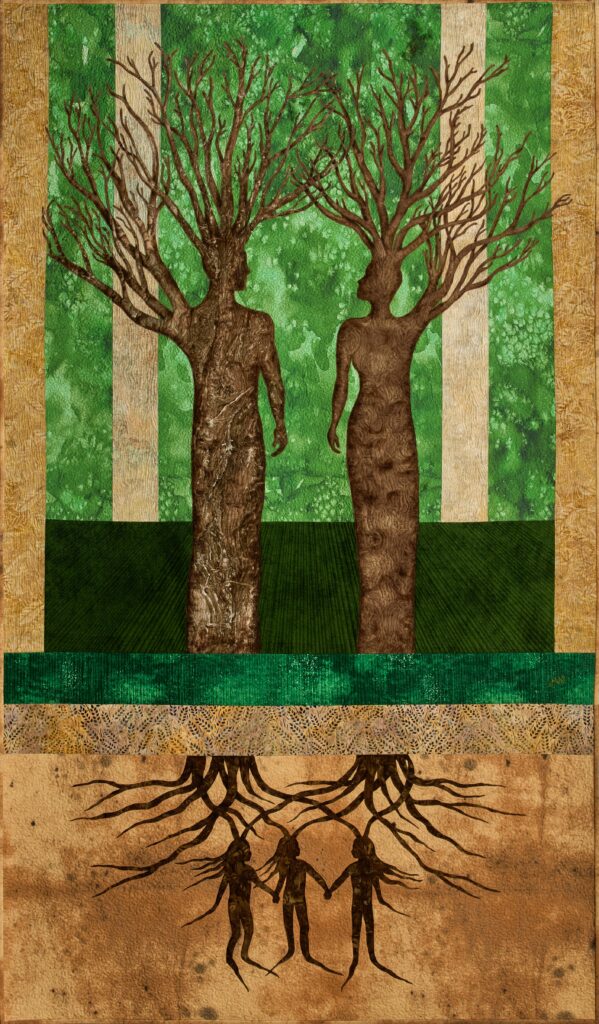
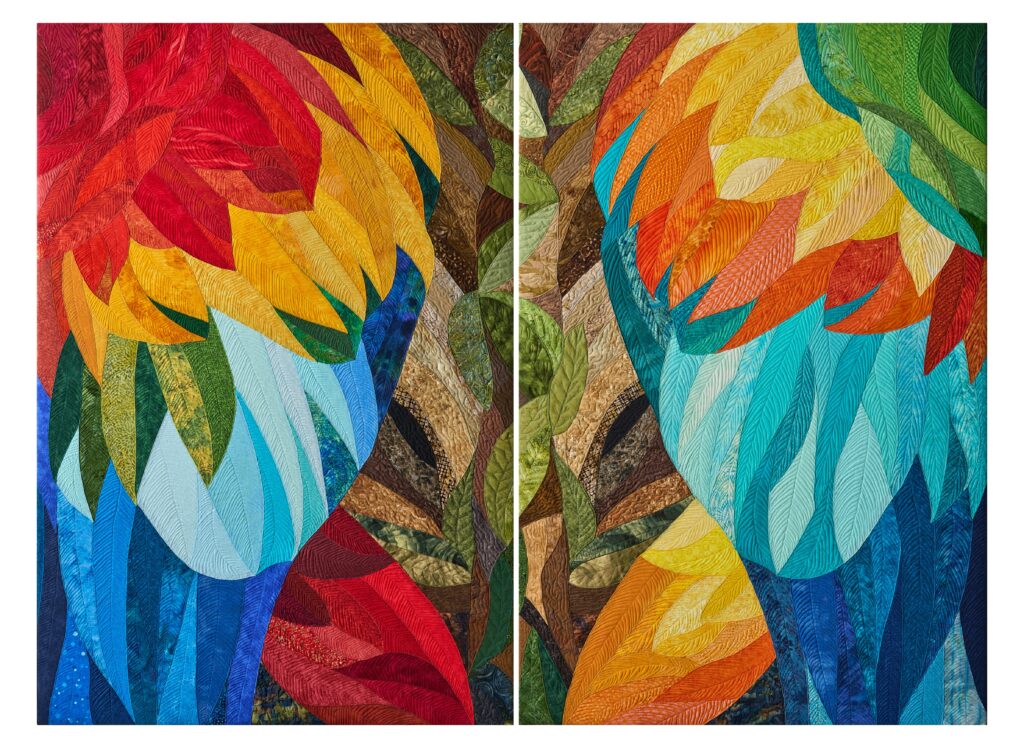
A client commissioned me to represent her family as a tree with roots. From there I built on the subject and drew a pair of trees that grow together and strong, touching and intermingling their branches in which they can conceive in their roots their three daughters.
They are vital for their lives, creating an axis which anchors them and expands their life. Forming a perfect symbiotic relationship where the roots are nourished by the falling leaves and the earth that surrounds them. I relate to this work, and it made me remember my own family as I was also one of three beloved daughters.
Q5. Nature appears throughout works like Macaws, Monarch Butterflies, Sunflower Field, and Tulip Field. What continues to draw you back to the natural world?
I’m very attracted to colours and shapes seen in nature. There is an infinite number of tones, and the emotions nature generates in me becomes a never ending fountain of inspiration for my work. For a while I was very interested in communicating that sensation of joy and pleasure that nature produced in me. I also wanted to bring nature back to the forefront to show how important it is in our modern and busy lives. Where people have stopped taking the time to observe a beautiful landscape at sunset, or taking the time to observe flowers, animals, and insects in detail.
My artwork is also an invitation to stop seeing screens for a moment, to instead appreciate and feel nature, filling ourselves with it.
Q6. Infinite Fire feels very different from some of your botanical works. What inspired that composition?
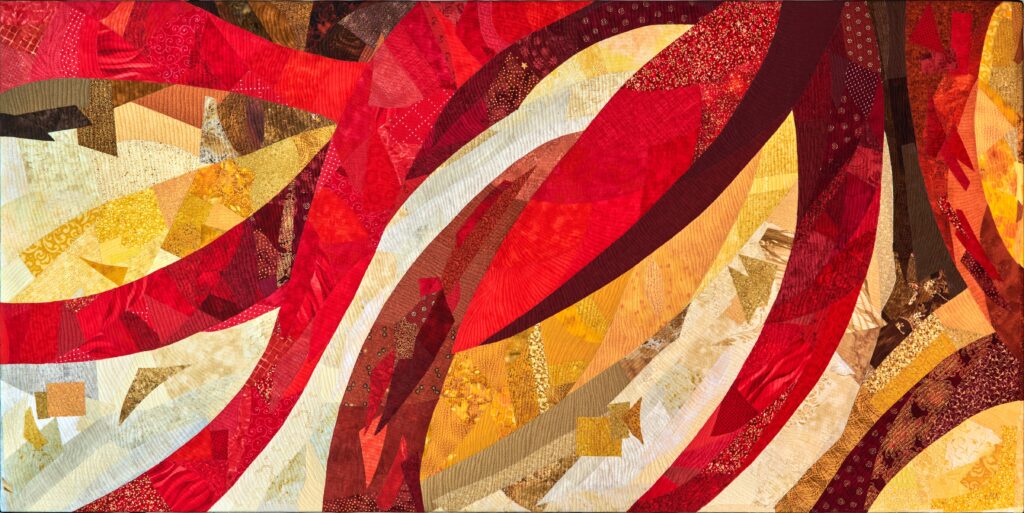
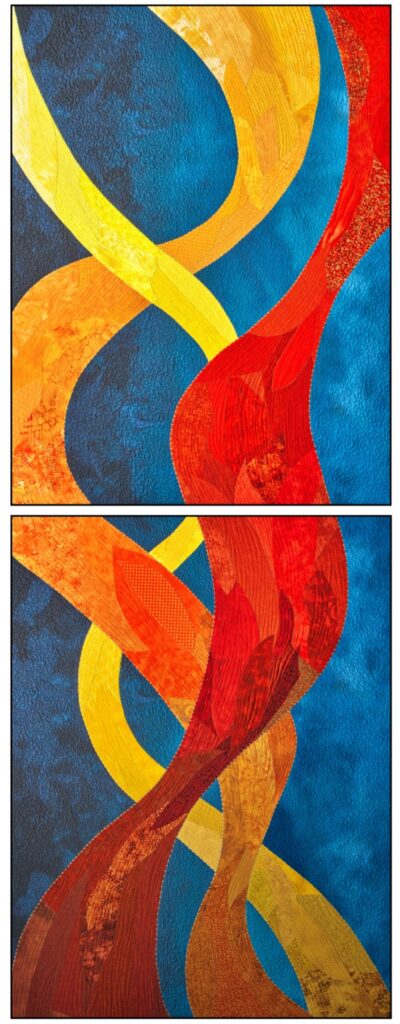
My inspiration came from seeing a video of a fire tornado. I was amazed by the way it moved and the colours it had. I therefore represented the kinetic energy of the flames as an infinite symbol where I created curved shapes, like waves, emerging from the interactions between red, yellow, and orange.
I embroidered with golden metallic threads the sparks that contain the flames. This fire is a force that has no beginning nor end, but always present. Creating and destroying. The fire is an element that hypnotizes with its heat, shapes, and colors.
Q7. You paint directly onto cotton before quilting. How does painting on fabric change the way you think about color?
I use commercial cotton fabrics, mostly American and Japanese. But sometimes I want to accentuate or enrich certain aspects, as sometimes it helps when creating an illusion of more volume in my artwork. Oil painting can add a special touch that I love, and I find it very useful to help achieve what I imagine in my mind when I visualize the final work.
Q8. Free-motion machine quilting creates both texture and movement. What does stitching allow you to express that paint alone cannot?
The inclination and the shape of the stitching that I make in every part of my work is very versatile. The work is not only quilted in a vertical vs horizontal dimension. But I create depth with curves, lines, and angles; all different with an intention that emphasises and forms varied textures that bring volume. I could never achieve the same with only oil paint, regardless of the use of perspective, or light and shadows applied to canvas. Textil art for me truly becomes alive in a completely different way.
Q9. Do your works begin with sketches, photographs, or ideas that develop directly through the materials?
My work begins in my mind. Almost always from an idea that I want to capture, perhaps of something that caught my attention because of its color or shape, or if I want to express a feeling. It starts taking shape in my mind and I make some quick sketches by hand, like a brainstorm. From there I start tuning the shapes, afterwards I draw the work true to the size of the artwork and I start selecting the fabrics.
Finally I think about the quilting and stitching. Every time I travel I go on the lookout for any cotton fabrics that I like and I buy them; this allows me to have an extensive inventory of fabrics with a range of tones for each color, which make it possible for me to have creative freedom to enrich my artwork.
Q10. You often describe your work as existing between painting and textile art. Do you think those boundaries still matter today?
I don’t think they matter too much nowadays, we as artists can use different techniques and materials; fusing things as we see fit to express ourselves in a unique way. In present time artistic expression is free, we expose to the world our particular point of view of how we perceive the world and what it means to us. We can use any artistic medium from our environment to create our art.
Q11. Having exhibited at international quilt festivals, what have you learned from presenting your work to audiences from different countries?
For me, being able to expose my work at international Quilt festivals in Houston and Chicago gave me a lot of validation of my work as an artist. It gave me the opportunity to feel like I was part of a community of artists who don’t see this type of work as only a craft.
They see things beyond that and work can be developed further to be valued as a work of art. I learnt that textile art is a universal expression. Regardless of background, culture, or country we can all unite in art. All of us exhibiting at these festivals can enrich our own experiences and lives by getting to know the works of one another; and seeing how differently people can express and work on a same subject with completely different techniques and outcomes.
Q12. Many people still associate quilting with craft rather than fine art. How does your practice challenge that perception?
Textile art has existed for thousands of years in a utilitarian way. Animal and vegetable fibres are processed to create threads to then be made into objects needed for everyday life. This sometimes gives the perception that textiles don’t require a higher skill. My works when they are seen by the public are not perceived as a craft but as art; because they always have a conceptual process of development.
Fabrics and threads are only the medium that I use to communicate a message.
My artwork establishes a connection with the viewer because it narrates a story. I’m currently working on a series with women as a theme; from the origin of humanity, to how women interact with the environment, and the way we move in the world.
Q13. Looking back on your Journey, what has been the most meaningful milestone in your career?
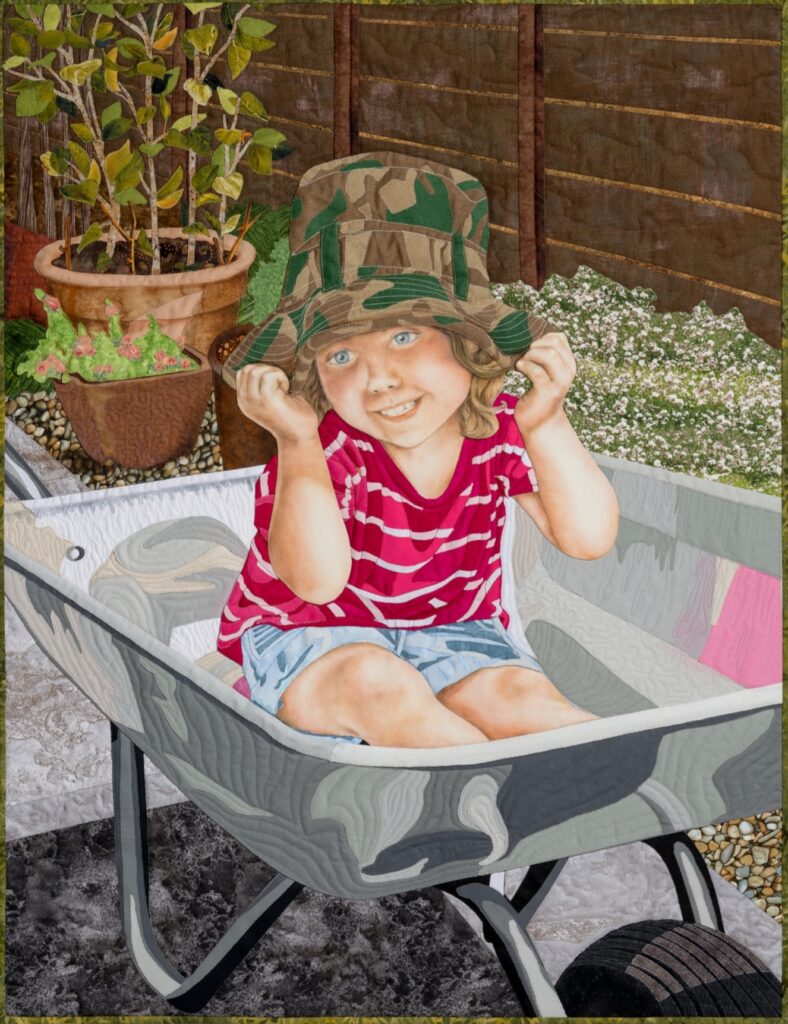
I think when my artwork titled “Summer Time” was chosen to be included in the exposition of the International Quilt Festival in November 2018. I submitted my work to the category of portraits and it received a ribbon as a finalist. This artwork was very special to me because it was the first time I fused my previous type of work (painting) with textiles. I painted the face, hands and legs with oil painting, and I used different commercial cotton fabrics to achieve what I wanted to express.
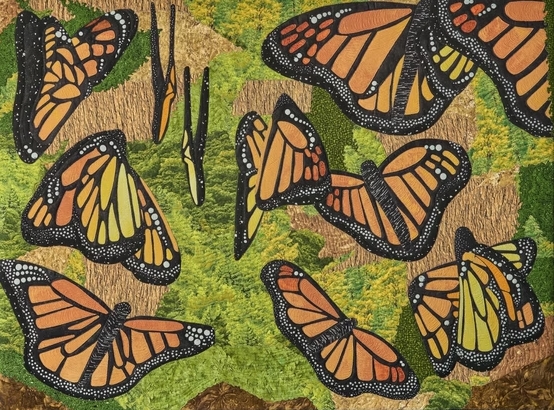
Q14. Works like Monarch Butterflies and Macaws celebrate biodiversity. How do you hope these pieces encourage viewers to think differently about the natural world?
For me these artworks are precisely an invitation to the viewer, so that they become involved and see the natural world in an abstract way. So that they can appreciate how wonderful nature is and to give urgency to take care of it now, by protecting it and taking care of it. We should all respect nature as we are part of it too. I like to showcase animals who are vulnerable to a loss of habitat to create more awareness of their situation to the viewer.
Q15. How has your definition of success changed since you began working primarily with textiles?
I feel that my work is successful or that it achieves what I wanted when people say that it transmitted a certain feeling to them. Sometimes it takes the viewer to their own past, or a special moment in their memory where they experienced happiness for example. So if my artwork moves something internally in the viewer for me that’s a success.
Q16. What advice would you give artists who are interested in combining traditional textile techniques with contemporary ideas?
My advice is not to be afraid. Dare to experiment to expose your ideas. Do not let yourself be influenced in how to do your work based on what people like or not, but by your own creative process; as people’s opinions are subjective. It’s better to focus on what you want your art to transmit to the viewer. Learn from your mistakes and carry on moving forward. You can achieve your goals with perseverance and patience.
As we wrapped our conversation with Mónica, we kept thinking about that collector who said the artwork looks different during daytime and nighttime. That she discovers new things in it every day. That the shapes change according to the light.
Most art doesn’t do that. Most art looks the same at nine in the morning as it does at nine at night. You hang it, you admire it, and after a few weeks it becomes part of the wall. Mónica’s work refuses to become part of the wall. The quilted surface catches every shift in light and turns it into a shift in the artwork itself. Shadows appear and disappear. Textures deepen and flatten. Shapes you noticed yesterday hide today and new ones show up in their place. The piece is never finished because the light is never finished with it.
That feels like a perfect metaphor for what this exhibition is about. Love and life and everything she creates. None of those things are static either. Love changes shape depending on the day. Life looks different in the morning than it does at night. And the things women create, whether it’s art or families or gardens or careers or just the daily act of holding everything together, all of it shifts and moves and catches different light at different hours and never looks exactly the same way twice.
Mónica makes art that does exactly what life does. It keeps moving. It keeps surprising you. It keeps revealing things you didn’t see before because you weren’t standing in the right light at the right moment. And when you finally are, when the angle and the hour and your mood all line up, the piece shows you something it’s been holding the whole time that it was waiting for you to be ready to see.
For anyone thinking about bringing Mónica’s work into their home, that’s what you’re getting. Not a piece that decorates a wall. A piece that lives on it. That has a different conversation with your room every hour of every day. That makes the light in your home part of the artwork itself. Fabric and thread and oil paint and stitching all working together to create something that most canvases can’t touch because most canvases are flat and Mónica’s work has never been flat. Not in surface. Not in meaning. Not in the way it makes you feel.
To follow Mónica’s journey and see more of her work, find her through the links below.
