
5 Paintings By Women Artists Who Wouldn’t Let Convention Define Their Art
For centuries, women artists were expected to work within very narrow boundaries. Even when they were allowed to paint, there were subjects they were encouraged to choose, spaces they were permitted to enter, and ways they were expected to present themselves. The art world had rules for what a woman could be, and even more rules for what she could become.
But women artists have never been okay with staying inside the lines. Again and again, women picked up their brushes and made work that asked difficult questions. Some painted subjects they were never expected to touch.
Others entered spaces that had been closed to them, found ways around institutions that excluded them, or simply insisted on taking their own lives and experiences seriously as worthy subjects for art.
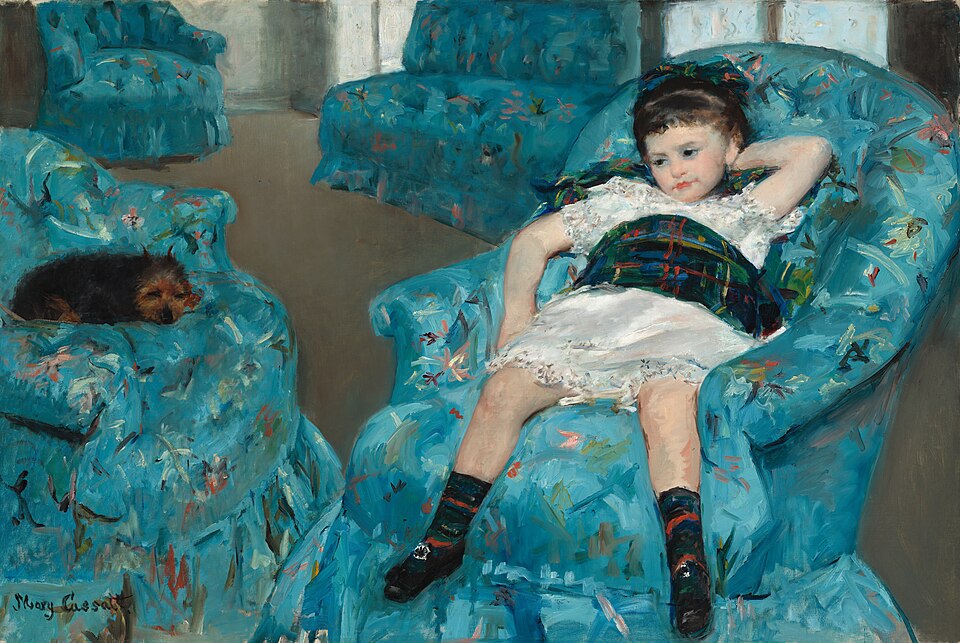
What makes these paintings so powerful is that their courage does not always announce itself loudly. Sometimes it appears in a woman standing confidently before her canvas. Sometimes it is in the decision to paint women as powerful rather than passive. Sometimes it is simply a little girl sitting however she likes in a blue armchair.
These five paintings remind us that challenging convention does not always mean breaking something apart. Sometimes it means quietly making room for yourself, and refusing to leave.
1. Self-Portrait In A Straw Hat By Élisabeth Louise Vigée Le Brun

When Élisabeth Louise Vigée Le Brun painted Self-Portrait in a Straw Hat in 1782, she was not simply painting her own face. She was presenting herself as an artist who belonged in the same world as the men around her.
The painting is bright, lively and surprisingly informal for an 18th-century self-portrait. Vigée Le Brun looks directly at us, holding her palette and brushes, while wearing a wide-brimmed hat decorated with flowers and a feather. Her expression is confident but warm, and her open smile makes the image feel almost conversational.
Vigée Le Brun was one of the most successful portrait painters of her generation, but being a woman in the professional art world still came with enormous restrictions. She was largely self-taught after the early death of her father, a painter, and eventually built a remarkable career that brought her into the highest circles of French society. She became a favourite portraitist of Marie Antoinette and, in 1783, was admitted to the French Royal Academy, one of only four women allowed membership during the 18th century.
Her self-portrait was also carefully considered. Vigée Le Brun based her pose on a famous portrait associated with Peter Paul Rubens, using the light and composition as a reference while turning the image into her own statement. She presents herself holding the tools of her profession, making it impossible to separate the elegant woman we see from the working artist she was.
There is something wonderfully self-assured about the way she meets the viewer’s gaze. She is not asking whether she is allowed to be here. She already knows she belongs.
And perhaps that is what makes the painting feel so modern. Vigée Le Brun understood that representation mattered. If women were rarely shown as serious working artists, she would show herself that way. She painted a woman who was not simply beautiful, but ambitious, skilled and completely at home with her own talent.
2. Self-Portrait With Two Pupils By Adélaïde Labille-Guiard

In 1785, Adélaïde Labille-Guiard painted herself standing proudly beside two young female students, Marie Gabrielle Capet and Marie Marguerite Carraux de Rosemond. At first glance, it looks like a beautifully composed 18th-century portrait. Look closer, though, and it becomes something much more radical.
The painting places women not simply as subjects or muses, but as artists and students. Labille-Guiard is dressed elegantly, holding her palette and brushes, while her pupils stand beside her. It is a portrait of women learning how to make art, and of a woman publicly presenting herself as a professional artist and teacher.
When Labille-Guiard and Vigée Le Brun were admitted to the French Royal Academy in 1783, the number of women artists who could belong to the institution was limited to just four. Labille-Guiard’s enormous self-portrait, exhibited at the Salon of 1785, has often been understood as an advocacy for women’s artistic education and professional opportunities.
The painting almost feels like a declaration: We are here, and we are learning. There is no apology in it. No attempt to make the women appear like an unusual exception. Labille-Guiard simply gives them space, dignity and ambition.
Even the presence of her students feels significant. She was not only claiming a place for herself. She was showing that other women deserved a place beside her too. For women who had so often been told what they could not become, that image was powerful.
3. The Horse Fair By Rosa Bonheur
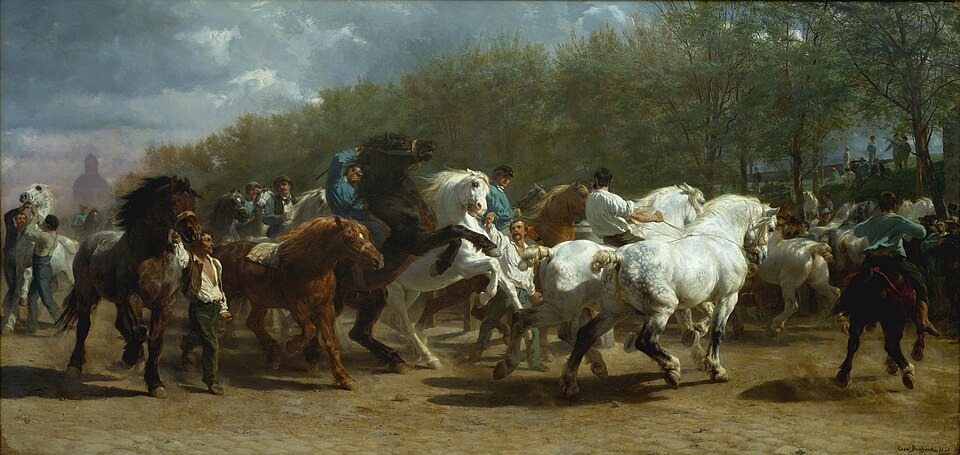
Rosa Bonheur did not seem particularly interested in accepting the limitations placed around women artists. Her The Horse Fair, painted between 1852 and 1855, is enormous, energetic and filled with powerful horses charging through a Parisian horse market. It was shown at the Paris Salon in 1853, where its scale and dynamism attracted considerable attention.
But the story behind the painting is almost as fascinating as the painting itself. Bonheur visited the horse market twice a week for a year and a half to make drawings and study the animals. Because women could not move through these male-dominated spaces as freely as men, she wore men’s clothing so she could work without attracting the same attention. She even obtained official permission from the police to wear trousers. And she needed those studies.
Women were excluded from the life room, where artists learned to study the human body from live models. This was considered an important part of serious artistic training. Bonheur found another way to develop the observational skills she needed, turning her attention to animals and eventually becoming one of the most celebrated animal painters of her generation.
The Horse Fair is therefore more than a painting of horses. It is a painting made possible because Bonheur found another way in. There is something wonderfully determined about that.
She did not wait for the rules to change. She did not wait for someone to make the art world more accommodating. She found a way around the restrictions and went to the places she needed to go. The result was a painting that feels almost impossible to contain.
4. Little Girl In A Blue Armchair By Mary Cassatt
Not every challenge to convention needs to be dramatic. Sometimes it can look like a little girl slouching in a chair. Mary Cassatt’s Little Girl in a Blue Armchair, painted in 1878, shows a young girl sitting almost completely at ease in a richly patterned blue armchair, with a small dog resting nearby. Her dress is carefully arranged, her shoes are still on, but her pose is wonderfully informal. She looks like a child who has momentarily forgotten that anyone is watching.
That ordinary moment was part of Cassatt’s larger contribution to art. Women artists in 19th-century Europe had far fewer opportunities to move through public spaces than men did. While male artists could paint cafés, streets and other aspects of everyday urban life, women were often confined to domestic interiors. Cassatt took those spaces and made them worthy of serious artistic attention.
The girl in the painting is not performing for us. She is simply existing. In fact, one of the sweetest details is the little dog across from her. His name was Baptiste, a Brussels Griffon who belonged to Cassatt and had apparently been helped into her life by Edgar Degas. He appears in several of her paintings.
The girl’s loose pose makes the painting feel almost wonderfully private. She is sprawled across the chair, looking bored or tired, completely unconcerned with presenting herself properly. And that is precisely what makes it so charming.
Cassatt understood that women’s worlds did not have to be treated as small simply because society had made them smaller. A domestic room could become the subject of a major painting. A child could deserve the attention of a museum wall. An everyday moment could become art.
She did not need a grand historical scene to make a statement. She found significance in ordinary life and made us look at it differently.
5. The Two Fridas By Frida Kahlo
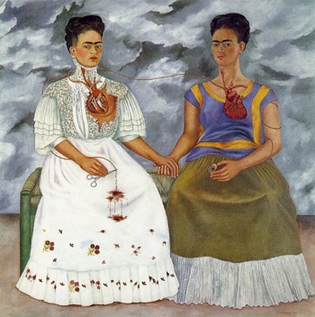
By the time Frida Kahlo painted The Two Fridas in 1939, she had already developed a way of turning her own life into a deeply personal visual language.
This double self-portrait shows two versions of Kahlo seated side by side, their exposed hearts connected by a blood vessel. One wears a European-style white dress, while the other wears traditional Mexican clothing. The two figures appear different, yet they sit together, holding hands.
The painting was created shortly after Kahlo’s divorce from Diego Rivera, giving the already intimate image another emotional layer. What feels so powerful about The Two Fridas is the sheer honesty of it. Kahlo did not separate the artist from the woman. She did not hide pain, identity, heritage, relationships or the complicated experience of being herself.
Instead, she put all of it on the canvas. Self-portraiture had a long history, but Kahlo pushed it somewhere intensely personal. Her body became a place where different identities, memories and emotions could exist together. She painted herself not as an idealized woman, but as a complicated human being.
There is vulnerability in the painting, but there is also tremendous strength. Kahlo seems to say that all these versions of herself can exist at once. The woman, the artist, the Mexican, the daughter, the lover, the person experiencing pain. None of them needs to disappear to make the others easier to understand. And that decision has resonated with generations of artists since.
The Women Who Refused To Stay Inside The Lines
Looking at these five paintings together, what stands out is how differently each woman challenged the world around her.
Vigée Le Brun presented herself unapologetically as a professional artist. Labille-Guiard made space for women not only to paint, but to learn and teach. Rosa Bonheur walked into spaces women were not expected to enter and painted on a monumental scale. Mary Cassatt transformed the supposedly ordinary world of women and children into something worthy of serious attention. Frida Kahlo made her own identity, body and emotional life impossible to overlook.
None of them had exactly the same fight. But each understood something important: conventions are not the same thing as limitations. Sometimes the most courageous thing an artist can do is believe that her subject is worth painting, her voice is worth hearing, and her place in the art world does not need anyone else’s permission.
The women who came before us did not always have the doors opened for them. Many had to push, negotiate, work around, or simply walk through doors that were never meant to welcome them. And because they did, the path became a little wider for the women who came next.
Their paintings remain more than beautiful objects from another time. They are reminders of what can happen when an artist chooses curiosity over obedience, courage over convention, and her own vision over the expectations placed upon her.
Perhaps that is the most lasting thing these women left behind. Not just paintings, but permission. Permission for the women who came after them to take up space, to be ambitious, to be difficult, to be vulnerable, to paint what mattered to them, and to believe that their place in art was never something they had to earn from anyone else.
Editor’s Note:
If you enjoyed this feature on 5 Women Artist who challenged the conventions and limitations of their time, you might as well like our article on 5 Controversial Paintings by Women Artists that Changed Art History.
