
Paulina Wróblewska’s Acrylic Paintings Bring the Power of Big Cats to Life
At Women in Arts Network, Love, Life and Everything She Creates brought together women artists from all kinds of backgrounds, each one shaped by her own story and her own way of creating. Every artist met the theme in her own way, drawing on what she loves and what drives her to make.
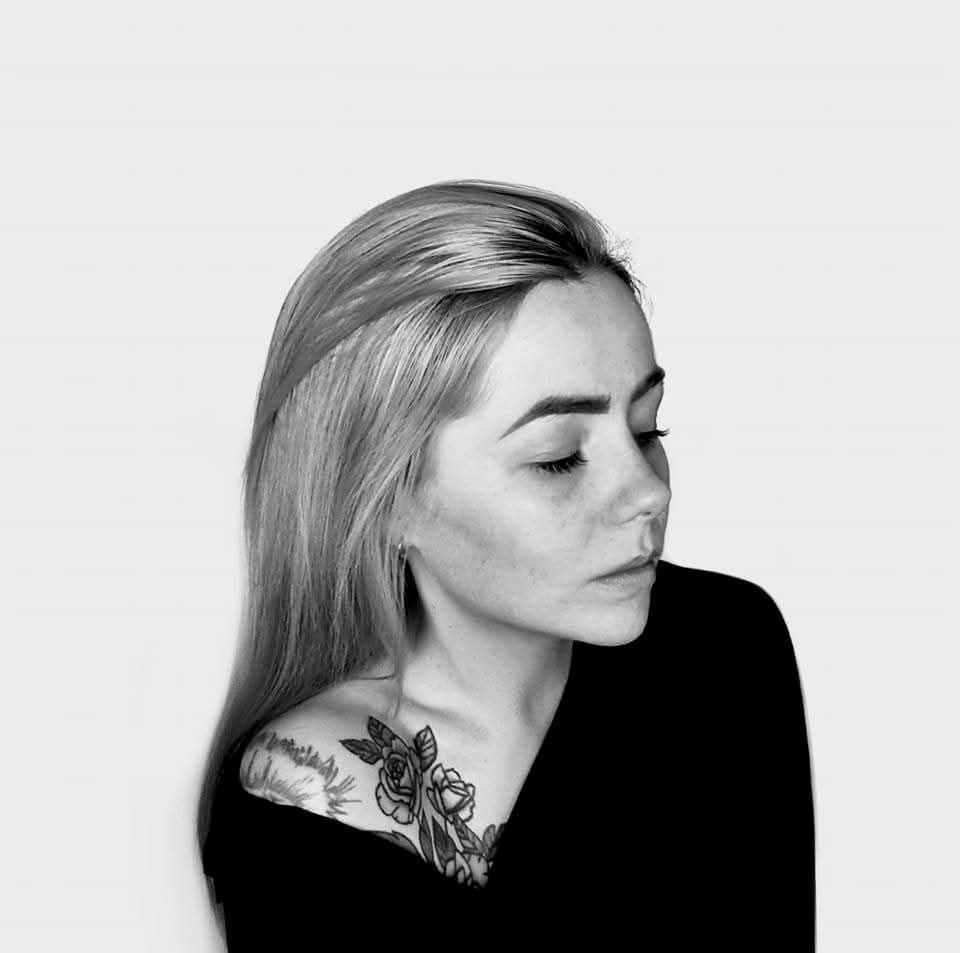
Among the artists selected for this exhibition is Paulina Wróblewska, a Polish painter who creates large, lifelike animals that don’t simply sit on the canvas, they look back at you.
Paulina is completely self-taught, with no formal art education. She started out with digital drawing on a graphic tablet, slowly building her foundation in light, anatomy, and proportion. But over time, the screen stopped being enough. Buying her first acrylics and canvas changed everything. Traditional painting finally gave her the physical space she needed for emotion, and a drive to make art that feels like a living presence rather than decoration.
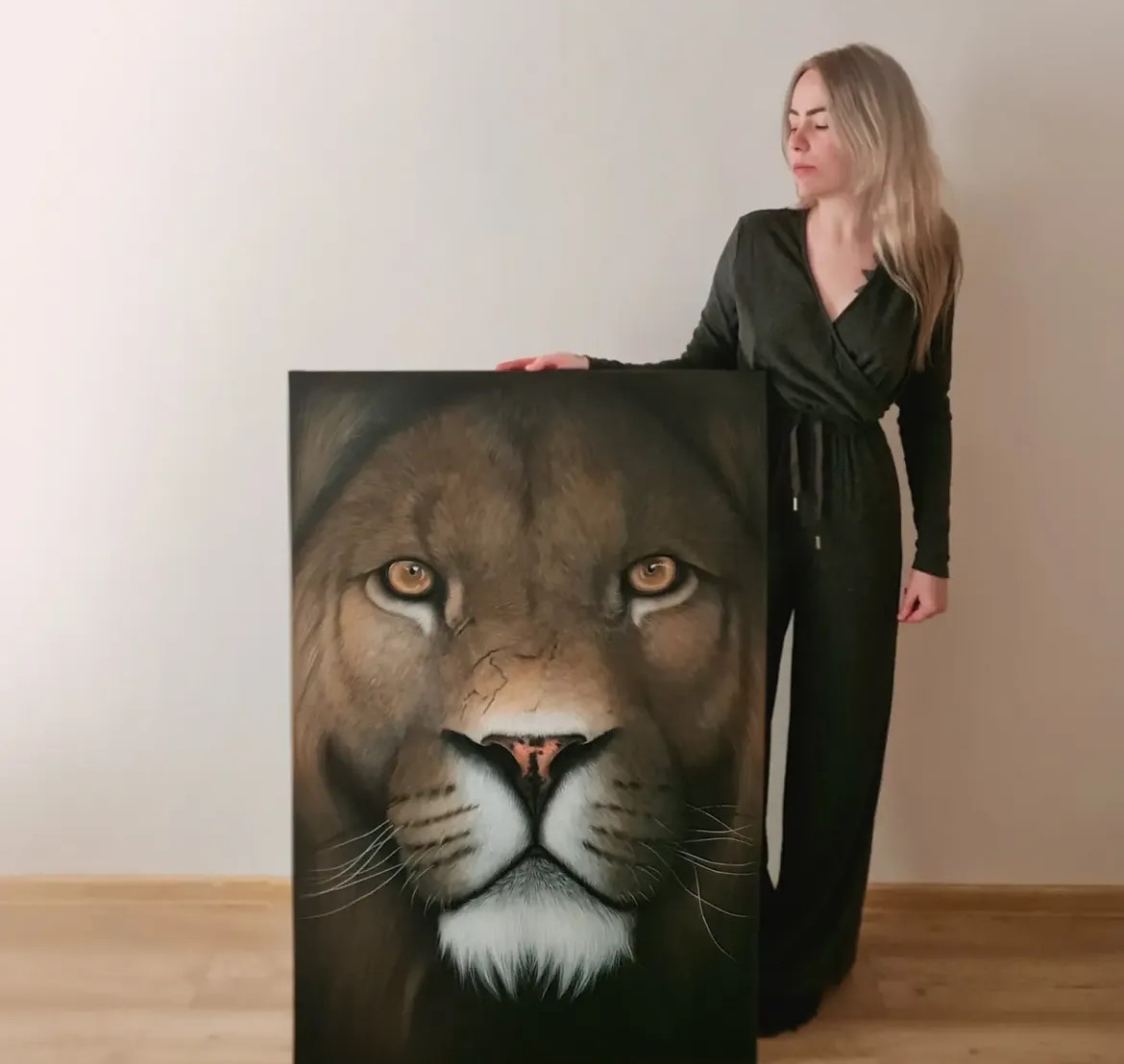
She works mostly in acrylics, drawn to how fast they dry and how well they suit her layer-by-layer process. Building a painting slowly, layer over layer, lets her control every strand of fur, every reflection, and the depth in the eyes, all while keeping the light and contrast absolutely clear. For the large-scale realism she loves, it’s the perfect medium.
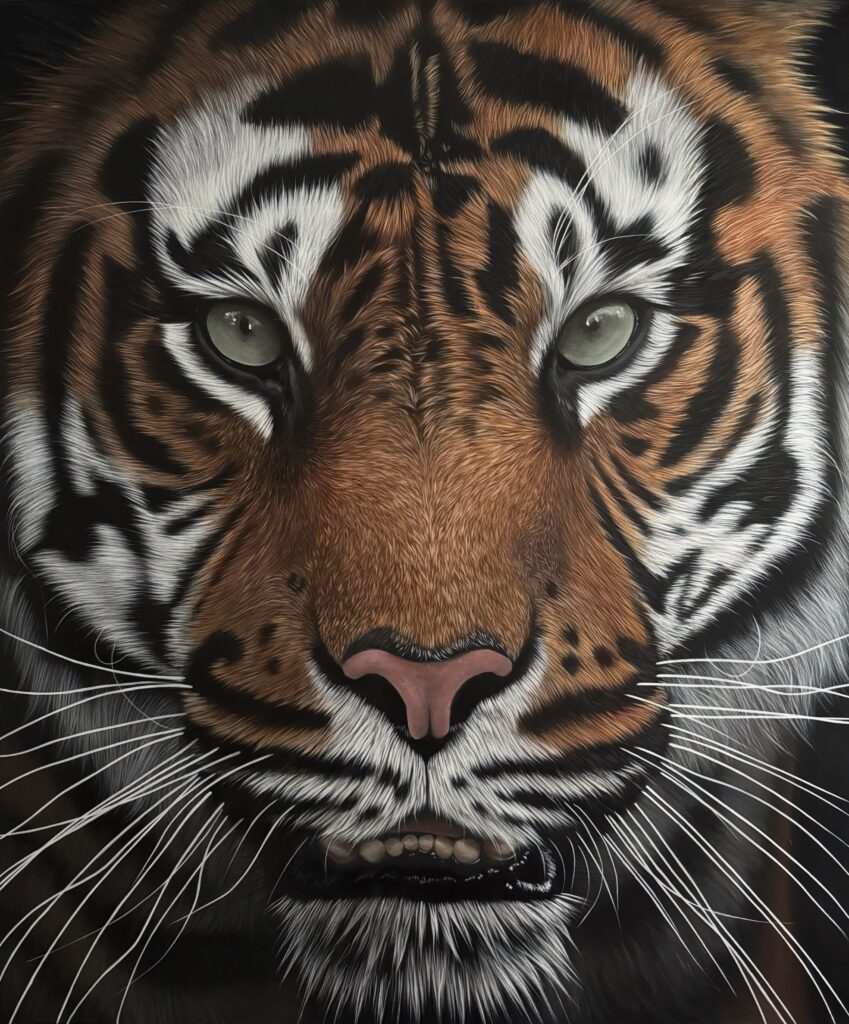
With every piece, she says, she is trying to create something more than an image. She is trying to create a presence, something that lives, breathes, and waits to be truly seen. Her big cats carry that presence most of all, their calm, their power, and their quiet dignity filling a canvas until they seem to command the whole room.
Her work has quietly earned real recognition. Critics have praised the rare level of technical skill in her paintings, and the living presence she brings to the canvas. Her work has been selected for international exhibitions across Europe, shown everywhere from historic palaces in Venice to major art fairs in Paris and Milan, and in recent years she has been named a finalist and longlisted for respected international art prizes. She is now represented by a gallery, and her paintings hang in private collections in Poland and beyond.
Now let’s hear from Paulina about teaching herself to paint, why the eyes matter more than anything else, what a painting can capture that a photograph cannot, and the quiet dignity she connects with most in the animals she paints.
Q1. Paulina, could you share a little about your background and what first inspired you to become an artist?
I’m based in Poland and I’m completely self-taught, with no formal art education. My journey started with digital drawing on a graphic tablet, where I built my foundation in light, anatomy, and proportions. Over time, the digital screen just wasn’t enough anymore. The shift to canvas was spontaneous.
Buying my first acrylics and canvas changed everything – traditional painting gave me the physical medium and space for emotions I needed to express. I was inspired by a drive to capture pure authenticity and create art that feels like a living presence, not just decoration.
Q2. You’re a self-taught artist who built your practice through patience and persistence. What gave you the confidence to trust your own path?
Confidence came gradually, with every canvas I painted. In the beginning, there was a lot of uncertainty, but daily, consistent work was key, analyzing my mistakes and learning directly from them.
The turning point was the first positive response to my work at art auctions and the reaction from collectors.
I realized that what I was doing intuitively truly resonated with people. Seeing viewers pause in front of my paintings and genuinely feel the animal’s presence gave me the ultimate validation that lacking formal art education wasn’t an obstacle, but my strength.
Q3. You work primarily with acrylic paint, creating incredibly detailed and lifelike animals. What first attracted you to acrylic as your medium?
Choosing acrylics was very intuitive for me. I was drawn to their versatility and speed, acrylics dry fast, which perfectly aligns with my process of building a painting layer by layer. It allows me to add fine details, adjust shapes, and revisit the same areas repeatedly without waiting for weeks.
This gives me precise control over fur textures and the depth in the eyes, all while maintaining absolute clarity of light and contrast. For large-scale realism, it’s the perfect medium for me.
Q4. Before you begin painting, you spend time studying anatomy, light, and texture. What do you enjoy most about that stage of observation?
I love the moment of discovery the most. I enjoy searching for that single detail a glint in the eye or a play of light on the fur that gives the subject its true character and emotion. This stage allows me to slow down and really get to know the animal before I even touch the canvas.
Q5. Big cats appear throughout your work. What first drew you to these animals as your main subject?
Big cats have a magnetic strength, calm, and profound dignity. I’ve always felt a deep connection with them. I chose them because their gaze and presence allow me to speak about raw emotions power, vulnerability, and wildness without using words. On a large canvas, their energy creates an unforgettable bond with the viewer.
Q7. Every strand of fur and every reflection in the eyes feels carefully considered. At what point do you know a painting has reached the level you’re looking for?
I know a painting is finished when I look at it and feel it has a life of its own when it genuinely stares back at me from the canvas. It’s the moment when technical details fade into the background, leaving pure emotion at the forefront. If I feel that spark of energy and a quiet connection with the animal, I put the brush down.
Overworking a piece in pursuit of absolute perfection risks stripping away its living soul.
Q8. Works like Ziya, Asur, Aira, and Echo each have distinct titles. How do you choose the names for your paintings?
Titles come to me very intuitively, often while I’m painting or right after I finish. I look for short, powerful words that sound almost like names because I want to emphasize that I’m painting a unique individual with its own persona, not just an anonymous animal. I often choose words from ancient languages or those with deep symbolic meaning (like Aira, Asur, or Ziya, carrying ideas of light, strength, or breath). A title acts as a subtle key it doesn’t force a rigid narrative, but it gives the piece an identity and reinforces its living presence.
Q9. You’ve said you’re fascinated by their power, grace, and quiet dignity. Which of those qualities do you connect with most as an artist?
With quiet dignity. I prefer working in quiet focus, staying true to my process rather than chasing noise. I want my paintings to speak for themselves calmly, but with a strength you can’t ignore.
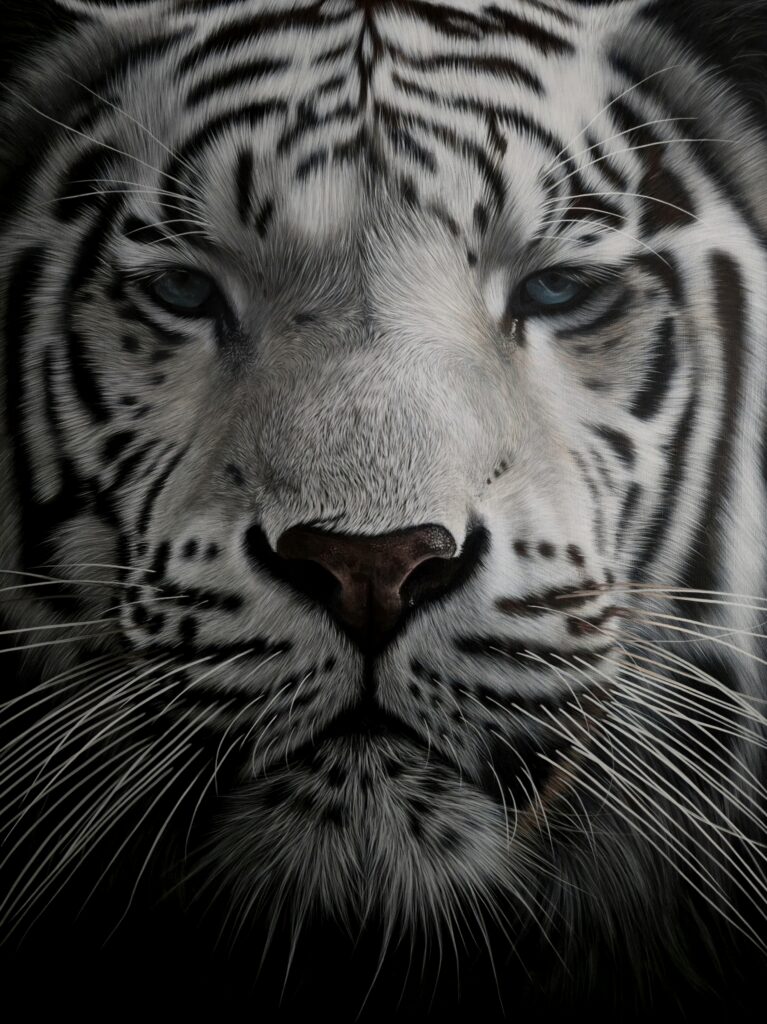
Q10. Each animal in your work seems to have its own personality. How do you bring that individuality into your paintings?
The key is in the eyes. I spend a long time searching for references and digitally tweaking the lighting and composition until I feel the subject is truly “looking” back, not just existing. I avoid cold, mechanical anatomy instead, I focus on the tiny specks of light in the pupil, muscle tension, and micro-expressions.
I don’t paint just a species; I paint a unique individual with its own history, power, and vulnerability.
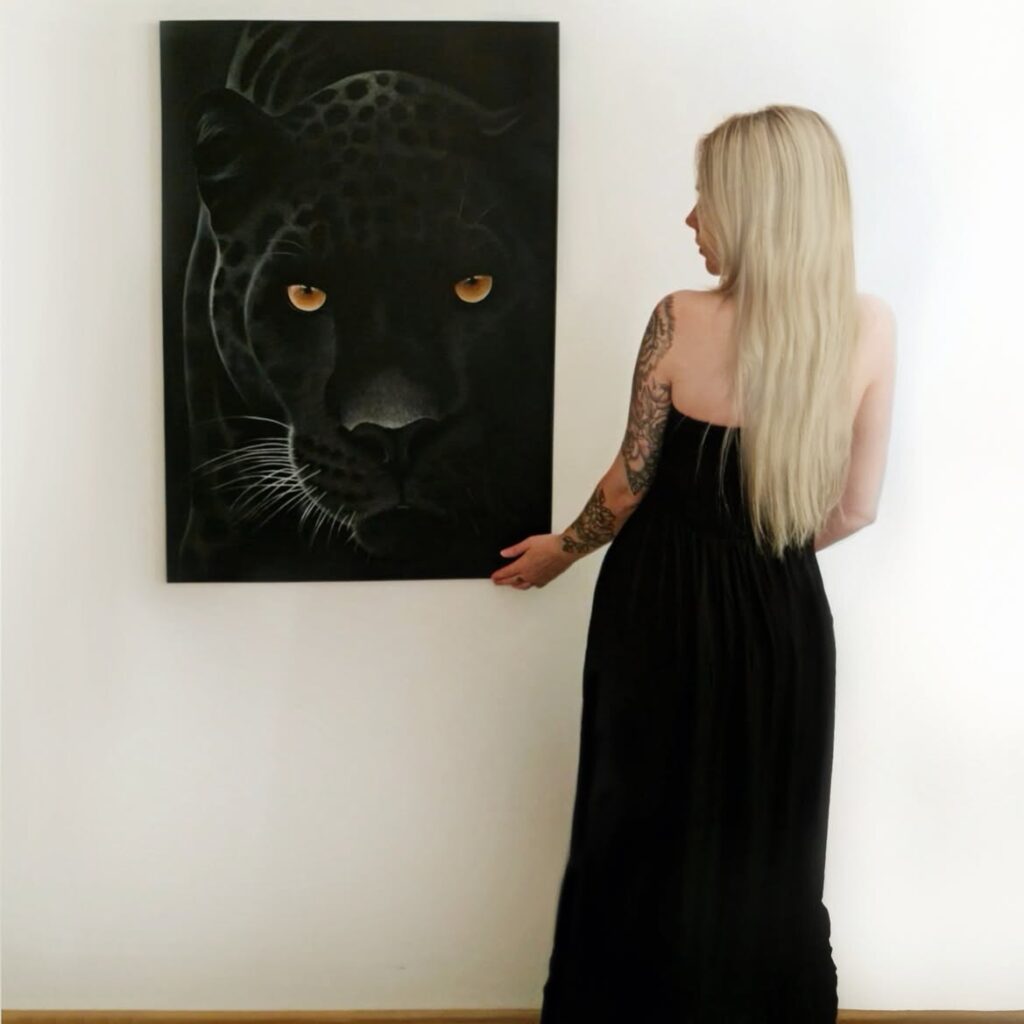
Q11. The black panther is one of the most striking subjects in your portfolio. What made it one of the most challenging animals you’ve painted?
The real challenge was balancing the subtle tones building depth, anatomy, and fur texture purely through cool light reflections, while still preserving that deep, rich blackness. The hardest part was ensuring its gaze hypnotized the viewer, emerging from the shadows with absolute strength.
Q12. Large-scale paintings require a different approach than smaller works. What challenges do they present for you?
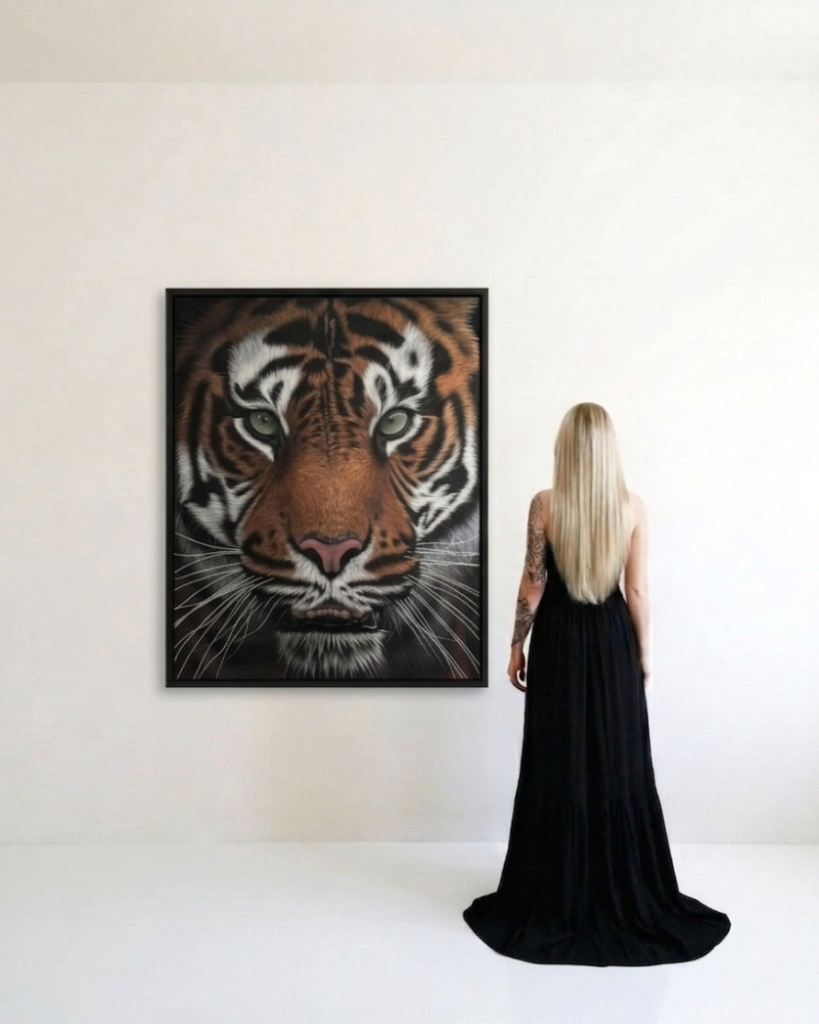
Large scale is both a physical and spatial challenge. Working on a canvas like 120 × 100 cm requires constant movement stepping back to control the overall composition and coming close for micro-details. It’s easy to lose proportions or get bogged down in one spot.
Large formats leave no room for mistakes, but they offer incredible impact: they let me create a life-sized presence that completely commands the space and directly confronts the viewer.
Q13. Has there been one painting that completely surprised you or changed the direction of your work?
Yes, the turning point was Wild Eyes. Instead of depicting the whole animal, for the first time I focused entirely on an extreme close-up of just the eyes. That piece changed everything. I realized that the true power of my work doesn’t lie in complete anatomy or overall scale, but in the gaze itself. It gave me the courage to lean into simplicity, strip away non-essential backgrounds, and inspired a whole new series dedicated entirely to that raw, intimate connection.
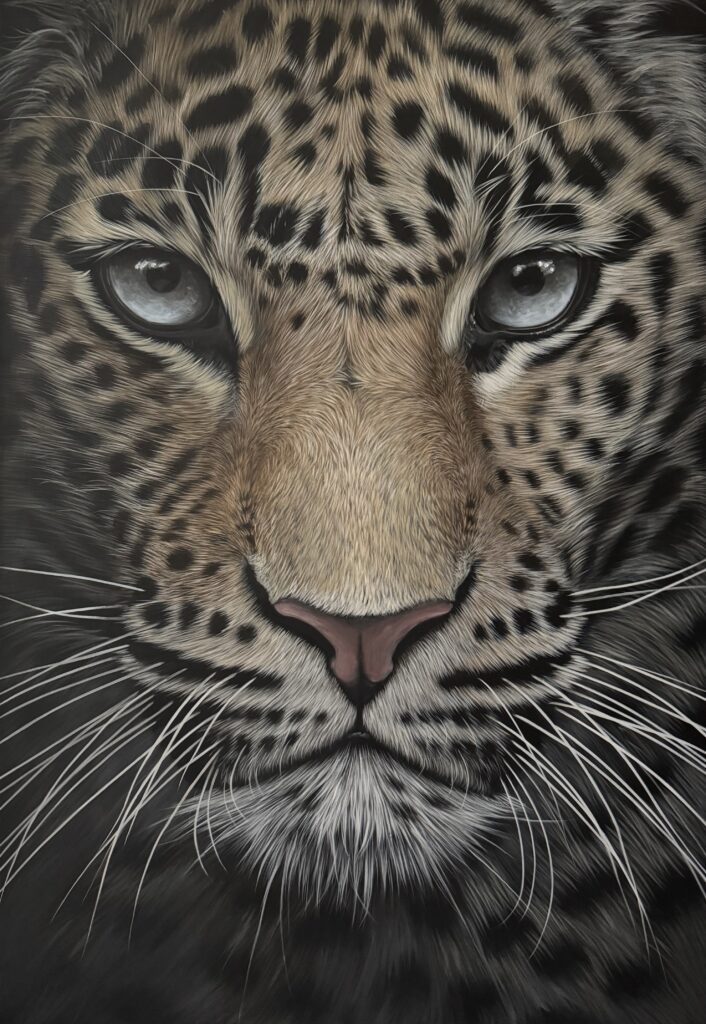
Q14. In a world filled with wildlife photography, what do you think painting can express that a photograph cannot?
A photograph freezes a fraction of a second. Painting adds time and emotion.
On canvas, I don’t just replicate a camera shot I choose what truly matters. I can strip away distracting backgrounds, enhance the light in the eyes, and build tension layer by layer. A painting doesn’t just show how an animal looked in a single moment; it captures its full energy, soul, and quiet presence.
Q15. Is there an animal you’ve always wanted to paint but haven’t yet found the right story for?
Yes, the puma. I’ve long been fascinated by this “ghost of the mountains”, quiet, elusive, and infinitely graceful. I don’t want to paint just another predator portrait. I’m waiting for the moment to capture that split second as it emerges from the shadows with its quiet, mysterious power.
Q16. Looking back, what has been the most meaningful milestone in your journey so far—not because of recognition, but because of what it meant personally?
The most meaningful milestone was the moment I stopped painting to meet external expectations and fully trusted my own intuition. It was a quiet shift in the studio a moment when I prioritized emotional truth over photographic precision or pleasing an audience. I realized that the true power of my work comes from creating a quiet, intimate connection between the viewer and the animal. Reclaiming that creative freedom gave me complete confidence in my path.
Q17. What advice would you give to artists who are teaching themselves and are still learning to trust their own abilities?
The most important advice? Avoid cheap art supplies from bargain stores. To start, all you need is a basic color palette just make sure it’s decent quality. I wasted months thinking the problem was me. The cheap paint was sticky, wouldn’t blend, and didn’t cooperate at all ,I was ready to give up painting entirely. It turns out it wasn’t a lack of talent; it was just terrible paint.
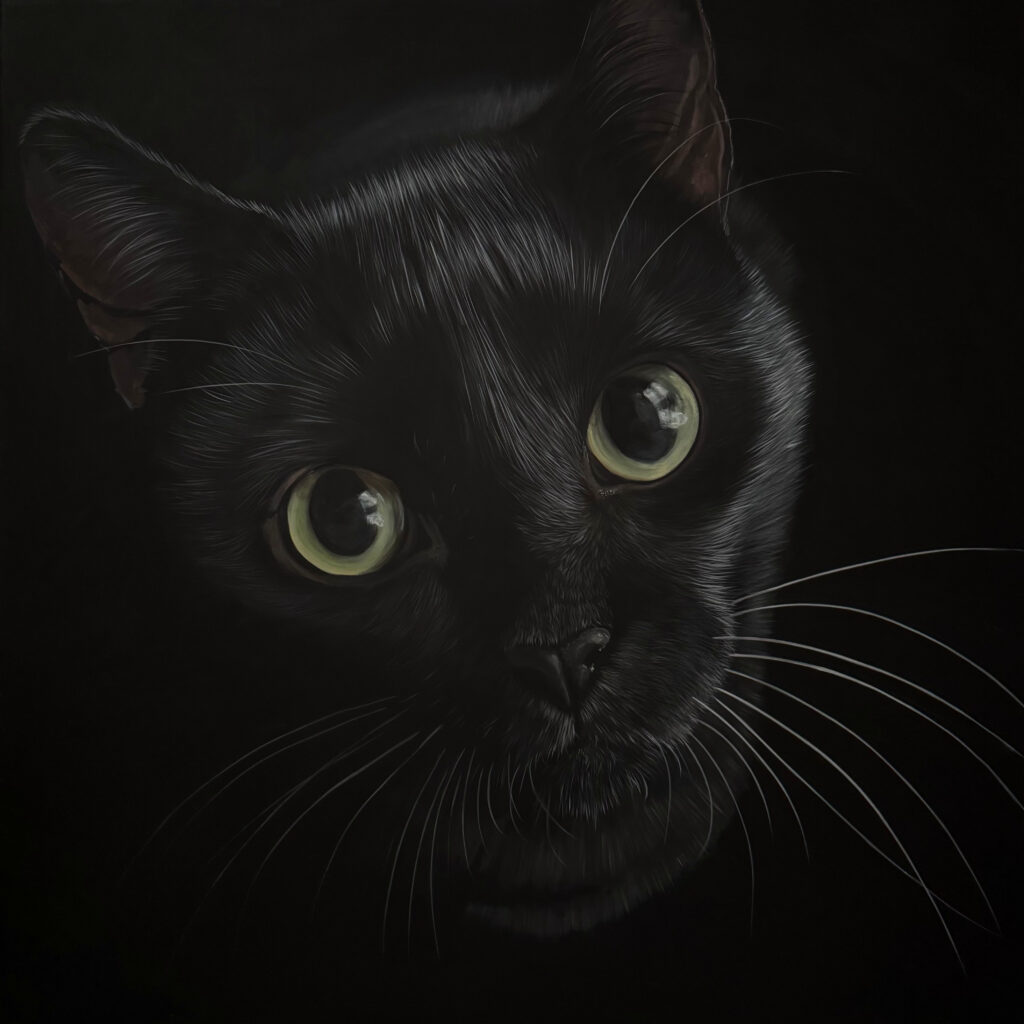
Talking to Paulina left us thinking about stillness the hush that falls when a painting stops you in your tracks. The held breath. The second glance. The quiet shock of looking into an animal’s eyes and feeling, somehow, truly seen in return.
That fragile moment is the whole of her ambition. For all the astonishing detail in her work, she insists realism was never the goal; what she chases is the feeling that the animal is actually there, alive and aware. A photograph captures one passing instant, but a painting, she believes, can hold time, emotion, and something words can’t quite reach. So she pares each scene back to its essence, pours herself into the eyes, and builds the image up in layers until it crosses over from careful copy into living presence. The brush only goes down when the creature meets her gaze any further, and she risks smoothing the life right out of it.
Her path to this point says something quietly powerful, too. Paulina is wholly self-taught, and for a long while she carried that as a doubt rather than a strength. Time proved her wrong. Her belief in her own work grew the slow way canvas after canvas, mistake after honest mistake until she stopped creating for anyone else’s expectations and began trusting herself entirely. There is encouragement in that for every artist still waiting to feel ready: no one hands you permission, and no qualification makes you real. You become an artist by showing up and working until the work could belong to no one but you.
And for anyone who loves or collects art, what she makes is genuinely uncommon. A full-scale animal that refuses to blend into the wall, fixing you instead with a steady, unflinching stare. Her big cats hold strength and tenderness in the very same glance, stepping from the canvas with a composure that stays with you. To share a space with one of her paintings is to live beside a breathing, watchful presence a daily reminder of the wild, and of all that can pass between two living beings in complete silence.
Follow Paulina Wróblewska through the links below and see her work for yourself.
