
This Artist Uses Large-Scale Portraits & Unfiltered Expressions to Challenge Beauty Standards │Maureen Daniel
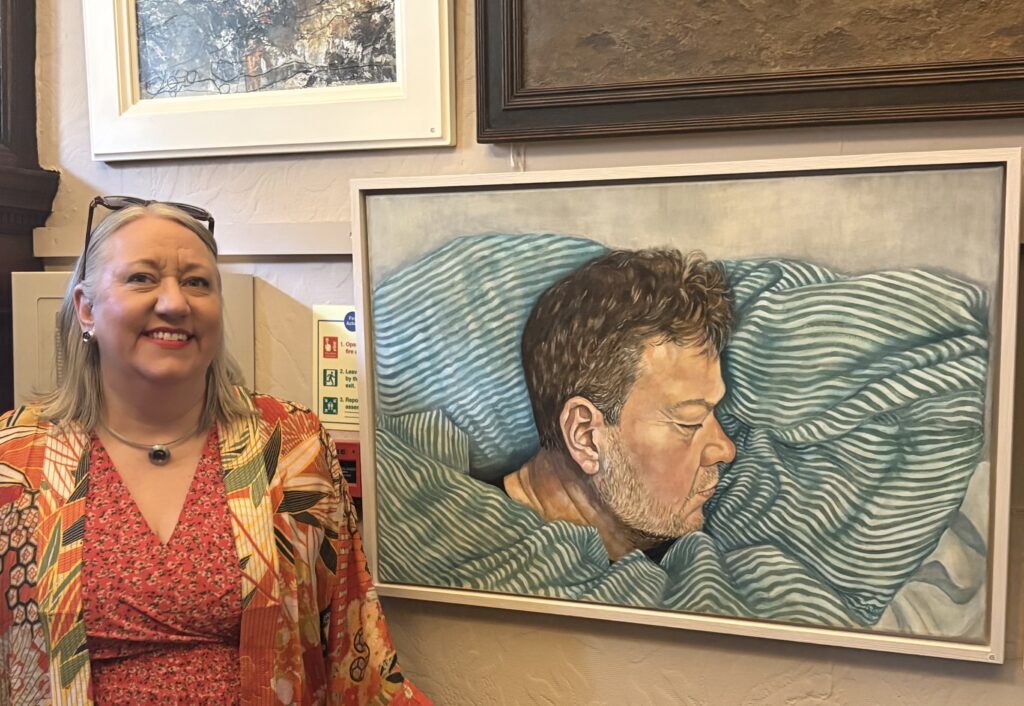
At Women in Arts Network, Portraits celebrated the face as the oldest and most revealing subject in all of art. A portrait has never really been about likeness alone. It is about everything that lives behind the face, the identity, the memory, the emotion, and the quiet contradictions that make a person who they are.
Each artist in this exhibition brings her own way of reaching for that, and her own answer to a question that never grows old: how much of a person can a painting truly hold? Among the chosen artists is Maureen Daniel, a Scottish painter whose work strips away expectation to show women exactly as they are, in all their strength and fragility.
Maureen has been fascinated by portraiture since childhood, by the idea of capturing a glimpse of another person at a single moment in time, their likeness, their character, their sense of self. As a student she was drawn to figurative art throughout history, to the way the human form could document the societal norms of its age.
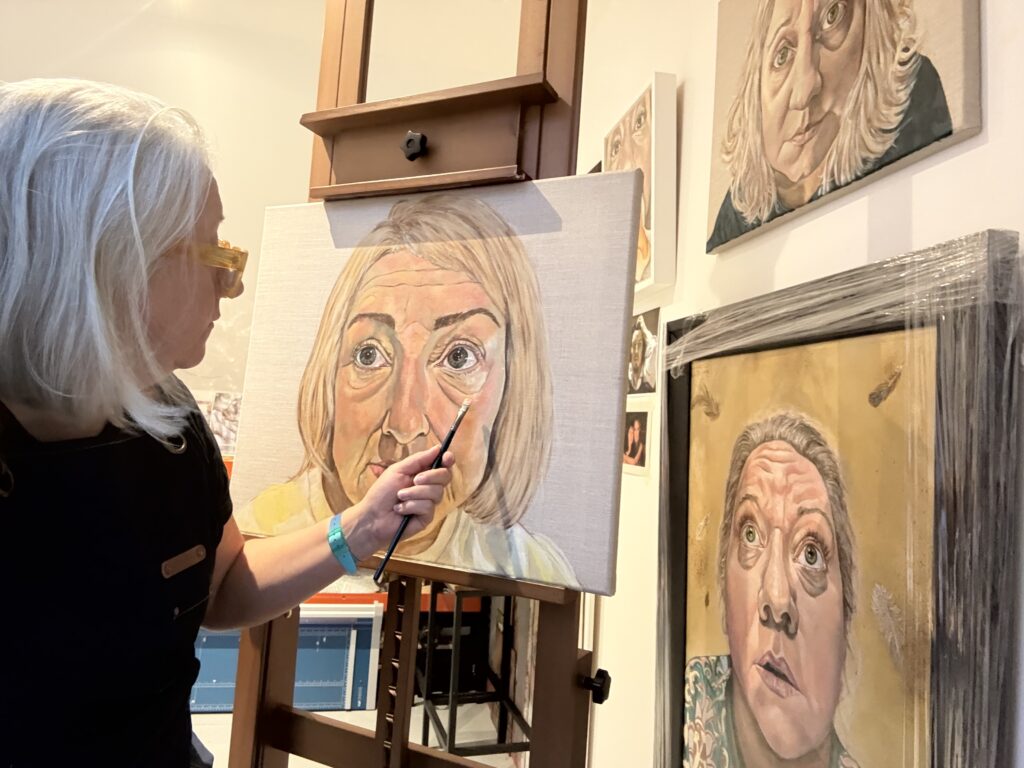
For her, portraiture has never been a mere exercise in likeness. It is a slice of human history, a moment shaped by the sitter and seen through the artist’s eyes, distinct from film or photography because of the freedom it gives her to choose colour, composition, and narrative for herself.
What drives her work is a frustration she knows intimately. As a woman, she has spent a lifetime surrounded by images built on society’s expectations of how women should look and behave, pressures that can distract us from simply being, thinking, and pursuing what truly matters. She has watched intelligent, accomplished women worry about a line on the face or the width of a waist, judged for their appearance rather than the qualities they bring.
Having felt those pressures herself when younger, and found real liberation in the confidence that comes with age and experience, she now paints the real sitter, not the version they feel they are expected to perform. For Maureen, true beauty lives within the human condition itself, in our strength and our fragility, our emotion and our deepest thoughts.
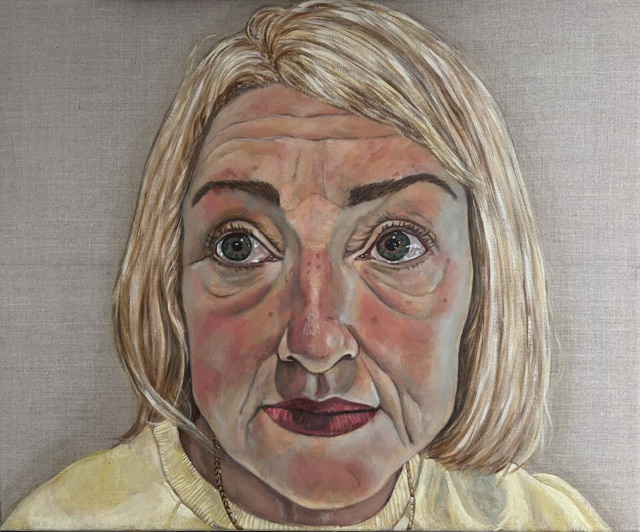
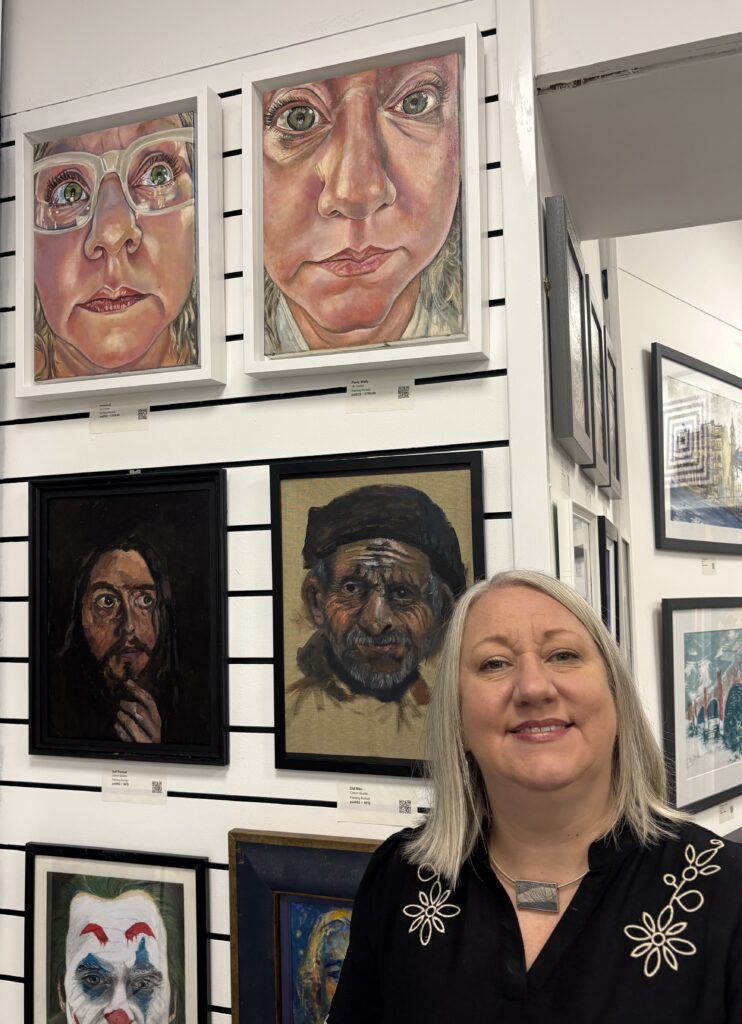
Her approach is deeply autobiographical, and rooted in genuinely knowing the people she paints. She is currently working on a series of dominant portraits of women she finds inspiring, each in a landscape orientation, the head filling the frame, set against nothing but the natural fibre of the linen so that nothing distracts from the sitter.
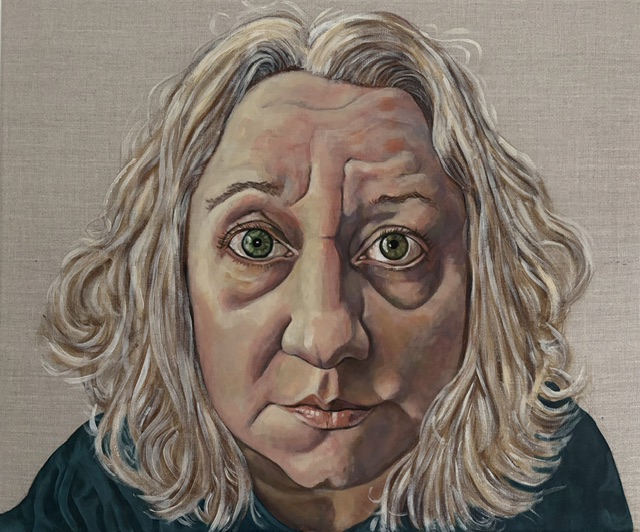
They are posed not for elegance or stereotypical beauty, but for experience and achievement. And though the compositions look alike on the surface, each is utterly different, shaped by the gaze, the thoughts, and the life of the individual woman, because, as she puts it, you could recreate a setting endlessly and never make two real people appear the same.
Much of this comes from another life’s work. Maureen spent many years in education, rising to head teacher in a male-dominated environment, and her experience of nurture, of how young people feel and express themselves, surfaces in her art on a subconscious level. She has seen first-hand the immense pressure young people face to match a social-media version of who they should be, and she wants her work to champion the inner voice instead.
Now let’s hear from Maureen about what first drew her to portraiture, what a female perspective allows her to explore, the self-portrait that became a turning point, and her advice for anyone returning to art after years away.
Q1. Maureen, could you share what first drew you to portraiture and the stories faces can tell?
I’ve always been fascinated by portraiture and the concept of capturing a glimpse into another person at a given moment in time. Capturing their likeness, character and sense of self at that point in time, and depicting their individuality has been something that has fascinated me since childhood. As a student I was drawn to figurative art through history.
The narrative created in the visual documentation of the human form and its ability to depict societal norms of its time drew me in. For me, figurative art and portraiture is more than a technical exercise in aesthetic representation, it’s a slice of human history. A moment in time created by the sitter through the eyes of the viewer and distinct from film or photography due to the individualised nature of the artist’s ability to depict the scene as they wish to in terms of colour, composition and narrative.
Q2. Your portraits explore women’s identities beyond societal expectations. What does a female perspective allow you to express?
As a women, I am bombarded with images created through the lens of societal representations and expectations of female aesthetics and behaviours. As such, women and girls can become passive supporters of entrenched norms that influence their decisions on how they present to the world. This can distract us from simply being, and thinking, and immersing ourselves in the activities that are important to us.
We are influenced by perceptions of appropriate presentation to worry about our appearance, our size, our age, our clothing when we could simply be considering our minds, thoughts, creativity and potential.
Men do not face the same pressures therefore the restrictions on how they present themselves seem less oppressive. This fascinated me as I believe we should all be empowered to be ourselves and to be ambitious for the fulfilment of our individual and collective potential. Looking at people through the lens of a woman who has experienced and succumbed to these pressures as a younger person, but sees the liberation and joy in self expression that comes with confidence and experience, is empowering to me. I want to depict the real sitter in my work as they truly are – not as they feel they are expected to be.
Q3. How do you choose the people and cultural references that become part of your paintings?
My work is quite auto-biographical in terms of the experiences that draw from. I enjoy connecting with the sitter. I have struggled in the past to produce work that fulfils an expectation of beauty or flattery regardless of gender. For me, true beauty exists within the human condition.
Our strength, and our fragility. Our emotion, and our deepest thoughts. I feel the subject matter for my work best conveys this when I know the character of the sitter well, and am comfortable enough with them to be open about our mutual expectation of the work. The cultural references that I draw from tend to be personal to the sitter and reflect daily tasks or interests, not allegory or fantasy.
Q4. When reinterpreting familiar portrait styles, what do you hope to reveal about the person being portrayed?
My intention in setting a composition is to convey the essence and character of the sitter. Images of portraiture have always existed, but each is a snapshot in time and as such, a sociological record of a human concept. The way they are posed, the restrictions – or freedoms – in the palette and composition – are all open to being adapted by the artist. For example, I am currently working through a series of quite dominant portraits of women who I find inspiring due to their own journey and influence. Each composition may on the surface seem identical, with a landscape orientation to depict how the sitter has pushed against societal norms and the head dominating the composition.
They are not posed for elegance or stereotypical beauty, rather for experience and achievement. The background is the natural fibre of the linen with nothing that could be seen to detract from the sitter or influence how they are perceived. However, despite the initial similarity of approach, they are all incredibly different due to inherent individuality and expression of each sitter. Their gaze, the thoughts they have when they pose, their life experience. You could recreate a setting over and over but could never be successful in making two genuine individuals appear the same.
Q5. How has your career in education influenced your artistic practice and the themes you explore?
My career in education has influenced my work deeply and on many levels. As a female head teacher/principal, I have worked within an environment which is inherently male dominated and that in itself presents frequent challenge and food for thought. As a woman, in leadership, there are expectations and projections that are brought to the table which I do not believe my male colleagues are equally challenged with.
Conversely, I feel my experiences as a women bring a deep understanding of nurture, and how young people feel and express themselves, that is beneficial to the role. I find this emerges in my art practice on a subconscious level. In addition, the journey of our young people is entrenched with the pressures of societal expectations and definitions of beauty or masculinity. The pressure young people face is immense. They worry all the time about how they are perceived and judged.
I want my art to promote their inner voice as human individuals and not what a social media pastiche of what they are expected to be.
Finally, equitable access to the Arts, irrespective of class or parental experience, has been a major priority for me as an educator. One of the most rewarding experiences of my career was taking regular trips to Paris, London and Barcelona that included young people who at times had never had the opportunity to explore beyond the parameters of their local housing estates. I recall my heart swelling with joy seeing one such young person confidently explaining Cubism to a tourist in the Picasso museum in Paris. This was a child who faced incredible adversity, and we had discretely funded the trip for them.
They were utterly animated by the experience of enjoying art and culture. Education is empowerment for our young people, and art challenges them to think, to see and to push the parameters of their potential. My role now is to support the next generation of educators to promote equality, equity of opportunity, creativity and nurture in their practice. What a privilege that is. I don’t think I can separate these values from my art practice. They are who I now am.
Q6. What first inspired you to challenge the ways women are represented in art and popular culture?
In short, being a woman has made me question representation. My daily lived experience. Seeing highly intelligent, educated and successful women worrying about getting lines in their faces, or the width of their waist, or the colour of their hair. Whilst I rejoice in each line on my face as it is the privilege of growing older and one which was not afforded my mother who passed away very young, I too am confronted with opinions about how I could improve my appearance.
This is generally now from female peers as opposed to men. Seeing women being judged for the way that they look rather than the qualities that they bring to the table is a source of deep frustration for me. These entrenched societal norms are still prevalent in society and art presents a vehicle to challenge prejudice and for women, and men, to lift each other up. In Art, we can all just be.
Q7. How has returning to your studio practice after years in education changed your approach to making art?
My career in education has been truly fulfilling to me. Seeing young people, and fellow professionals flourish, has been a constant source of tremendous joy. I feel this has increased my confidence as a professional and I have been able to transfer this self assurance to my artistic practice. My work with young people has also made me consider the social responsibility of being an artist.
The subject matter that we depict can influence a viewer positively, or conversely. We must be aware of our visual communication and its scope in progressing important views on certain issues. I think the fact that I am now more experienced has enabled me to be more assertive with my themes. I worry far less about how my work is perceived, and am more concerned about whether there is truth in my work than popularity.
Q8. Was there a particular painting that marked a turning point in your recent artistic journey?
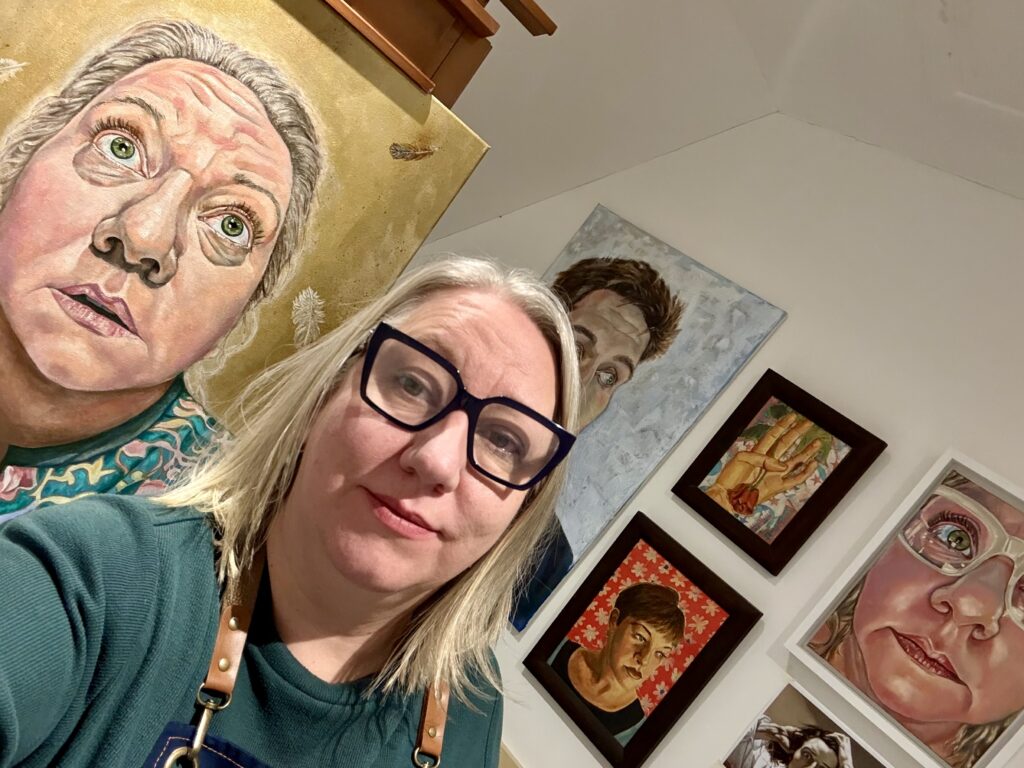
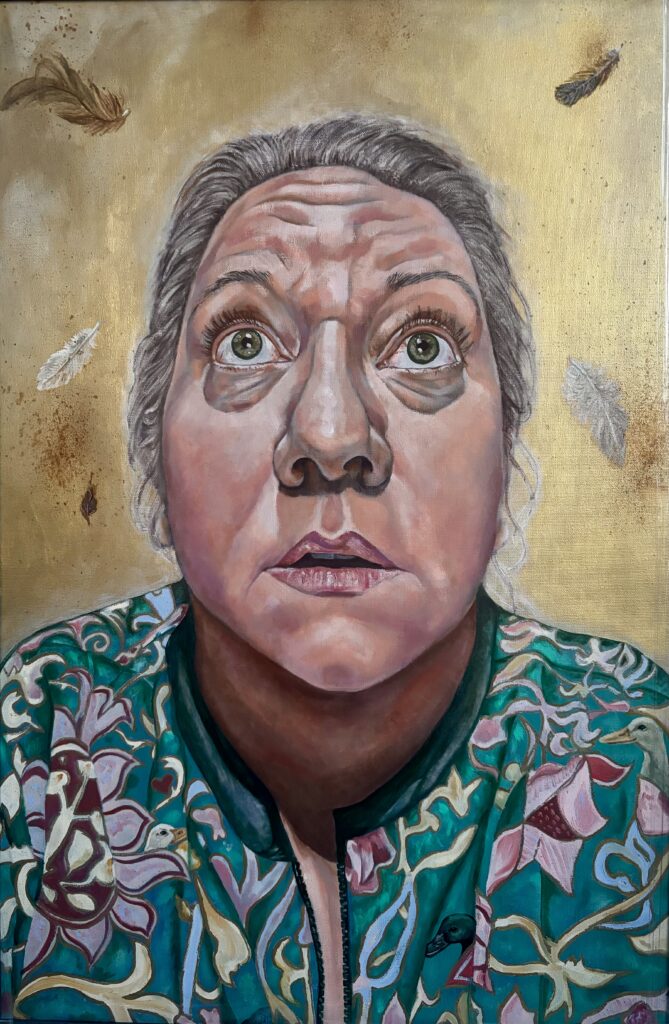
My self portrait ‘The Duck Keeper’ was a turning point for me. I had been working on A3 scale pastel studies and oil paintings which were exaggerated and cropped images of faces. I departed from this in ‘The Duck Keeper’ which was 84cm x 60cm and which focused on a fuller form. I found it liberating to return to a scale that I was familiar with from my earlier practice and simultaneously challenging. The result of this was that there was more scope for creativity and the inclusion of visual challenge within the composition. Since this piece, I have been more confident in executing larger scale works and in immersing myself in the medium of paint.
Q9. Do you think representations of women have genuinely changed, or do familiar stereotypes still persist in new forms?
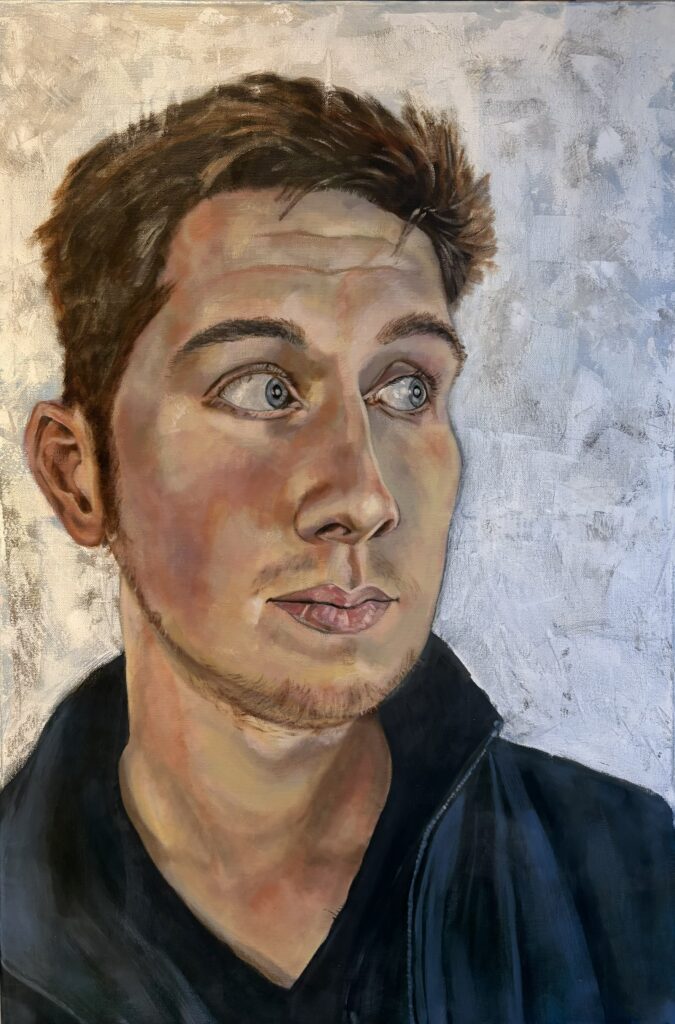
This is an interesting question because I think that depends entirely on the artist and the perspective of their gaze. There are still many extremely provocative and sexualised images of women in the art world emerging from particular artists. Similarly, the desire to confront this uncomfortable reality has at times resulted in a celebration of feminist empowerment which can be perceived as an extreme view, and at times, is at odds with genuine female expression.
Until we can truly represent the female form as being comfortable within our own skin, free of cultural expectation, I feel that there will always be discomfort in gender based representation.
Q10. How has your understanding of artistic success changed since graduating from Glasgow School of Art?
It certainly has. As a recent graduate, I felt emotionally overwhelmed by the art world and the competing expectations of young artists and their potential practice. There was an expectation that we would all fit a genre, a style, a group. As a young woman with considerable responsibility in my personal life, I did not believe I fitted a particular mould and this concerned me. Was I too commercial, traditional, not commercial enough, not pushing enough boundaries? It was difficult to fit within the established parameters that were available to me.
Now I believe that success as an artist does not require external affirmation. It comes from within. There’s a deep desire within every artist to create – an urge that simply cannot be suppressed. To effect this with authenticity and true conviction, while remaining open to positive influence and technical improvement, is for me the definition of artistic success.
Q11. What advice would you give artists returning to their creative practice after years away?
We all have one shot at life and it is both joyful and at times, extremely difficult. Art is beautiful – it is deeply rooted within the human condition. If you are an artist, you should not suppress it, for it could bring you great fulfilment and equally adverse challenge. Just let it emerge – for you. Not for anyone else. You will connect with people who share your values, and you will grow through your practice. This will bring you great satisfaction and will positively challenge those who view your work.
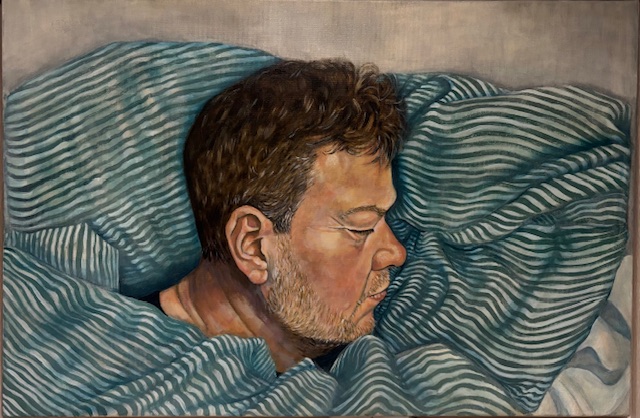
As we wrapped up our conversation with Maureen, we found ourselves returning to a question that has always lived at the heart of portraiture: whose eyes are we really seeing a person through? For centuries, the way women were painted said as much about the painter, and the society behind him, as about the woman herself, her pose, her beauty, her role all shaped by expectation. To paint a woman as she truly is, rather than as she is expected to appear, is quietly radical, and it is exactly what Maureen sets out to do.
Her work belongs to a long and necessary reckoning within the genre. Painting from a distinctly female perspective, she strips away the flattery and the performance, posing her sitters not for elegance but for experience and achievement, and letting the plain linen behind them refuse any distraction.
Her approach also challenges one of portraiture’s oldest assumptions: that a portrait should idealise. For Maureen, the truest beauty is found not in perfection but in the human condition itself, in strength and fragility held together in a single face.
There is a broader conversation running through her practice, too, one the art world is still working through: how women are represented, and who gets to shape that image. She is clear-eyed that old stereotypes have not disappeared so much as taken new forms, and that even well-meaning attempts to counter them can drift from honest female expression.
What she offers instead is something steadier, women depicted as comfortable in their own skin, free of cultural expectation, simply allowed to be. It is a reminder that representation is never neutral, and that the artist’s gaze always carries a responsibility.
For art lovers and collectors, Maureen’s work offers a portrait of a different kind: honest, unflinching, and quietly empowering. Rooted in a lifetime of looking closely at people, her paintings reward the same attention they were made with, revealing the individuality, strength, and interior life of each sitter. To live with one of her works is to live with a reminder that a person’s worth was never in how they looked, but in everything they carried beneath the surface.
Perhaps that is the enduring power of portraiture: it can either repeat the way the world sees us, or gently insist on something truer. A face may be where Maureen begins, but what she is really painting is the right of a woman to be seen, at last, entirely as herself.
Follow Maureen Daniel through the links below and explore more of her work and creative journey.
