
Susan Grabel Challenges Traditional Views of Women Through Figurative Art
At Women in Arts Network, Portraits brought together artists who turn to the human form to tell us something true about who we are. A portrait, after all, has never been only a face. It can be a whole body, and all the life, history, and feeling written into it. Each artist in this exhibition reaches for that truth in her own way.
Among the artists chosen for this exhibition is Susan Grabel, an American sculptor who has spent more than five decades shaping the human figure in clay, paper, and cardboard, and using it to speak about the people and experiences our culture too often looks away from.
Susan fell in love with sculpture almost by chance, as a student searching for a course to take, and once she found the studio, she never left it. But the path that followed was anything but easy. As a woman making figurative work in a macho, male-dominated art world that prized abstraction, and as an artist devoted to clay at a time when clay was dismissed as a serious sculptural medium, she was, by her own description, an outlier.
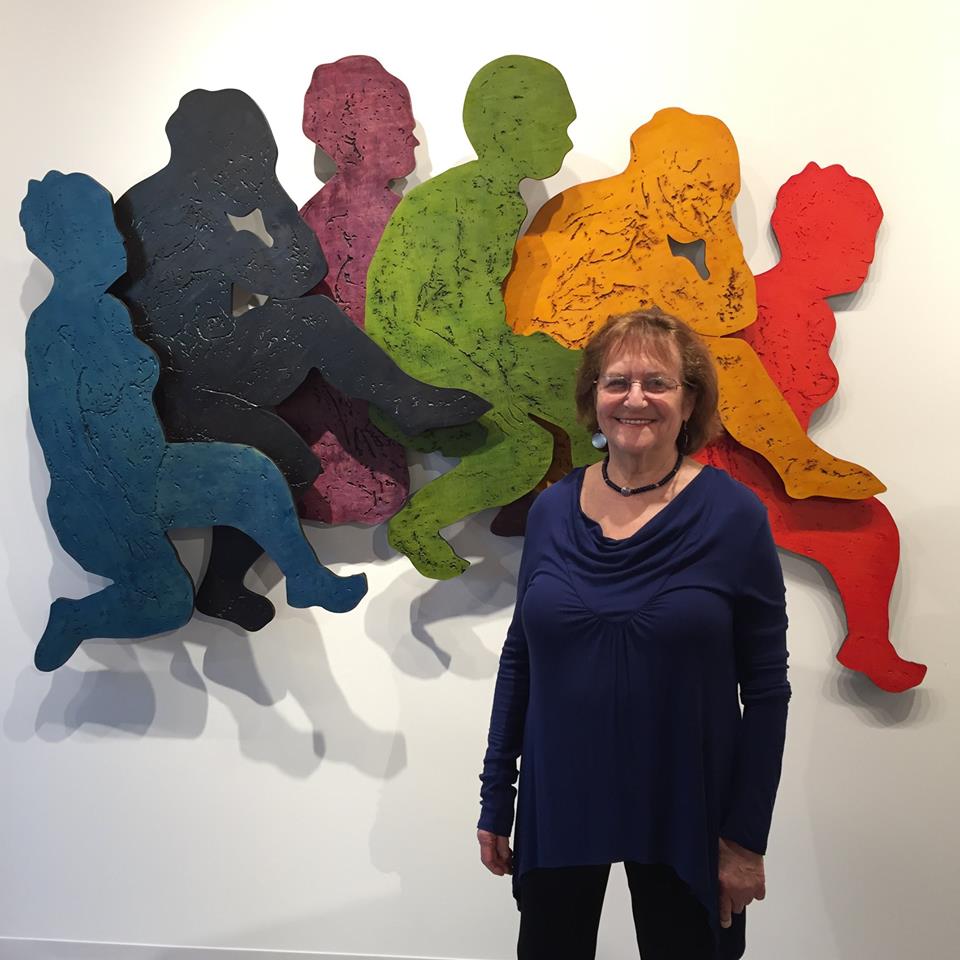
She learned early to trust her gut, to forge her own path, and to keep going with or without outside approval. The work, she decided, would be its own validation. Feminism has run through her life and her art from the very beginning, the simple conviction that women have the right to live up to their full potential, free of assumptions about who they are supposed to be. This conviction runs deepest in her sculptures of the aging female body.
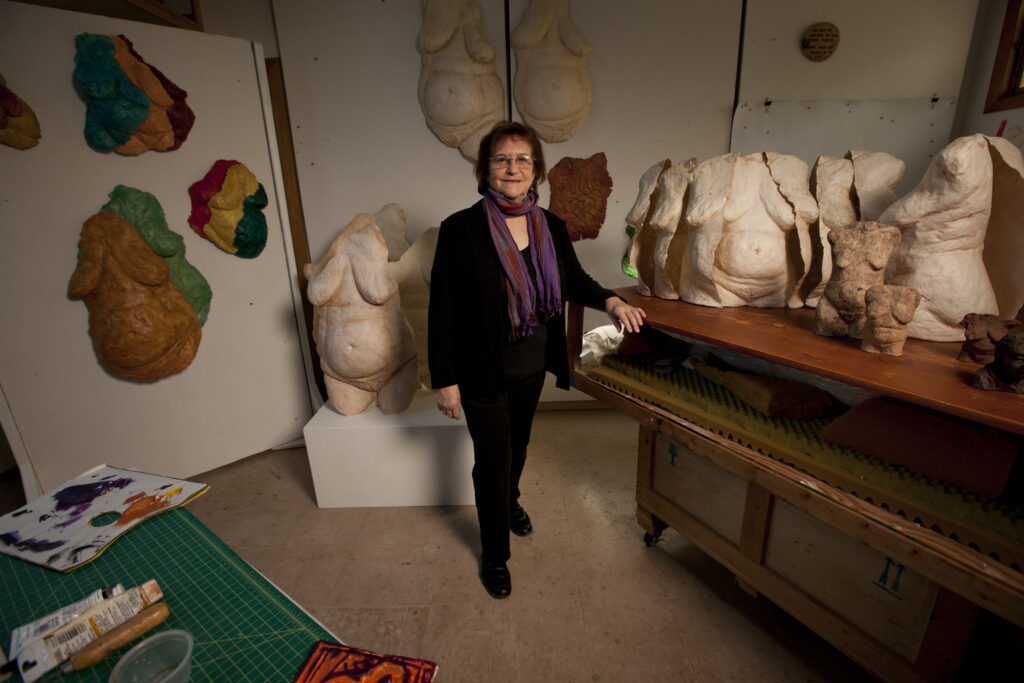
Surrounded by a youth-obsessed culture that offered no reflection of what she saw in the mirror, she set out to redefine beauty itself, portraying the older woman’s body not as something to be corrected or hidden, but as a manifestation of nature’s own cycles, sensual, dignified, and quietly powerful.
Her materials are chosen with great care. Handmade paper, light and tactile, carries an almost bodily sense of fragility and vulnerability, while humble, disposable cardboard becomes a way of holding and protecting something precious. In her hands, these ordinary materials turn into metaphors, for the structures we build around ourselves after loss, and for the fragile business of carrying memory and grief.
After more than fifty years of making, Susan’s work is finding wider recognition at last, entering museum collections across the country and recently taking centre stage as a featured artist in a university museum exhibition, a long-earned validation for an artist who never stopped doing the work.
Now let’s hear from Susan about the moment she fell for sculpture, what it meant to be an outlier, why she turned her attention to the aging female body, and her hard-won advice for artists still waiting to call themselves artists.
Q1. Could you take us back to the very beginning of your creative journey and tell us what first made you fall in love with sculpture?
I did a summer session at the University of Wisconsin at Madison at the end of my sophomore year at Brooklyn College to determine my major. It was between Math and English Lit. After 2 days of Analytic Geometry, I decided on English Lit and in looking for a substitute course to take, I homed in on Sculpture which I had been interested in at Brooklyn College but was daunted by the pre-requisites. I fell in love with the processes and spent day and night at the studio. That was it. I was hooked.
Q2. You’ve described yourself as an “outlier” in the 1970s. How did being an outsider shape your determination as an artist?
As a woman figurative artist in a macho male dominated abstract expressionist art world, as a clay artist when clay was not taken seriously as a sculptural medium, I have felt frustrated and bewildered at times not knowing how to get past the obstacles but I don’t know another way of being.
I have to trust my gut with the work and forge my own path and keep going even when there is little or no outside validation. The work is the validation.
Q3. Feminism has been an important part of your artistic life. How has your understanding of feminism changed since you first became involved in the women’s art movement?
I see Feminism as the belief in social, economic and political gender equality and that has not changed. I believe that women have the right to live up to their potential as human beings without constraints or assumptions about their gender roles and that has not changed. How that gets expressed has changed.
I have a broader understanding and tolerance for different expressions of feminism because a feminist action in one culture or at a particular time looks different than in another culture or time. I undervalued my stay-at-home Mom. I felt that she never realized her potential which was true but I began to understand where she was coming from.
She grew up in a luncheonette playing with dolls and taking cash at 8 years old, seeing the hard life her parents had. When she married my dad who was an accountant and doing well for his time, she didn’t have to work. THAT for her was liberation.
Q4. Your Venus Cycle challenged conventional ideas surrounding the aging female body. What prompted you to focus so directly on women’s experiences of aging and visibility?
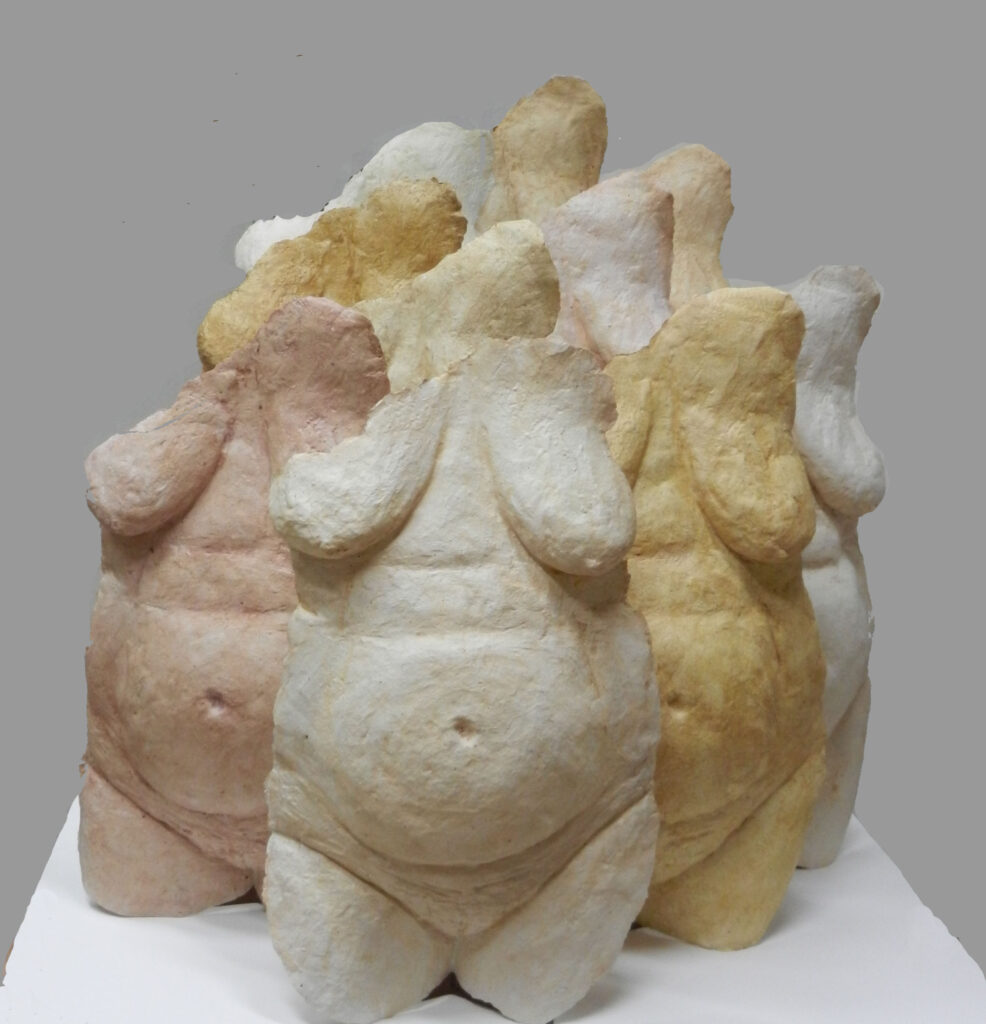
In the late 1990’s, I started being more aware of the changes in my own body and the lack of positive images of aging women in our youth-oriented culture. I felt bombarded by media images that bore no relationship to what I saw in the mirror daily.
So I started a series of sculpture in handmade cast paper to redefine Venus and upend conventional views. I see the aging woman’s body as a manifestation of nature’s patterns and cycles and wanted to show its beauty and sensuality.
Q5. How has your own relationship with the female body changed as you have moved through different stages of life?
Our culture is so critical of women’s bodies. We’re too fat, too thin, too busty, too flat chested, too tall, too short. It’s hard not to internalize that. I always felt there was something wrong with my body. I’ve been very aware of the changes as I get older. The smooth skin and tight muscles give way to lines on my face, crepe skin on my arms, sagging boobs, bulges but in a strange way, I’m more comfortable in my body now.
And as an artist, I’ve been fascinated by the changes and finding it all very interesting sculpturally. When I look at pictures of myself as a young woman, I feel sad that I didn’t appreciate my body then. I had a nice body. I wasn’t “too” anything.
Q6. Your work has addressed homelessness, alienation, war, consumerism, reproductive rights, and social inequality. What makes a social issue feel urgent enough for you to turn it into art?
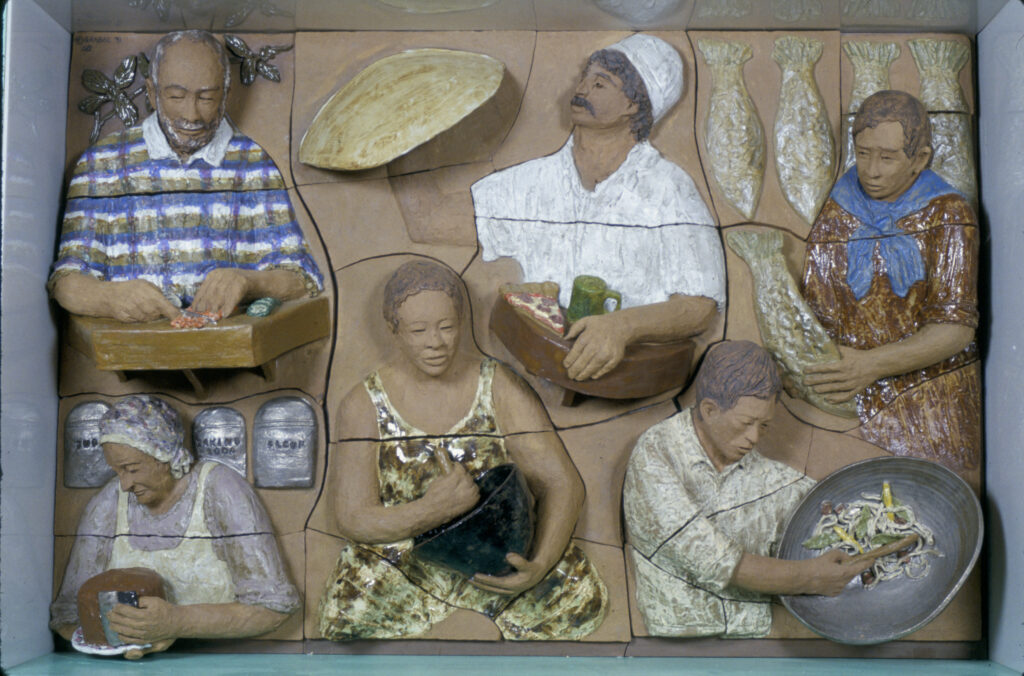
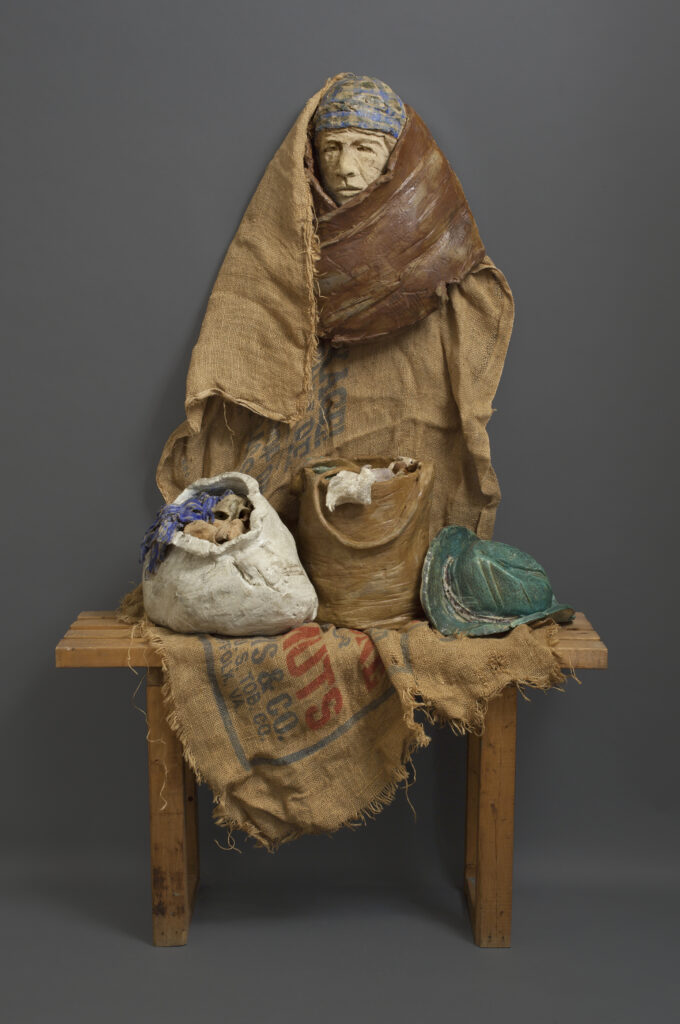
I have always had strong feelings about these issues but what brings it out has to do with what’s happening in the world and in my own life at a particular time. The work on consumerism came out of feeling strangled by possessions after buying a house for the first time. The work on homelessness came in the 1980’s when there was a burgeoning of homeless people living on the streets of NY. I was commuting to a job in the city daily and saw a homeless man huddled by an elegant store window.
The contrast and inequality was so striking that felt compelled to show the humanity of homeless people and tell their stories.
The work on women’s reproductive rights has become front and center as anti-abortionist politicians have been chipping away at women’s rights since Roe vs Wade was enacted in 1973, and now they are criminalizing pregnancy and women are dying.
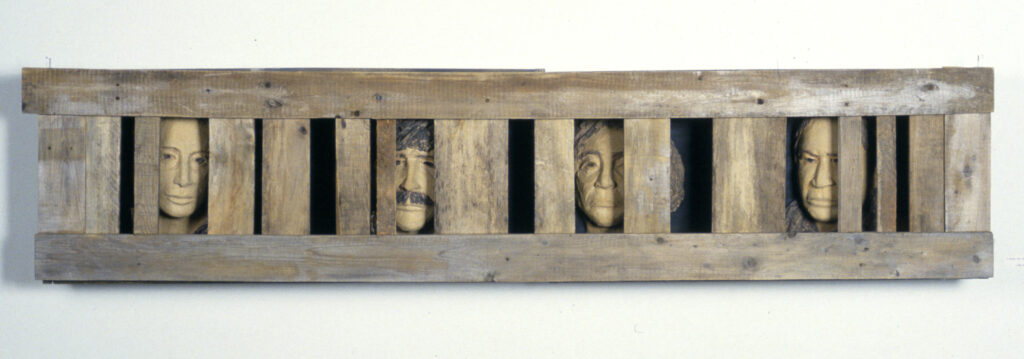
Q7. In Faces of Alienation, you placed clay portraits behind grates, screens, and wooden barriers. What interested you about the idea that something created for protection can also become a form of imprisonment?
I’m always interested in contradictions. I was thinking about how easily protection can turn into confinement. We build walls and barriers to protect ourselves, but the irony is that those same barriers isolate us.
Q8. What attracts you to handmade paper and cardboard as materials for addressing subjects such as memory, grief, and vulnerability?
Handmade paper is light and has a very tactile, almost bodily quality. It gives the feeling of vulnerability and fragility. The molded cardboard, an ordinary and disposable material, is used to hold and protect something precious. It also represents the structures we build around ourselves after loss, creating a protective enclosure around something fragile. It’s a metaphor for holding memory and grief.
Q9. What would you say to younger women artists entering an art world that is very different from the one you encountered in the 1960s and ’70s?
In terms of the work, the advice is the same. Stay true to yourself and keep doing the work and follow it where it goes. In terms of the career aspect, there are more opportunities for showing now than in the 60’s and 70’s but you have to take charge of your own path. Use social media, show wherever you can. Join a feminist organization or gallery. Women used to be concerned about being ghettoized, but you are a woman, there’s nothing wrong with leaning into that.
Q10. What does success mean to you now that you are giving your art a much larger place in your professional life?
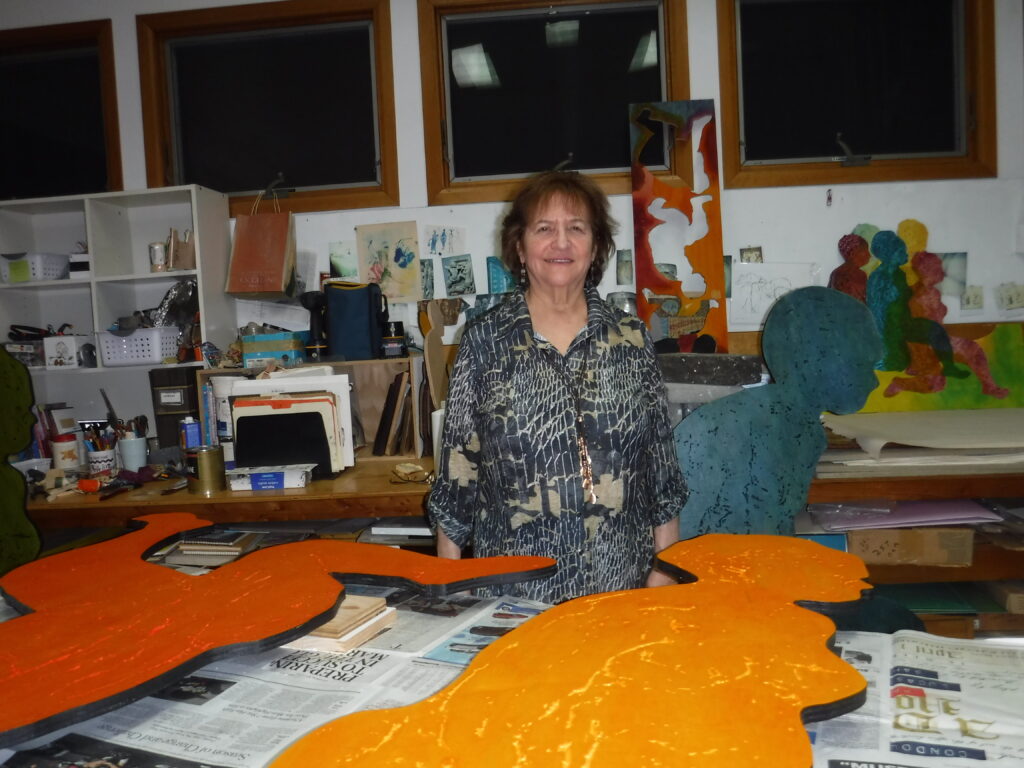
Success is getting the work out and seen and appreciated whether through exhibitions, donations or sales. I have shown extensively but I feel that all the showing and networking I’ve done over the years is finally bearing fruit. I have finally had some success in having work accepted into several museum collections across the country and am also currently the featured artist in an exhibition at Hofstra University Museum of Art and that all feels validating.
Q11. After more than five decades of making art, what still makes you want to begin the next piece?
It’s a calling. It’s what I need to do for my sanity and well-being. I love the processes and have a strong need to express my concerns visually. I am not comfortable in myself if I’m not involved in making art in some way.
Q12. What would you say to artists who feel they started too late, or who are still waiting for permission to call themselves an artist?
Too late for what? It’s never too late to express yourself creatively. Just do the work. You will know yourself when you can comfortably call yourself an artist.
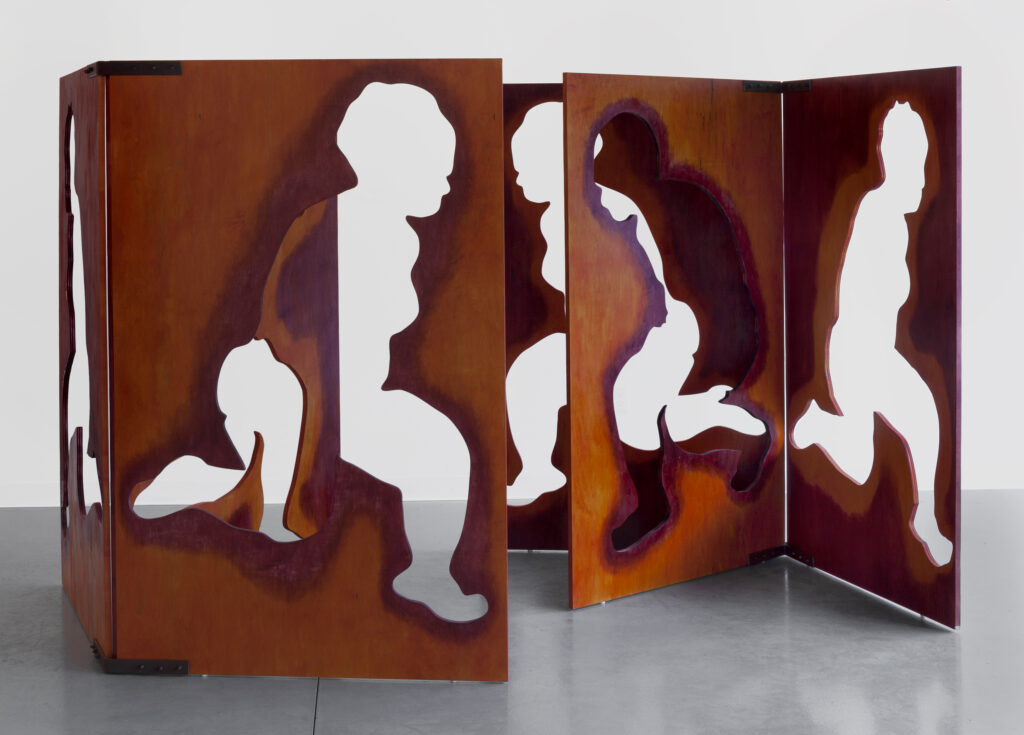
As we wrapped up our conversation with Susan, we found ourselves thinking about who gets to be seen. For centuries, the figure in art celebrated youth, beauty, and power, bodies the world already admired. But the deeper purpose of portraying a human being has always been to confer a kind of dignity, to say: this person, this body, this life matters. That is exactly what Susan’s work insists upon.
Her sculptures turn their attention to the bodies and people our culture would rather not look at, the aging woman dismissed by a youth-obsessed world, the homeless man invisible on a busy street. Rather than idealise or pity them, she renders them with honesty and tenderness, finding beauty in the aging body’s natural cycles and humanity in those pushed to the margins.
Her work gently challenges the idea that art should only show us what is young, polished, or comfortable. Sometimes its truest task is to make the overlooked impossible to ignore.
There is a larger story running through her five decades of work, too, one the art world is only now reckoning with. Susan built her practice as an outlier, a woman making figurative sculpture in clay when both were dismissed as unserious, pressing ahead with little outside validation because, as she puts it, the work itself was the validation.
That the art world is finally opening its doors to artists like her, honouring the materials and subjects it once overlooked, is a quiet vindication, not only for Susan, but for a whole generation of women who refused to stop making. It is a reminder that the hierarchies of what counts as serious art were never permanent, and were always worth defying.
For art lovers and collectors, Susan’s work offers something rare and necessary: sculpture that is as compassionate as it is unflinching. Made from humble, fragile materials, handmade paper and ordinary cardboard, her pieces hold memory, grief, and resilience in forms you can almost feel. To live with her work is to live with a reminder of the dignity in every body and every life, especially the ones the world is too quick to pass by.
Perhaps that is the enduring power of portraying the human form: it decides who is worthy of being seen, and insists that everyone is. Susan may begin with a body in clay or paper, but what she is really sculpting is visibility itself, for the aging, the overlooked, and the unheard.
Follow Susan Grabel through the links below and explore more of her work and creative journey.
