
Ana Magallón Turns the Beauty of Nature and Its Destruction Into Powerful Visual Stories
At Women in Arts Network, our latest exhibition, The Beauty of Still Life, set out to celebrate one of art’s quietest and most enduring traditions. For centuries, still life has asked us to slow down and look closely at the things we usually pass by, and to find, in that stillness, a surprising depth of feeling. It is the art of noticing, of discovering beauty in the overlooked. Each of our selected artists honours that spirit in her own way.
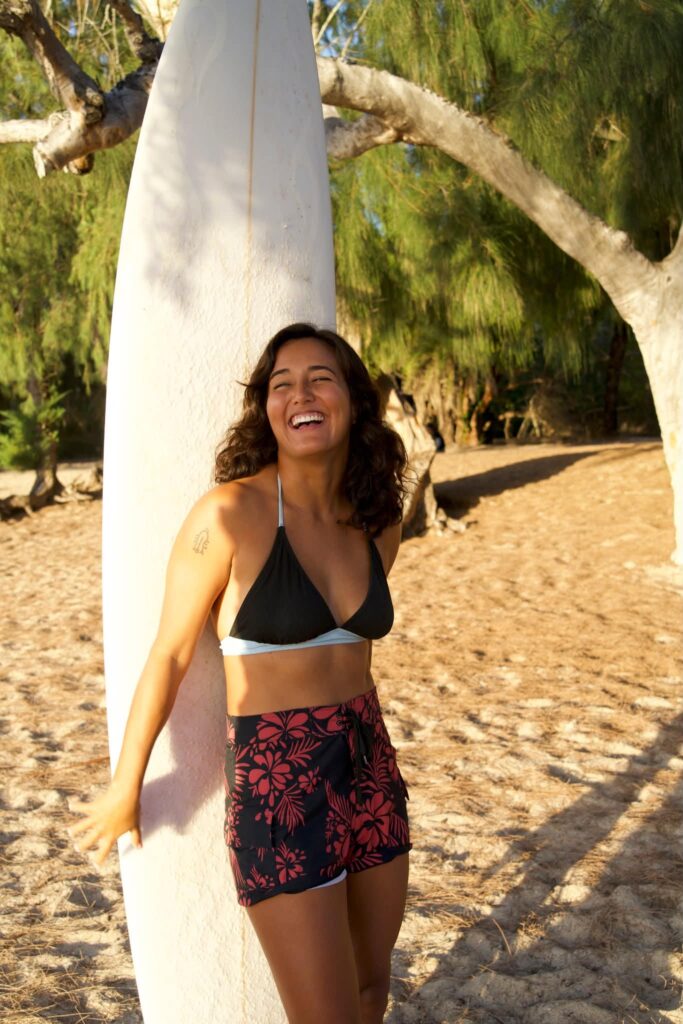
Among them is Ana Magallón, an emerging Mexican-born artist now living in Waialua, Hawaii, whose work has a rare gift for drawing us into a scene and making us feel we are part of its story.
Ana comes from a long line of artists and designers, and she has been drawing, as she puts it, since she could hold a crayon. She went on to earn a double Bachelor of Science, in Art and Illustration, and in Digital Cinematography, and that cinematic eye shapes everything she makes.
Rather than offering a scene to be observed from a distance, she wants to absorb the viewer inside it, to make them feel like a character in the story rather than someone simply standing before a piece on a wall.
Her inspiration comes from two places at once: her dreams, and the real, often desolate landscapes she has known, the mountains and oceans of Mexico and Hawaii, and the vast southwestern deserts of the continental United States. Remembered and reimagined, these places run through all her work, from surf and dreamscapes to pieces reflecting on humanity’s impact on the planet.
She works across a wide range of two-dimensional media, acrylic, watercolour, paint markers, graphite, pen and ink, and epoxy resin, and has recently begun branching into three dimensions, experimenting with found-object sculpture, clay, and textiles. Whatever the medium, her true subject is feeling, and the quiet power of a single, atmospheric moment.
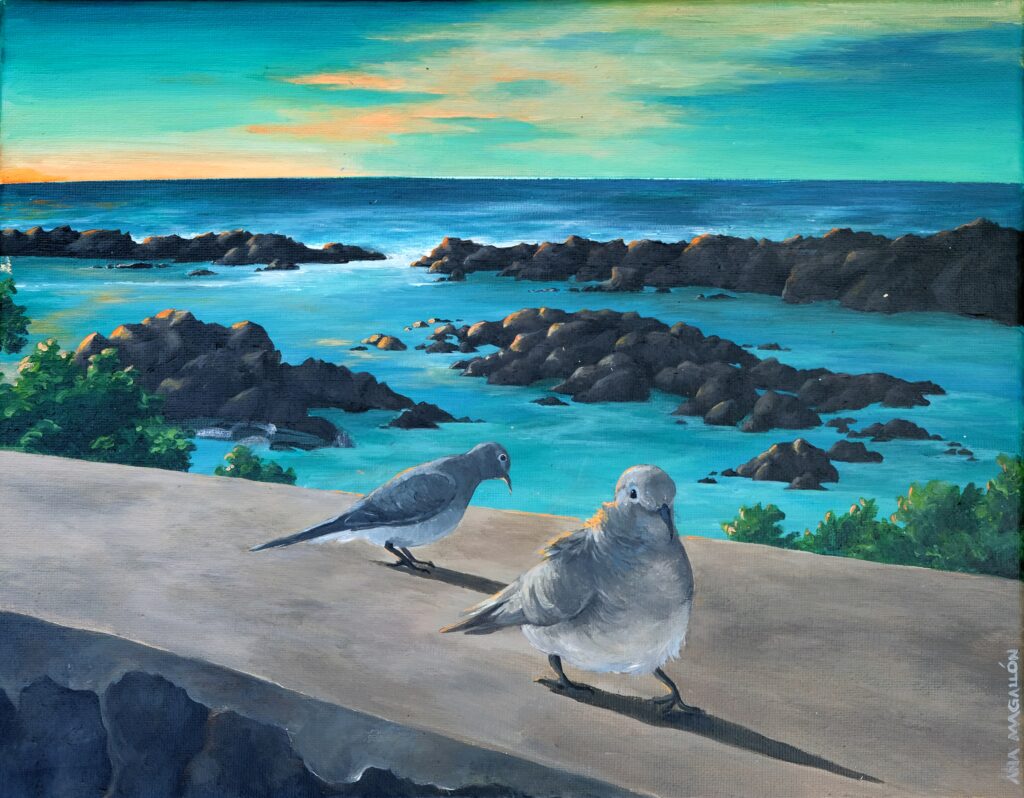
And it is that attention to the quiet and the overlooked that sits so beautifully within this exhibition. Alongside her more dramatic subjects, Ana lingers on the small, easily missed moments, a pair of contented doves resting on a wall, a modest sunset over her Hawaiian neighbourhood, finding in them a depth of feeling that rewards anyone who stops to look. When a subject moves her, she gives it the spotlight, trusting that if it speaks to her, it will speak to someone else too.
Now let’s hear from Ana about the childhood that first put a crayon in her hand, how her filmmaker’s eye shapes her painting, why she lingers on the quiet moments others miss, and her advice for staying true to your own creative voice.
Q1. Ana, could you tell us about your background and what first inspired you to pursue art?
I’ve been drawing since I can remember. My dad always encouraged it, making sure my sibling and I always had ready access to art supplies, even when our family was in financial straits.
I remember when I was 5, someone gifted me one of those art briefcases that comes with colored pencils, markers, paper, pastels, etc., and it was the best gift I had ever received. When I was 9 years old, I stumbled across Hayao Miyazaki’s Spirited Away on TV. It was strange and magical and unlike anything I had seen. It turned out that whatever channel it was was showing like a month straight of Studio Ghibli movies, so I watched as many of them as I could.
That was when I realized that drawing could be more than something I did when I was bored. For the first time, I was motivated to learn how to get better. I found concept art books and Hayao Miyazaki’s Nausicaa graphic novels and started copying characters, paying attention to expressions, perspective, and cross-hatching. Since then, I’ve discovered hundreds of artists, from classical to modern, who have continued to feed my inspiration and drive. If I’m near an art museum, I go. If there’s a local art market going, I make a stop. If there’s an opportunity to try a new medium, I do it.
However, despite my love for art, I never pursued doing anything professionally with it, in part from fear, in part from listening to the wrong voices that told me it was impossible. This year, 2026, is the first time that I decided I was sick of not knowing and wanted to see where I could take it. You never know until you try. My goal is to get into some galleries and make some side-income (or full-time income) with my art or perhaps find an illustration, concept art, or storyboarding job.
Q2. How has growing up around different places and outdoor environments shaped your approach to illustration?
New environments, people, cultures, settings feed the imagination.
I believe we will stagnate as creatives if we’re only ever in the same environment repeatedly receiving the same input.
No one can deny that the natural world provides an endless sea of inspiration in creatures, places, textures, colors, moods, whether through dramatic environments like the ocean or more “mundane” places like a park. Life is ever-moving and ever-changing.
When I started drawing more consistently at 9 through high school, I primarily drew people. I was intrigued by the nuances of facial features and expression, whether drawing realistically or trying to capture emotion in a few simple lines, like Miyazaki or Bill Watterson do. In my adult life, my work has shifted to include more environments. In part, I think it’s because all of the amazing places I’ve experienced begin to haunt me and beg to be shared with others.
And in addition to being an artist, I’m a writer and filmmaker, which has made me want to involve the viewer in my painting and drawing. I seek to invite them to feel like a character in the scene rather than just a passive observer, much like one does when reading a novel or watching a movie. In that way, the viewer can visit some of the places I’ve been, including some of the ones they may never get to experience in real life.
Q3. What draws you to capturing the energy and atmosphere of surfing through painting?
As a surfer, I’m constantly thinking about surf when I’m not doing it– remembering my best waves and worst wipeouts, recalling conditions on different days, trying to figure out how to improve. I even have regular dreams about surf. I grew up doing a lot of extreme sports, but water sports, and surfing in particular, are the most dynamic and exciting to me. There’s so much going on at any given moment, and all your senses are firing at 2x speed, yet you still have these magical slow motion moments.
I see a lot of photographers and videographers capturing surf action amazingly, but I hadn’t seen paintings of surf that truly captured the energy and spirit of it. With no disrespect to existing surf painters, a lot of the work I have seen feels more like a postcard– peaceful and pretty but without the excitement. I wanted to give a sense of what it feels like to surf. How bold and even unearthly the colors can seem at sunset sometimes.
The speed at which everything happens. The strange serenity of it even in the midst of an adrenaline-filled moment. I don’t know that I am yet achieving those things, but they’re what I’m set on capturing in my surf art. It’s a way to share one of my greatest passions with both those who know the sport and those who will never hold a surfboard. And I think it’s a unique subject for fine art. I’m often motivated to paint art I haven’t seen done before– art that I wished existed so I could put it on my wall.
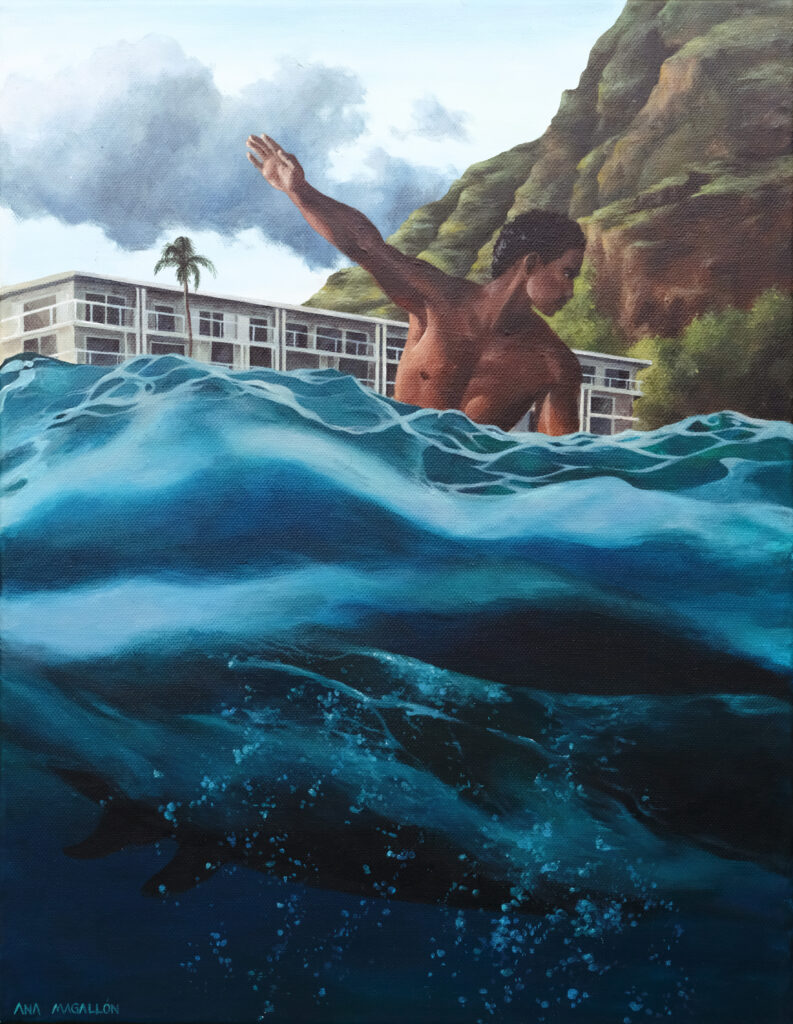
Q4. What inspired your Our Anthropocene Age collection and its focus on environmental change?
I think this ties back to the second question and spending so much time outdoors. Even in my lifetime, I have seen the impact of industrialization and tourism on places I love. For example, there’s a waterfall we frequented in high school that, at the time, was pristine and remote. You hiked along a crystalline river among massive cypress trees and arrived at a rocky pool holding water of the purest turquoise and aquamarine tones.
A towering waterfall tumbled into the pool along a craggy cliff. At night, we set our sleeping bags on the sand under the stars, listening to the rushing of the water as little glowing bugs crawled along the riverbank. Now, only about 15 years later, the place has become a weekend party destination. Tourists show up in vans, litter lines the river, the waterfall’s roar is contested by blaring boomboxes, and the formerly pure water swirls with sunscreen eddies.
Rising sea levels and climate-change fueled storms have demolished the beach of my childhood in Acapulco, Mexico. When I was a kid, we’d visit my grandma there. The expansive white-sand beach was perfect for sand castles and throwing frisbees. Now, the sand is gone, and the ocean comes right up to the street, the waves breaking directly against the cement buildings.
I could tell dozens of stories based only my own experiences. And anyone who spends extensive time outside has their own too. Farmers, fishermen, divers, lifeguards, surf instructors, wilderness guides, first responders, etc. Some of my work is meant to communicate a message. Some of it is simply to process my own grief at the destruction we’ve caused and continue to cause. It sounds melodramatic, but it’s true.
Q5. What interests you about exploring dreams and surreal imagery in your Oneiros Dreamscapes collection?
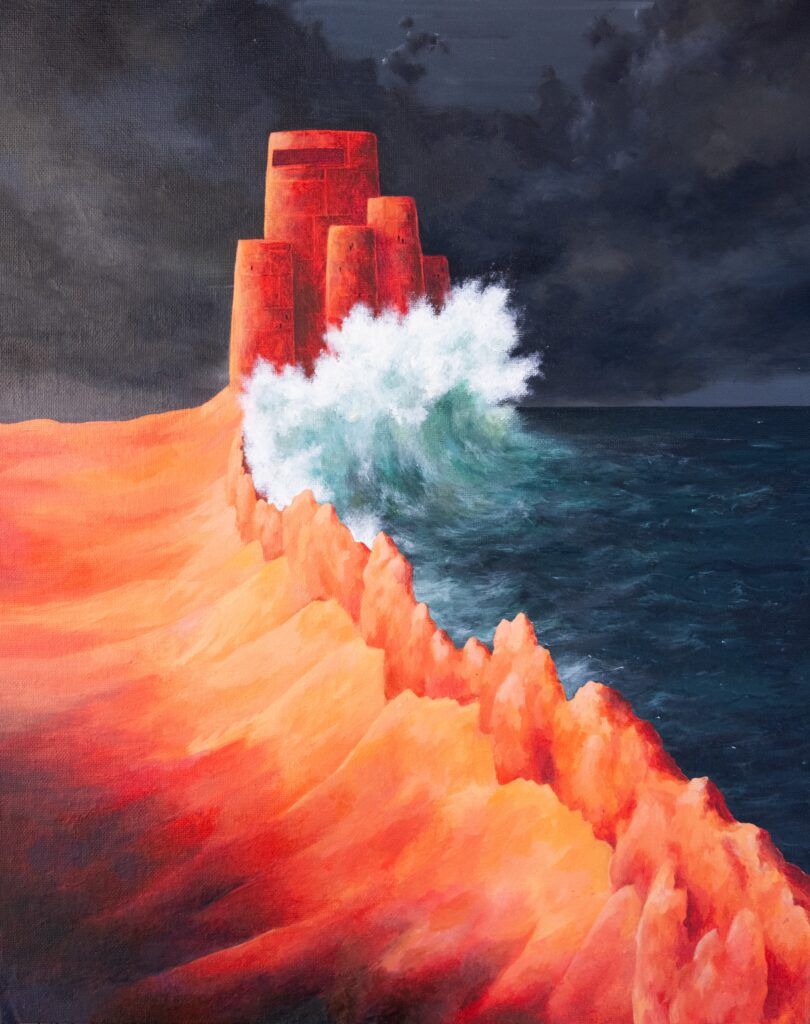
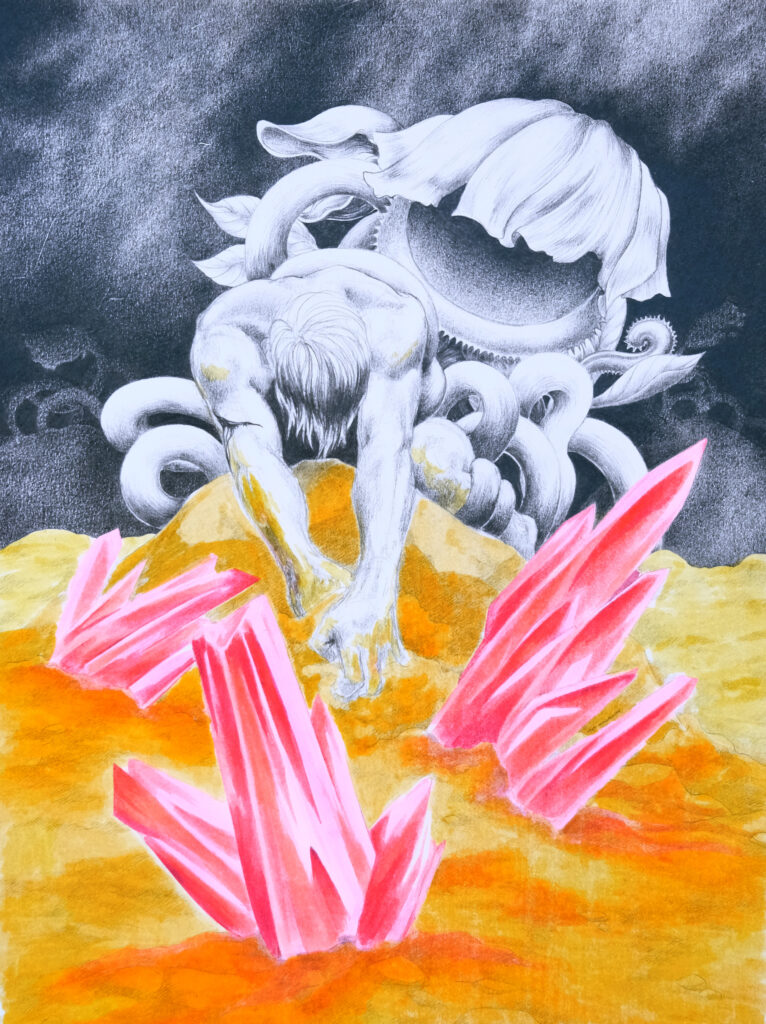
I’ve always been fascinated by dreams. The way our brain misfires in our sleep, gathering everything we’ve ever experienced and throwing a rager with it. Sometimes our dreams are nonsense, other times they ring true in ways we’d rather they didn’t. Oneiros is an ongoing project that melds dreamscapes with the reality of a dying earth (so it’s closely related to my Anthropocene Age work). Most of the dreams I’ve had since I was a kid til the present day (and remembered) have been post-apocalyptic of some kind.
But recently, my dreams have turned from the out-there post-apocalyptic style of zombie movies into more realistic, existential dread-driven dreams based on environmental and societal collapse The idea for Oneiros was born when my husband and I were driving through Vegas on a summer day in 2024. It was 118 degrees Fahrenheit outside. Even blasting the AC in the car, I felt physically sick.
There were headlines of people getting 3rd-degree burns from tripping and touching the asphalt and others of people getting heat exhaustion in air-conditioned planes that waited too long on the tarmac. It was so bizarre to be in an already-dystopian place like Vegas and have these things happening around us. It felt like a bad dream. But unfortunately, we knew it was no dream. So Oneiros became an art project that plays with that line between sleeping and waking, when you’re half conscious but half dreaming still and have a hard time separating what’s real from what’s not.
It explores our dying earth from both a realistic side and a surreal side and delves into the emotional difficulty of facing reality and hiding behind fiction. We don’t want to believe our earth is dying. We don’t want to accept the damage we’re doing and what immediate effects we’re having, so we go on pretending it’s fake and that everything’s okay. And so much of it ends up feeling like a dream– so much so that sometimes we can’t remember what we dreamed and what is actually real.
Q6. How do you translate dream memories into finished artworks?
I have tried to capture exact scenes from my dreams many times and failed. So over time, I’ve focused more on capturing the sense and essence of the dreams.
I aim to share what I felt in that moment with the viewer. If they can get the ambience or mood I experienced in the dream through my painting, then I’ve succeeded.
So, for example, even if an element or building doesn’t look the way I remember it looking in my dream, but the lighting or colors communicate the emotion I felt when in the dream, then its a successful piece.
Q7. What connects your realistic scenes and more imaginative compositions?
I think everything is entwined for me. Color and/or light, and emotion drive all my work. It’s all about setting the mood, so whether I’m painting a surfer at dusk or a fantastical philosophical piece, I’m seeking to evoke specific emotions via color and light. Maybe it comes from my filmmaking brain. But imagine a scene in which a little girl plays with her dolls on her bedroom floor. The lighting is warm and soft, like afternoon sun diffused through curtains. The colors of the scene are cheerful pastels. What does that evoke? Now imagine the same composition.
Same girl, same toys, but the lighting is cold and bleak with start shadows, like the eery light before a storm. The room’s colors are dingy, tones of blue and gray. What does that evoke? That’s the same approach I have for every piece. How do I make the viewer feel like a participant in the scene, regardless of whether it’s an action scene, a landscape, or something surreal or dreamlike. It’s all about the emotion. I establish what I want the viewer to feel and reverse engineer it from there, determining colors, lighting, composition accordingly.
Q8. How do you address environmental issues in your art without overwhelming the viewer?
This is a tough question, because I often feel overwhelmed by the subject myself.The best I can do is to point to my 9 Planetary Boundaries series. I painted them as colorful abstract designs as a way to balance the gravity of the situation. People have been drawn to them for their vibrance, which leads them to ask the meaning behind them.
This has led to many meaningful conversations about our environmental impact which lead me to discuss Environmentalist David Suzuki’s perspective that despite how far we’ve pushed things, we can still choose to make a difference by investing in our communities. Creating pieces that encourage questions, engagement, and productive conversations regarding what we we can still do is a way to balance the seriousness of the issues at hand.
Even with the tougher ones, like From Anthropocene Waters, I seek to encourage conversation. People may be startled by it, but then I strive to have actionable steps they can be encouraged with taking when they ask about it. But this is something I’m still discovering and improving on. It’s a difficult area to explore as an artist.
Q9. What emotional thread connects the different subjects you explore in your work?
I think the common thread among the varied subjects of my work is how deeply it moves me. Whether it’s a painful environmental image, a peaceful commonplace scene, a bleak, surrealist landscape, or an adrenaline-filled wave, all evoke the strongest of emotions for me– emotions I seek to share. Deep grief and deep comfort, awe and wonder. Even the ecstasy of surf. All of these span the things that speak the loudest to me and evoke vivid imagery that may be literal and experienced or abstract and metaphorical.
Or a mix of both. For example, a lot of my Oneiros work was directly fueled by backpacking through a swathe of desolate New Mexico desert, once in the heat of summer and once in the midst of a blizzard. I didn’t have to concoct the colors or shapes, and while I may have added fictional elements inspired by dreams, the emotion behind these pieces mirrors what I felt. I knew I couldn’t do the accurate settings justice, so I added elements to convey what I felt in those places.
I don’t think that’s any different than when I paint a quiet sunset in my neighborhood, seeking to share the sense of comfort that brief moment brings– a moment that many may have missed since it didn’t bear the glory of a more flashy sunset. In the end, everything I portray is deeply familiar and moving to me. My waking life fuels my dreams which motivate my waking thoughts and so forth. And emotion is the same throughout the experienced and imagined moments, the otherworldly and the mundane places. Ultimately, what I paint is what spoke to me. And I never know what will speak to me next– it’s often not what I think it will be.
Q10. What have different projects taught you about your creative instincts?
I think I’m learning a lot about my instincts even through thinking about and answering these questions.
I’m realizing that for me to be satisfied in a piece from start to finish, it has to have emotional impact for me.
I could have the most gorgeous photo reference in front of me, but if it doesn’t speak to me at a personal level, I’m not going to enjoy painting it. I will probably give up or, if I manage to finish it, I will probably not be happy with the final piece. I’ve been asked about one of my recent paintings, “Why the zebra doves?”
My simple answer was that I saw them standing on that little wall, and they moved me so deeply. I love zebra doves, and these seemed so particularly content that I wanted to paint them. I felt they deserved the spotlight rather than the ocean or sunset behind them. If it moves me, I’ll enjoy the creative process AND the final result.
Q11. How do you balance personal projects with commissions and commercial work?
This is a question I think about constantly. I’ve extended to painting subjects that I might not have explored for myself to try to make my portfolio more palatable. I tried pigeon-holing myself into styles or subjects that didn’t speak to me. This year, I think I finally arrived at a healthy place. I know landscapes and sunsets are crowd-pleasers–but I realized if I was going to tackle those subjects, I still had to do it in a way that was true to me.
Hence the Zebra Dove and the Waialua Dusk pieces. I found that I do enjoy painting scenes like these if I can choose a uniques perspective or unique colors. This way I could produce work that might be more commercially palatable for art markets and art shops than my surrealist dreamscapes while still holding onto my artist voice and process.
Regarding commissions, I do believe in holding fast to one’s style. If someone is commissioning me, I assume they’re hiring not just me but buying my style. If someone wants me to replicate someone else’s style or work in a medium that I don’t like, I tell them no. I’m willing to strike a balance between what the client wants and what I want– after all, they’re buying the piece. But I will always refuse to create something that doesn’t feel like me. If they don’t like my style, they may need to find a different artist. I think this is a personal process for every artist.
Some are willing to make compromises, some are unwilling to bend at all, and I think that’s okay. I have found that I always have to have some degree of passion for a project to avoid burnout, so I’ll never create work for galleries, markets, or clients that don’t have my soul in them to some degree. This allows me to have motivation and energy left for my own passion projects. And sometimes you get lucky, and a client falls for one of your odd, personal pieces that you never thought anyone would like but yourself. That’s the most rewarding sale of all.
Q12. How do you maintain your artistic identity while allowing your work to evolve?
I stay focused on my personal growth and development, letting my media exploration and style fluctuate based on what I’m feeling and where I’m at in life. I honestly don’t pay much attention to trends with regards to my artwork itself. (As a marketing specialist, I do keep an eye on marketing and social media trends, because, unfortunately, that’s a requisite part of the game these days). I feel like my visual identity stays consistent, taking the natural progression of any evolving artist.
I think just as a writer or movie director can tell a vast variety of stories in different genres but still be recognizable, an artist can create across media and subjects and still have a cohesive voice.
And I believe that the more you create, holding to what moves you rather than outside expectations or trends, the more you refine your voice and strengthen your visual identity. The more you look outward, the more likely you are to get muddled and lose a consistent voice.
Q13. What advice would you give to artists developing their style and building a career?
Goodness! I don’t feel qualified to answer this question as I’m really an aspiring artist myself. I guess the two things I can say with absolute confidence are: Stay true to yourself and your voice. Don’t let anyone tell you there’s no place for your medium, style, or subject matter. There’s no wrong way to use any medium, whether you’re super traditionalist or avant-garde. Ultimately though, the most important thing is that YOU like it. What’s the point of creating if it doesn’t bring you life? And what brings you life will bring life to someone out there.
I guarantee it. The strangest of my pieces that I have thought only I would appreciate still always find an audience. Make connections. And I don’t mean this in a “get ahead” sort of mentality. I mean, build an artist community. Meet artists and share ideas, share work in progress, support each other. Throw art parties. Seek out smaller-following artists on social media and reach out. Collaborate. You’ll learn so much and find ways to grow outside your comfort zone. You never know who could change your mentality, provide inspiration, help you break out of a plateau. I’ve met artists on Instagram, at art markets, at random parties, and found amazing inspiration (and friendships) from those meetings.
While I believe a support system or community of any kind is crucial, I think artists will always understand the joys and struggles at a level that non-artists may struggles to grasp. Regardless of whether you skyrocket into fine art stardom or get a couple more followers on Instagram, a strong artist community that celebrates each other’s success will make all the difference. When you confront difficulties or have amazing victories, they’ll get it like no one else. Find you some artists and make art together!
As our conversation with Ana came to a close, we found ourselves returning to the quiet idea at the very heart of still life: that beauty is often hiding in the things we overlook. For centuries, the tradition has invited us to slow down and really see the small, ordinary corners of life. Ana carries that same spirit into everything she makes, even when her subjects are anything but ordinary.
Her work belongs to a wider, more modern understanding of what “still life” can be. It isn’t only about fruit on a table or flowers in a vase; it’s about the overlooked moment, the unremarkable sunset, the pair of doves content on a wall, held still long enough for us to feel its worth. By choosing to give these quiet subjects the spotlight, Ana challenges the idea that beauty has to be grand or dramatic to matter. Sometimes the most moving thing an artist can do is point at what the rest of us walk past.
This is part of what keeps still life so alive in contemporary art. Artists keep returning to the everyday, but each brings new eyes and new feeling to it. For Ana, the secret is emotion: colour and light are her real language, and she uses them, like a filmmaker, to make us feel we’ve stepped inside the scene rather than merely glancing at it.
There is no single way to capture a quiet moment, just as there is no single way to feel one, and the most memorable images are the ones that let us bring our own hearts to them.
For art lovers and collectors, work like Ana’s offers a different kind of relationship with a painting. Rather than handing over everything at once, it rewards attention, and its mood shifts with whoever is looking. To live with one of her pieces is to keep a small, quiet reminder close, a prompt to slow down, to notice the fleeting and the overlooked, and to feel the depth in a moment you might otherwise have missed.
Perhaps that is the enduring gift of still life: it teaches us that the ordinary is never really ordinary at all. Ana may begin with a simple, quiet scene, but what she’s truly painting is the feeling inside it, and the reminder that beauty, and meaning, are waiting wherever we are willing to stop and look.
Follow Ana Magallón through the links below and explore more of her work and creative journey.
