
Clara Peeters: The Forgotten Woman Behind the Rise of Still Life
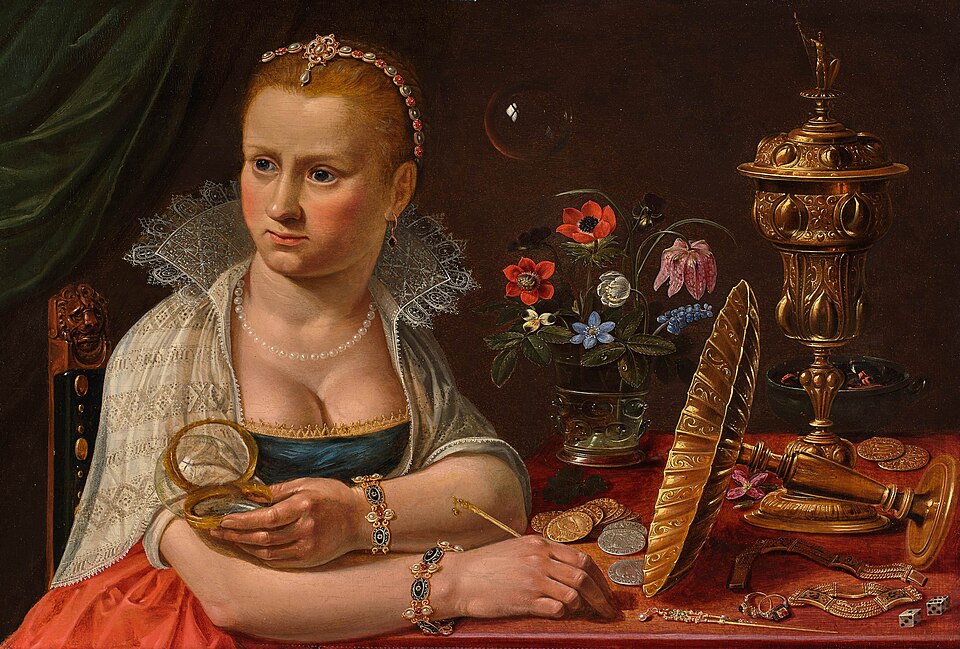
Clara Peeters’ story begins with a table full of ordinary things. She did not paint grand religious scenes. She did not fill enormous canvases with kings, saints, battles, or mythological heroes. Instead, she painted things that could sit quietly on a table: a piece of cheese, a peeled lemon, a silver goblet, a porcelain bowl, a few flowers, a fish, a knife.
And yet, look closely at one of her paintings and the quietness begins to disappear. A polished metal cup catches a tiny reflection of the artist herself. A knife carries her name. A glass catches the light. A shell is rendered with such precision that it seems almost possible to reach into the painting and pick it up.
This was Clara Peeters’ world.
Working in Antwerp in the early seventeenth century, Peeters became one of the earliest artists to specialize in still life, at a moment when the genre itself was finding its place in European painting. Very little is known about her life, but her paintings tell us an extraordinary amount about what she valued: observation, material, craftsmanship, food, wealth, trade, beauty, and perhaps most importantly, her own identity as an artist.
Her story is, in many ways, also the story of still life itself.
Who Was Clara Peeters?
This is where Clara Peeters becomes particularly difficult to trace. For an artist whose paintings have survived for centuries, remarkably little is known about the woman who made them.
Her exact birth date is uncertain, and even the basic details of her early life remain debated. Antwerp records contain a baptismal record for a Clara Peeters, daughter of Jean Peeters, dated 15 May 1594, but scholars have questioned whether this is the same Clara Peeters who produced the highly accomplished paintings dated 1607 onward. Some have therefore suggested that she may have been born earlier, possibly in the 1580s.
What seems more certain is her connection to Antwerp. Her style points strongly toward the city, which was an important centre for the emerging still-life tradition. She was already producing technically sophisticated paintings by 1607, suggesting that she had received substantial artistic training before then. Yet, unlike many of her male contemporaries, her name does not appear in the surviving apprenticeship records of the Antwerp Guild of Saint Luke. Scholars have proposed several possibilities: she may have been the daughter of a painter and therefore trained within her family, or she may have studied under an artist such as Osias Beert, whose work bears striking similarities to hers.
Her movements can be traced only in fragments. She was established in Amsterdam by 1611 and documented in The Hague in 1617. Paintings bearing her name provide the strongest evidence of her career, with thirty-one signed works forming a particularly important record of her activity between 1607 and 1621. Beyond those securely signed paintings, dozens of other works have been proposed as part of her oeuvre, although their attribution remains less certain.
For an artist whose biography has largely vanished, these small appearances feel significant. Her paintings may tell us little about where she lived, whom she knew, or how her career unfolded, but they make one thing unmistakably clear: Clara Peeters wanted to be seen.
She Painted Herself Into the Still Life
Look closely at some of Peeters’ paintings and you may suddenly notice a tiny face staring back. Not a conventional self-portrait. Not a large painted likeness placed proudly in the centre of the composition.
Instead, Peeters often hid miniature versions of herself in reflective surfaces.
A polished goblet. A pewter vessel. A metal lid. These objects become tiny mirrors, and in them we can sometimes see the artist herself, occasionally shown at her easel with her painting tools.
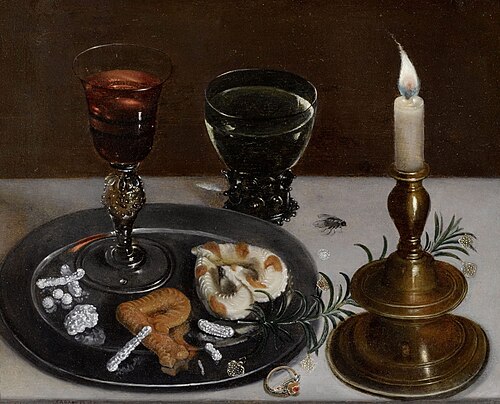
In one of her still lifes, her reflection appears multiple times on the curved surface of a gilt goblet. In another, she appears repeatedly on a goblet and a pewter jug. It is an astonishing little trick. You have to look for her. And once you know she is there, you start looking at every reflective object differently.
These miniature reflections were not simply decorative. They demonstrated an extraordinary level of technical skill: Peeters had to paint not only the object, but the distorted image reflected across its curved surface, while also convincing the viewer that the surface itself was shiny and reflective.
But there is something else happening too. She was putting herself inside the world she had painted.
A Signature Wasn’t Always Just a Signature
Peeters also signed her name onto objects within her paintings. Several of her works contain a distinctive silver knife, and her name appears inscribed on the blade. At least some of these knives also carry Antwerp hallmarks. The knife itself is interesting because diners at the time could bring their own knives to meals, and such objects could be presented as wedding gifts.
Another painting, Still Life with Cheeses, Almonds and Pretzels, contains both her name and a tiny reflected image of the artist on a metal surface.
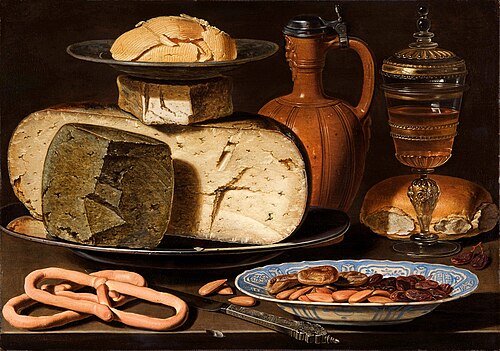
Her self-images therefore become more than clever visual puzzles. They can also be understood as assertions of authorship. She may have painted small, but she did not paint anonymously.
The Beauty in the Details
Peeters’ paintings are filled with things that reward close looking. A silver goblet catches a highlight. A lemon curls over the edge of a dish. The rind of a piece of fruit reveals its texture. Fish glisten. Shells display intricate patterns.
A porcelain bowl sits among objects that could not have been more different in material, origin or texture. This variety gave Peeters an enormous technical challenge. Still life allowed her to demonstrate what a painter could do with paint itself. Could oil paint imitate metal? Could it recreate the translucent quality of glass? Could it make a lemon look juicy, a shell hard, bread crusty and silver reflective?
Could a flat wooden panel create the illusion of an entire collection of objects sitting in front of us? Peeters repeatedly answered yes. Her work is therefore about objects, but it is also about the act of painting them. The more convincing the illusion, the more aware we become of the artist’s skill behind it.
That was one of the great attractions of still life: the ordinary world became a stage on which a painter could demonstrate extraordinary control.
Food, Wealth and a Changing World
There is another reason Peeters’ paintings are so interesting today: they preserve a visual record of the material culture of her time.
Her tables contain cheeses, butter, bread, fish, fruit, nuts, sweets, wine and elaborate vessels. Some paintings feature luxury objects and imported materials alongside everyday foods. These were not insignificant details.
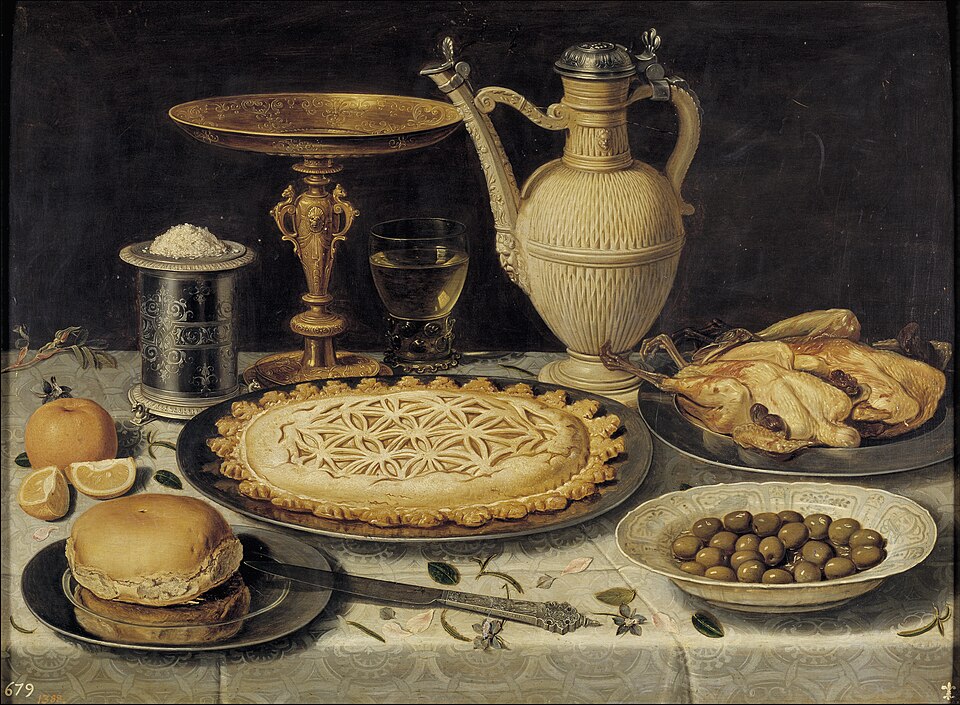
Food production and trade were important parts of the economy of the Netherlands, while objects such as porcelain, silverware and exotic shells carried associations of wealth, rarity and global exchange. The Mauritshuis, for example, notes the economic importance of cheese and butter as valuable export products in the Netherlands. So when Peeters paints a table, she is also painting a society.
Her still lifes show us what people ate, what they collected, what they considered beautiful and what kinds of objects could signify status. And yet, unlike a portrait of a wealthy patron, the people themselves are often completely absent.
The table tells the story for them.
Stillness, But Never Quite Silence
The name “still life” can make these paintings sound passive. They are anything but that.
Peeters’ compositions are carefully balanced. A knife extends beyond the edge of the table. A lemon curves outward. A goblet catches light. A flower leans into another object. A shell breaks up a familiar arrangement. There is movement hidden inside the stillness. And there is also time. Flowers will eventually wilt. Fruit will decay. Food will be eaten. A candle will burn down. Objects will change hands.
This awareness would become increasingly important within still-life painting, especially as artists developed the language of vanitas and the fleeting nature of material life.
Peeters’ works do not always announce these ideas as dramatically as later vanitas paintings, but their very subject matter invites us to think about the strange relationship between permanence and disappearance.
The real lemon will rot. The painted lemon can remain. The meal will be eaten. The painted meal survives. The artist herself is largely absent from historical records. And yet, here she is.
Why Clara Peeters Remains Relevant
Clara Peeters occupies a fascinating position in art history because she stands at the intersection of several important stories.
She was part of the emergence of still life as an independent artistic genre. She worked within the thriving artistic and commercial culture of Antwerp. She demonstrated exceptional technical skill in representing different materials and surfaces.
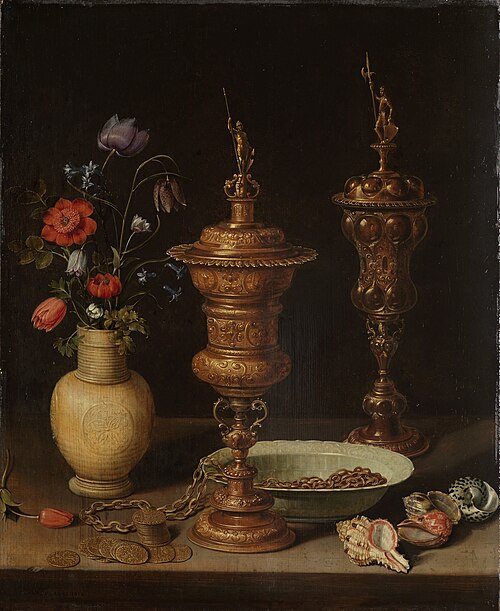
She painted food and luxury objects at a time when these things reflected changing patterns of trade, consumption and collecting. And she was a woman pursuing professional artistic work at a time when that path was far less accessible to women.
Most importantly, she understood that a still life could be more than a collection of objects. It could be a demonstration of skill. A record of material culture. A study of light and reflection. A meditation on wealth and time. And, quietly, a self-portrait.That is perhaps why looking at Peeters’ work feels so rewarding. The paintings ask you to slow down.
Look at the knife.Look at the glass.Look at the flowers.Look again at the silver.And there she is. Tiny, reflected in a surface, holding her tools, looking back at us from more than four hundred years ago.
Before Still Life Had a Name
Clara Peeters did not need a grand historical scene to make her presence known. She had a table. She had a few objects. She had paint. And she had an extraordinary understanding of what those things could do.
Today, still life is one of the most familiar categories in art. We encounter it in museums, classrooms, photography, contemporary painting and everyday visual culture. But paintings like Peeters’ remind us that the genre was once something new: a way of looking at ordinary things and deciding that they deserved our full attention.
That idea feels surprisingly contemporary. To stop and really look at what is already around us. To find beauty in the overlooked. To make an object carry a story. To turn a simple table into a record of a world.
And above all, to leave a small trace of yourself within it. Clara Peeters did exactly that. Her life may remain partly hidden from us. Her paintings, however, keep giving her away.
In every polished surface, every carefully painted object and every tiny reflection, she reminds us that still life was never really about things sitting still. It was about learning how to see them.
Editor’s Note
If you enjoyed reading about Clara Peeters and her quiet, remarkable contribution to the history of still life, we invite you to explore the genre further. Our virtual exhibition, The Beauty of Still Life, is currently open for submissions, with a deadline of August 30, 2026. We would love to see your interpretation of still life!
