Cristina Chirilā Uses Emerald Shadows and Fragmented Portraits to Explore the Human Psyche
At Women in Arts Network, every exhibition begins with a new theme, a different lens through which to look at art and the women behind it. We never choose these themes lightly. Each one comes out of a long process of research and conversation, of looking closely at the art being made right now and asking what feels urgent, honest, and worth exploring. This time, all of that led us to a single word: Portraits.
It felt like exactly the right moment to turn toward the face, the oldest and most human subject in all of art. Because a portrait has never really been about capturing a likeness. It is about everything that lives behind the face, the identity, the memory, the emotion, and the quiet contradictions that make a person who they are.
We wanted to see how different artists would answer a question that never grows old: how much of a person can you ever truly capture? You can paint someone’s features exactly and still miss them completely or blur them almost beyond recognition and somehow land closer to the truth. Each artist in this exhibition has answered that in her own way.
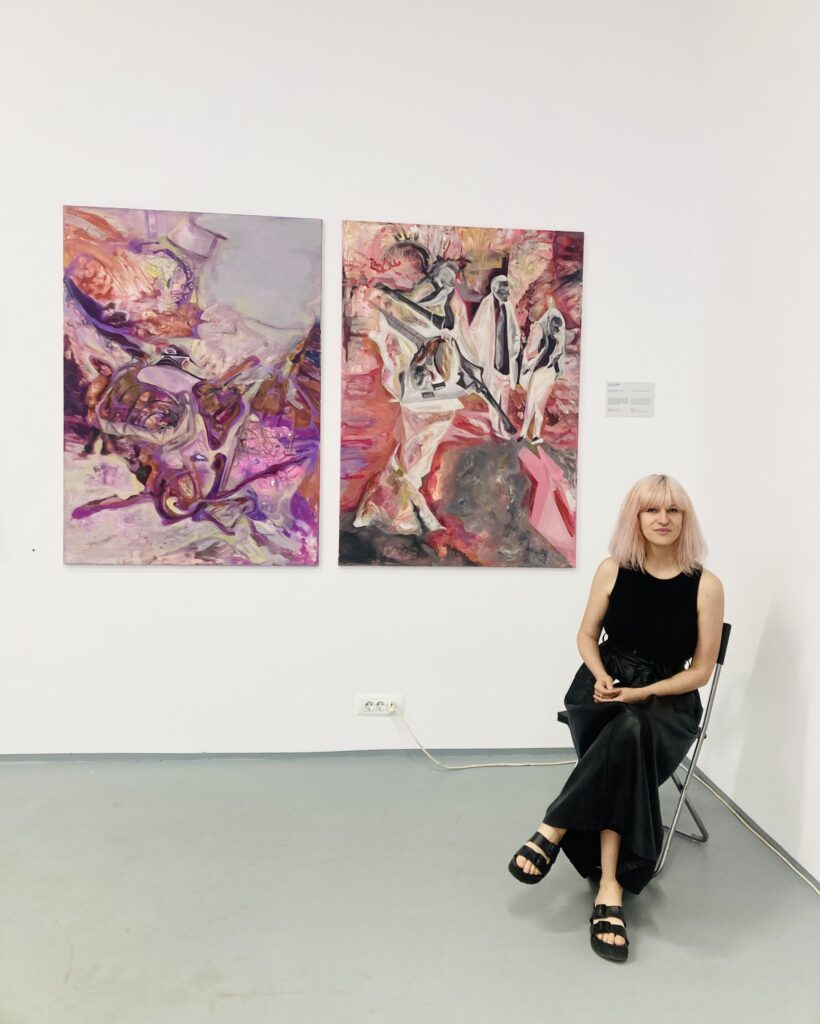
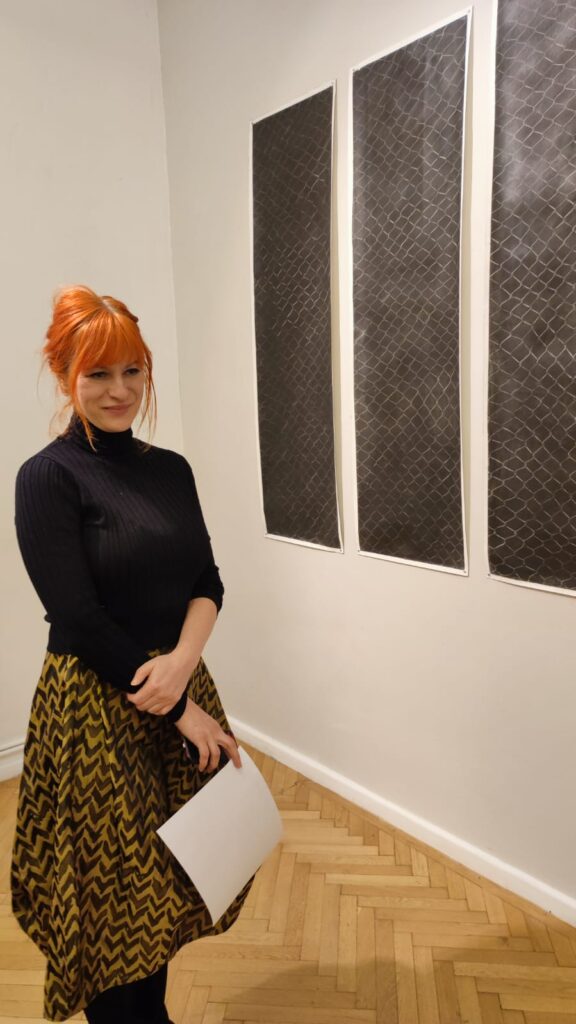
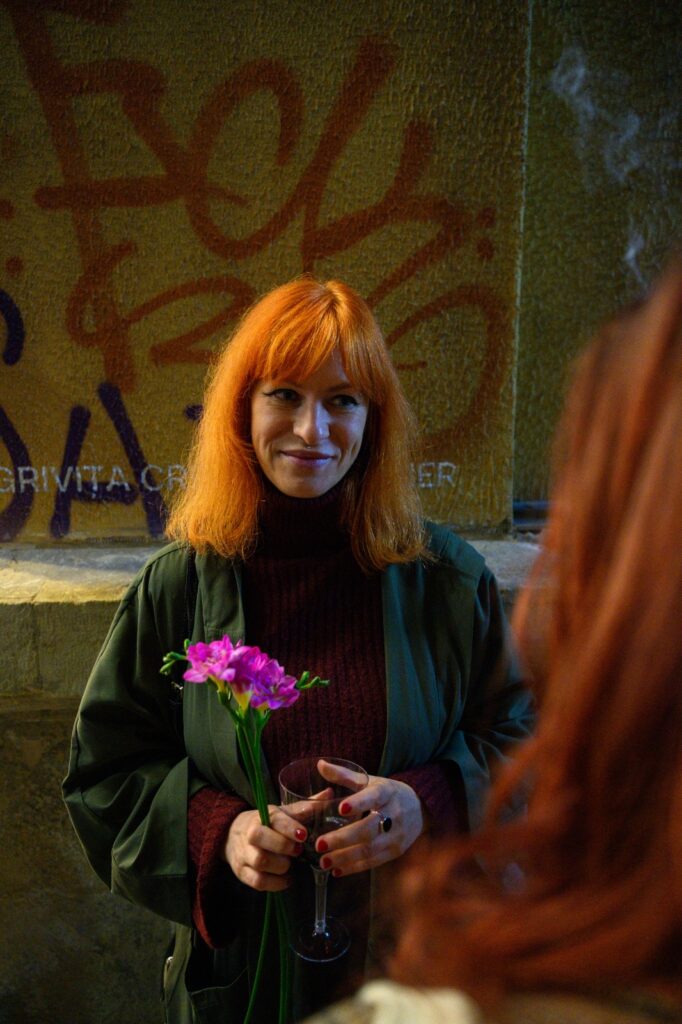
Among them is Cristina Chirilă, a Romanian artist whose portraits go looking for what sits beneath a recognisable face, the tangled, contradictory inner world we rarely let anyone see. Cristina’s journey began early. As a child she attended an art club where a teacher truly believed in her work and sent it to international competitions, and before long she was receiving medals from as far away as Japan and India.
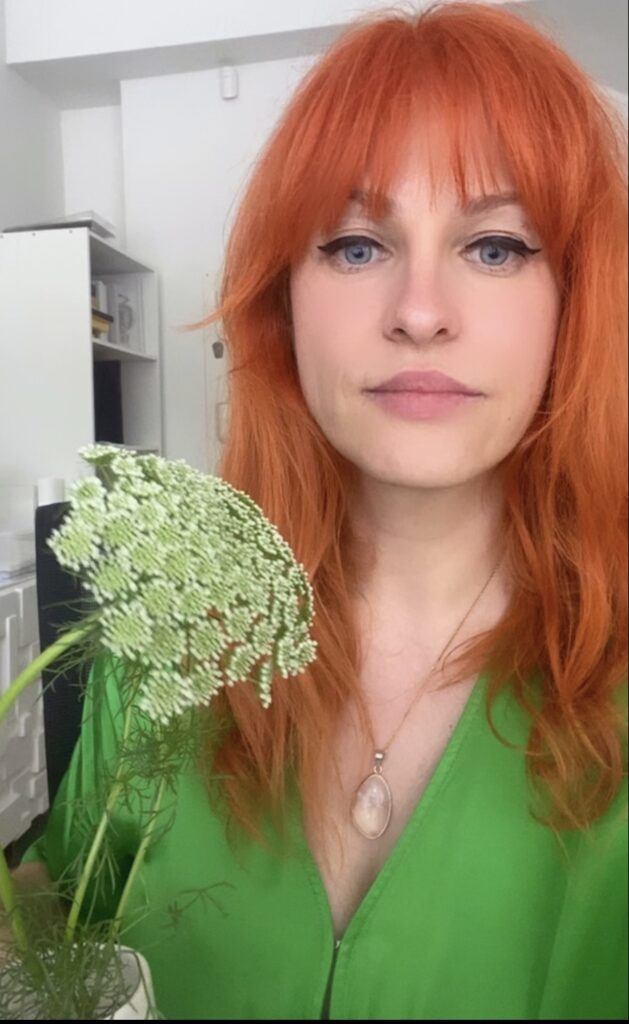
At that age it felt more like an adventure than a calling. What stayed with her was something simpler: the sense that through painting she could create a world of her own. Yet for years she circled art without pursuing it directly, working in advertising and film while studying psychology and completing a PhD in art therapy.
She remembers walking into galleries and feeling almost overwhelmed, aching to be on the other side of the experience. Eventually she left it all behind, applied to the Faculty of Fine Arts, and was accepted on her first attempt. From that point, her studies, her psychology, and her art finally began to speak to one another.
She works across painting, photography, and installation, though she never moved between them simply to experiment. Each medium, on its own, began to feel insufficient. After losing her father, she became painfully aware that a photograph can hold an image but cannot bring a person back. She found herself wanting to make things that physically exist, objects with weight, texture, and presence. That is where her interest in hybrid images began: a picture might start as a photograph and end up painted over, transformed, or fragmented across different materials.
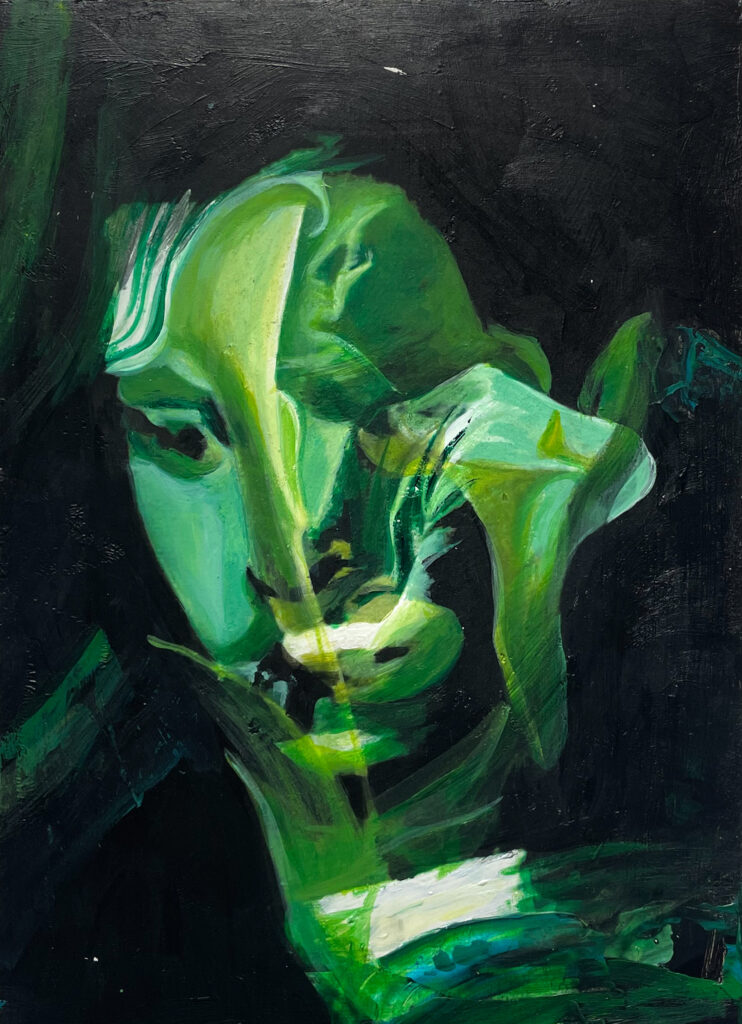
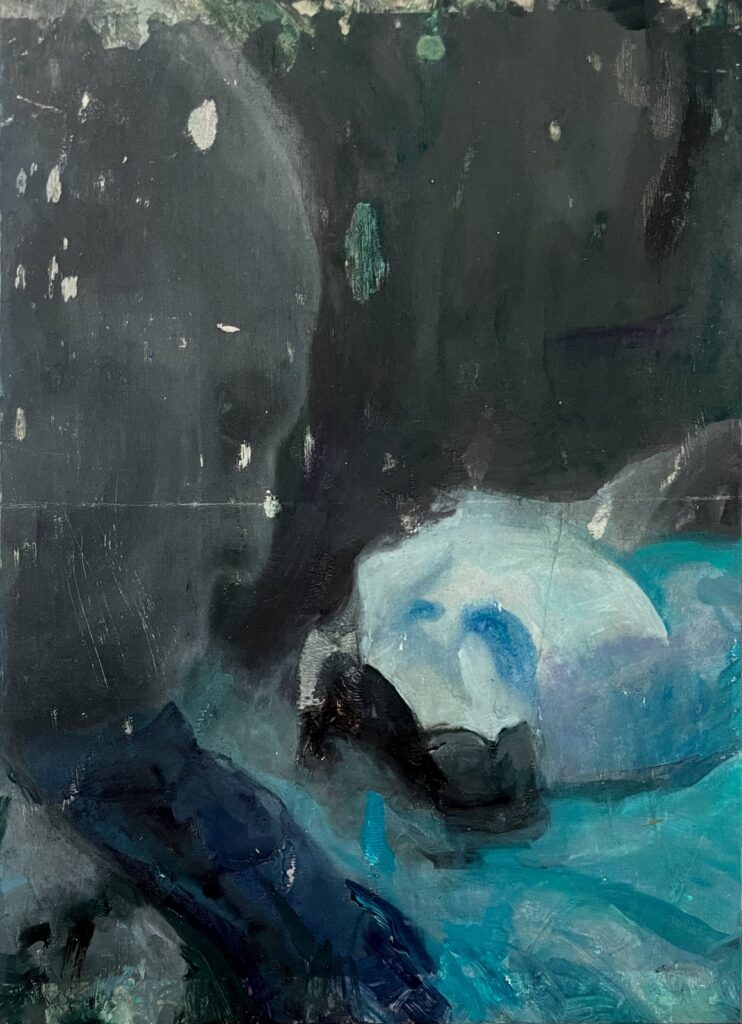
She often begins by taking an image apart. Through blurring, fragmentation, or overpainting, she removes just enough for a face to become uncertain. When we recognise something instantly, she says, we name it and stop looking. But when recognition slows, the viewer has to linger, filling the gaps with their own memories and associations.
Much of her recent work moves through grief and absence, not to illustrate them, but to explore what they do to the way we see, how someone who is missing can become strangely, achingly present.
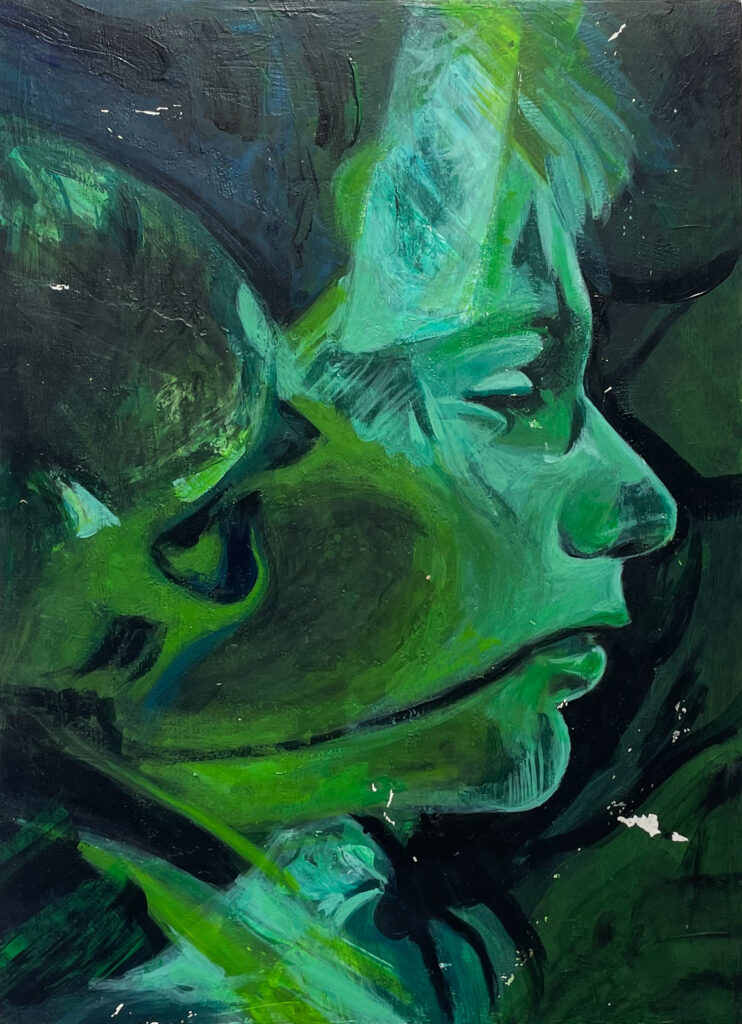
Her portraits are never a single, settled face. In Mixed Feelings, two female figures overlap and interfere with one another while strange, dragon-like forms surface in the same space, the impulses and contradictions that live beneath any coherent identity. For Cristina, a person is always an accumulation of opposing experiences, and a portrait can hold that tension more honestly than any tidy story.
Now let’s hear from Cristina about the childhood that first drew her to painting, the moment she finally allowed herself to change direction, why she lets a familiar image come apart, and her advice for turning difficult experiences into something honest.
Q1. Could you take us back to the beginning of your creative journey and share what first drew you toward painting?
My creative journey began quite early. As a child, I attended an art club for children and students, where I was fortunate to have a teacher who really encouraged us and believed in our work. She would send our paintings to international competitions, and, somewhat unexpectedly, I began receiving medals and awards from places like Japan and India. At that age, of course, it all felt more like a wonderful adventure than the beginning of a career.
But I think what stayed with me was something simpler: the feeling that through painting I could create a world of my own. Long before I had the language to think about art conceptually, painting was already a space where I could spend time differently — observing, imagining, and translating things that I perhaps didn’t yet know how to articulate.
Q2. Your work has moved between photography, installation, and painting over the years. What has each medium taught you about the way you want to tell a story?
I didn’t really move from one medium to another because I wanted to experiment with different techniques.
The shift happened because, at a certain point, painting and photography started to feel insufficient in different ways. Photography allowed me to hold on to images, but I became increasingly aware of its distance from the things it represents. You can have an image of someone, you can preserve a moment, but the image doesn’t bring that person back. After losing my father, I think this became much more difficult for me to ignore.
I found myself wanting to make things that were not only images or memories of something, but things that physically existed in the world. That is when objects and installation became important to me. I started thinking about whether something made with my hands, something with weight, texture, or even an awkward physical presence, could hold something that a photograph could not. Not replace what was lost, of course, but create another kind of encounter with it.
At the same time, I never really left painting or photography behind. I began to bring their different ways of working into the same process. Sometimes an image starts as a photograph and ends up being painted over, transformed, translated into an object, or fragmented across different materials. I think that is where my interest in hybrid images really began — not as a theoretical decision, but from a very practical and personal dissatisfaction with what a single medium could do.
Q3. You often begin with abstraction and deconstruction. What happens to an image when you allow it to lose its familiar form?
For me, abstraction and deconstruction are not really about making an image disappear. I’m interested in what happens when you remove just enough for the image to become uncertain. When we immediately recognise something, we also bring everything we already know about it. We name it, place it in a category, and, in a way, stop looking.
But when an image begins to lose its familiar form — through blurring, fragmentation, overpainting or physical alteration — recognition becomes less automatic. You have to spend more time with it. What interests me is that the image doesn’t simply become empty. Something else starts to happen in that gap.
The viewer begins to fill in what is missing, often bringing their own memories, associations or expectations into the image. So deconstruction can actually make an image more open rather than less meaningful. I also like the fact that you can never completely control that process. Once an image has been altered enough, it begins to move away from its original intention.
Sometimes I no longer know exactly what I am looking at either, and I find that quite productive. The image stops being an answer and becomes a place where something can still happen.
Q4. Your recent work explores grief and the experience of absence. What led you to approach such an intimate subject through art?
I don’t think I consciously chose grief as a subject. It entered my work because it became impossible for me to separate what I was experiencing from the way I was looking at images and making things. After my father died, I became very aware of how strange absence actually is. It isn’t simply that someone is no longer there. Their absence changes the way you experience the objects, rooms, photographs and small details that remain. Things that had been completely ordinary suddenly seemed charged with meaning. I think that was what brought me back to making things.
I needed something more than memory. Photographs could preserve traces, but I became interested in what it means to create a physical presence around something that is no longer physically present. Painting, objects, fragments and later installation became different ways of approaching that tension. I’m not interested in illustrating grief or telling a personal story through images. I’m more interested in what grief does to perception — how it changes the way an image is remembered, how an ordinary object can suddenly become almost unbearable, and how something that is missing can become strangely present.
In that sense, the work is personal, but I hope it doesn’t remain only mine. I think absence is something we all experience, even if the circumstances are completely different.
Art gives me a way of turning something very specific and intimate into a space that another person can enter with their own memories.
Q5. Mixed Feelings and The Two-Way Portrait both suggest an inner conversation or tension. What were you exploring through these works?
Both works came from a similar impulse: I was interested in the fact that we are rarely made up of one feeling at a time. We can experience completely contradictory things simultaneously — love and anger, tenderness and fear, attraction and rejection, memory and the desire to forget. I think we often try to separate these things because it makes experience easier to understand, but internally they are usually much more entangled. In Mixed Feelings, the two female figures overlap and almost interfere with one another, while the strange dragon-like and demonic forms appear within the same space. I didn’t think of these figures as symbols with fixed meanings.
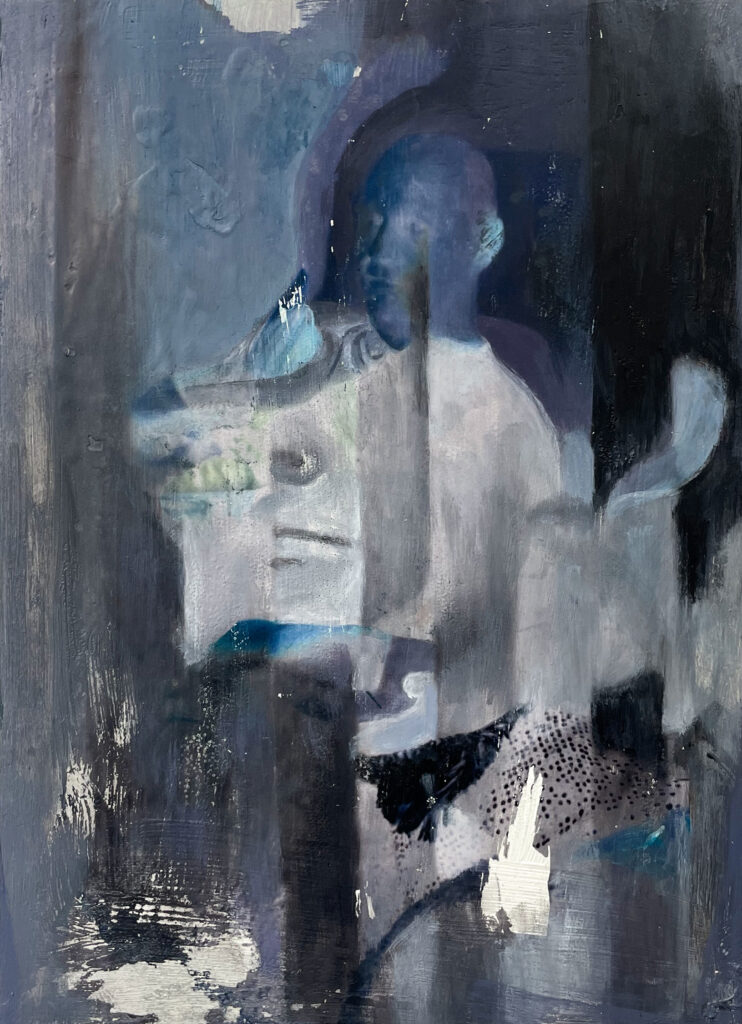
They emerged more intuitively, almost like fragments from an unconscious space. For me, they suggest the things that can exist underneath a recognisable image or a coherent identity — impulses, fears, desires, contradictions. The Two-Way Portrait started in a similarly intuitive way. It brings together a portrait of Marcel Duchamp in the foreground and an image of my father behind it, almost like a double exposure, although the image is constructed through painting rather than photography. I didn’t begin with a clear explanation of why these two people should be together.
The connection emerged through the act of making the image. Looking at it afterwards, I became interested in the fact that two very different kinds of presence — one belonging to my personal memory and one belonging to the history of art — could occupy the same visual space. Perhaps that is what both works are really about: not resolving contradictions, but allowing them to remain together. I think a person is always a kind of accumulation of opposing experiences and influences. We are constantly negotiating between different versions of ourselves, and sometimes an image can express that tension more honestly than a clear narrative can.
Q6. Hands Tied and Feet Bound immediately evokes a feeling of restriction. What inspired you to explore that sense of being unable to move freely?
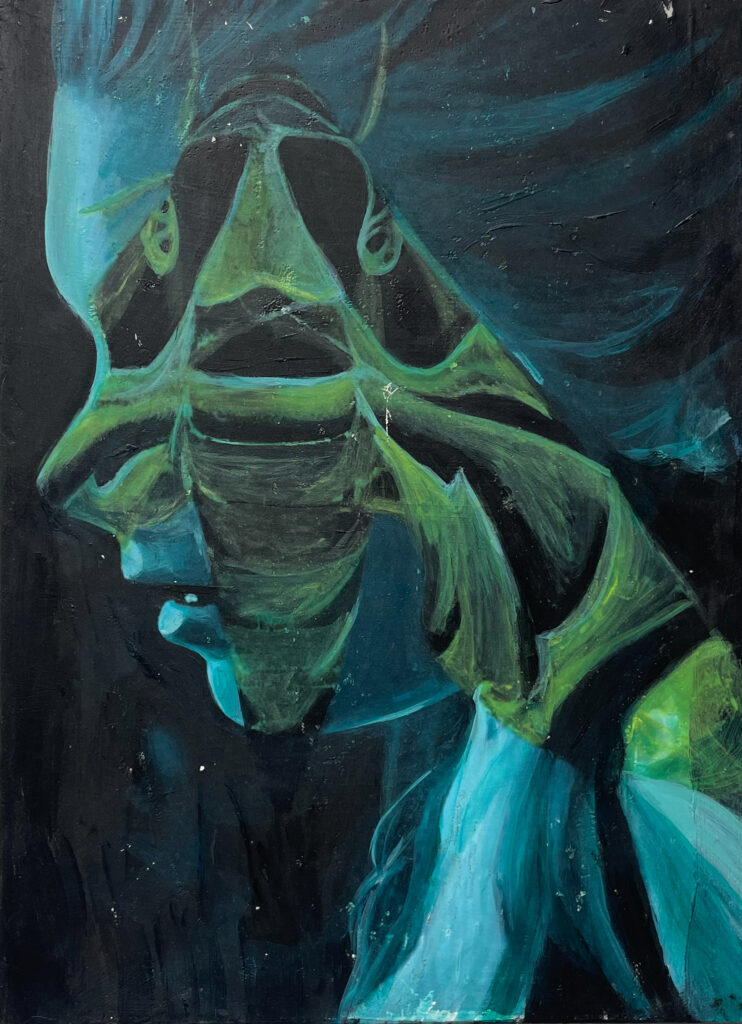
The work actually began with an object. I came across a latex sculpture by the artist group Pastila Roz and was immediately drawn to it — especially to the softness of the material and the way the body seemed to lose its ability to support itself. There was something strangely vulnerable about it, almost like a puppet or a doll whose strings had been cut. When I later translated that image into painting, it started to resonate with something much more personal.
There are moments when you become aware that there are things you simply cannot control, no matter how much you want to. You can make decisions, resist, try to change direction, but sometimes you find yourself confronted with something that feels almost like an inevitable course of events.
That is where the feeling of being tied or bound came from for me. It wasn’t really about physical restriction, but about the psychological experience of having no meaningful direction to move in. The figure becomes almost like a marionette — soft, suspended, unable to pull itself in any direction. I think that vulnerability interested me more than the idea of helplessness itself. There is something unsettling about a body that is still there, still visible, but has temporarily lost its agency. Painting that form allowed me to stay with that feeling and transform it into something physical rather than simply describing it.
Q7. You often work with ideas that are difficult to put into words. Do you begin with a thought that needs to be expressed, or does the artwork help you discover what you are thinking?
I think it happens somewhere in between. There are thoughts, questions and emotional states that exist somewhere in the background long before I consciously decide to make them into a work. I have always been quite introspective, and my background in psychology probably contributed to that tendency to observe and question what is happening internally. But I don’t usually start with the intention of illustrating a particular thought or feeling.
Sometimes I begin with an image, a material, an object, or simply a feeling that I can’t quite explain. I work with it without necessarily knowing where it is going. Then, somewhere along the process, something becomes recognisable. I might suddenly realise that what I have been making is very close to something I have been experiencing, thinking about, or struggling with. In that sense, the artwork often knows something before I do.
It brings something to the surface that was already there, but that I hadn’t yet been able to formulate. I also think this is why I’m reluctant to explain a work too quickly. Sometimes the explanation comes only after the image exists. Making the work is not simply a way of expressing something I already know; it is one of the ways I find out what I actually think.
Q8. Looking back at your journey so far, what has been the moment that made you feel most certain about the direction of your practice?
I think the clearest moment was actually when I finally allowed myself to change direction. Before becoming a full-time artist, I had spent many years working in creative industries, particularly in advertising and film. Even when I was working in movie production, I was always trying to move closer to the creative side. Looking back, I think I was constantly circling around something I wasn’t yet brave enough to pursue directly.
I had also studied psychology and completed a PhD in art therapy, so art was never really absent from my life. But there was always this strange frustration. I remember going into galleries and sometimes feeling almost physically overwhelmed — I could actually feel like crying because I wanted to be on the other side of that experience so badly. Eventually, I quit my job and applied to the Faculty of Fine Arts. I was accepted on my first attempt, and from that point on, things started to connect in a way they hadn’t before.
My studies, my previous experience, my interest in psychology, and my artistic practice gradually began speaking to each other. I think another important moment came when I started being selected for some of the first open calls and exhibitions I applied to. Those moments gave me a kind of recognition I hadn’t expected. Not necessarily external validation in itself, but the feeling that there might actually be a place for the kind of work I was trying to make.
So I wouldn’t say there was one single moment when I suddenly knew exactly where I was going. It was more the gradual feeling that, for the first time, I was no longer forcing my life in one direction while wanting to go somewhere else. The different parts of my experience were finally beginning to make sense together.
Q9. What advice would you give to artists who are trying to turn difficult experiences into something meaningful without losing the honesty of those experiences?
I would say: don’t start by thinking about how the work will be received. Don’t worry too much about whether it fits a trend, whether it is easy to understand, whether it is commercially appealing, or even whether it might make some people uncomfortable. Those things can become very loud in your head, especially when you are trying to build a career, and they can easily interfere with the reason you started making the work in the first place.
Someone once told me that what comes directly out of you is often the most important thing. I didn’t fully understand what that meant at the time, but experience has made me believe it. The works that feel most honest to me are usually the ones I didn’t try to make acceptable beforehand — I simply followed something that felt necessary to make. That doesn’t mean that every personal experience automatically becomes meaningful art. There is still a process of questioning, editing, transforming and finding the right form. But I think the starting point has to remain yours.
You can refine an experience, abstract it, disguise it, or turn it into something completely unexpected, but if you begin by asking what other people want to see, you risk losing the thing that made it worth making. And difficult experiences don’t have to become beautiful or inspirational. Sometimes they can remain uncomfortable, unresolved or even contradictory. I think there is value in allowing the work to carry some of that discomfort rather than trying to make it easier for the viewer. For me, that is where authenticity begins — not in telling everything, but in not betraying the truth of what made you need to make the work in the first place.
As we wrapped up our conversation with Cristina, we kept returning to a question that has followed portraiture throughout its history: can an image ever tell us everything about a person? From traditional painted portraits that aimed to preserve a likeness for generations, to contemporary artists who distort, fragment, or reimagine the face, the possibilities of portraiture have kept expanding.
What once centred largely on how a person looked can now explore the less visible parts of identity, including memory, contradiction, and the experiences that shape how we see ourselves.
Cristina’s work belongs to this wider shift, where a portrait does not need to offer a complete or easily recognisable image to feel deeply human. By allowing familiar forms to become uncertain, she creates room for viewers to question their first impressions and consider what might exist beyond the visible surface. Her approach also challenges the idea that clarity always leads to understanding. Sometimes, an image becomes more meaningful when it refuses to explain itself completely.
This openness is part of what keeps portraiture relevant in contemporary art. Artists continue to return to the human face, but they approach it with different questions and intentions. Some seek recognition, others investigate identity through abstraction, and many move between the two.
There is no single way to represent a person, just as there is no single version of who that person is. The most compelling portraits often acknowledge this complexity rather than trying to resolve it.
For art lovers and collectors, work like Cristina’s offers a different kind of relationship with an image. Instead of revealing everything at first glance, it rewards time and attention. Its meaning can shift as we bring our own experiences to it, making the act of looking a personal process rather than a passive one. A portrait becomes something we return to, not necessarily to find a final answer, but to discover how our own understanding changes.
Perhaps this is one of the enduring strengths of portraiture: it gives artists a familiar subject through which to explore questions that have no simple answers. A face may be where we begin, but it is rarely where the story ends.
Follow Cristina Chirilă through the links below and explore more of her work and creative journey.
