
The Hidden Meanings Behind 5 Iconic Paintings by Women Artists
A painting can hold much more than what we see at first glance. A familiar face, a seemingly ordinary moment, or even an arrangement of colors can carry a story that changes the way we understand the entire artwork. Sometimes, the inspiration comes from a deeply personal experience. Other times, it comes from a historical event, a complicated relationship, or an idea the artist spent years trying to understand.
Women artists have given us some of the most memorable paintings in art history, and many of these works have fascinating stories behind them. When we look a little closer, we discover details that are easy to miss but make the paintings even more meaningful.
Here are five famous paintings by women artists, along with the stories, personal experiences, and hidden details that make them worth looking at again.
1. Judith Beheading Holofernes by Artemisia Gentileschi (c. 1620)
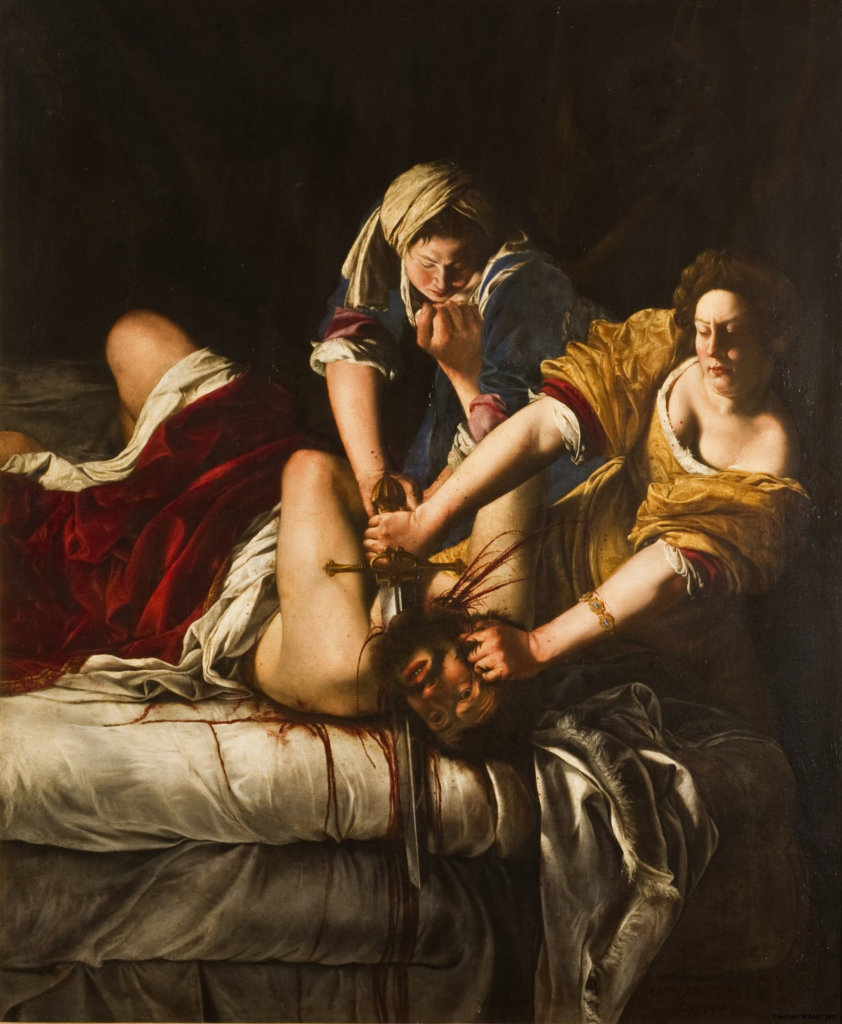
At first glance, Artemisia Gentileschi’s Judith Beheading Holofernes is difficult to look away from. The painting captures a brutal moment from the biblical story of Judith, a Jewish widow who saves her people by killing Holofernes, an Assyrian general who threatens their city.
Judith enters his camp, gains his trust, and waits until he falls asleep after a banquet. With the help of her maidservant, Abra, she takes his sword and beheads him.
But what makes Gentileschi’s interpretation so striking is how physically demanding the scene feels. Judith is not portrayed as a delicate heroine standing at a distance. She grips Holofernes firmly, pulls his head back, and pushes the sword through his neck. Abra is equally involved, holding him down as the two women carry out the act. Blood spills across the white sheets, making the scene even more unsettling.
There is another story that makes this painting particularly significant. When Gentileschi was seventeen, she was sexually assaulted by Agostino Tassi, an artist who had been working with her father. The case went to trial in 1612, and Artemisia was subjected to questioning and torture during the proceedings. Her experience became an important part of how later generations understood her work.
It is tempting to read Judith as Artemisia’s personal revenge, and many art historians have explored that interpretation. However, it is important not to reduce the painting to one biographical event. Violent biblical scenes were also popular subjects during the Baroque period, and Gentileschi was working within that artistic tradition while bringing an extraordinary sense of physical strength to her female protagonists.
What makes the painting even more remarkable is that Gentileschi went on to build a successful career in a profession where women faced enormous restrictions. She became the first woman admitted to Florence’s prestigious Academy of Drawing.
Her Judith does not simply tell a story about a biblical heroine. It also reminds us of the artist who painted her, and of a woman who refused to let the limitations of her time define her career.
2. The Two Fridas by Frida Kahlo (1939)
Frida Kahlo was known for turning her personal experiences into paintings, often using her own face and body to explore identity, relationships, pain, and belonging. But in The Two Fridas, she takes the idea of a self-portrait somewhere quite different. Instead of painting one version of herself, Kahlo gives us two.
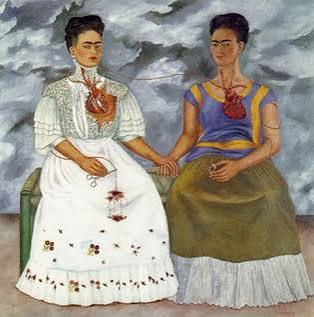
The two figures sit beside each other, holding hands, with their hearts exposed and connected by a visible vein. One Frida wears a traditional Tehuana dress, while the other wears a white European-style dress. Their clothing is not simply a difference in fashion. It points towards two sides of Kahlo’s identity and the different cultural influences that shaped her.
The painting was created in 1939, following Kahlo’s separation from her husband, the Mexican muralist Diego Rivera. The couple had been through a complicated relationship, and their separation deeply affected her.
Look closely at the two figures. The Frida in the white dress holds surgical scissors, and blood runs down onto her skirt from a cut artery. In her other hand, the Frida wearing traditional clothing holds a small portrait of Diego Rivera. The vein connecting their hearts creates a powerful visual link between the two women, even as one appears to be losing blood.
The contrast is difficult to miss. One Frida seems connected to the cultural identity and appearance Rivera admired, while the other represents a different part of her background and sense of self.
The painting is often interpreted as an exploration of heartbreak, but it also speaks to the experience of living with multiple identities. Kahlo’s work frequently returned to questions of who she was, where she belonged, and how she understood herself.
Interestingly, the painting was also much larger than many of Kahlo’s other works, making its two figures feel almost monumental.
Today, The Two Fridas is one of her most recognised paintings. Yet what makes it so memorable is not simply the unusual double portrait. It is the feeling that we are looking at a conversation between two parts of the same person, neither of which can exist entirely without the other.
3. The Child’s Bath by Mary Cassatt (1893)
Not every remarkable painting needs a dramatic subject. Sometimes, the most interesting stories are found in the ordinary moments people rarely stop to notice.
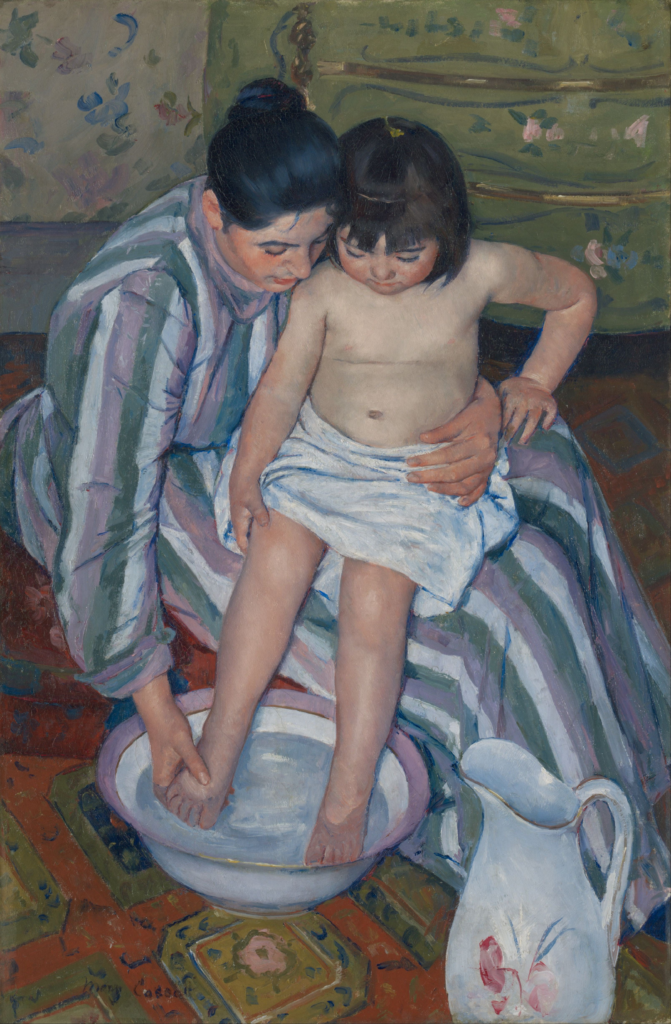
Mary Cassatt’s The Child’s Bath shows a woman gently washing a young child in a domestic setting. There is no grand historical event, no elaborate landscape, and no dramatic expression. Instead, Cassatt invites us into a quiet moment of care.
But look at the painting’s composition and something unusual becomes apparent. The viewer is looking down at the figures from a raised angle. The patterned floor, the woman’s striped dress, and the decorative objects create a flattened arrangement that feels quite different from the traditional European paintings of the time. This was no accident.
Cassatt was deeply interested in Japanese woodblock prints, which were becoming increasingly influential among European artists in the late nineteenth century. Their bold patterns, unusual perspectives, cropped compositions, and decorative use of space inspired her to experiment with how she arranged figures and objects.
You can see that influence throughout The Child’s Bath. The patterns are almost as important as the figures themselves, and the unusual viewpoint makes the viewer feel like an observer of a private moment rather than someone standing directly inside the room.
There is also something particularly interesting about Cassatt’s choice of subject. Women and children appeared frequently in her work, but she avoided turning them into overly sentimental figures. Instead, she paid attention to the small gestures and everyday responsibilities that shaped women’s lives. The child leans forward, the woman supports the little body, and the entire scene feels absorbed in the simple act of caring.
Cassatt was also an important figure in the Impressionist movement. She was invited by Edgar Degas to exhibit with the group in 1877 and became the only American artist to exhibit with the French Impressionists.
The Child’s Bath reminds us that a painting does not need an extraordinary subject to be extraordinary. Through an everyday scene, Cassatt experimented with perspective, pattern, and intimacy, creating an artwork that still feels surprisingly modern.
4. Self-Portrait with Her Daughter Julie by Élisabeth Louise Vigée Le Brun (1789)
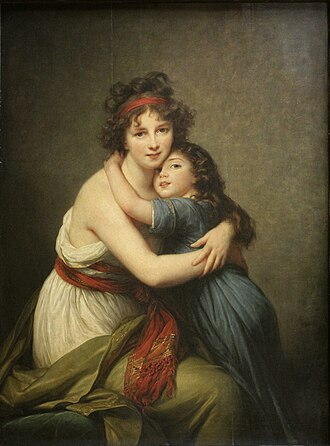
There is something wonderfully personal about Élisabeth Louise Vigée Le Brun’s Self-Portrait with Her Daughter Julie. The artist sits with her young daughter leaning towards her, their arms wrapped around one another. Their expressions are warm, and the composition feels almost like a private family photograph.
But this painting was doing more than documenting a mother’s affection. Vigée Le Brun was one of the most successful portrait painters of her time. She painted members of European royalty and aristocracy, including Marie Antoinette, and built an impressive career in a profession that offered women very few opportunities.
Her admission to the French Royal Academy of Painting and Sculpture in 1783 was itself unusual. Women faced restrictions within the institution, including limited access to formal artistic training. Vigée Le Brun eventually gained entry through the intervention of King Louis XVI.
In this self-portrait, she makes a particularly interesting artistic choice. Rather than presenting herself in the elaborate clothing and formal pose expected of a fashionable portrait, she wears a simple, draped garment inspired by ancient Greek clothing.
The choice gives the painting a timeless quality. It also connects her composition to the work of the great Renaissance painter Raphael, particularly his Madonna and Child paintings. The way Julie leans into her mother and the way their arms circle each other echo the familiar imagery of mother and child in religious art.
There is another detail worth noticing: Vigée Le Brun’s open mouth and visible teeth. At the time, showing teeth in a portrait was considered unconventional, particularly in formal representations. Her relaxed expression helped give the painting a sense of natural affection rather than the controlled formality usually associated with aristocratic portraiture.
The year 1789 was also a significant one. The French Revolution was beginning to change the country, and Vigée Le Brun would soon leave France with her daughter, travelling across Europe and continuing her career in exile. Knowing this makes the painting feel even more intimate. It captures a moment of closeness between a mother and daughter just before their lives would be reshaped by political upheaval.
What initially appears to be a tender family portrait is also a carefully considered statement about identity, motherhood, artistic ambition, and the kind of woman an artist could choose to present herself as.
5. The Ten Largest by Hilma af Klint (1907)
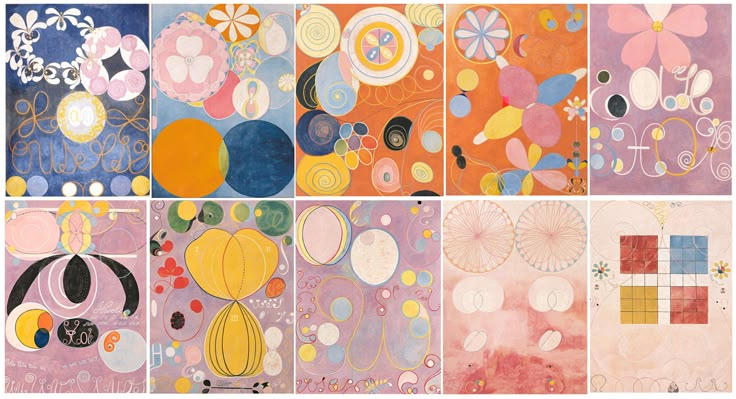
Long before abstract art became a familiar part of modern art history, Swedish artist Hilma af Klint was creating paintings filled with spirals, enormous shapes, bright colours, and symbols that seemed to belong to another world.
Her series The Ten Largest, created in 1907, is among her most fascinating works. The ten enormous paintings explore four stages of human life: childhood, youth, adulthood, and old age. Instead of depicting people or recognisable scenes, af Klint used organic forms, geometric shapes, letters, and flowing patterns to represent ideas about existence, growth, and the relationship between opposing forces.
But the story behind their creation is perhaps even more surprising. Af Klint was deeply interested in spiritualism and Theosophy, and she participated in séances with a group of women known as The Five. During these gatherings, the women explored spiritual ideas and produced automatic drawings.
In 1906, af Klint believed she had received a major spiritual commission to create a series of paintings for a future temple. This became the beginning of The Paintings for the Temple, a body of 193 works produced between 1906 and 1915.
The Ten Largest formed a central part of this ambitious project. The paintings were created remarkably quickly. Af Klint completed the ten works between October and December 1907, with help from two members of her circle. Because of their enormous size, she likely worked on the sheets of paper while they were laid out on the studio floor.
Even the colours carried meaning. The different stages of life were represented through changing palettes, moving from the blues associated with childhood to more vibrant orange tones for youth, and softer purples and other colours for later stages.
Perhaps the most interesting part of af Klint’s story is that she did not believe the world was ready for these paintings. In her will, she stipulated that her abstract works should not be shown publicly until at least twenty years after her death in 1944.
As a result, much of this extraordinary body of work remained outside public view for decades. Today, af Klint is recognised as a pioneering figure in the history of abstraction, and her work has encouraged art historians to reconsider the familiar story of how abstract art developed.
Looking at The Ten Largest, it is difficult not to wonder what the art world might have looked like if these paintings had been exhibited when they were first created.
Looking Beyond the Canvas
These five paintings remind us that looking at art is not always just about understanding what an artist has painted. Sometimes, the most fascinating part of an artwork is what happened before it was created, what the artist was experiencing at the time, or what they hoped to communicate through a particular detail.
From Artemisia Gentileschi’s powerful biblical heroine to Frida Kahlo’s two versions of herself, from Mary Cassatt’s quiet domestic scene to Hilma af Klint’s spiritual explorations, each painting opens a different window into the artist’s world.
And perhaps that is one of the most wonderful things about art. The more we learn about the person behind the painting, the more we discover in the work itself.
