
Jessica Fisher Paints Eyes So Close You Can See Every Detail
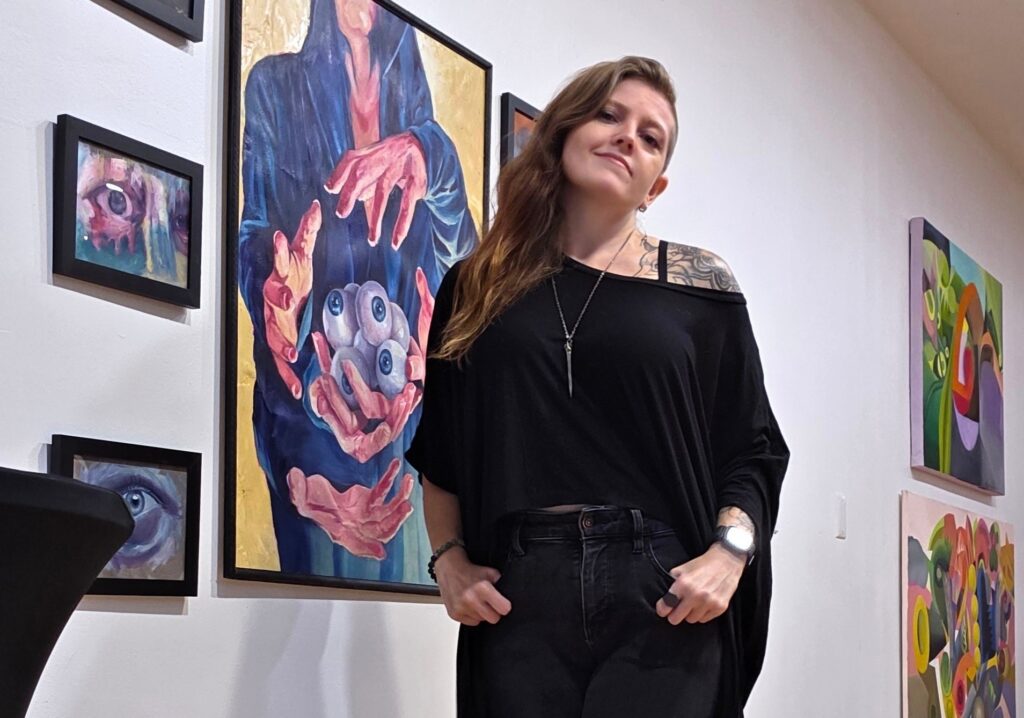
At Women in Arts Network, for our Faces exhibition, we’ve seen faces from a distance. Faces in profile. Faces half-hidden. Faces made of fragments and colour and shadow and sand. Beautiful work. Powerful work. But most of it gives you room. Space to stand back. Space to observe. Space to decide how close you want to get.
Jessica Fisher doesn’t give you that space. And that’s exactly why she’s here.
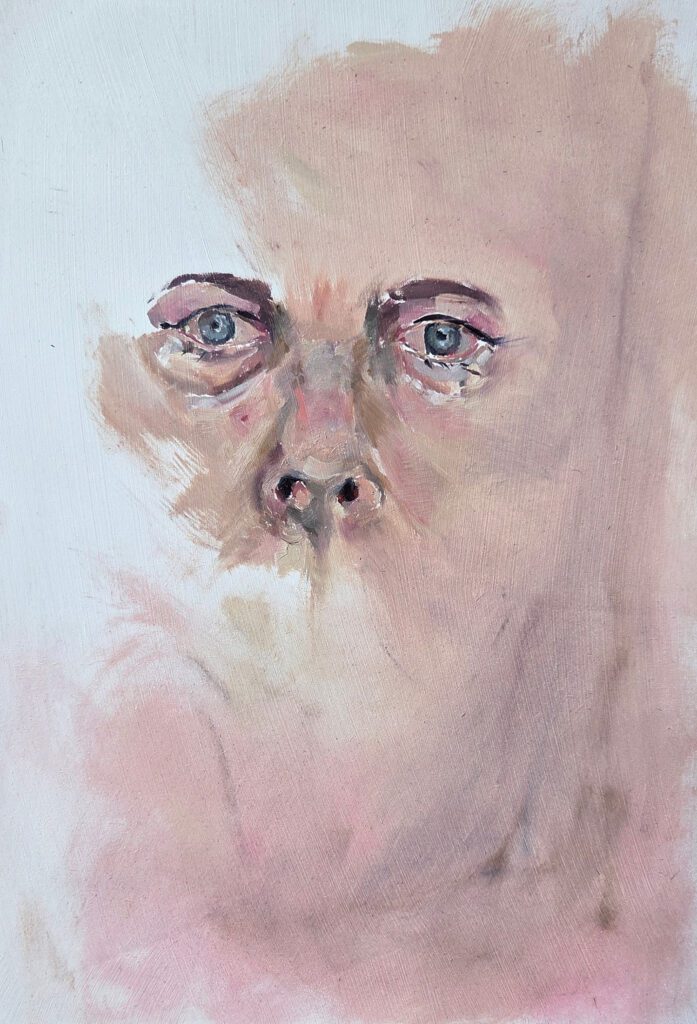
Jessica is a selected artist for the Faces exhibition and her paintings do something physically to the way you experience a face. They bring you in so close that the figure fills your entire field of vision. There’s no background to rest your eyes on. No edge to escape to. Just the figure and whatever it’s holding and you, standing right there in front of it with nowhere to go.
She’s a narrative painter and you can feel the storytelling in every canvas even when there’s no obvious story being told. Something is always happening in her work. Not action. Something deeper. A tension. A presence. The sense that you walked into a room where something just happened or is about to happen and nobody’s going to explain it to you. You just have to stand there and feel it.
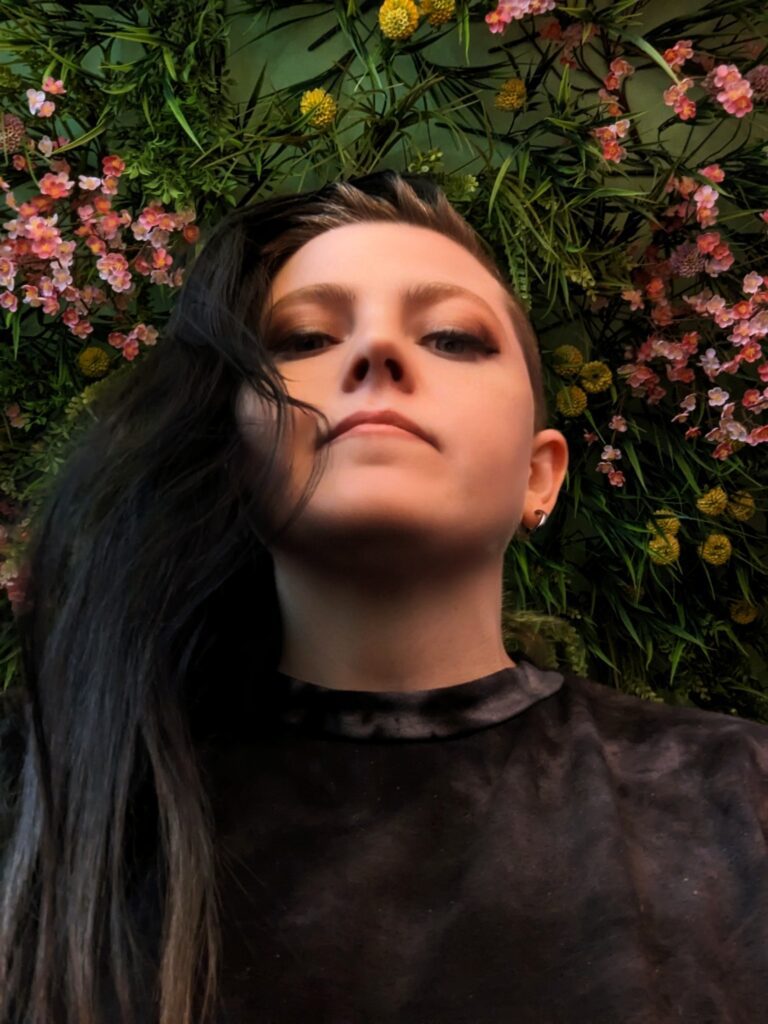
Her brushwork is gestural, sometimes raw, the kind where you can see the effort and the hand behind every mark. Even when the scale is large, and her work has been getting larger, the paintings feel intimate because nothing is polished to the point of distance. There’s always a human fingerprint in the making. Always evidence that someone stood here and meant this.
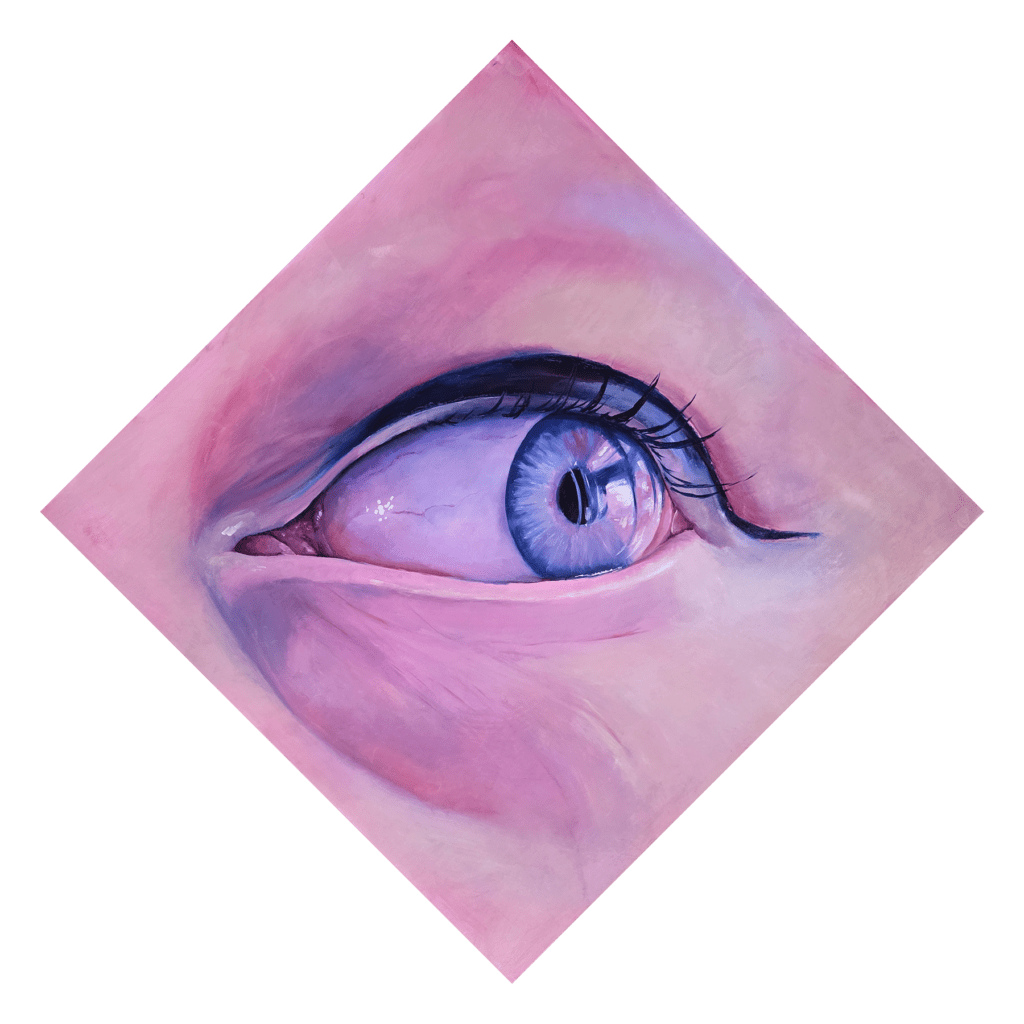
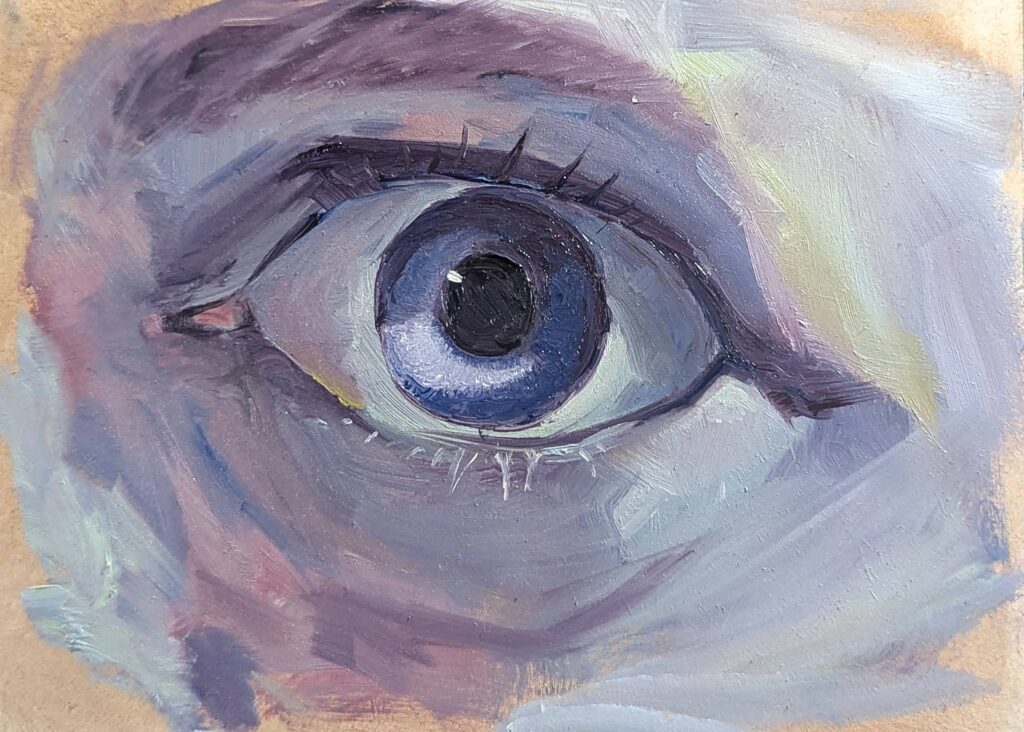
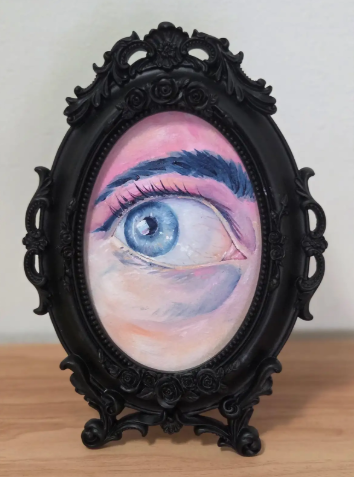
She paints figures and faces and eyes. And the eyes in particular do something you don’t forget. They hold you. Not poetically. Actually. You look at them and they look back and for a second you’re not sure who’s doing the seeing anymore.
Jessica didn’t take the easy road to get here. She didn’t take any road really. She took the long way through a complicated childhood and a career that wasn’t quite right and years away from making entirely and then a return that changed everything. Her story has the kind of turns in it that make you understand why her work feels the way it does. There’s weight behind it. Real lived weight. And we’ll let her tell you that story herself because it deserves to be heard in her own words.
She’s recently moved from New York to France. New chapter. New landscape. New quiet. And she’s curious about what that’s going to do to her work. That kind of openness in an artist, that willingness to not know what comes next and be excited instead of afraid, that tells you she’s nowhere near done becoming who she’s going to be.
Now let’s hear from Jessica, about painting faces so close there’s nowhere to hide, about eyes that hold more truth than words ever could, about the long way around to becoming the artist she was always supposed to be, and why the most powerful portrait might be the one that sees you before you see it.
Q1. Can you tell us a little bit about your background like where you grew up, how you first encountered making art, and when painting became central to who you are?
I grew up in a complicated household—my father was a talented artist but not someone I could learn from safely. I taught myself by sneaking art books off his shelves and copying from comics; drawing constantly on whatever I could find. I wanted to study art in college, but ended up getting a film degree instead. I found work creating illustrations for a fashion company, but the pressure to copy other artists’ work burned me out. Combined with personal struggles, I stepped away from art for several years. The turning point came in 2023 when I studied with Sterling Hundley. He was transformative—the best teacher I’ve ever had—and rekindled something I thought I’d lost. I then took a leap of faith by joining the Quarantine program in Menorca, Spain. That experience changed everything. I discovered my love for painting there and met mentors like Phil Hale, Edward Povey, and Henrik Uldalen, along with an incredible community of artists. Painting became more than a practice—it became a way to process years of pain and find my way toward healing. It’s central to who I am now because it represents both artistic growth and personal transformation.
Q2. Your work often explores memory, identity, and the subconscious. How did you first become interested in these themes, and how have they changed over time?
These themes emerged naturally from my own experiences. I’ve been through psychological and emotional abuse, a broken marriage I eventually left, periods of instability, and years of not feeling safe in my own life. When I returned to art, I discovered it gave me a language for things I’d been carrying but couldn’t articulate in other ways. My paintings became a form of confession, a way to explore what felt too difficult or vulnerable to say out loud. There’s something about the act of painting—the way memory surfaces through color, form, and gesture—that allows me to access parts of my past and inner life that remain hidden in everyday conversation. The subconscious reveals itself on the canvas in ways that feel more honest and raw than words ever could. Over time, this work has shifted from purely cathartic to more intentional. Early on, I was trying to survive, to process trauma and find solid ground. Now, while those experiences still inform everything I make, there’s more distance and reflection. The paintings have become less about reliving pain and more about understanding it, integrating it, and transforming it into something that connects with others carrying similar weight. There’s more agency in the work now, more hope alongside the darkness.
Q3. Many of your recent paintings from Queen of Eyes to Dreams Don’t Blink have evocative, almost poetic titles. How do you arrive at a title, and what role does it play in how you think about the work?
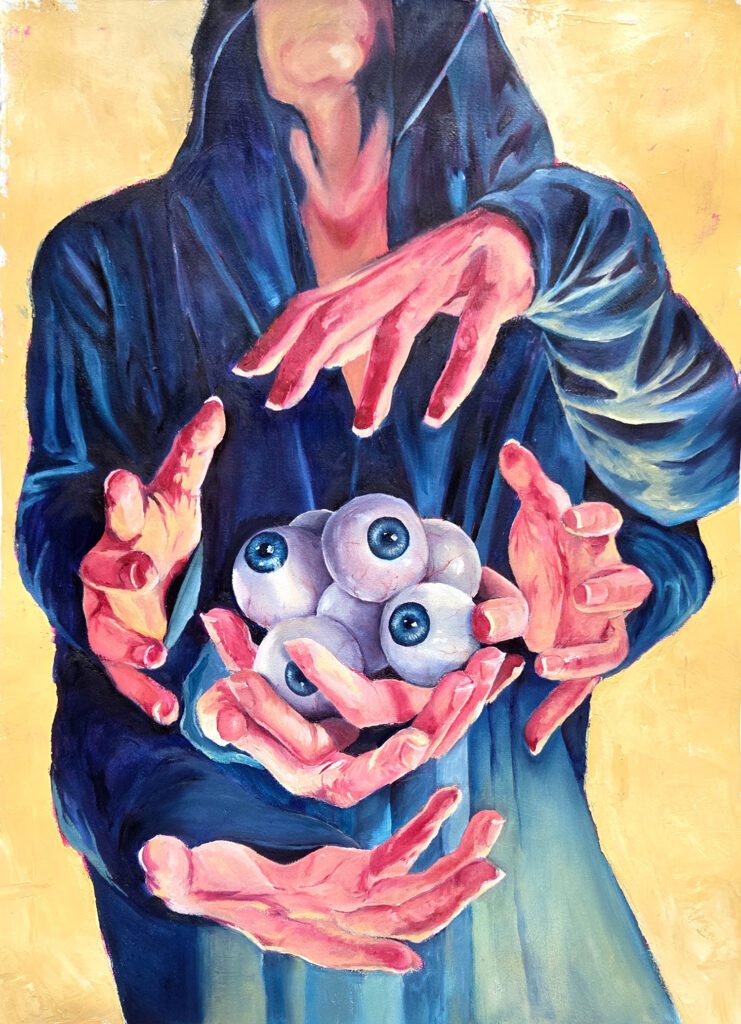
My titles are often memories distilled down to a phrase or a few essential words. While I’m painting, memories surface—triggered by a particular color or the way the brush moves across the canvas. The title becomes a way to name what has emerged without over-explaining it. I want titles to feel poetic, leaving space for interpretation while anchoring the work in something specific from my experience. Sometimes the titles are more conceptual. “Queen of Eyes,” for example, is part of a series I call the Blasphemous Saints—cloaked figures that represent ideas or issues I can’t seem to shake, things that feel urgent or inescapable. The Queen represents this pervasive sense of being watched, whether it’s the expectation to perform your life on social media or the reality of constant surveillance. “Dreams Don’t Blink” works differently—it’s about commitment and courage.
You can’t hesitate or let fear paralyze you when it comes to the things that truly matter. Your dreams won’t wait for you to feel ready.
The titles play a crucial role for me. A title’s not just a label—it’s part of the work’s meaning, a key that opens up one possible way into the painting while still allowing viewers to bring their own interpretations and experiences to what they see.
Q4. How do you think of the relationship between your work as a narrative painter and your background in film, storytelling, and visual narrative?
My background in film gave me a foundation I didn’t fully appreciate until I returned to painting. Film school taught me how to craft a scene—how lighting, angles, and composition work together to create meaning and atmosphere. I learned that storytelling doesn’t always need to be explicit; sometimes the most powerful narratives live in subtle gestures, in the tilt of a head or the way light falls across a face. That sensitivity to visual language carries directly into my painting. I’m always thinking cinematically—about how to frame a moment, how to use shadow and light not just for mood but to guide the viewer’s eye and reveal emotional truth. Photography plays a big role in my process too. I use it extensively to capture fleeting gestures and expressions that contain unspoken feeling. As a writer and filmmaker, I learned that every element in a frame should serve the story. That discipline has made me more intentional as a painter. I’m not just rendering a figure—I’m capturing a moment within a larger, often unspoken narrative. The viewer might not know the full story, but they should feel it. That’s where film and painting converge: in creating images that feel like they’re part of something bigger, still unfolding.
Q5. When people respond to your paintings, what do you hope they feel first curiosity, discomfort, recognition, something else?
I hope they find some part of themselves reflected in the work. More than anything specific—curiosity or discomfort or recognition I want that moment of unexpected connection, where something in the painting touches something in them. It’s been one of the most meaningful parts of sharing my work publicly. I’ve had people stand in front of my paintings and suddenly start telling me stories about their own lives—things they’ve been through, things they’re carrying. That moment of resonance breaks down the usual distance between artist and viewer, between the work and the world. It makes me feel less alone in my own experiences, and I hope it does the same for them. I don’t think you can dictate what someone should feel when they look at art, and I wouldn’t want to. But if my paintings can create a space where someone feels seen, where they recognize their own pain or struggle or resilience reflected back at them, then the work is doing what I need it to do. That connection—that sense of “this person understands something I thought was only mine”—is what makes the vulnerability worth it.
Q6. Your Blasphemous Saints series addresses vulnerability and complicity. How do those ideas change the way you approach figure, gesture, and presence on the canvas?
Those figures come to me unbidden, almost like visions. I’ll be struck suddenly by an idea, and I can see the saint rising out of the shadows—sometimes clear as day, sometimes requiring patience to fully emerge. It feels less like invention and more like revelation.Once I have that initial vision, I spend time building reference material. I usually use myself as a model, taking many photos until I capture the right gesture and presence. I’m deeply inspired by works like Bouguereau’s “La Vierge au lys” and Sargent’s “Incensing the Veil”—paintings that create figures feeling both human and transcendent, intimate and iconic. The cloaked, shrouded quality is essential. I deliberately avoid painting whole faces because these aren’t specific people—they’re creatures of concept, embodiments of ideas. By obscuring the face, I’m creating something more universal, something viewers can project themselves onto. The gesture and posture carry the meaning: the way a figure holds itself, the tilt of the head, the drape of fabric. Those elements convey vulnerability or complicity or defiance more powerfully than any detailed portrait could. Vulnerability and complicity aren’t just themes—they’re structural. The figures are vulnerable by design, exposed yet hidden, inviting viewers to complete them.
Q7. Your studio practice happens in New York, a city of layered histories and human intensity. How does place the city, its light, its energy influence what you make?
I’ve lived in various parts of New York for most of my life, and my relationship with place has always been complicated. Growing up, I had physical space—forests and open land—but felt confined at home because of my family situation. When I moved to the city, I thought I’d finally feel free, but my life became constrained in different ways. It wasn’t until I got my own place and built my studio that I could really breathe.The city is wild and relentless, constantly moving—it feels alive and hungry. That energy seeps into the work whether I intend it to or not. There’s an intensity to New York that matches the intensity of what I’m trying to process through painting. It can be overwhelming, but it fuels a certain urgency. You can’t be passive in New York; it demands you show up fully, and my paintings reflect that—they don’t shy away, they confront. That said, I’ve very recently moved to a small town in France to help build an art atelier, and I suspect my work will shift as I settle into a quieter life. I’m genuinely curious how this change will affect what I make. Will the paintings become more contemplative? Will new themes emerge? I don’t know yet, but I’m open.
Q8. Several of your pieces feel both intimate and expansive at the same time. What choices in scale, brushwork, or framing help you achieve that tension?
As I’ve been building confidence as an artist, the scale of my work has grown to match. The Saints series in particular demands larger canvases—these figures need physical presence, they need to inhabit space in a way that feels commanding, almost confrontational.I essentially bring the camera—the viewer’s eye—in very close on the figure, as if you’re standing directly in its presence. There’s intentional claustrophobia to the framing. The painting doesn’t give your eyes room to wander or find relief. The figures fill the frame and demand attention; there’s nowhere else to look.That’s where the tension between intimacy and expansiveness lives. The scale is monumental, which should feel expansive, but the tight framing creates pressing intimacy—you’re too close, almost uncomfortably so. It mimics standing before something powerful that you can’t fully take in all at once. The brushwork plays into this too. I use gestural, sometimes raw marks that reveal the process, the hand behind the image. That keeps the paintings from feeling too polished or distant. Even at large scale, you can see the human effort, the vulnerability in the making. That push and pull—between monumental and intimate, universal and deeply personal—is what I’m always chasing.
Q9. What does the eye mean to you as a motif especially when you title works around vision, gaze, or witnessing?
The eye is profoundly important to me, both symbolically and viscerally. We’re visual creatures—our vision is sharper than most of our other senses, and we rely on it to navigate the world. But beyond that practical function, the eye carries centuries of symbolic weight: the window to the soul, enlightenment, divine witness. All of that history lives in the motif. What draws me most is how impossibly expressive eyes are. You can look into someone’s eyes and immediately sense how they’re feeling, even when they’re trying to hide it. You might be smiling, but your eyes can still betray sadness or fear. Eyes can’t lie the way the rest of our face can—they reveal the truth we’re carrying, whether we want them to or not. When I paint eyes, I’m trying to capture that moment of truth, that unguarded expression. I’m drawn to the vulnerability there, the way a gaze can be both an act of witness and an invitation to be witnessed. In works like “Queen of Eyes,” the motif becomes about surveillance and scrutiny. But in other pieces, the eye is about connection—about really looking at someone, or being brave enough to let yourself be seen.
Q10. How has your understanding of painting changed as your practice has become more public through exhibitions, prints, and showing work online?
It’s really been an experience. For a long time, I was the only one seeing my art—painting felt like this private conversation with myself. Now that the work is more public, through exhibitions, prints, and sharing online, I get to see it through other people’s interpretations, and that’s changed everything. I’ve learned so much about what draws people to the work. Sometimes viewers pick up on emotions or meanings I wasn’t consciously aware I was putting into a piece, and that’s been incredibly revealing. It’s shown me that once a painting leaves the studio, it stops being entirely mine—it becomes something people complete with their own experiences. There’s a vulnerability in making the work public that mirrors the vulnerability of creating it. You’re exposing not just the paintings, but the parts of yourself embedded in them. But that risk has been worth it. The connections I’ve made, the stories people have shared while standing in front of my work—those moments have deepened my understanding of why I paint and what painting can do. I really look forward to doing a solo exhibition where I can give viewers a deeper, more immersive look into my world through the art, where the paintings can speak to each other.
Q11. What advice would you give to emerging artists who are trying to make work that is emotionally honest and intellectually grounded especially in a world where quick impressions often dominate?
My biggest advice is to do the work of self-analysis. Sit down and make lists—things in your life that feel significant, your influences, colors that move you, subjects that catch your interest, anything that potentially has meaning to you. This creates a well you can draw from when searching for what to paint. It grounds you in something real and personal rather than chasing trends or trying to anticipate what might perform well online. Keep your eyes open and study work that resonates with you. Ask yourself what it is about certain paintings that attracts you. Is it the mark-making, the colors, the themes, the composition? Can you interpret those elements in your own way, filtering them through your own experiences? Look at the world you live in—how does it influence you? There are so many things that can help you define who you are, and who you are becomes your art. The hardest part is forgetting about what you think other people want. You have to make the art that you need to make, the work that’s true to you. Be yourself truly and wholeheartedly—that’s what makes your work uniquely yours. The work that endures and connects deeply is the work that comes from a real place, that couldn’t have been made by anyone else.
As we wrapped our conversation with Jessica, one thing kept sitting with us. The thing about her work that stays with you isn’t any single painting. It’s the feeling of having been seen by something you were only trying to look at.
That reversal is rare in art. Most paintings let you be the observer. You stand there, you take it in, you walk away on your own terms. Jessica’s work doesn’t allow that. The framing is so tight and the presence so intense that somewhere between looking at the painting and the painting looking at you, the dynamic flips. You came to see art. And the art saw you instead.
For anyone reading this who collects or lives with art, that quality is worth understanding. Because this isn’t work that decorates a room. It occupies it. A Jessica Fisher painting on your wall doesn’t fade into the background after a few weeks. It confronts you every time you walk past it.
The eyes follow you the way real eyes do. The gesture holds something different depending on what you’re bringing to it that day. A piece that felt powerful in November might feel tender in March. One that unsettled you on a Tuesday might comfort you on a Sunday. That’s the mark of work that justifies its place on a wall for years, not months. Work that grows with the collector rather than being consumed by them.
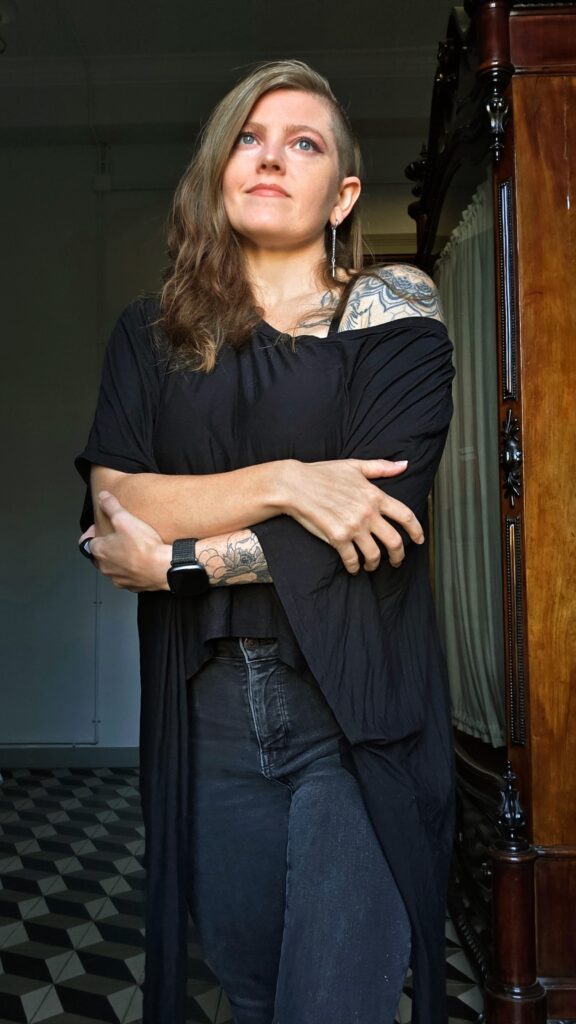
And there’s something else that gives her work depth that only increases over time. Jessica’s paintings come from real experience. Not concept. Not trend. Not aesthetic exercise. Real pain, real healing, real survival processed through real craft by someone who came to painting not because it was a career option but because it was the only language that could hold what she needed to say.
That origin is in every brushstroke. You can feel it. And collectors who understand what they’re looking at aren’t just buying a painting. They’re investing in a body of work being made by an artist at a pivotal moment, someone whose practice is growing visibly, whose ambition is expanding, whose recent move to France signals a new chapter that hasn’t been written yet.
She taught herself to draw from stolen books. She walked away from art for years and came back stronger. She puts the viewer so close to the truth that there’s nowhere left to hide. And the work that comes from that kind of honesty doesn’t just hold its value.
It becomes more valuable the longer you live with it. Because every time you look at it you see something you missed before. And that’s because Jessica’s paintings aren’t finished when she stops painting them. They’re finished every time someone stands in front of them and finally sees themselves.
To follow Jessica’s journey and see more of her work, find her through the links below.
