
From Television Screens to London Streets: Joanna Pilarczyk’s Creative Journey

Some artists make you notice a face. Others make you notice everything around it: the colours, the patterns, the little details of a room, the flowers, the clothing, the atmosphere. Joanna Pilarczyk does both.
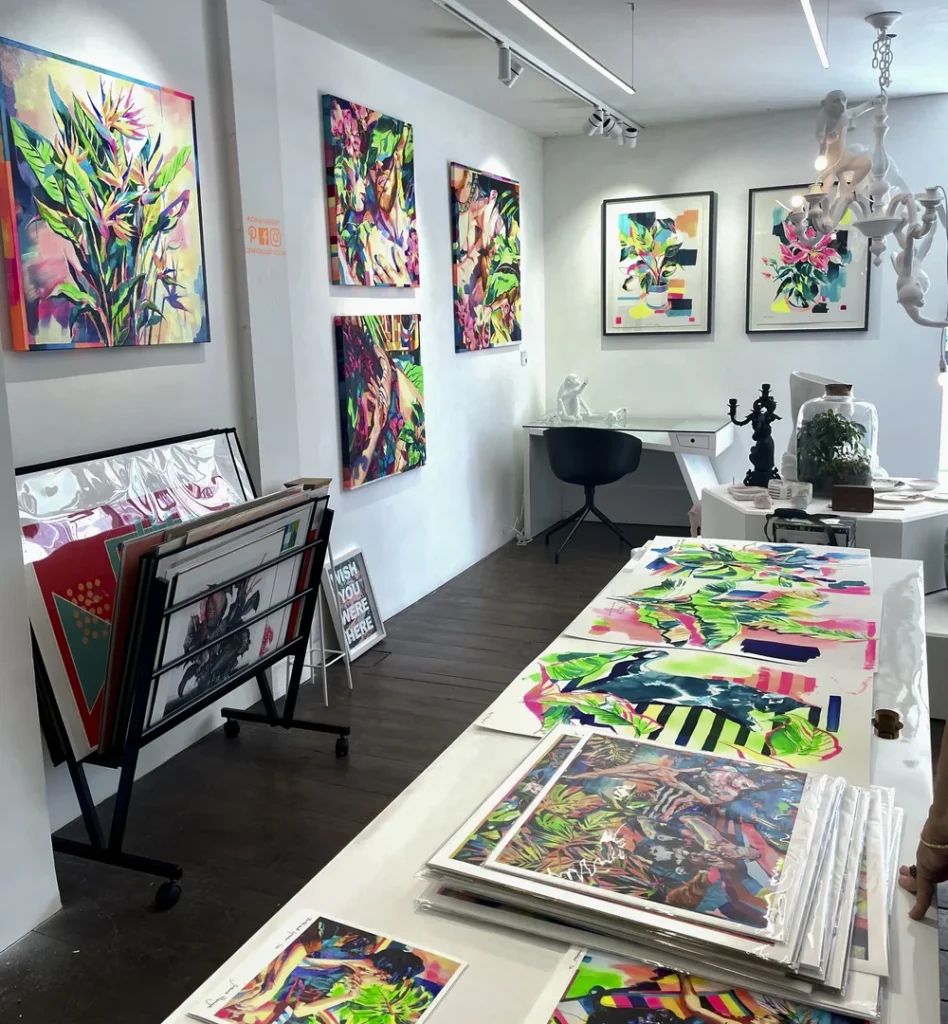
Her paintings are instantly recognisable. Figures sit at the centre of compositions filled with intense colour, geometric shapes, foliage, patterned fabrics, and unexpected combinations of neon and earthy tones. There is something intimate about them, but also something unapologetically vibrant. Her subjects appear caught in quiet moments, simply existing in their own space, while the world around them becomes almost dreamlike.
For Pilarczyk, colour is not simply a way of making a painting beautiful. It is connected to memory, culture, place, and even the experience of seeing a world that once felt distant. Born in Poland and now based in London, she has built a practice around people, relationships, diversity, and the feeling of belonging somewhere.
It is a body of work that feels personal without being closed off. The people in her paintings may come from her own community, but the emotions they carry are much more universal.
Who Is Joanna Pilarczyk?

Joanna Pilarczyk is a London-based contemporary figurative painter, originally from Poland. Her formal artistic education began early. She attended art classes from the age of five and later went to art college at fifteen, before continuing her studies at the Art University in Zielona Góra, Poland. She eventually completed a Master’s degree in Visual Arts and Art Education, specialising in figurative painting and portraiture.
Painting was always a natural part of her life. As a child, she and her twin sister were both drawn to art, and their early relationship with drawing and painting eventually developed into serious artistic training. Interestingly, the sisters initially had very similar styles, before developing their own artistic directions as they grew older. Joanna describes her own approach as becoming more impressionistic and expressionistic.
After art college, Pilarczyk briefly explored another direction, working in Warsaw and considering a career designing characters for video games. But she soon realised she wanted to continue studying art. Returning to Zielona Góra gave her the opportunity to explore areas beyond painting, including printmaking, sculpture, photography and multimedia, before ultimately choosing figurative painting and portraiture as her focus.
She moved to London in 2012, and that change of place became an important turning point in her artistic life. The multicultural environment of North London introduced her to people, cultures, fashion and visual experiences that were very different from those she had known growing up. It was here that the distinctive world we now recognise in her paintings began to take shape.
A World Built Around People
At the heart of Pilarczyk’s practice is the human figure.
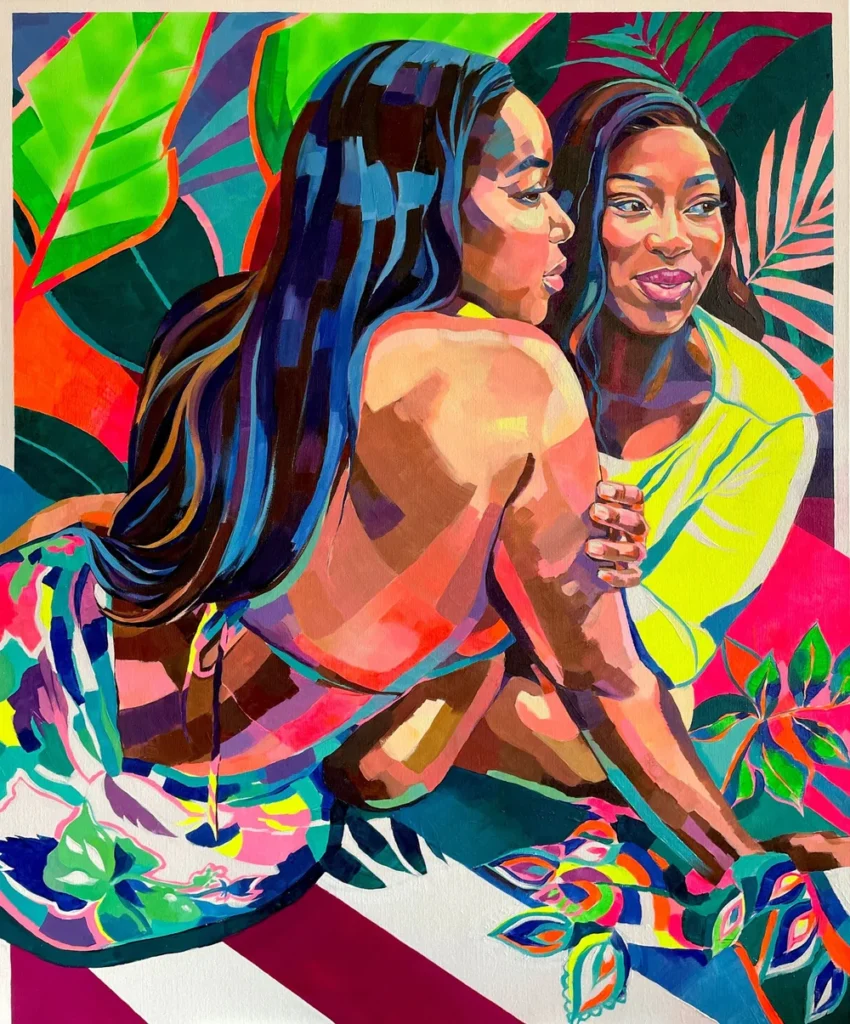
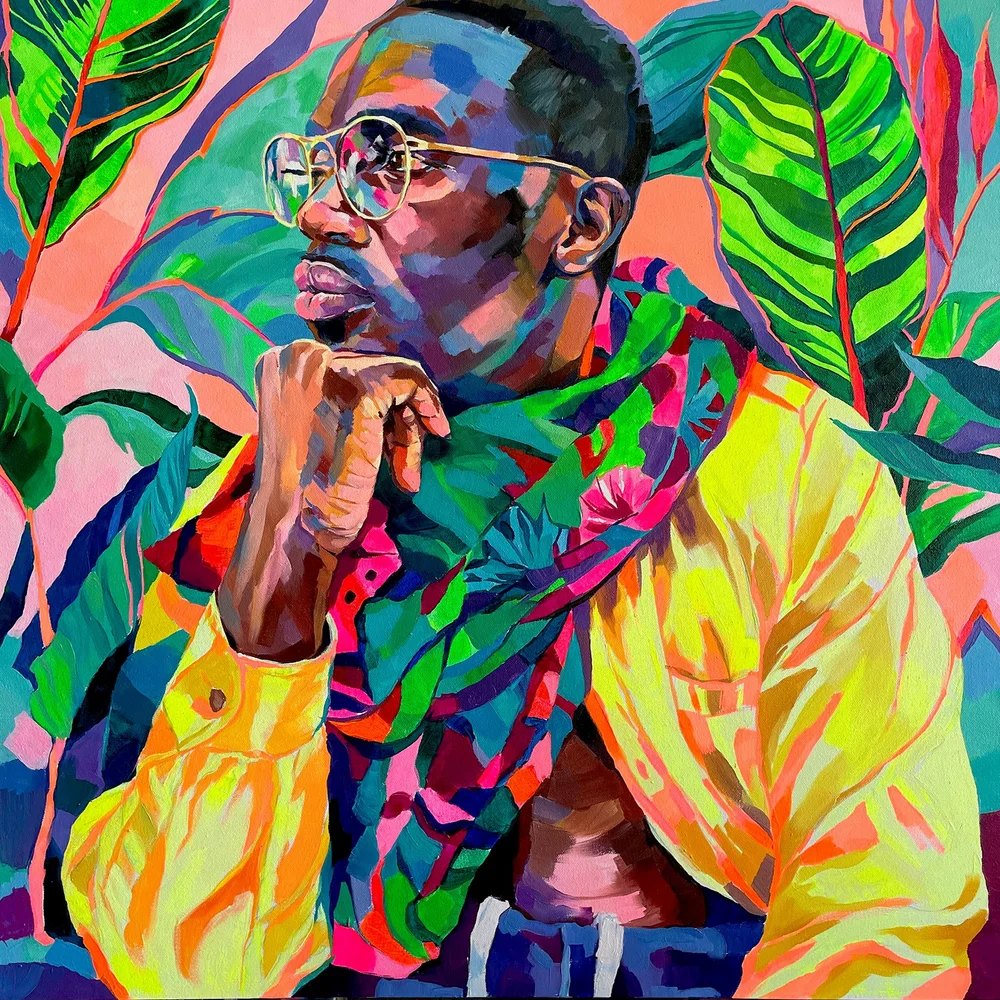
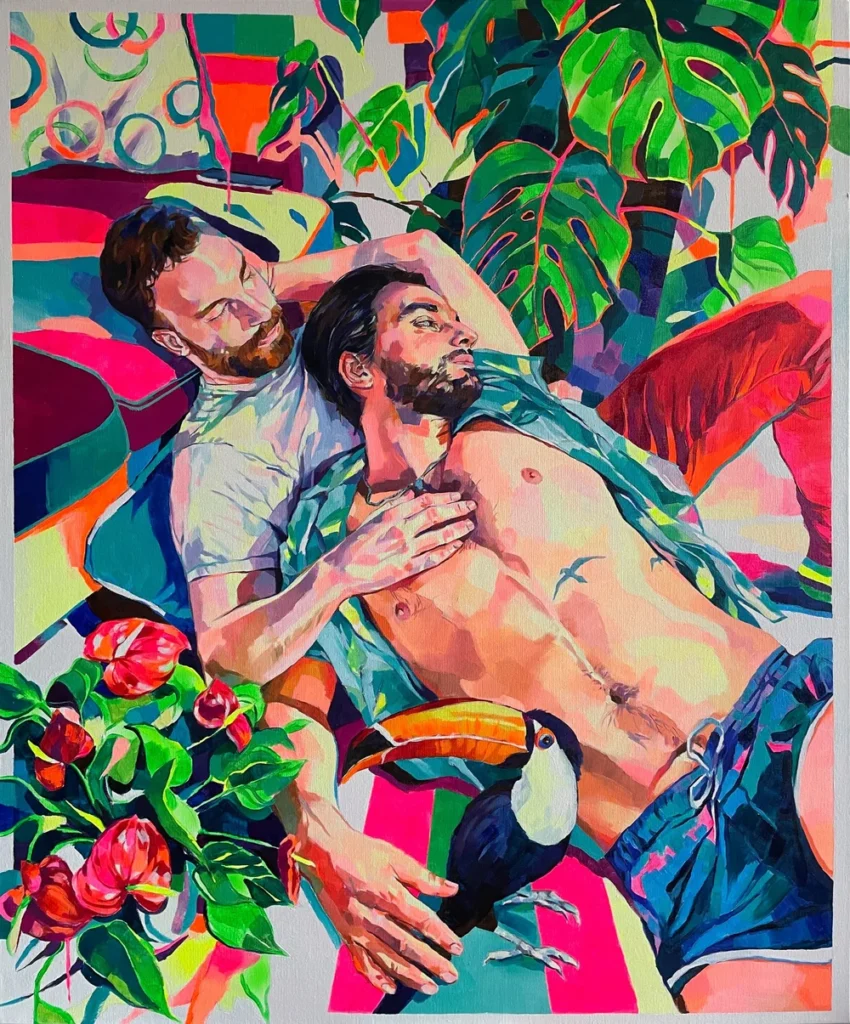
Her portraits are often inspired by friends, acquaintances and people she encounters within her North London community. Rather than simply painting someone because of how they look, she is interested in knowing something about them. Conversations, relationships and personal stories become part of the process.
That is especially important in her portraits of women of colour, mixed-race couples and same-sex couples. These paintings explore identity, relationships, acceptance, diversity and belonging, while giving space to people and experiences that have historically been underrepresented in traditional portraiture.
There is also a lovely sense of stillness in these paintings. Her figures are not necessarily performing for the viewer. They might be resting, embracing, sitting quietly or simply sharing a moment with another person. Pilarczyk has described her interest in those moments when people are unguarded and free from expectation.
This is perhaps what makes her work feel so intimate. Even when the colours are loud, the emotions are often quiet.
The result is a fascinating contrast: bright surroundings and deeply human subjects, visual energy alongside moments of calm.
When Colour Becomes Part of the Story
It is impossible to talk about Pilarczyk’s work without talking about colour.
Her fascination with intense colour has roots in her childhood in Poland. Growing up during the post-Soviet period, she remembers her surroundings as relatively grey and recalls having limited access to colourful art materials. At the same time, she was discovering a very different world through American television and films.


The neon colours, fashion, tropical settings and city lights she saw on shows such as Miami Vice made a lasting impression on her. These colours once represented something distant and almost unreachable. Years later, they became part of her own visual language.
London gave her another kind of colour experience. Suddenly she was surrounded by people from different cultures, with different skin tones, clothing styles, patterns and ways of expressing themselves. The city’s energy became a constant source of inspiration.
That history helps explain why her paintings never use colour quietly. Neon pinks, vivid greens, oranges, yellows and blues can sit next to softer skin tones, deep shadows and botanical greens. Rather than simply decorating the composition, colour helps create its emotional atmosphere.
Oil, Acrylic, Spray Paint and Gold
Pilarczyk’s primary medium is oil paint, and her relationship with the material is an important part of her practice. She loves its texture, vibrancy and ability to blend, describing oil as the medium that allows her to achieve the richness she wants in her paintings.

But she does not stop there.
Her recent paintings frequently combine oil and acrylic, with some works also incorporating spray paint and gold leaf. Pieces such as My Brazil, Gentle Embrace, Between Us, Dream of Summer Night and Grace show how varied this material vocabulary has become.
The combination is particularly interesting because the different materials contribute different qualities. Oil allows her to build the figures and skin tones with depth, while acrylic can bring the vivid, almost electric colours that have become so characteristic of her work. Spray paint adds another layer of texture and immediacy, while gold leaf introduces small moments of light and luxury.
She also continues to work across other mediums. Earlier in her career she experimented with ink, watercolour and drawing, and she has taught watercolour techniques within her local community.
From Familiar Faces to a Larger Story
Pilarczyk’s artistic journey is also a story about finding a visual language that feels completely her own.
She began with portraiture because people interested her. At university, she often painted friends, learning about their lives through conversations and using those relationships as a starting point for paintings. After moving to London, that interest expanded naturally as she encountered a much broader range of cultures and communities.
The pandemic brought another unexpected shift. Unable to work with her usual models, Pilarczyk began painting herself and her husband. Self-portraiture was initially uncomfortable for her, but the experience became an important part of her development and opened up another way of thinking about the figure.
The pandemic also marked the point at which she moved toward working as a professional, full-time artist, while continuing to share her knowledge through teaching.
Today, her work carries all of these chapters with it: the discipline of formal training, the influence of Poland, the energy of London, the people she meets, and the constant search for new ways to bring colour and emotion together.
Recognition and a Growing International Presence
Pilarczyk’s career has steadily gained international attention.
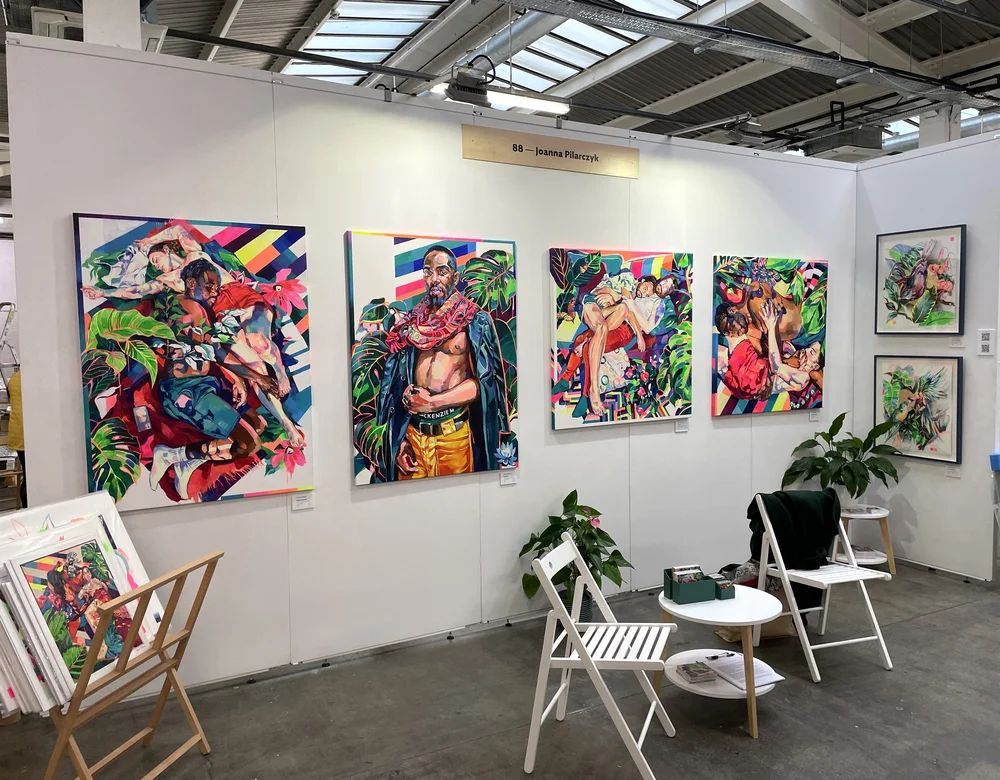
In 2026, she won the Young Masters Mentorship Award, presented during the Women in Art Fair in London by Cynthia Corbett and artist and curator Sadie Clayton. It is a particularly meaningful recognition within a career that has increasingly connected her work with platforms supporting women artists.
Her recent recognition also includes being shortlisted for the Guildford House Open 2025 and the Herbert Smith Freehills Portrait Award at the National Portrait Gallery. She has won the Boynes Monthly Artist Award multiple times, including in November 2024, 2023 and 2022, and was the winner of The Untitled Magazine’s May 2024 Cover Open Call. She was also a finalist for the International FiKVA Award for Figurative Painters in 2023 and the Women United Art Prize in 2021 and 2022.
Her exhibition history is equally impressive. Her work has appeared at the Royal Society of Arts, Mall Galleries, The Other Art Fair, Saatchi Gallery’s Start Art Fair and Women in Art Fair, alongside international exhibitions in New York, Los Angeles, Munich and Palm Beach.
My Paradise and Other Special Projects
One particularly significant chapter came in 2024 with Joanna Pilarczyk: My Paradise, an online solo exhibition presented by The Untitled Space on Artsy, with selected works also shown at the Superfine Art Fair in Times Square, New York.
The exhibition brought together the vibrant figurative language that had become central to Pilarczyk’s practice and followed her recognition as the winner of The Untitled Magazine’s May 2024 Cover Open Call.
Her involvement with Women in Art Fair has also become an important part of her journey. In 2026, she returned to the fair and received the Young Masters Mentorship Award, making the occasion more than simply another exhibition opportunity.
Another lovely aspect of Pilarczyk’s career is her connection with her local community. Alongside her own studio practice, she has taught painting and watercolour techniques in North London, continuing a relationship with art education that began during her formal training.
A Painter Who Makes Room for People
There is something generous about Joanna Pilarczyk’s paintings.

They are colourful, certainly. They are bold, contemporary and visually distinctive. But beneath all of that colour is a very human interest in people: who they are, where they come from, how they connect with one another, and what it means to feel seen.
Perhaps that is why her work feels so alive. The figures are not isolated from their surroundings; they belong to them. Flowers, patterns, colour and architecture become part of the stories being told, creating environments that feel somewhere between memory and imagination.
For an artist who once looked at the bright colours of another world through a television screen, Pilarczyk has created a world of her own, one filled with the vibrancy she once longed for, but also with the people, relationships and communities that make that vibrancy meaningful.
And that may be the most beautiful thing about her work. Joanna Pilarczyk does not simply paint people. She paints the spaces between them, the colour, closeness, identity and quiet sense of belonging that can turn a portrait into something much bigger than a likeness.
Explore More on her Website:
