She paints small faces to remind us we’re just dust in a universe we don’t respect I Nerea Azanza
At Women in Arts Network, we’ve met a lot of artists over the years. But there’s something different about the ones who had to fight their way back to making art. They don’t take a single brushstroke for granted. Every line matters. Every color choice feels like it’s carrying the weight of all the years they couldn’t do this.
Nerea Azanza is one of our selected artists for our Faces exhibition, and the first time we saw her work, something felt different. Those tiny faces surrounded by flowing lines, they weren’t just beautiful. They felt like they’d been waiting a long time to exist. Like someone had something to say and finally, finally got the chance to say it.
We chose Nerea because you can feel her story in the work without knowing what it is. There’s this urgency underneath everything. This sense that she’s making art like she knows exactly how precious the ability to make it actually is.
And she does know. Because she lost it. For decades. Not by choice. Not gradually. It was taken from her by a medical mistake when she was just sixteen years old.
Imagine waking up one day and the thing that’s always defined you, the thing that flows through you as naturally as breathing, just stops. You’re still you. Your hands still work. Your eyes still see. But the connection between what you feel and what you can make is just… gone. And you don’t know if it’s ever coming back.
That’s what happened to Nerea. A misdiagnosis. Wrong medication. And slowly, the creativity that had always been there disappeared. By her early twenties, fresh out of art school, she couldn’t create anything original. Only copy what she saw. And copying, for someone who’d always made things, felt like dying slowly.
She couldn’t be the artist she’d trained to become. So she did the only thing she could. She stayed close to art in the only way left. Through conservation and restoration. Taking care of other people’s work. Spending years with wax anatomical models, with bodies broken into parts. Still art. Still something. But not hers. Never hers.
Decades passed like this. Going to work. Coming home. Living around art but unable to make it. Watching other people create while she couldn’t. Carrying the weight of what she’d lost every single day.
Then something shifted in 2019. After five years of rehabilitation, trying to understand what was wrong, doctors finally told her the truth. The original diagnosis had been completely wrong. She’d never needed that medication. All of it, the decades of numbness, the years of lost creativity, had been a mistake. Someone got it wrong when she was sixteen and she paid for it with most of her creative life.
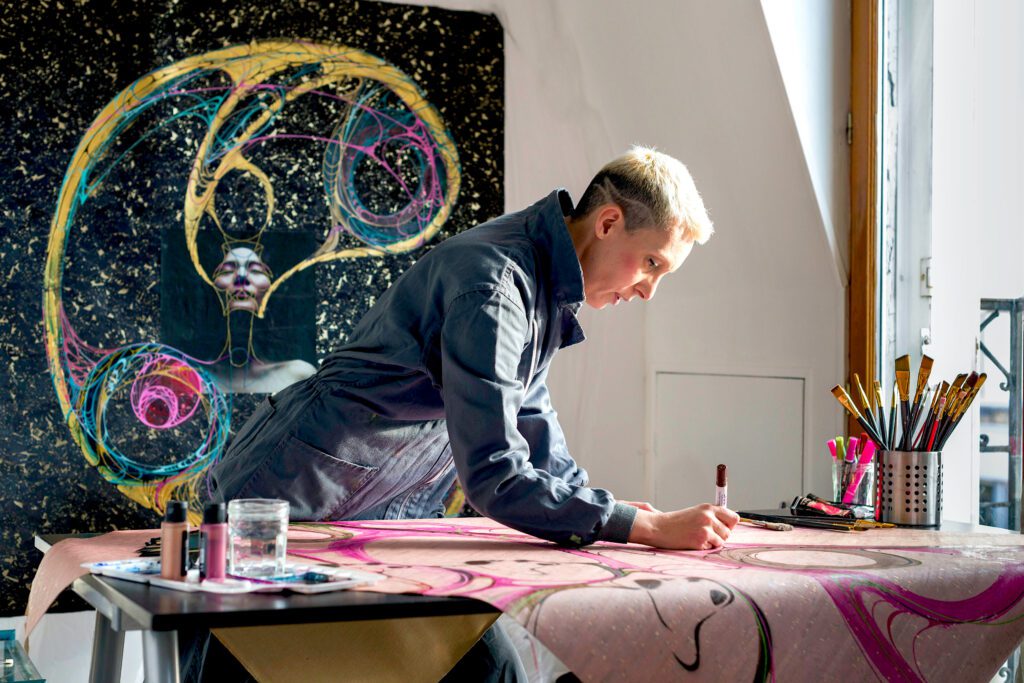
She paints everything freehand now. No sketches. No safety nets. Just her hand following what her body knows. Every line is a risk. Will this work? And if it doesn’t, she’ll make it work anyway. Because she spent too many years unable to make anything at all. She’s not going to waste time now being afraid of imperfection.
Now let’s hear from Nerea about what it actually feels like to get your life back after decades, about painting us tiny in a universe we forgot to respect, and about what all those years of silence taught her that she couldn’t have learned any other way.
Q1. Could you share your background and early artistic journey where your interest in abstraction and figurative blending began, and how your early experiences shaped your current practice?
My artistic path did not follow a straight line. I have a background in science, art, and Conservation–Restoration of Cultural Heritage. Although I trained from an early age in classical figurative art academies before moving to Madrid to study Fine Arts, I was always deeply intrigued by biological patterns and architectural lines. Art, science, and architecture have coexisted naturally in my mind since adolescence. Both of my parents are scientists, and I was constantly and abundantly exposed to scientific imagery while growing up. Much later, before age and illness took their toll, they told me they could see their work reflected in my art. I am not consciously aware of that influence, to be honest. While I was learning to draw — even before entering the faculty — I began exploring classical sculpture through geometry, mapping, and structural analysis. This approach allowed me to pass the very rigorous entrance exam required to access Fine Arts studies at the Complutense University of Madrid. This may have been my first attempt to bring both languages together, although it dissolved completely at the time. During my years at the faculty, I continued to explore figuration and abstraction separately. I did not intersect them at all. That idea never crossed my mind. I was simply experimenting, following instinct rather than concept. At the age of sixteen, I was subjected to a serious medical misdiagnosis. My creativity, which had once flowed continuously, suddenly dried up in my early twenties. By the time I was finishing my degree in Plastic Arts, I was no longer able to create original work. I could only copy, and I refused to accept that limitation. Copying never felt natural to me — not even sketching. One of my teachers, a respected contemporary Spanish artist, once told me, “You are very interpretive, and that is also valid.” At the time, that sentence stayed with me more deeply than I could understand. Many professors had to deal with a young rebel girl, someone who refused to sketch because I found it boring. They were amused when I arrived with a croquis and instead produced a large-scale work that had nothing to do with it. All of this still lives in my practice, here and now. The intuitive creative process I developed during those years has become key to how I blend figuration and abstraction today. Being unable to pursue a career as an artist was sad and difficult, but all I could do was continue. Wanting to remain connected to the art world and drawn by my interest in science, I completed a degree in Conservation–Restoration at the same school, as it was the only path where creativity did not play a central role. I later pursued an MFA in Preventive Conservation and Museology, and a PhD focused on the Conservation–Restoration of wax anatomical models — a rare and unknown form of Human Heritage. For decades, the human figure remained present in my daily life as a professional reality: the dissected body, the limb alive, seen through flesh and skin. Those sculptures felt very abstract.
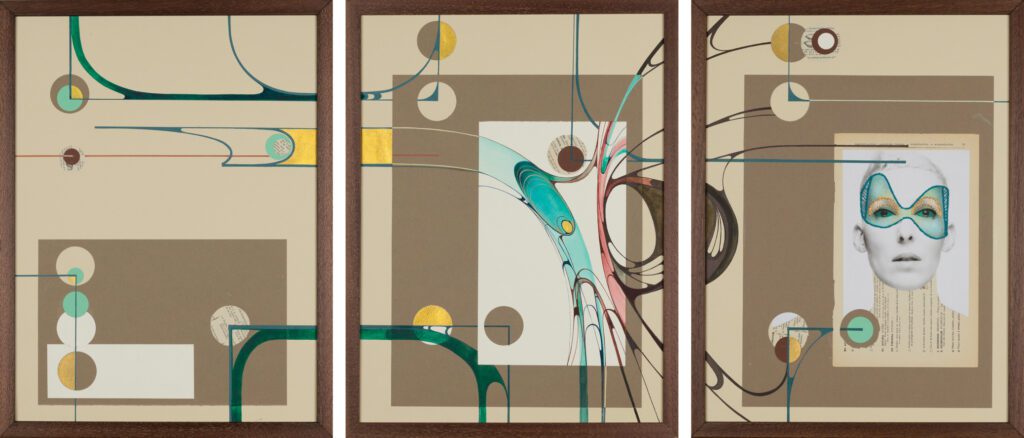
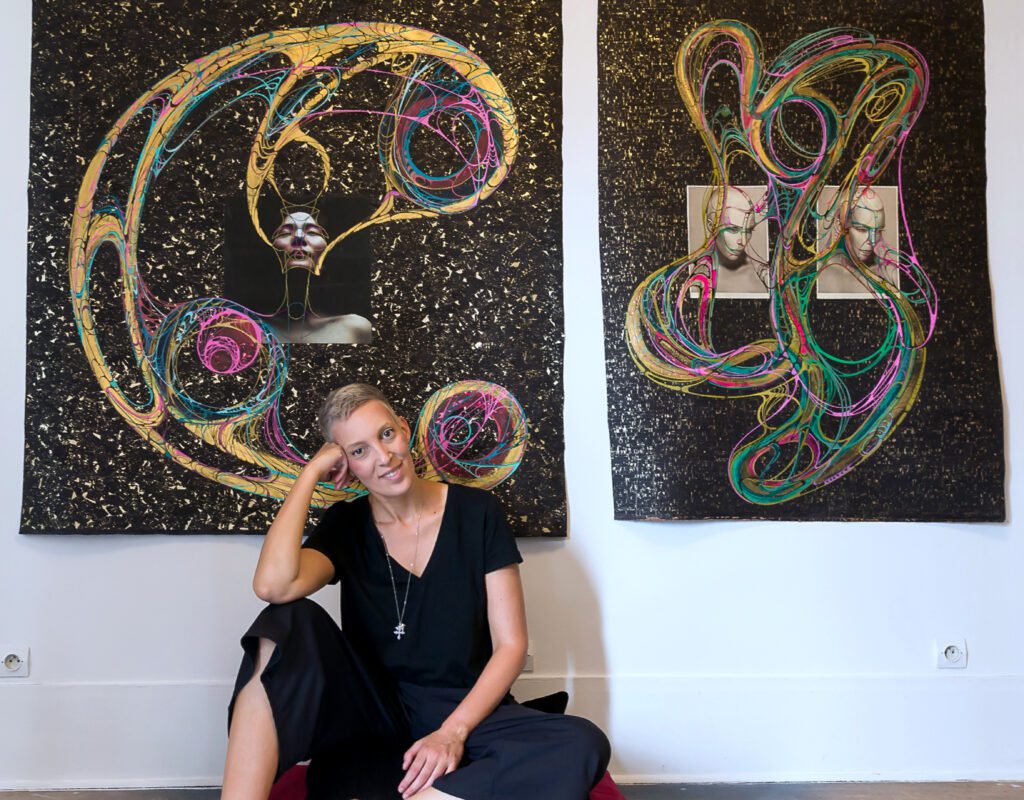
All of this makes me feel that when I returned to making art in 2019, after decades of not picking up a brush or a pencil because it made me feel powerless, the blending of figuration and abstraction emerged naturally — as something that needed to happen. I did not want to renounce either. After a long rehabilitation process lasting five years, during which it became clear that all medical diagnoses had been wrong and that I had never needed the medication that had numbed me, my creativity flourished again. The happiness I felt is indescribable. I returned to making tiny drawings in a Moleskine, and exploring the human condition became essential — not to speak about myself, but about us. I had spent a long time observing the world from a bed and a wheelchair, in silence. It was time to speak up through art. If, as I experienced studying the history of art blended with the history of anatomy, what we recognize as a mirror of our human condition is a face, the body, the movement of hands, the eyes — how could I remove that from my work while trying to understand who we are and how we exist in relation to our surroundings? I couldn’t. Therefore, I chose to represent humanity with human faces in my work, keeping them very small. We are tiny particles of dust in an immense universe we barely respect. I did not want the faces to dominate the surface. Humility toward others and toward nature felt necessary, especially after everything I had been through. And still, that was not enough. I began distorting the portraits through lines and geometric structures over the surface, as I had done at nineteen while working with classical sculpture to prepare for my entrance exam. This tendency comes directly from my scientific background — the search for patterns, underlying structures, and from many years of anatomical study in which the human body is constantly dissected. To me, patterns and lines are everywhere, and they are astonishing. I am aware that I am known for my lines, even though I am still an emerging artist, a baby in the art world. Honestly, I had never painted lines before. Ever. If I make an effort to remember, I can tell you that, being young, while drawing the human figure from life, I had always paid close attention to line — internal and external — emphasizing some, allowing others to dissolve. It was a condensed form of language, a way of understanding how light inhabits the body. I believe lines entered my actual work as a kind of language, an invisible calligraphy, an abstract element shaping the freedom I feel in knowing my truth, a celebration of being back, and of my desire to reconnect with people and with life. And this is how “Art in Expansion” emerged, so let´s go with the next question.
Q2. You describe your practice as art in expansion, where small portraits grow into larger, more open compositions. How did this idea first take shape, and what does “expansion” mean to you personally?
Today I work from an art studio, but in 2019 that was not the case. After moving to Paris during the pandemic to care for my father-in-law, I was painting on paper in a corner of my bedroom. I had very little space, yet I felt the need to go bigger. That limitation became the starting point. When I created DNA, my first series, I began working in modules. The works are large, sometimes composed of more than ten panels. I would start with a portrait, transform it, and then let lines expand it into space through a second module, then a third, and so on. “Art in Expansion” was born as a technical solution, and only afterward did I realize it was a concept I wanted to explore further. The human figure remains small, yet we are social beings. During the COVID years, this tension between isolation and the need for connection became something we all experienced. The line an element that connects two points in space naturally became my language to connect people, to connect souls.
For me, personally, “expansion” means connection. I spent many years disconnected before returning to life, leaving my country, and starting again. I paint small portraits expanded through lines in space to speak about our deeply human desire to connect.
Q3. In The Origin Series, you explore human identity within today’s social and digital context. How do you think about the relationship between the human figure and the more abstract spaces surrounding it?
“The Origin Series” is an ongoing body of work that brings together people of different backgrounds who represent the human figure rather than specific individuals. The figures often appear in pairs, expressing the duality between nature and the digital. By placing them at the center and allowing them to expand fully into space through freehand lines, I explore how identity is shaped today — not in isolation, but through constant interaction with the social, digital, and natural environments that surround us. In some works, such as “Origin” or “DD.DoubleDream”, this relationship appears as a blend and a positive experience. In others, it becomes a form of critique — an attempt to awaken us from living constantly through screens and to reconnect with real life. This is the case in works such as “AI.Distraction” and “VS. The Machine”, which I painted before artificial intelligence became as pervasive as it is today. Some portraits remain deeply human, while others are transformed and distorted, becoming almost robotic. One of the earliest works in this direction was “Cyborg.IAM”, a double self-portrait in which one face appears upside down, expressing how disoriented and out of place I felt when I returned to making art during a time of isolation and rapid digital transformation. The figures expand into a dark, cosmic space, where the lines form a fetal-like zone, suggesting vulnerability, transformation, and the possibility of rebirth within a completely different artistic landscape from the one I had known before. Entering the art world later in life meant confronting a hyper-connected, fully digital environment that initially left me unsettled. That personal experience deeply shaped how the abstract spaces surrounding the figures emerged in my work. These large abstract areas are not backgrounds; they are active spaces. They reflect uncertainty, distance, and silence, but also openness and potential. I use handcrafted textiles made through recycling processes to create a dialogue with nature, sometimes incorporating metallic leaf to introduce a more cosmological dimension. I have always been interested in merging textiles, paper, and surfaces without covering them. They remain visible and become large abstract shapes within the composition.
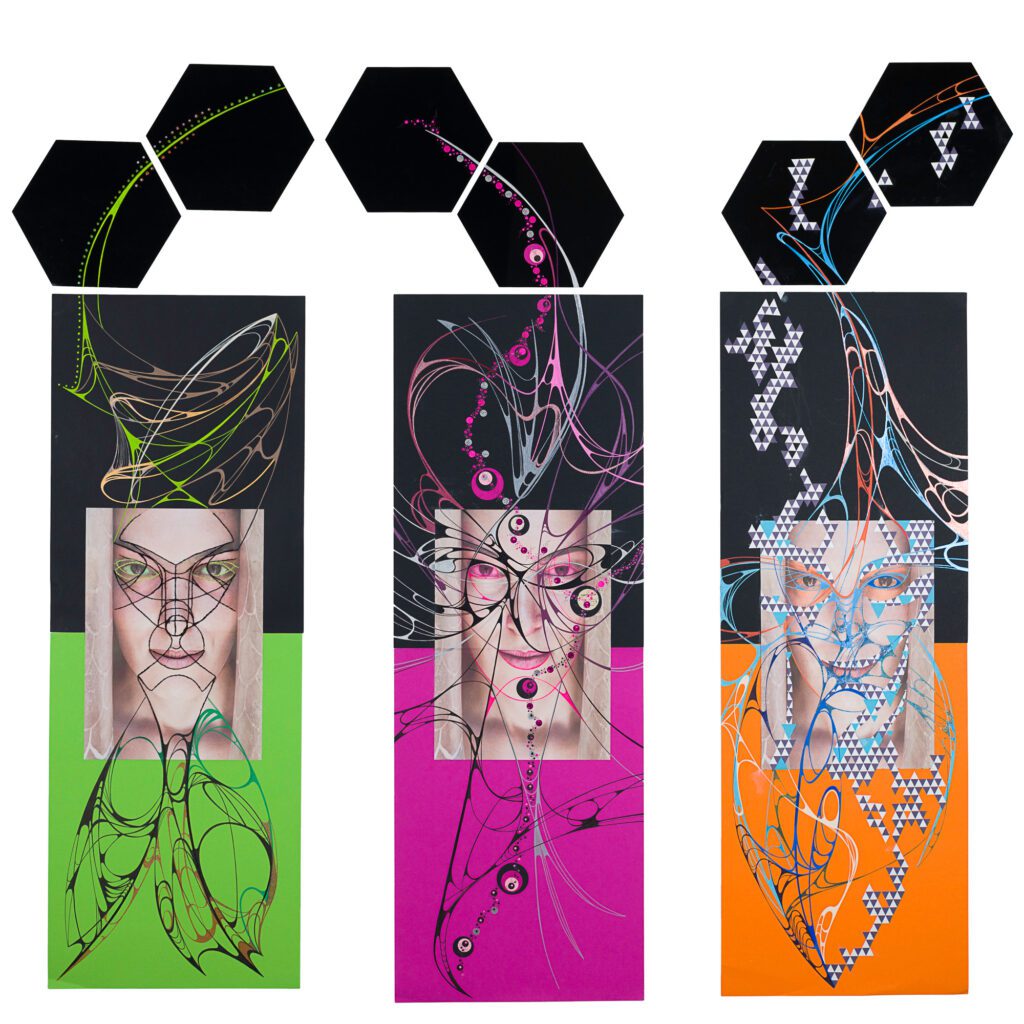
Q4. Many of your compositions begin with recognisable figures that gradually dissolve into movement and colour. How do you decide when a form should remain clear and when it should begin to open up?
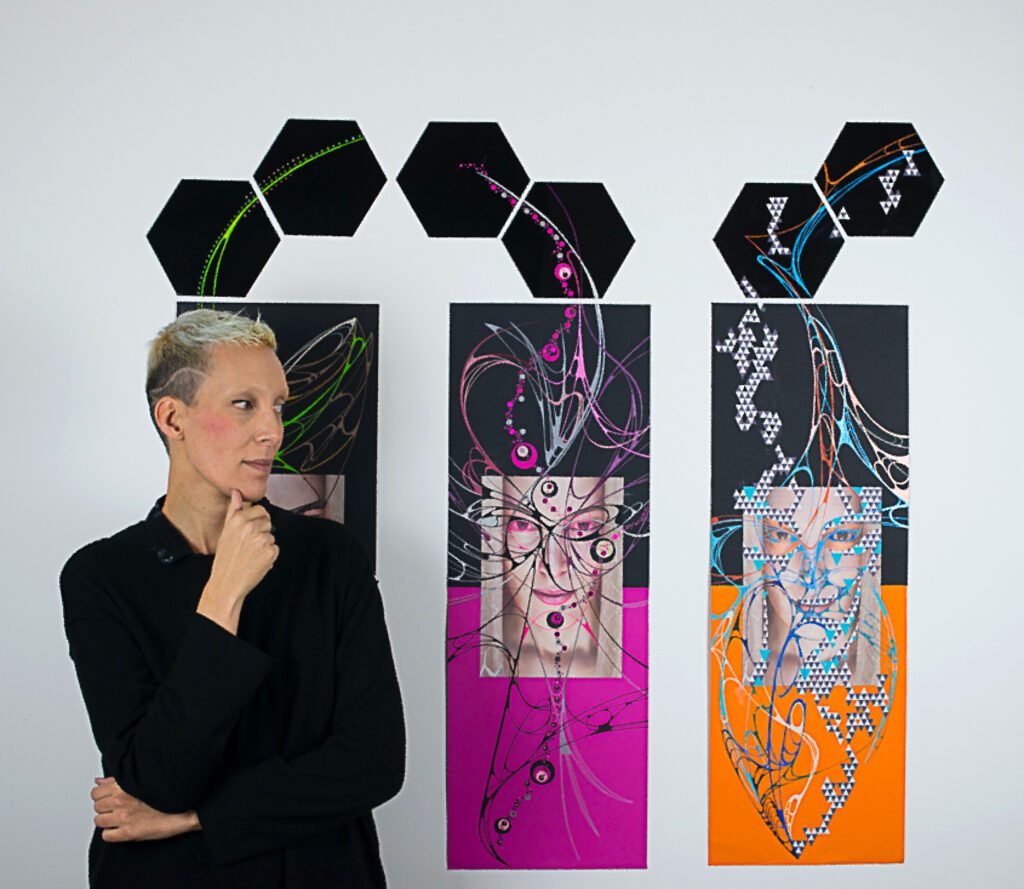
The decision of whether a figure remains clear or begins to dissolve is never planned. It emerges from the concept I am exploring. I work with ideas rather than images, and those ideas evolve, grow, and mutate, much like we do. Titles play an important role in this process. Both the title of the series and the title of each work act as part of a narrative, guiding the composition and its internal rhythm. I paint intuitively, without sketches, and I never know exactly how each artwork will look when I begin. Flow is essential to my process. In order to allow that freedom while still building a cohesive body of work, I define a few anchoring elements based on the chosen concept: the type of support, the mixed media technique, the scale, and the overall structure. For example, “The Re.connection Series” is composed of triptychs that follow a clear structure, while in “Un.labeleD” all the works are diptychs. “SeedS” is purely abstract, and in both “The Re.connection” and “Un.labeleD”, the frames become part of the composition. Without this underlying structure, storytelling would not be possible for me. As a jazz music lover, I often think of my process through that metaphor. Jazz has a framework, a spine, and shared tools — and within that structure, musicians improvise, listen to each other, and flow. That is very close to how I work. From there, the concept itself defines what you are asking. When a concept is linked to vulnerability, connection, or nature, the figures tend to remain more human and recognizable. They function as an anchor to something universal. When the concept involves fear, criticism, or dehumanization, the figure begins to transform. It opens up, dissolves into movement and color, sometimes becoming almost cyborg-like. This dissolution is not about losing identity, but about questioning it. We are individual beings, yet we are also part of much larger systems — social, technological, natural, cosmic. When identity becomes rigid or dominant, when we place ourselves at the center of everything, it can lead to disconnection, harm to others, and disregard for the natural world. Allowing the figure to open up is, for me, a way of expressing that tension.
Q5. You often use freehand lines to connect different parts of the composition. What role do these lines play for you are they intuitive gestures, connectors, or something more symbolic?
Lines are essential in my work. I often say “My lines, my DNA,” because that is how I experience them. I am better at painting freehand lines than at speaking. They are intuitive gestures that follow my body. Even at a small scale, my process is physically demanding, as I do not use masking techniques or preliminary sketches, and there is little — if any — possibility to correct them. Each line feels like an act of defiance: “let’s go and see if this works — and if not, I will make it work.” The line emerges directly from movement, from presence, and from the body itself. They flow in the same way we try to move through life — even when we have a plan, it may change or fail, and we need to adapt. That is something I have done all my life: accepting impermanence as a constant part of everyday experience. At the same time, lines act as connectors. They move through space, dancing between elements. What fascinates me is that the lines I was drawing in 2019 are not the same ones I paint today. They evolve. They become a kind of visual calligraphy, similar to written languages made of symbols I cannot read, yet deeply admire. As I evolve, so do my lines. Sometimes they repeat themselves as patterns, and when I look back at older works, I can appreciate those lines while clearly feeling they no longer belong to my present moment. Because I am strongly driven by iconography, lines also carry symbolic meaning. When they end in empty or undefined spaces, they express disconnection. When I work with modules and allow lines to expand from one element to another, they become a way of symbolizing reconnection. Tracing a line between two points is, for me, a gesture of pure connection. Color and shape amplify this symbolism, reinforcing the emotional and conceptual charge carried by the line.
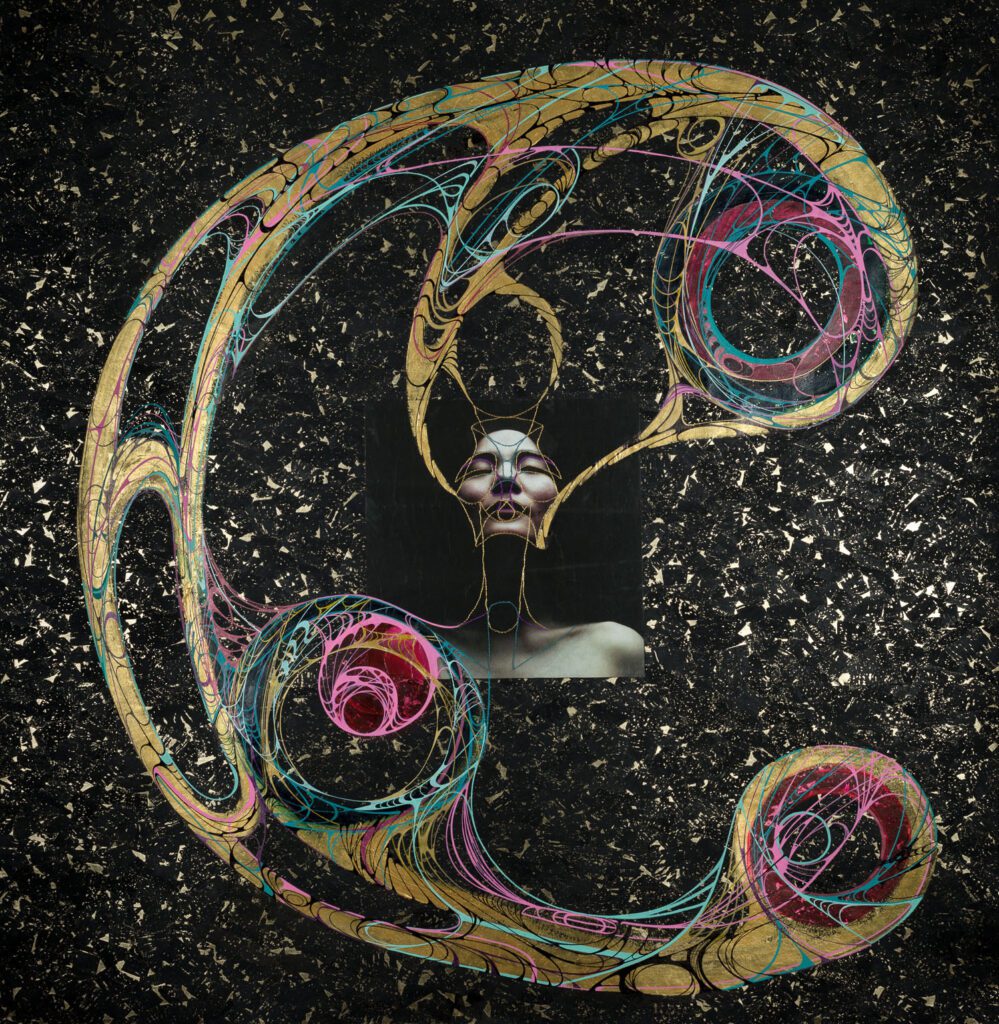
Q6. Some areas of your paintings feel open and spacious, while others are dense and layered. How do these spatial decisions affect the emotional tone of a work?
Space is never neutral in my work; it carries emotion before any figure does. The way space opens up or becomes dense directly shapes the emotional tone of a painting. Open areas allow the work to breathe, introducing silence, distance, and reflection. Dense and layered areas, on the other hand, create tension, noise, and a sense of pressure, often echoing the emotional saturation of our social and digital environments. A clear example of this can be seen in “The Re.connection Series”, which is composed of triptychs. Each module represents a different emotional state. The first panel focuses on the human figure, grounding the work in presence and identity. The second module is its expansion into chaos — a space filled with noise, overlapping lines, and visual tension, expressing the feeling of being lost, disconnected, and overwhelmed. The third module is deliberately minimal. Only a few lines reach it. It embodies calm after the storm, a moment of clarity and quiet that follows emotional turbulence. Space becomes a narrative and emotional tool. It guides the viewer through different states of being — from presence, to disorientation, to reconnection, disconnection, and calm. These spatial decisions are never decorative; they are fundamental to how emotion is experienced in the work.
Q7. You share a lot of process online. How has showing work in progress influenced the way you think about making versus finishing a piece?
My answer may sound a bit unexpected but sharing my process online has not influenced the way I make or finish my work. I share my process mainly because, as an emerging artist, I have not yet had many opportunities to show my work in physical spaces. My paintings are much more organic when experienced in person — something I have been told many times. When I first started posting images of my work, many people assumed it was digital. That genuinely surprised me. I do not work digitally at all. I simply paint very precise lines freehand. There are no sketches, no masking techniques, no tricks. The lines just happen. At some point, I felt the need to prove that what I was saying was true. I picked up my phone and began recording myself while painting — holding the camera with one hand and painting with the other. Once people could see the process, many told me it gave them a sense of calm. Some even suggested I should make long videos for mindfulness purposes. I believe they are simply feeling what I feel while painting. My process is very meditative. I practice yoga and meditation, and that inner state naturally carries into the way I work. That said, I do not share every step of the process. Everything is handmade. There is a strong crafting dimension in my work that I do not show. I prefer to preserve a sense of mystery. I usually share only short moments especially the act of drawing lines. Unfortunately, algorithms tend to favor fast content, which I do not enjoy. There is something slightly ironic in all of this. When I watch myself painting, I sometimes barely recognize myself. In life, I am much more active and restless. Painting is the place where I slow down. Making the work is where everything settles.
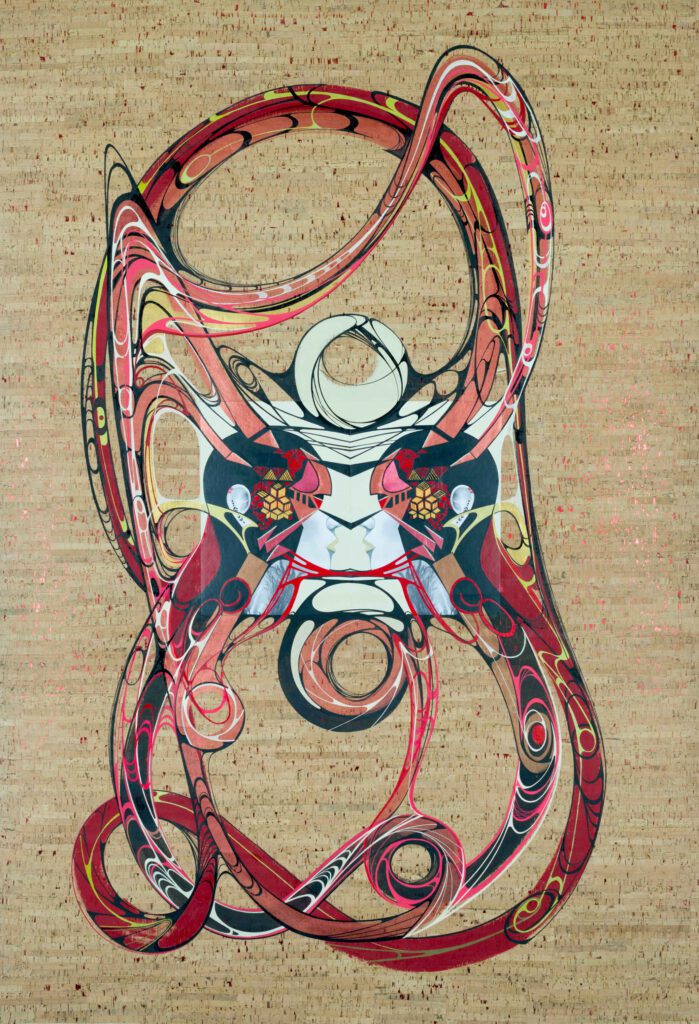
Q8. When you begin a new work, what is the first thing you focus on space, line, emotion, or something else?
Something else. When I begin a new work, I do not start with space, line, or emotion individually. I start with a concept. When I plan a series, I first focus on the idea behind it and form an abstract vision of how the entire body of work might exist in a large white room. It is an image that exists only in my mind — not something specific or fixed. For each series, I establish what I call a vertebral spine. This includes the type of support I will work on, the mixed media techniques I will use, the scale, and a clear structural framework. I need this map before I begin, so that I can later write the chapters of the novel that each body of work becomes. Within each series, every individual work explores a specific theme connected to the central character or idea. Titles are fundamental in this process. Faces, colors, and shapes are ichnographically attached to each work, helping to articulate its meaning. During my PhD, I studied color iconography throughout history, and that knowledge continues to inform my practice naturally. It is something that always finds its way into the work.
Q9. Looking back at your earlier work, what do you notice now that you couldn’t see at the time?
Honestly? Almost everything. I have only been painting for five years after a long interruption. When I began, I was working intuitively, experimenting without being fully conscious of what lay beneath my materials and subjects. It took me time to develop the language to understand and articulate my own work. At first, I did not know how to speak about it — even my earliest artist statements made no sense to me. That learning process has required time, reflection, and deep introspection. Looking back now, I can see patterns, intentions, and recurring questions that were already present from the beginning. I was not lost, but I was not yet conscious. Learning to see my own work more clearly has been as important as making it.
Q10. What advice would you give to emerging artists who want to move between figuration and abstraction while staying true to their own questions and concerns?
As a former art teacher, I have one recommendation that I consider crucial. If you want to work between figuration and abstraction, train yourself to be a strong figurative artist, and do the same within abstraction. Learn the basic rules of both paths, because to merge them you will need to break many rules and reframe them in your own way. Only then does blending become something natural rather than forced, and truly aligned with your own vision.
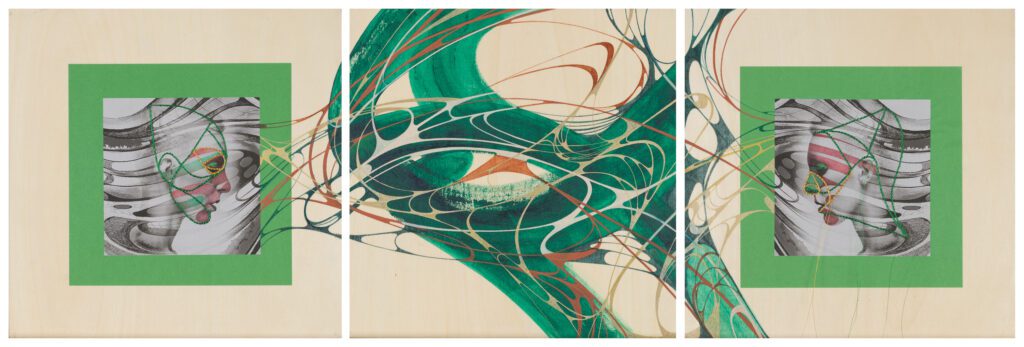
Finishing up with Nerea, I keep thinking about something she said that I can’t shake. When her creativity came back after all those years, the first thing she felt wasn’t anger or bitterness. It was gratitude. And the first thing she wanted to make wasn’t about her pain. It was about all of us.
That tells you everything about who she is.
Most of us, if we lost decades to a medical mistake, we’d spend years making work about that loss. Processing it. Screaming about it. Making sure everyone knew what was taken from us. And we’d have every right.
Nerea didn’t do that. She picked up a pencil after decades of not being able to create and immediately started drawing tiny faces surrounded by expanding lines. Started making work about how small we are in this vast universe. How connected we need to be. How we’ve forgotten to respect what’s around us.
She turned decades of forced silence into a message we desperately need to hear. And she did it with such gentleness. Such care. Her tiny faces aren’t screaming at us. They’re quietly reminding us. The lines aren’t aggressive. They’re reaching out, connecting, saying we’re in this together.
What moves me most is knowing where that work comes from. She spent years watching from beds and wheelchairs while life happened around her. Years of observing in silence while her hands couldn’t make what her heart was feeling. And instead of that making her bitter, it made her see things more clearly.
She learned what the rest of us keep forgetting. That we’re not the center of everything. That we’re fragile and temporary. That connection isn’t luxury, it’s survival. That humility toward each other and nature isn’t weakness, it’s wisdom.
And now she’s painting that truth with such beauty. Such hope. Every freehand line she makes without sketches, every risk she takes on canvas, it’s someone who knows exactly how precious the ability to create actually is. Someone who’s not wasting a single moment on anything that doesn’t matter.
What her story shows us, if we’re willing to see it, is that loss doesn’t have to destroy you. Time passing doesn’t mean it’s too late. Years of waiting don’t mean you’re not meant to have what you’re hoping for.
She got her creativity back after decades and immediately used it to try to help the rest of us wake up. Not with anger. With love. With these tiny vulnerable faces and delicate lines that say: look how small we are, look how much we need each other, look what we’re forgetting.
That’s courage that looks like kindness. That’s strength that feels like gentleness. That’s someone who went through something unbearable and came back wanting to give rather than take.
If you’re carrying something heavy, if you’ve been waiting a long time for something to come back, if you’re wondering whether you still have time to become who you were meant to be, Nerea’s work is a quiet answer. It’s never too late. The years you think you lost might be teaching you exactly what you need to know. And what you make when you finally can might matter more because of everything it cost to get there.
Follow Nerea from the links below to see work that turned decades of silence into the gentlest, most urgent reminder of what actually matters, and proof that sometimes the longest wait creates the clearest vision.
