
5 Creative Sketchbook Practices To Help You Grow As An Artist
A sketchbook can be many things. It can be a place to collect ideas, a record of things that catch your eye, a space to work through a difficult composition, or simply somewhere to draw when you have a little time to yourself. Yet, somewhere along the way, many artists begin to treat their sketchbooks as places where every page needs to look good.
The pressure to make something beautiful can turn a space that should feel freeing into another place where we judge our work. We avoid unfamiliar subjects, erase the lines that do not look right, and sometimes leave entire pages untouched because we are waiting for a good idea to arrive.
But what if your sketchbook did not need to impress anyone? What if it could become a place to experiment, follow your curiosity, and discover things about your practice that you might never find while working on a finished piece?
Creative thinkers and artists have long explored the value of routine, observation, experimentation, and play. In The Creative Habit, choreographer Twyla Tharp explores how creativity develops through consistent practice rather than inspiration alone. Writer Julia Cameron, in The Artist’s Way, offers exercises designed to help people reconnect with their creative instincts. And painter Georgia O’Keeffe used drawing throughout her career to study the natural world, exploring how lines and shapes could capture the essence of what she observed.
Inspired by these approaches, here are five sketchbook practices to help you loosen up, experiment with intention, and rediscover the possibilities waiting inside those pages.
1. Draw What You See, Not What You Think You Know
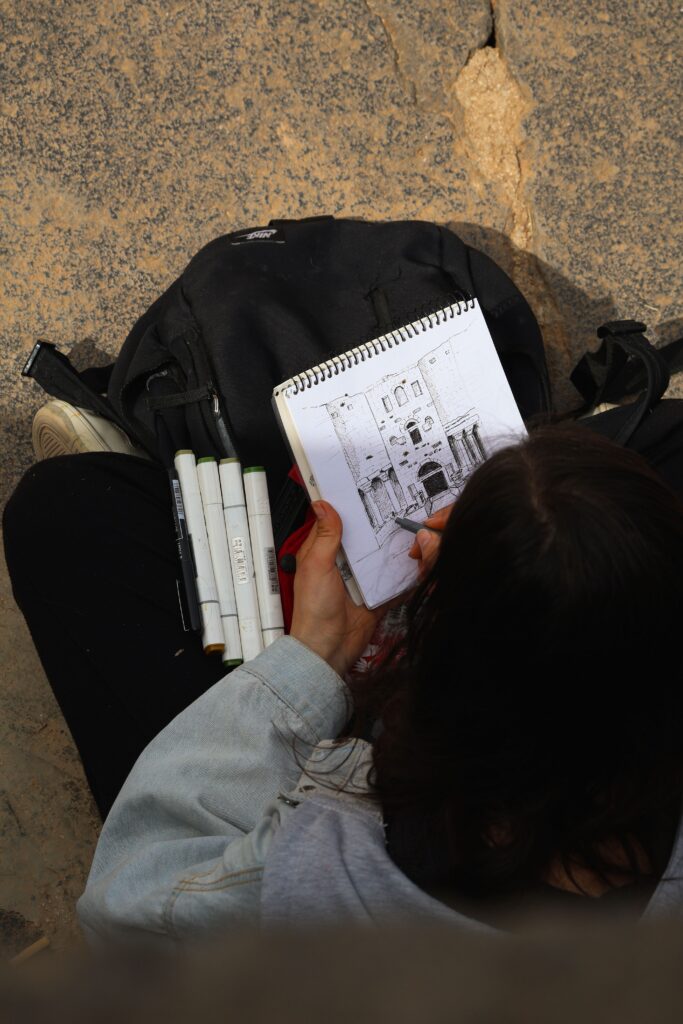
Inspired by Georgia O’Keeffe’s disciplined drawing practice
How often do we look at something familiar without really seeing it? We know what a flower looks like, how a cup is shaped, or what a tree should look like in a drawing. That familiarity can sometimes get in the way of observation, encouraging us to draw what we remember instead of what is actually in front of us.
Georgia O’Keeffe’s approach to drawing offers a useful reminder to slow down and look more carefully. According to the Georgia O’Keeffe Museum, she maintained a drawing practice throughout her career, using sketchbooks to record her visual observations and explore the underlying forms of the natural world. Her studies helped her reduce complex subjects to essential lines, shapes, and compositions.
You can bring a similar spirit of observation into your own sketchbook without travelling anywhere or purchasing special materials.
Try this exercise:
- Choose an ordinary object near you, such as a mug, a houseplant, a pair of shoes, or a piece of fruit.
- Spend two minutes looking at it before you begin drawing.
- Notice its proportions, the direction of the light, the shapes created by shadows, and the small irregularities that make it unique.
- Draw the object without relying on an image or your memory of how it should look.
- Repeat the exercise from another angle, paying attention to what changes.
For an extra challenge, try drawing the object without looking at your paper for the first minute. The point is not to produce a perfectly accurate drawing, but to strengthen the connection between your eyes and your hand.
Why it helps: Careful observation can reveal details you might otherwise overlook. It also gives you a richer visual vocabulary to draw upon when developing more complex work. A familiar object can become surprisingly interesting when you stop treating it as something you already know.
2. Create A Small Daily Ritual
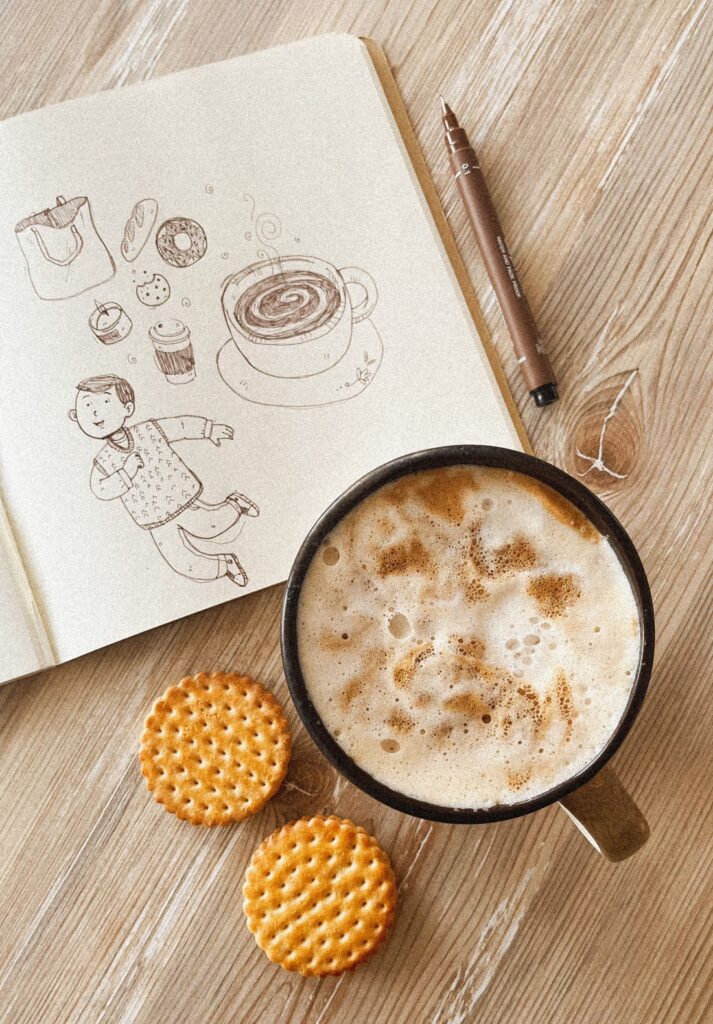
Inspired by Twyla Tharp’s The Creative Habit
Waiting for inspiration can make a creative practice feel unpredictable. Some days, ideas arrive easily. On other days, even opening your sketchbook feels like work.
In The Creative Habit: Learn It and Use It for Life, choreographer Twyla Tharp explores the importance of preparation, routine, and repeated effort in creative work. Her book includes practical exercises that encourage artists to observe their surroundings, collect ideas, and establish habits that make it easier to begin.
You do not need to spend hours drawing every day to benefit from this approach. In fact, a small, manageable ritual can be a much kinder place to start.
Try this exercise:
Set aside ten minutes at roughly the same time each day. Keep your sketchbook and a pencil somewhere easy to reach, and give yourself one simple instruction: make something on the page.
You might draw your breakfast, sketch the view from your window, practise a few different lines, or fill a page with shapes. On another day, you could explore colour combinations or make small studies for a painting you have been thinking about.
The important part is to make starting easy. You are not required to finish a drawing, produce something portfolio-worthy, or discover a brilliant new idea every time.
If ten minutes feels like too much on a particularly busy day, begin with five.
Why it helps: A regular ritual removes some of the pressure from deciding when and how to create. It also helps you build a record of your progress. Looking back after a few weeks may reveal recurring interests, improvements in your technique, or ideas that you want to develop further.
Think of it as keeping a small appointment with your creative self. The goal is not to make every session extraordinary. It is to keep returning.
3. Fill A Page Before You Judge It
Inspired by Julia Cameron’s The Artist’s Way
Sometimes, the biggest obstacle to making art is the voice in our heads that wants to evaluate everything before we have even begun.
Is this good enough? Does this make sense? What if I ruin the page?
In The Artist’s Way, writer Julia Cameron introduces a practice called Morning Pages, which involves writing three pages of longhand, stream-of-consciousness writing to help clear mental clutter and reconnect with one’s thoughts. Although this exercise is primarily about writing, its underlying invitation to create without immediately judging the result can inspire a useful sketchbook experiment.
Think of this as a visual warm-up rather than a direct adaptation of Cameron’s original method.
Try this exercise:
Open your sketchbook to a fresh page and set a timer for ten minutes. Draw continuously, without stopping to erase or correct yourself.
Begin with whatever comes to mind. You could make loose marks, draw fragments of objects around you, create little abstract shapes, or let one line lead into another. If you feel stuck, write a word that describes your mood and turn it into a shape or drawing.
Keep moving until the timer ends.
You might not love the result. That is perfectly fine. The point is to give your hand permission to move before your inner critic has time to take over.
You can also combine words and images on the same page. Add a sentence about something that caught your attention, a colour that reminds you of a particular memory, or a question you would like to explore through your work.
Why it helps: This exercise separates the act of creating from the act of evaluating. It can help you notice ideas and associations that emerge when you are not trying to make a polished piece.
Some pages will remain messy collections of marks. Others might contain the beginning of an idea worth exploring. Both outcomes are valuable.
Your sketchbook does not have to become a gallery of finished work. Sometimes, its greatest purpose is simply to help you get started.
4. Give Yourself A Creative Restriction
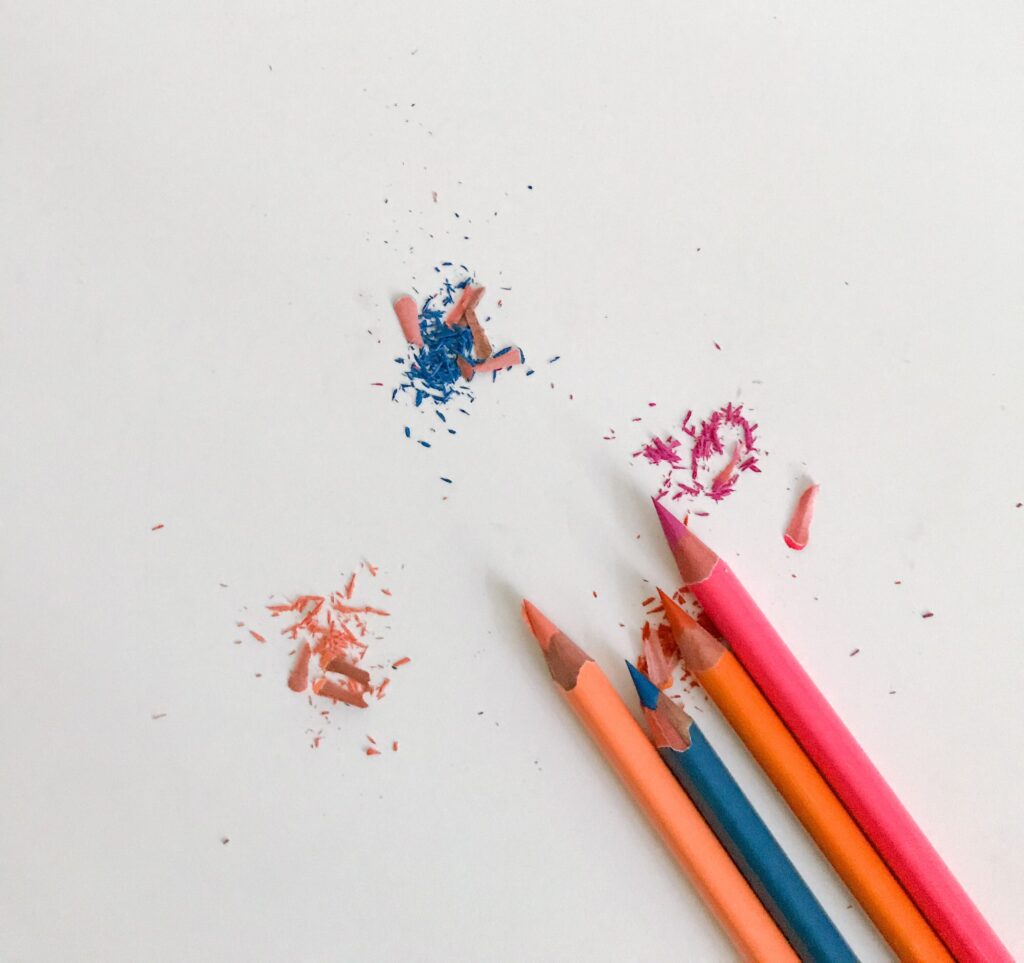
A practical way to break familiar habits
Experimentation does not always mean adding more materials, trying a completely new medium, or changing your entire artistic style. Sometimes, it begins by taking something away.
When you work in a familiar way, your hands often know what to do before you have consciously considered other possibilities. You might reach for the same colours, repeat the same compositions, or approach every subject with a similar set of marks.
A small restriction can interrupt that automatic process and encourage you to look for alternatives.
Try this exercise:
Choose one limitation for a single sketchbook session. You could:
- Draw using only three colours.
- Create an entire page without lifting your pencil.
- Use only circles, squares, and triangles to represent a subject.
- Draw an object using your non-dominant hand.
- Make five versions of the same composition, changing the viewpoint each time.
- Use one brush or drawing tool throughout the exercise.
For example, if you usually create detailed botanical illustrations, try representing a flower using only geometric shapes. If your work is primarily monochromatic, explore how three carefully chosen colours might change its mood.
Do not worry about whether the results fit your usual style. The purpose is to explore what happens when you approach a familiar problem differently.
Why it helps: Constraints give you a clear problem to solve. Instead of facing the endless possibilities of a blank page, you have a starting point and a set of boundaries within which to experiment.
They can also reveal unexpected preferences. You might discover that simplified shapes communicate an idea more effectively than detailed drawing, or that an unfamiliar colour combination opens up a new direction for a series.
You do not need to keep every experiment or turn every discovery into a finished artwork. Sometimes, learning what does not work is just as useful as finding something you love.
5. Collect Ideas Without Deciding What They Must Become
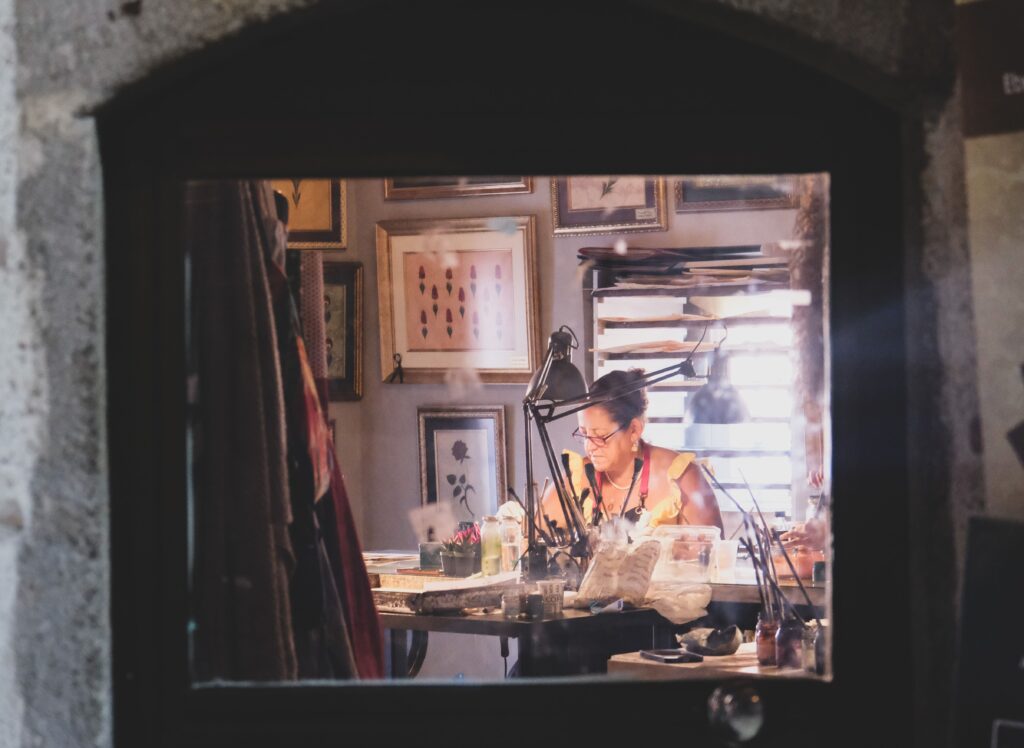
Build A Personal Archive Of Inspiration
Not every interesting observation needs to become a finished artwork immediately. Sometimes, an idea needs time to sit quietly in the back of your mind before you understand what to do with it.
Twyla Tharp explores this aspect of creativity in The Creative Habit, particularly through her discussion of collecting ideas and the early stages of developing creative work. Her approach offers a useful reminder that preparation is part of making, even when it does not look like making anything at all.
Your sketchbook can become a place to collect these fragments before they have to become something more.
Try this exercise:
Dedicate a few pages to observations, images, textures, words, and visual details that catch your attention.
You could sketch the pattern of shadows on a wall, note the colours of a market stall, record an interesting shape in a building, or draw the folds in a piece of fabric. Add small written notes about where you found something or what interested you about it.
You can also include colour swatches, paper scraps, quick photographs printed at home, or rough compositional ideas. If you prefer to keep your sketchbook entirely drawn, recreate the details by hand instead.
Every week, spend a few minutes revisiting your collection. Look for connections between seemingly unrelated pages. Perhaps you have collected several curved shapes without realising it, or repeatedly returned to the contrast between bright colours and dark spaces.
Choose one of these observations and develop it into a more considered study.
Why it helps: Collecting ideas allows you to build a personal visual archive without demanding an immediate outcome from every observation. Over time, your sketchbook may reveal recurring interests and unexpected relationships that help you develop a more distinctive artistic direction.
It can also be reassuring to know that an idea does not have to be fully formed before you record it. A small detail that seems insignificant today might become the starting point for a future painting, illustration, or mixed-media work.
Let Your Sketchbook Be A Place To Begin Again
Changing the way you work does not always require a dramatic breakthrough. Sometimes, it begins with looking more carefully at an ordinary object, spending ten minutes drawing without a plan, or giving yourself permission to make something that does not turn out the way you imagined.
These five practices offer different ways to approach your sketchbook, but they share one important idea: creativity grows when we give ourselves room to explore. You might discover that a daily drawing ritual works best for you, or that creative restrictions help you escape familiar habits. Perhaps collecting visual details will become your favourite practice, or you will find that the most useful pages are the ones you never intend to show anyone.
There is no need to adopt every exercise at once. Choose one that interests you, try it for a week, and notice what changes. Keep the practices that make you curious, adapt the ones that do not quite fit, and allow your approach to evolve alongside your work.
Most importantly, resist the urge to make every page beautiful. Your sketchbook can be messy, unfinished, repetitive, surprising, or full of ideas that never become anything else. It can hold the work you are proud of and the experiments you would rather forget. All of it belongs.
Sometimes, the most meaningful change in your art begins when you stop asking your sketchbook to prove how good you are and start allowing it to show you what you might become.
Editor’s Note:
The deadline to submit your art to Women In Arts Magazine Issue 01 is around the corner! The theme for our inaugural issue is open, so feel free to submit artwork that you find the most meaningful for the magazine. October 31, 2026 is the last date to submit. We can’t wait to see what you have in store for our First Magazine Issue.
