
Jie P. Colter Brings New Life to Traditional Chinese Painting Through Collage and Texture
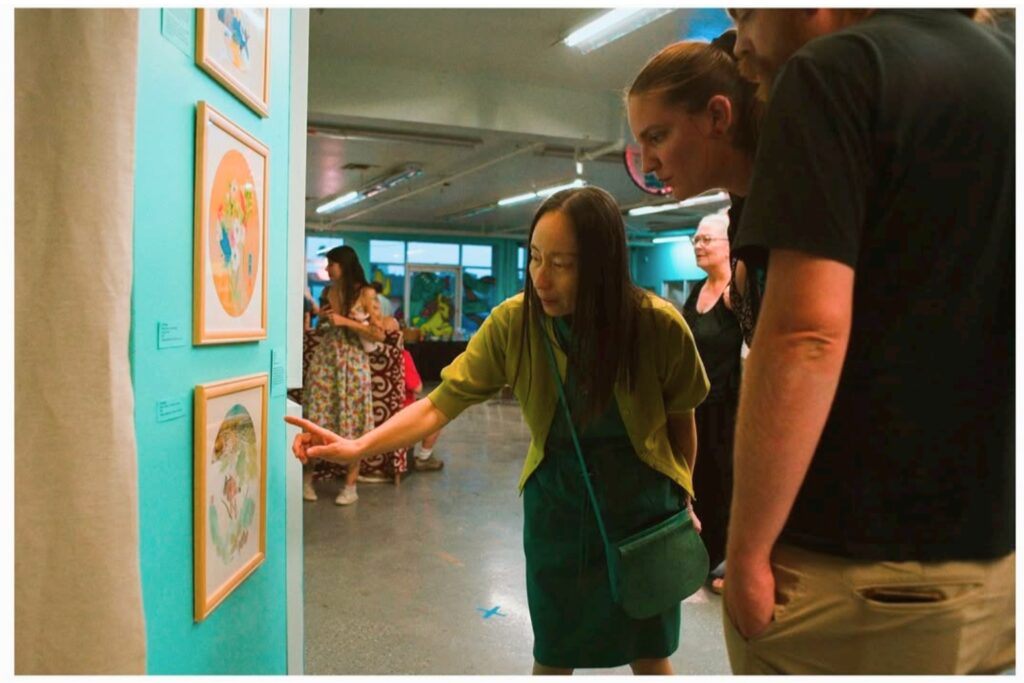
At Women in Arts Network, Portraits brought together artists drawn to the most human subject in all of art: the face. Each of them approaches it in her own way, less interested in a simple likeness than in everything that lives behind it, the identity, the memory, the emotion, and the quiet contradictions that make a person who they are.
Among them is Jie P Colter, a Chinese-born artist, now based in the United States, whose portraits and figures carry a quiet message of kindness, memory, and the shared humanity that connects us across cultures.
Jie was born in central China and grew up in a historic town near the Yangtze River, in a home where art was simply part of the air. Her grandfather was a traditional Chinese folk artisan, skilled in painting and calligraphy, and her father too was a gifted calligrapher. Encouraged by an early art teacher and by her mother, she went on to study at the Hubei Institute of Fine Arts, earning a degree in Art Education and later a master’s specialising in Chinese painting.
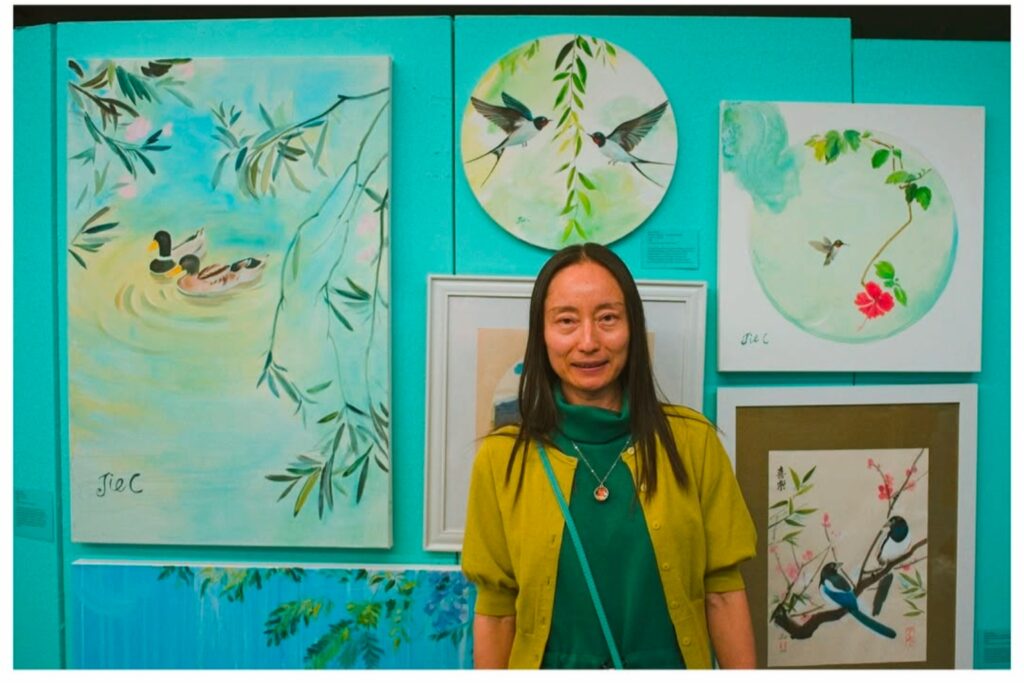
Her graduate advisor urged his students to explore freely rather than confine themselves to a single style, an openness that still shapes her work. She later taught both Chinese and Western art history, before eventually building a new life across the world in the United States.
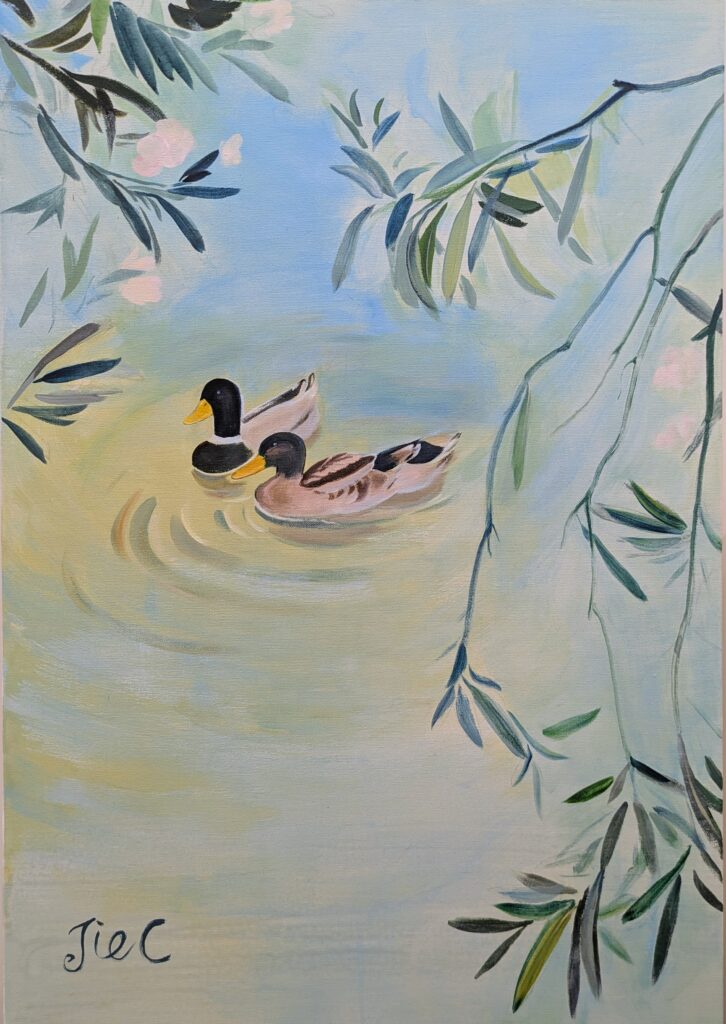
Today her paintings bring traditional Chinese brushwork together with acrylic, collage, and printed imagery. She never combines materials simply for the sake of mixing them; she lets the needs of each piece guide her. Chinese brushwork brings rhythm, movement, and the expressive power of empty space, while acrylic, collage, and print add colour, texture, layers, and traces of contemporary life.
Line and empty space remain essential to everything she makes, a line carrying the energy and emotion of the hand, and empty space left open so the image can breathe and the viewer’s imagination can enter. Bringing these languages together lets her connect tradition with the present, and reflect her own experience of living between two cultures.
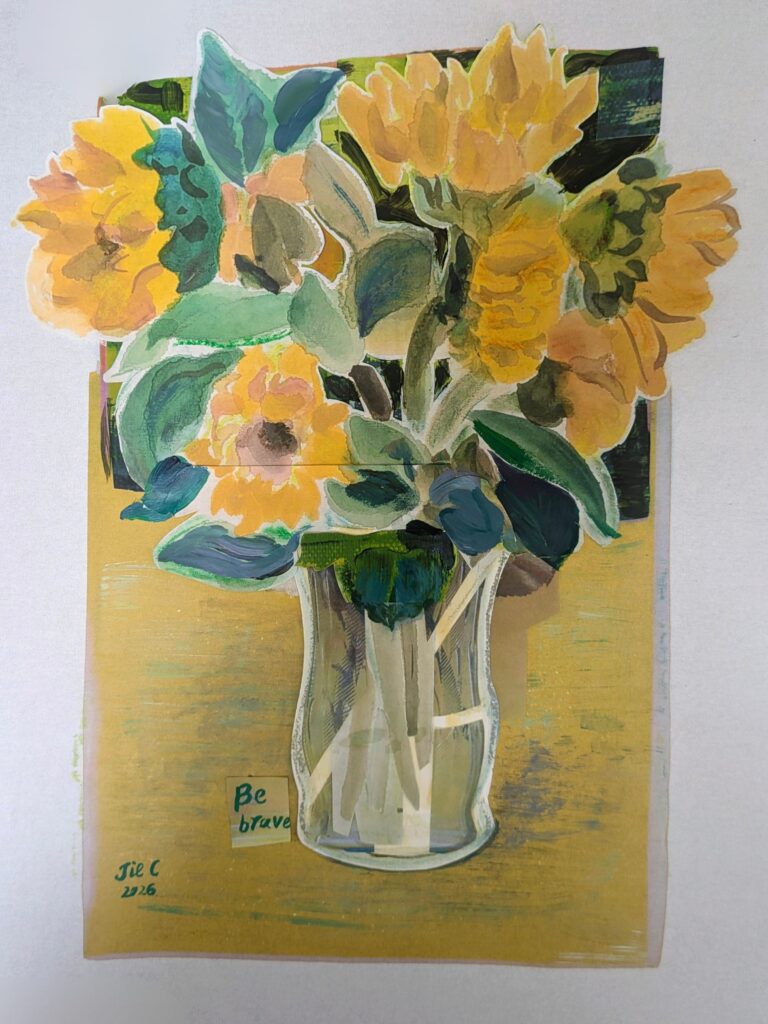
Her process is one of layering, cutting, attaching, covering, and revealing, a way of showing how memory and identity are gathered, fragmented, and sometimes repaired. She often begins with something ordinary, a flower, a bird, a person, a small interaction, that stays in her mind or touches something in her own life.
Through painting, a brief moment becomes a space for reflection, and the simplest things come to stand for growth, kindness, resilience, or hope.
Now let’s hear from Jie about the childhood that first surrounded her with art, why she brings Eastern and Western languages together, the small moment of kindness that inspired one of her most personal works, and what she hopes viewers from every culture recognise in her work.
Q1. Could you tell us about your childhood and how art first became part of your life?
I was born in central China and grew up in a historic town near the Yangtze River. Art touched me from a very young age. Even as a small child, I could be deeply moved by a beautiful melody, a story, or a painting. I also grew up surrounded by traditional Chinese art. My grandfather was a traditional Chinese folk artisan who was skilled in Chinese painting and calligraphy, and my father was also skilled in calligraphy.
Their influence made art feel like a natural part of my life. Later, while attending a school for early childhood education, my art teacher recognized my potential and encouraged me to apply to a fine arts academy. My mother also strongly encouraged and supported me in studying art. Their encouragement became an important turning point in my life and led me to pursue art professionally.
Q2. Your work brings traditional Chinese brushwork together with contemporary materials. What draws you to combining these different visual languages?
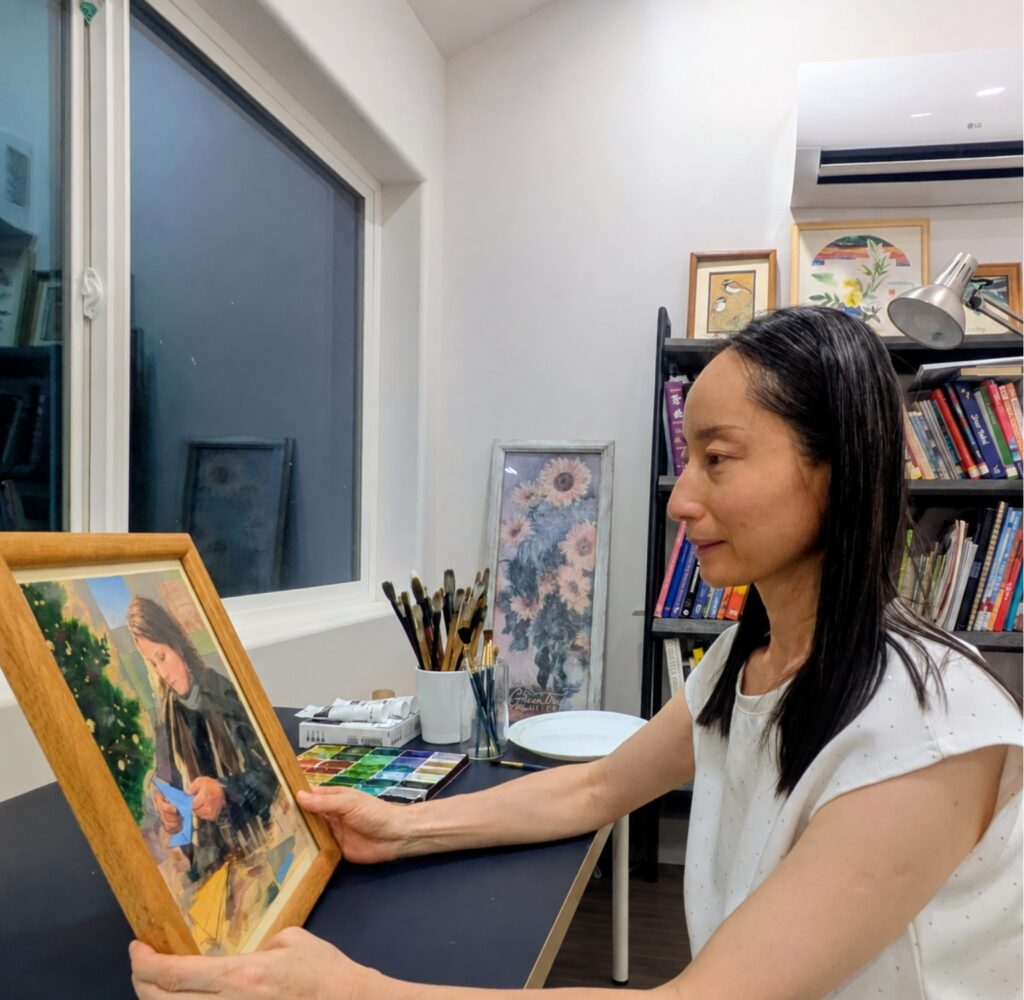
I graduated from Hubei Institute of Fine Arts in China with a bachelor’s degree in Art Education and later earned a master’s degree specializing in Chinese painting. My graduate advisor, Professor Xu Yongmin, also encouraged his students to explore freely rather than be limited to one particular style, and this openness continues to influence my practice. After graduation, I taught Chinese and Western art history ,and foundation courses in drawing, color, and design at the university level.
My education and teaching experience gave me a broad understanding of both Eastern and Western artistic traditions. I do not combine materials simply for the sake of mixing them; I let the expressive needs of each work guide my choices.
Chinese brushwork brings rhythm, movement, and the expressive use of empty space, while acrylic, collage, and printed imagery add color, texture, layers, and traces of contemporary life.
Bringing these visual languages together allows me to connect tradition with the present and create work that reflects my experience of living between cultures.
Q3. What does mixed media allow you to express that traditional Chinese painting alone might not?
Traditional Chinese painting has profound expressive power, so I do not see mixed media as replacing it. Instead, mixed media expands my visual vocabulary and allows the materials themselves to become part of the story. A piece of printed paper, a textured layer, or an actual folded object can carry a physical presence and personal associations that a painted image alone may not have.
Through layering, cutting, attaching, covering, and revealing, I can express how memory and identity are accumulated, fragmented, and sometimes repaired. Mixed media also allows ordinary materials from daily life to cross the boundary between life and art. It gives me a more direct way to connect personal experience, cultural memory, and contemporary life while still preserving the spirit of Chinese painting.
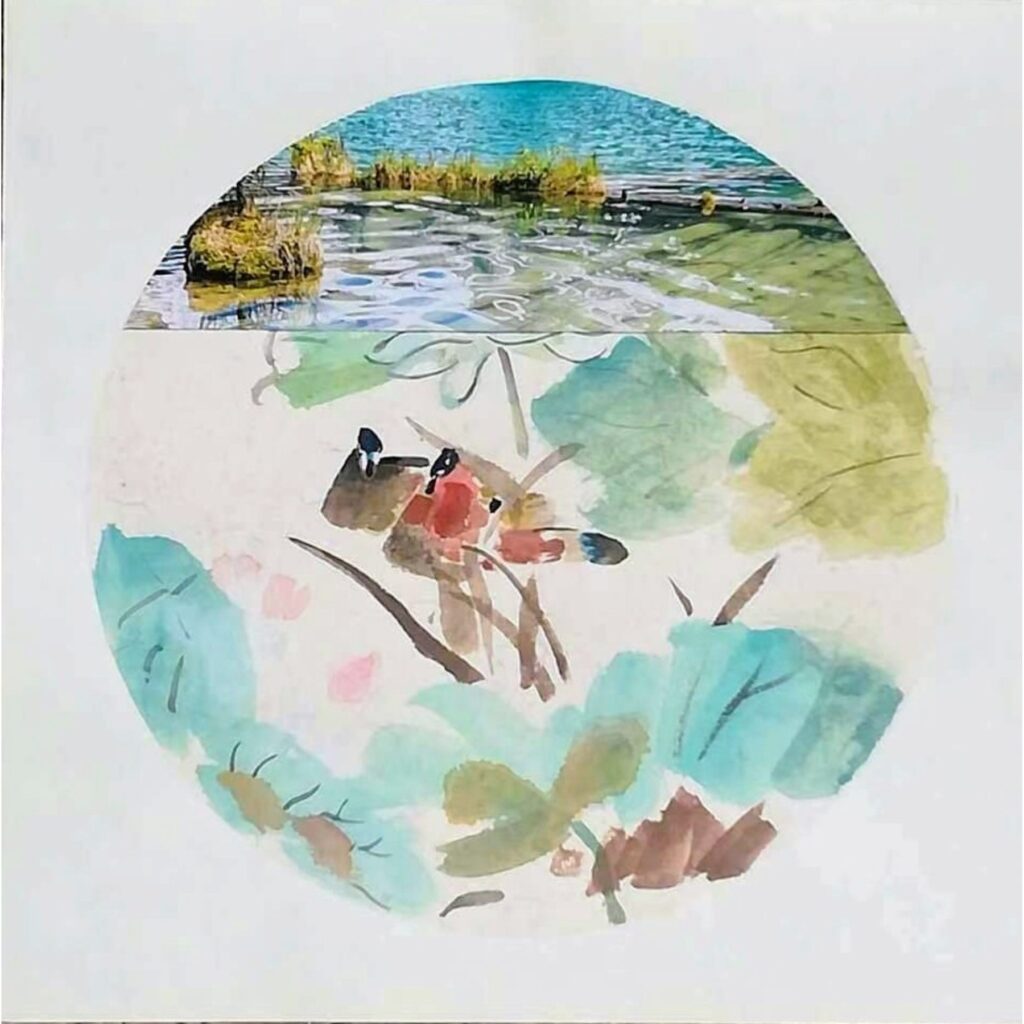
Q4. Nature, people, and everyday objects often inspire your paintings. What makes an ordinary moment worth turning into art?
I am often drawn to the formal beauty quietly revealed in nature and everyday life—the lines, colors, rhythms, and relationships through which living things depend on one another and coexist in harmony. In the growth and transformation of flowers, birds, and plants, I sense the enduring vitality and continual renewal of life. When an ordinary moment or object allows me to recognize this beauty and life force, it becomes worth turning into art.
Creating art allows me to pause and observe these easily overlooked moments, and to share their sense of harmony, hope, and connection with viewers.
Q5. When an everyday scene stays with you, how do you transform it into an artwork?
I believe art can begin wherever attention and feeling meet. When an everyday scene stays in my mind or connects with something in my personal experience, it becomes more than ordinary. Through painting, I can transform a brief moment into a space for reflection and connection. Flowers, birds, people, and everyday objects in my work often come to represent growth, kindness, resilience, or hope while still preserving the simplicity of the original moment.
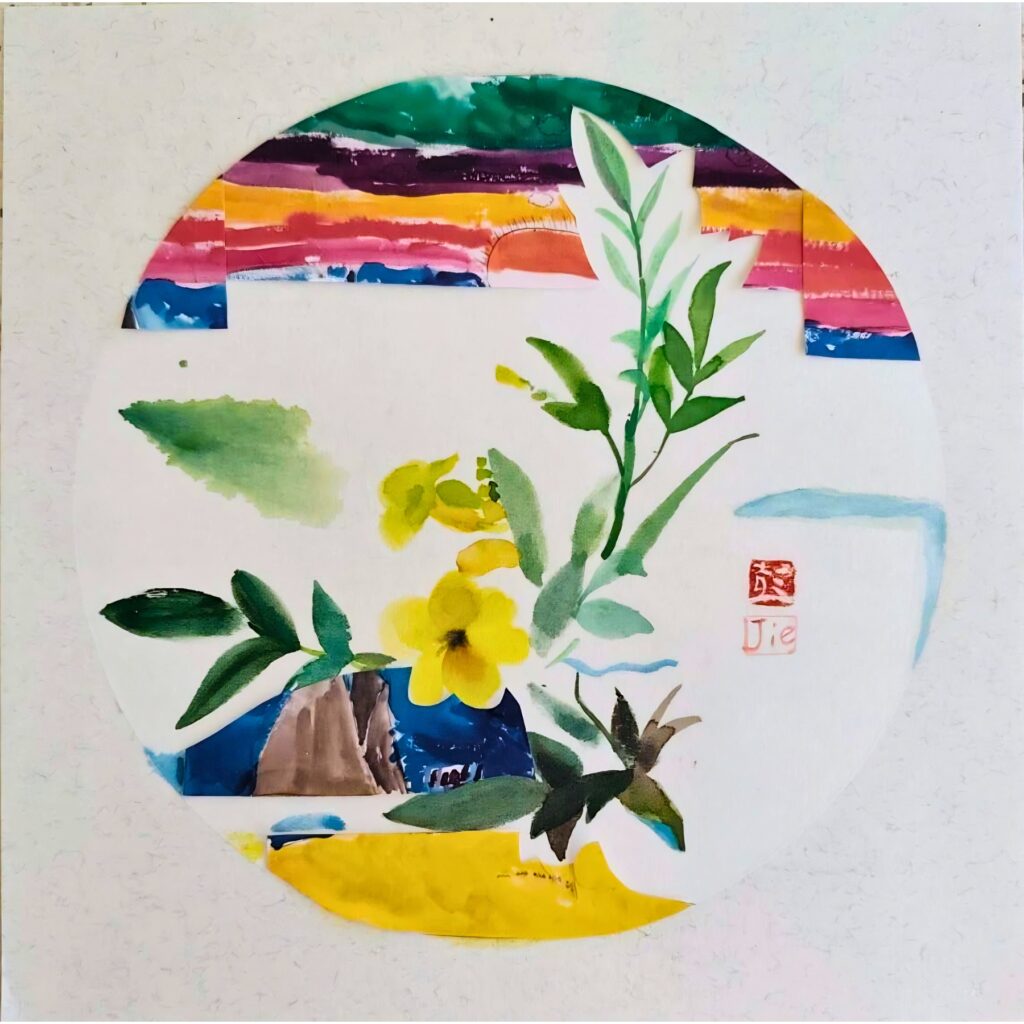
Q6. How do line and empty space shape your compositions, even when you work with contemporary materials?
Line and empty space remain essential to my compositions. In Chinese painting, a line is not simply an outline; it carries the movement, rhythm, energy, and emotion of the artist’s hand. Empty space is also not merely an unpainted area. It is an active part of the image that allows the composition to breathe, suggests what is unseen, and leaves room for the viewer’s imagination.
Even when I work with acrylic, collage, and other contemporary materials, these principles continue to guide how I organize the image. The relationship between line, form, and empty space helps me create balance, visual rhythm, and a sense of quietness within the work.
Q7. The story behind Folding Hope began with a small act of kindness during a difficult time. Why has this moment stayed with you?
During a difficult period in my life, Julia, a staff member with the City of Tempe, was helping me complete an application. She noticed that I was anxious and suggested folding paper. Although I no longer remember exactly what she folded, I have never forgotten how this small and deeply human gesture changed the moment. It made me feel seen and understood, and helped me relax. Her kindness reminded me that during a difficult time, even a small gesture can bring someone comfort, hope, and strength. That is why the moment has stayed with me.
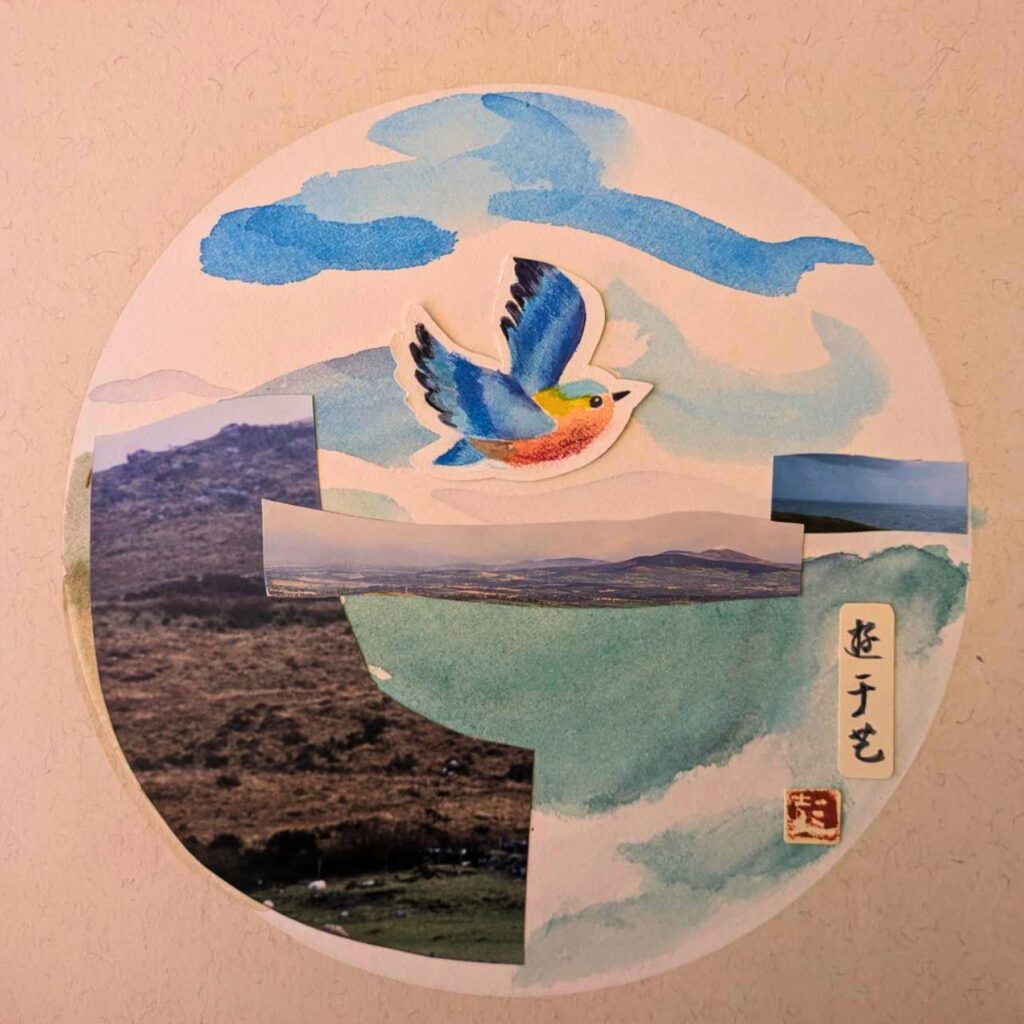
Q8. How did combining Julia’s portrait with collage, acrylic, printed elements, and a folded paper airplane help tell the story of Folding Hope?
Combining these materials allowed me to move beyond simply illustrating what happened and instead express the emotional truth of the memory. Julia’s portrait grounds the story in a real person and conveys her human warmth. The collage and printed elements suggest fragments of experience and layers of memory, while acrylic brings them together within one emotional space.
Although I no longer remember exactly what Julia folded, I chose a three-dimensional paper airplane as a symbol of her gesture. To me, it carries a wish—hope, freedom, and movement toward the future. Airplanes are also a familiar sight in the sky where I live, connecting this memory with my present life. By extending beyond the flat surface, the folded airplane makes the kindness feel tangible and invites viewers to enter the story through both image and object.
Q9. Your practice connects Eastern and Western artistic traditions. What do you hope viewers from different cultural backgrounds take away from your work?
I hope viewers first feel our shared humanity rather than focusing only on cultural differences. Emotions such as kindness, resilience, longing, hope, and the desire for connection can be understood across cultures. Through Chinese brushwork, line, and empty space, I hope viewers encounter the rhythm and quiet strength of Chinese aesthetics; through acrylic, collage, and contemporary imagery, I offer other points of connection.
I want my work to suggest that different cultures do not need to compete with or erase one another—they can meet, coexist, and enrich each other. If viewers recognize something from their own lives while also becoming curious about another culture, then the work has created the kind of connection I hope for.
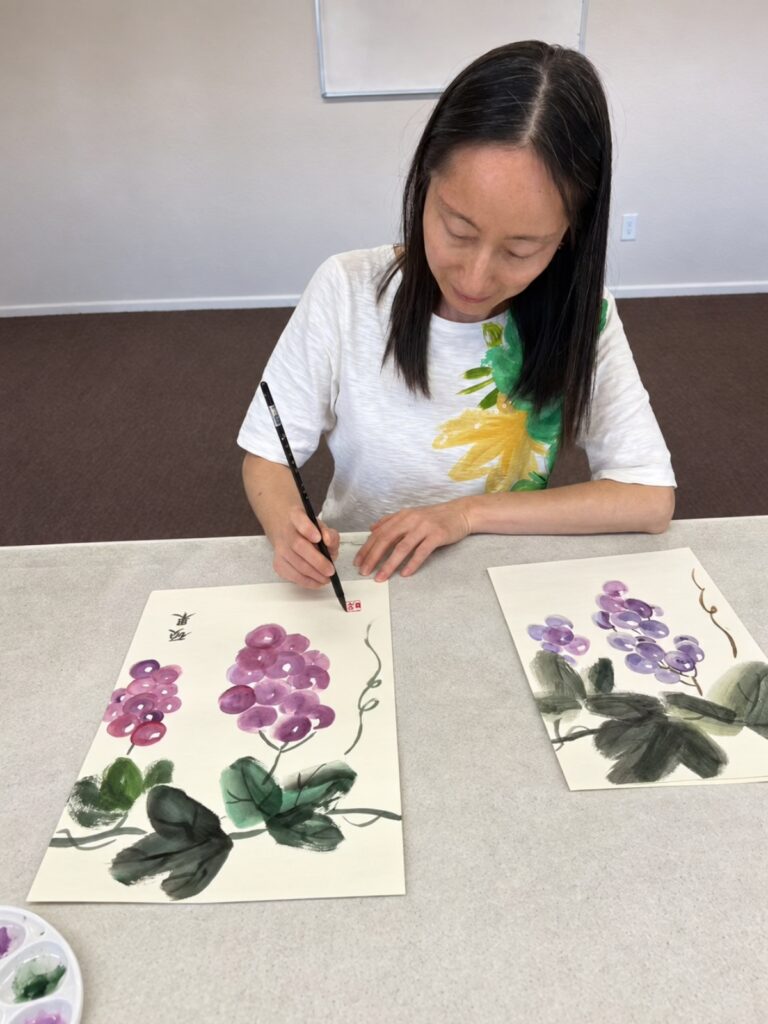
Q10. You teach both children and adults in your local community. How does teaching influence your own artistic practice?
Teaching gives me renewed curiosity and a strong sense of connection. Children approach art with openness and often make unexpected choices. They remind me that art begins with play, observation, and courage rather than perfection.
Adult students bring patience, personal experience, and thoughtful questions. Explaining line, color, composition, and Chinese brushwork also encourages me to examine my own artistic decisions more clearly.
Teaching in my local community allows art to become a bridge between generations and cultures. Watching students discover their own visual voices gives me joy and a sense of purpose, and their energy often returns with me to the studio. In this way, my teaching and creative practice continually nourish one another.
Q11. How has your understanding of success changed throughout your journey as an artist and educator?
When I taught art at a university in China, I understood success largely in terms of professional growth and my responsibilities as an educator—deepening my knowledge, teaching with care, and helping my students develop. As my life circumstances and roles have changed, my understanding of success has become more expansive. Today, success means sustaining my love for art wherever I am, continuing to create, deepening my own artistic voice, and building meaningful connections through art. Professional recognition and exhibition opportunities remain important, but they are not the only measures of success.
I also consider an artwork successful when it honestly carries my experience, touches another person, or encourages understanding between cultures. Continuing to grow, teach, and find hope through life’s changes is also part of what success means to me.
By the time our conversation with Jie drew to a close, we kept returning to the story behind Folding Hope, to a moment of kindness that might have passed unnoticed by anyone else, and to the way an artist can hold onto an experience long after the moment itself has disappeared.
Think about how often the smallest gestures become the ones we remember most clearly. Someone notices we are struggling. Someone takes a moment to help without expecting anything in return. The circumstances may fade with time, but the feeling stays with us. For Jie, that memory became the starting point for a work that brings together a portrait, fragments of printed imagery, layers of acrylic, and a folded paper airplane.
The airplane is not simply an object placed within the composition. It carries the idea of hope, freedom, and the possibility of moving forward. Through these different materials, she transforms a personal experience into something others can recognise in their own lives.
There is a similar kind of thoughtfulness in the way Jie approaches painting itself. Her foundations in Chinese brushwork have taught her to see line as something that carries movement and emotion, and empty space as something that gives an image room to breathe.
Her use of collage and contemporary materials extends those ideas, allowing her to build layers of memory, experience, and meaning. She does not abandon tradition to explore new possibilities, nor does she treat tradition as something that must remain untouched. Instead, she allows the two to exist together, each bringing something different to the work.
It is hard not to think about what this means in a world where cultures are often presented as separate, distinct, and sometimes in opposition to one another. Jie’s paintings suggest another possibility. Her Chinese artistic heritage meets the materials and imagery of contemporary life, while her personal experiences become a point of connection with people whose backgrounds may be entirely different from her own. She believes that kindness, longing, resilience, and hope can be understood across cultural boundaries, and her work gives these shared experiences a place to unfold.
For anyone who loves or collects art, there is something particularly rewarding about the way her paintings reveal themselves. A portrait might draw you in first, but then you begin to notice the textures, the spaces between forms, or an ordinary object that carries a much deeper meaning. Each material contributes something to the story, and each detail offers another way into the work. What begins as a personal memory gradually opens into something more universal, reminding us that art can preserve not only what happened, but also how it felt.
Follow Jie P Colter through the links below and see her work for yourself.
