
5 Women Who Helped Shape The Future Of Women In Art
The history of art is filled with women who created extraordinary work, but some of their greatest contributions cannot be found hanging in a gallery. They are found in the opportunities they fought for, the young artists they encouraged, the spaces they created, and the boundaries they challenged simply by choosing to become artists in a world that was not always ready to welcome them.
For generations, women faced restrictions on where they could study, which subjects they could paint, whether their work deserved professional recognition, and how far they could take their artistic ambitions. Some were denied opportunities because of their gender, while others faced additional barriers because of their race, background, or financial circumstances.
Yet, many refused to accept the limitations placed before them. They built careers, established art schools, experimented with new mediums, and made room for other women to follow.
Their names may not always appear alongside the most familiar figures in art history, but their contributions deserve to be remembered. Here are five women whose courage, creativity, and determination helped make the art world a little more welcoming for the generations that came after them.
1. Edmonia Lewis: The Sculptor Who Refused To Be Defined By Her Circumstances
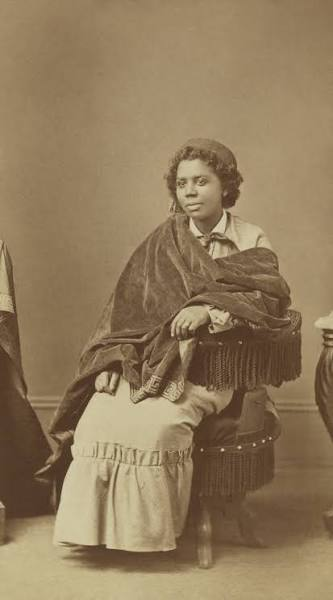
Long before conversations about diversity and representation became part of the art world’s vocabulary, Edmonia Lewis (1844–1907) was challenging the expectations placed on women artists.
Of African American and Native American (Mississauga) descent, Lewis grew up in a society where opportunities for women of colour were extremely limited. Sculpture was an especially difficult profession to enter. It required formal training, access to expensive materials, financial support, and recognition from institutions that were largely dominated by men.
Lewis encountered discrimination even during her education. She attended Oberlin College in Ohio, one of the early American colleges to admit both women and Black students. However, after facing serious accusations and hostility, she was forced to leave without completing her studies. Rather than allowing this experience to end her ambitions, she moved to Boston and began establishing herself as a sculptor.
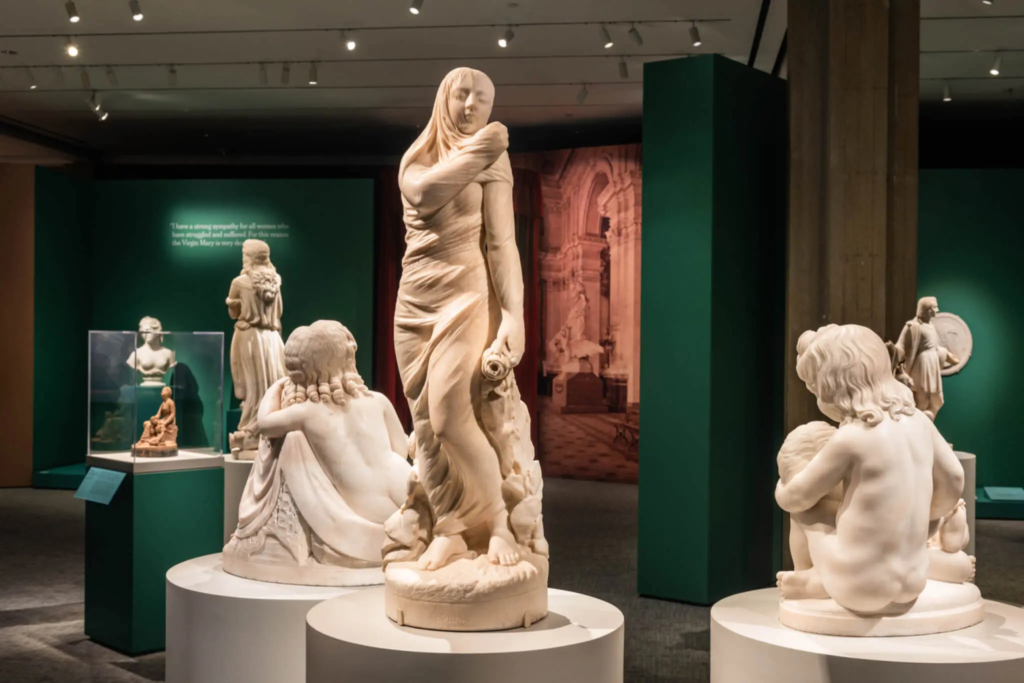
Her career took a remarkable turn when she travelled to Rome in 1865. There, she became part of a community of American women sculptors and began working with marble, developing a practice that would eventually earn her international recognition.
One of her most notable works, The Death of Cleopatra, demonstrated her ability to approach a traditionally male-dominated artistic subject with remarkable confidence and technical skill. She also created sculptures that explored African American history, Indigenous identity, and the experiences of marginalised communities.
What makes Lewis’s story particularly important is that she did not simply succeed in an environment that excluded her. She challenged the very idea that artistic excellence belonged to a particular race or gender. Her achievements created a powerful precedent for artists who would come after her. She demonstrated that a woman could build an international reputation as a sculptor, work on her own terms, and earn recognition for the quality of her work rather than the expectations society had placed upon her.
Today, Lewis is recognised as the first sculptor of African American and Native American descent to achieve international acclaim. Her journey remains an important reminder that sometimes opening a door begins with refusing to accept that it was never meant for you.
2. Anna Atkins: The Woman Who Saw Art In The Science Of Photography
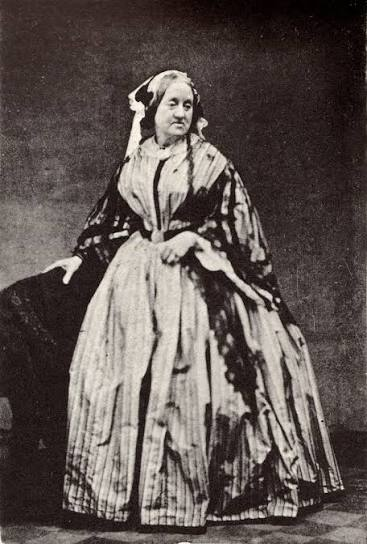
Imagine being among the first people to recognise the artistic possibilities of a completely new technology, at a time when women were rarely welcomed into scientific circles. That was the world of Anna Atkins (1799–1871).
An English botanist, illustrator, and photographer, Atkins is widely recognised as the first person to publish a book illustrated entirely with photographic images. Her work helped establish photography as a valuable method of visual documentation, while also demonstrating its artistic potential.
Atkins was particularly interested in botanical illustration. Before photography became widely available, plants were documented through drawings, engravings, and other traditional printing techniques. She saw an opportunity to approach this process differently.
Her interest led her to experiment with cyanotype, an early photographic printing technique that produces beautiful blue-and-white images. By placing botanical specimens directly onto light-sensitive paper and exposing them to sunlight, she could create detailed impressions of plants, seaweed, and other natural forms.
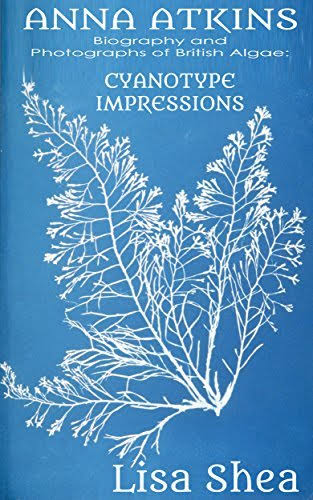
In 1843, she began publishing Photographs of British Algae: Cyanotype Impressions, a groundbreaking work that brought together science, photography, and visual art. She continued producing and developing these images over the following decade, creating hundreds of delicate botanical prints.
What makes Atkins particularly interesting is how she challenged the boundaries between different creative disciplines. Her work was scientific documentation, but it was also deeply visual. The shapes of seaweed, the delicate structures of leaves, and the striking blue backgrounds gave her photographs an aesthetic quality that continues to attract artists and photographers today.
Her contribution also came at a time when women had limited access to professional scientific opportunities. Although her father’s scientific connections helped her gain access to knowledge and resources, she used that access to develop something entirely her own.
Atkins helped demonstrate that photography could be much more than a technical process. It could be a creative language, a way of observing the natural world, and a medium through which women could make significant contributions. For future generations of women photographers and mixed-media artists, her work represents an early example of what can happen when curiosity is allowed to lead the way.
3. Augusta Savage: The Artist Who Made Sure Other Artists Had A Place To Begin
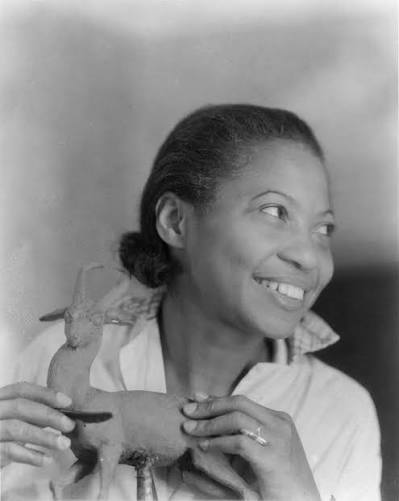
Some artists leave behind extraordinary collections of work. Others leave behind an entire generation of artists who might never have found their footing without them. Augusta Savage (1892–1962) managed to do both.
A central figure of the Harlem Renaissance, Savage was an American sculptor and educator who dedicated much of her life to creating opportunities for African American artists.
Her own journey was far from easy. Growing up in Florida, she discovered an early interest in sculpting, often making small figures from the clay she found around her. Despite her obvious talent, she encountered resistance from people who did not believe that sculpture was an appropriate pursuit for a young Black woman.
After moving to New York, she studied at Cooper Union and gradually established herself as a sculptor. However, even as her reputation grew, she continued to face discrimination. In 1923, she was awarded an opportunity to attend a summer art programme in France, only to have the offer withdrawn because of her race. She publicly protested the decision, bringing attention to the discrimination faced by Black artists.
But perhaps Savage’s most lasting contribution came through her work as an educator and community leader. In 1932, she established the Savage Studio of Arts and Crafts in Harlem, creating an accessible space where aspiring artists could learn, experiment, and develop their skills. She later became the first director of the Harlem Community Art Center, which provided art education and creative opportunities to people in the neighborhood.
Her influence reached far beyond the classroom. Among the artists who benefited from her guidance and encouragement were Jacob Lawrence, Gwendolyn Knight, and Norman Lewis, all of whom went on to establish significant artistic careers.
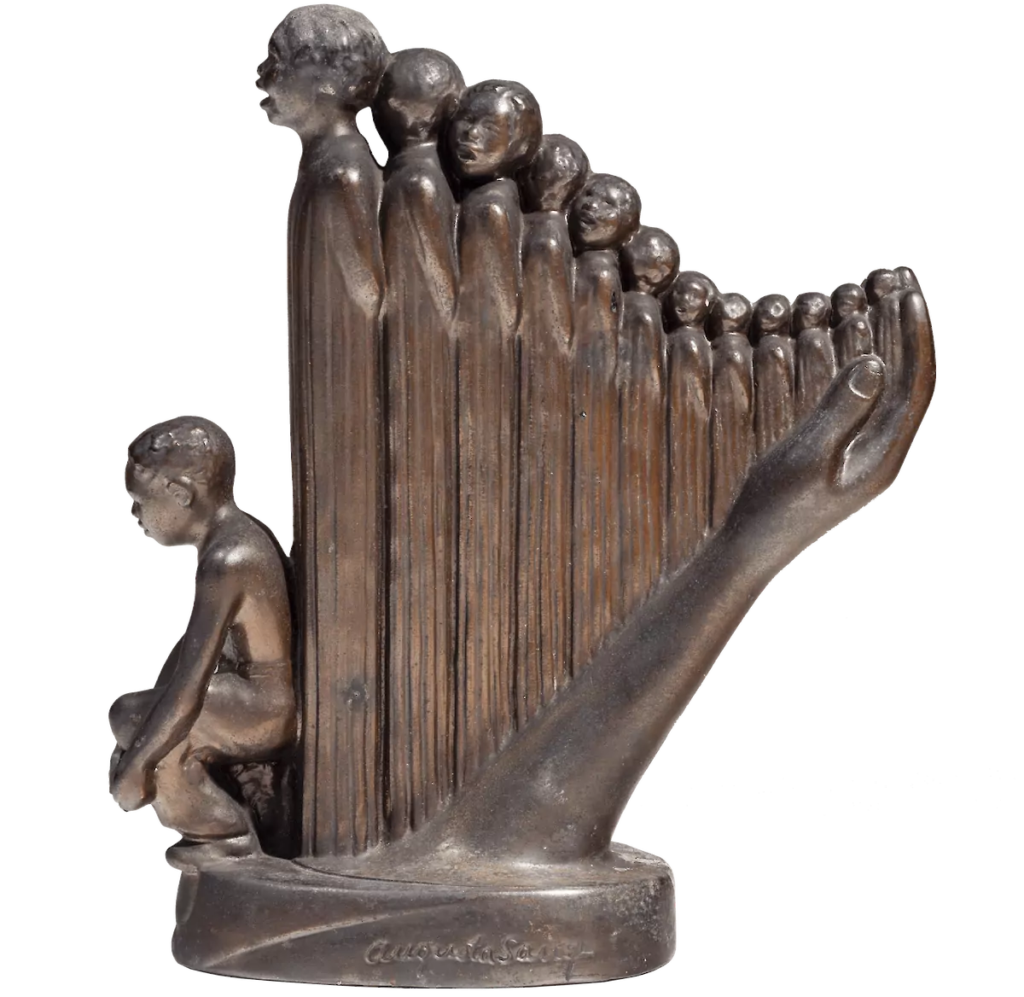
Savage also helped co-found the Harlem Artists Guild, an organization that advocated for employment and professional opportunities for Black artists. Her own sculpture, The Harp, created for the 1939 New York World’s Fair, was one of her most ambitious projects. Inspired by the song Lift Every Voice and Sing, it depicted a group of Black singers arranged in the form of a harp. Unfortunately, the large plaster sculpture was never permanently cast and was eventually destroyed.
There is something particularly moving about Savage’s legacy. Despite struggling to secure lasting recognition and financial support for her own work, she continued to invest in the possibilities of other artists.
She understood that talent alone was not always enough. Artists also needed teachers, opportunities, affordable spaces, encouragement, and people willing to take their work seriously. And she spent her life trying to provide exactly that.
4. Loïs Mailou Jones: The Teacher Who Shaped Generations Of Artists
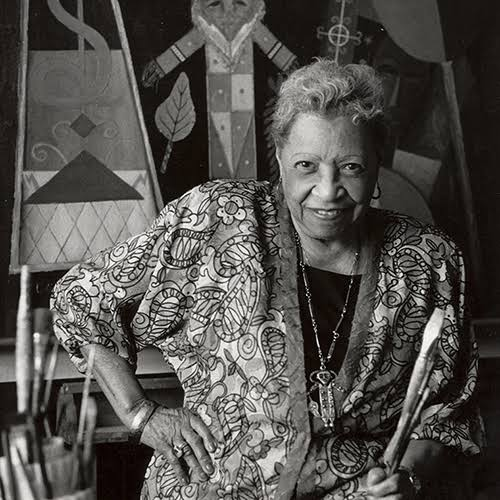
Not every artist changes the art world by founding a movement or creating a groundbreaking masterpiece. Sometimes, the influence of an artist is found in the students they teach, the confidence they build, and the creative possibilities they introduce to others.
This is one of the reasons Loïs Mailou Jones (1905–1998) deserves a place in this conversation. Jones was an American painter whose career spanned several decades and whose work explored a wide range of subjects, from landscapes and portraits to African American history and African cultural traditions.
After completing her education in Boston, she began her career in textile design and illustration before moving into teaching. In 1930, she joined the faculty of Howard University in Washington, D.C., where she would spend much of her professional life.
For nearly five decades, Jones taught generations of students, many of whom would go on to become influential artists themselves. Among them were Elizabeth Catlett, David Driskell, and Sylvia Snowden. At a time when African American artists faced significant barriers within established art institutions, her classroom became an important place for artistic development, experimentation, and intellectual exchange.
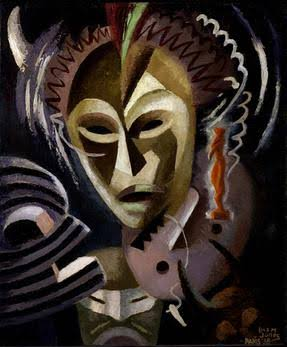
Jones also encouraged her students to look beyond the boundaries of Western art history. Her own artistic practice reflected an interest in African and Caribbean cultures, which became increasingly visible in her work as she travelled and explored different artistic traditions. One of her best-known paintings, Les Fétiches (1938), draws inspiration from African masks and sculptural forms. Rather than treating these objects as simple decorative references, Jones explored their visual power and cultural significance through her own modernist approach.
Her contribution extended beyond teaching. She also worked to preserve and document African and Caribbean art, collecting photographs, research materials, and information that helped create a broader understanding of these artistic traditions.
Jones reminds us that education can be one of the most meaningful ways an artist contributes to the future of art. By sharing knowledge, encouraging experimentation, and introducing students to different cultural perspectives, she helped shape artists who would carry those ideas into their own practices.
Her story is also a lovely reminder that an artist’s influence does not have to end with their own body of work. Sometimes, it continues through every student who takes something they learned and makes it their own.
5. Harriet Powers: The Artist Who Turned Quilting Into A Form Of Storytelling
When we think about art history, our minds often go straight to paintings, sculptures, and works displayed in prestigious galleries. But art has always existed in many other forms, including textiles, embroidery, ceramics, and crafts that were traditionally created within homes and communities.
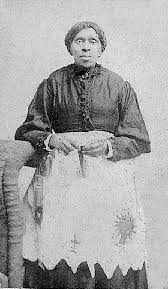
Harriet Powers (1837–1910) is an important example of a woman whose work challenged the boundaries of what could be considered fine art. Born into slavery in Georgia in 1837, Powers became an accomplished quiltmaker whose work combined storytelling, religious imagery, personal expression, and traditional textile techniques.
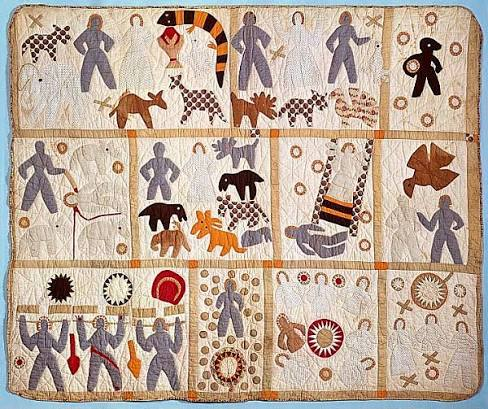
Her quilts were not simply functional objects made to keep people warm. They were carefully constructed visual narratives, with individual panels depicting biblical stories, historical events, and scenes inspired by the natural world.
One of her most celebrated creations, The Bible Quilt, made between 1885 and 1886, featured a series of detailed scenes arranged in separate panels. Each section told a story, allowing viewers to follow different narratives through fabric, color, and composition.
Powers exhibited her work at a cotton fair in Athens, Georgia, in 1886. It was here that her quilt attracted the attention of Jennie Smith, an art teacher who later acquired the piece. Importantly, Powers insisted that Smith document the meaning of each panel. She wanted the stories behind her work to be understood rather than left to interpretation alone.
Today, the quilt is part of the collection of the Smithsonian’s National Museum of American History, where it is recognised as an important example of African American artistic and cultural heritage.
Powers’ contribution is particularly meaningful because textile arts have historically been overlooked in traditional art history. Activities such as quilting and embroidery were often dismissed as domestic crafts rather than recognised as serious artistic practices.
Her work challenges that distinction. It demonstrates the imagination, technical ability, storytelling, and cultural knowledge that can exist within a textile artwork. Although Powers did not establish an art school or formally mentor a generation of artists, her quilts became an important source of inspiration for later generations of quilters, textile artists, writers, and visual storytellers.
Her legacy encourages us to look more closely at the art forms that have traditionally been overlooked and to recognise the women whose creative achievements were often preserved in materials and traditions outside the conventional art world. Sometimes, the doors that need opening are not just the ones leading into galleries. They are the ones that allow us to reconsider what art itself can be.
Their Legacy Is Bigger Than Their Art
Looking at the lives of these five women, one thing becomes clear: changing the art world does not always mean creating something entirely new. Sometimes, it means making it possible for someone else to create something new.
Edmonia Lewis challenged the racial and gender expectations surrounding professional sculpture. Anna Atkins explored the possibilities of photography when the medium was still in its infancy. Augusta Savage created spaces where young artists could learn and find their place. Loïs Mailou Jones passed her knowledge on to generations of students, while Harriet Powers showed the world that powerful artistic expression could be found in the most unexpected materials.
Their journeys were different, but they shared something important. None of them allowed the limitations of their time to become the limits of their ambitions. And perhaps that is what makes their stories so worth revisiting today. For women artists working in the present, their legacy is not simply something to admire from a distance. It is a reminder of the importance of supporting one another, sharing knowledge, creating opportunities, and recognizing artistic talent wherever it exists.
The art world we have today was shaped by countless women who made it a little easier for the next generation to find its way. Some left behind celebrated masterpieces, others established institutions, and many simply refused to give up on their creative ambitions.
We may never know all their names, but their influence continues to live on in the artists who create, experiment, teach, and challenge expectations today. Because sometimes, the most meaningful thing an artist can leave behind is not just a body of work, but a world in which other artists have more room to grow.
Editor’s Note:
Women in Arts Magazine : Issue 02 is open for submissions! The theme for Issue 02 is “Home”, and we can not wait to see what home means to you in your practice. It can be a person, a place, a memory, or anything that resonates with the idea of home for you. Submissions are open until November 30, 2026.
