
Justine Martinez’s Expressive Portraits Explore the Stories Hidden Beneath Every Face
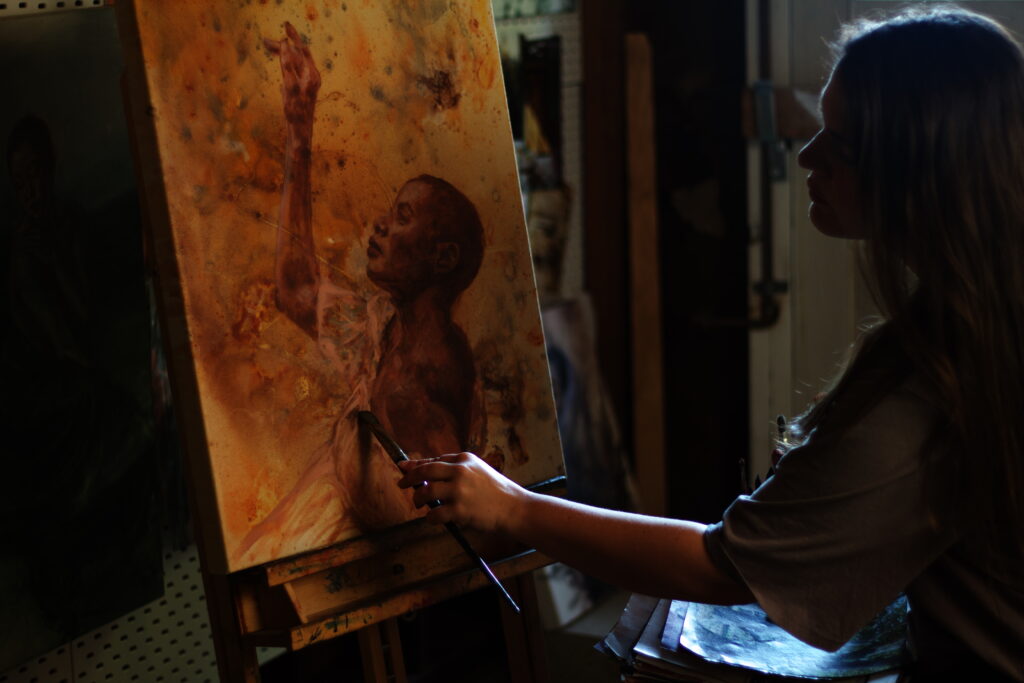
At Women in Arts Network, our Portraits exhibition set out to explore everything a face can hold, not only how a person looks, but the feeling moving quietly beneath. Each artist approaches that in her own way, and together they remind us why the human face has fascinated artists for centuries.
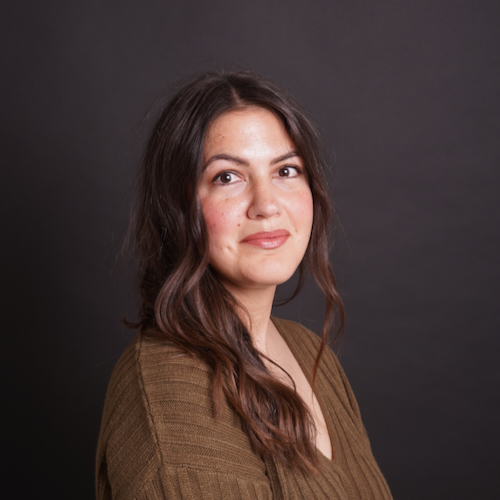
And among our many selected artists is Justine Martinez, an American painter whose portraits of women reach for the deep, complex emotions we so often struggle to put into words, and for the quiet, universal longing simply to be seen.
Based in the San Francisco Bay Area, Justine came to painting by a long and winding route. Her fascination with the face began in childhood: a deeply sensitive child, she absorbed the unspoken feelings around her and grew keenly attuned to the emotions beneath people’s expressions.
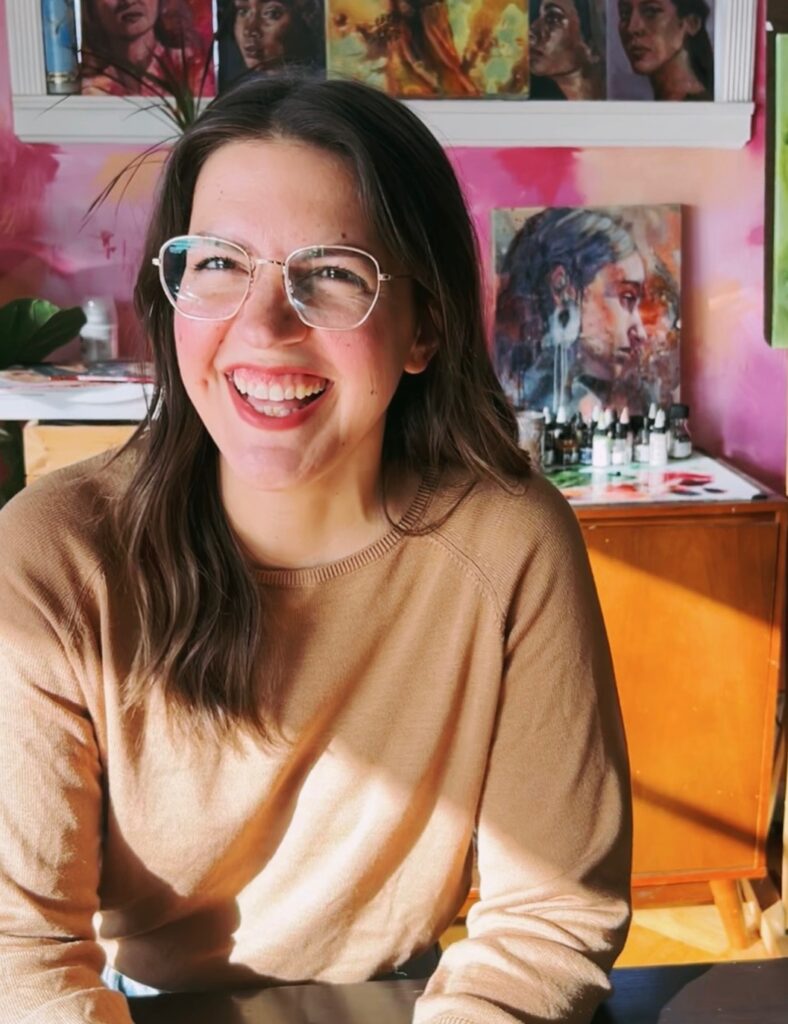
By the age of seven or eight she was already drawing women’s faces for hours, copying from the vintage art books her mother had kept and inventing women in elaborate dresses and dramatic scenes of her own. Yet for most of her adult life, art stayed in the background. She spent more than two decades in nonprofit service work, mentoring and supporting women, raising her children, and quietly absorbing the stories of others.
Her journey as a painter is only a few years old, begun in her forties, and she has come to see those earlier years not as time lost but as rich soil, everything developing quietly beneath the surface before it could grow into the open.
When she paints a person, she searches for the moments that rise from somewhere deep, expressions carrying what isn’t yet ready to be spoken. She is drawn to the complex emotions that hold a whole story, the tension of joy and pain, grief and beauty, the feelings we often struggle to allow or even understand. Above all she paints women, hoping to create a space where their stories, so often overlooked, can be truly seen.
Her materials are central to how that story takes shape. She works across ink, oil, and acrylic, reaching for palette knives, droppers, brushes, and whatever else the moment calls for. Each tool and medium, she feels, offers its own language, and together they become collaborators in giving form to something intangible.

Her process is intensely intuitive and deeply embodied. She begins not with a plan but with a feeling held in the body, a deeply felt emotional story, and lets it travel through her heart and hands into the paint. She allows an unconscious, soul-deep layer to speak first, before conscious intention arrives, trusting her instinct to show her where the work wants to go. That trust is shaped by another part of her life, too: Justine is also a spiritual director, and the practice of surrendering to mystery, of loosening her grip and letting what happens happen, flows directly into the way she paints.
Running through all of it is the theme that has become her life’s work: the longing to be seen, which she believes belongs not to women alone but to all of us, in a world moving too fast to notice its own deeper feelings.
Now let’s hear from Justine about the childhood that drew her to faces, what she searches for when she paints a person, how her materials guide the work, and her belief that a different timeline is never really a delay.
Q1. Could you take us back to the beginning of your creative journey and share what first drew you to faces and figures?
The beginning of my journey toward the human face and all of its emotional expression goes back to my childhood. I was a very highly sensitive personality, and I absorbed a lot of the unspoken things. As a result, I was very aware of people and their expressions, the emotions that lived underneath the surface.
As evidence of what was going on inside of me as a child, I developed a fascination for drawing faces and figures. I would spend a lot of my time as a kid drawing women’s faces in particular, and I never seemed to tire of that as a subject. I remember starting by the age of seven or eight. I would find these vintage drawing books that my mom had saved from her youth and try to recreate some of what was in those instructional books. But I would also spend time creatively imagining women in dresses, inhabiting these very dramatic and elaborate scenes.
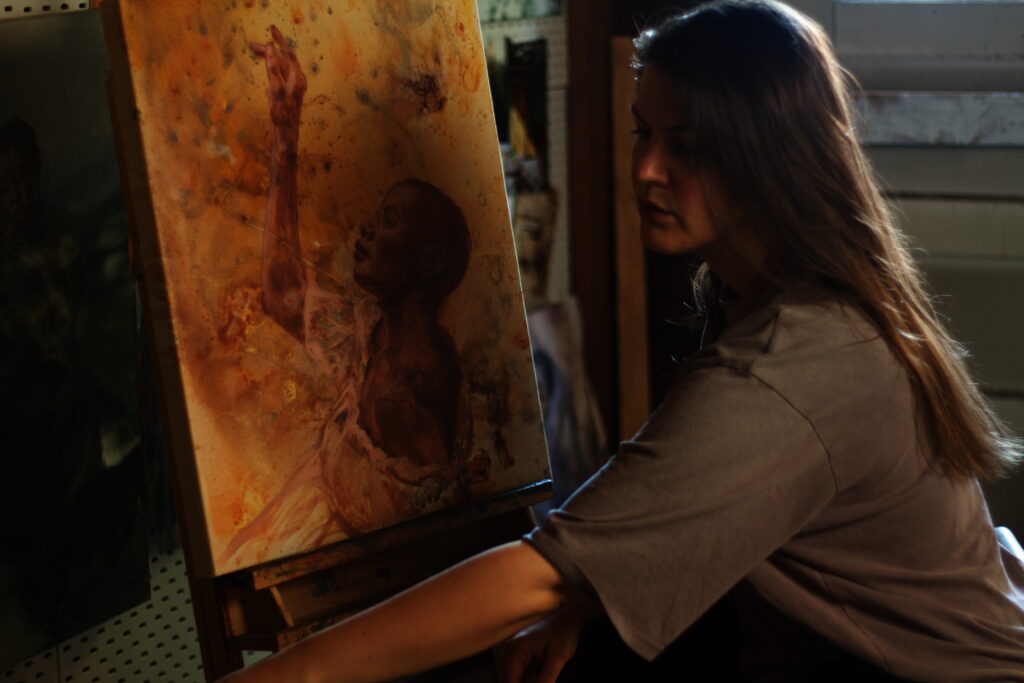
Q2. You describe your return to painting as a form of renewal and reclaiming. What did you feel you were reclaiming through art?
I’ve spent a lot of my life witnessing and absorbing the stories of others. In that internalized space, where worlds were always being created and stirred in me, there was often a block in making what was internal become external. I struggled having that part of me be seen and witnessed by others, having it become a reciprocal thing.
When I started to paint, it was as if that internal world in me was being expressed, as if I was entering into the conversation, instead of being in the background as this invisible figure. Art making was a reclamation of my presence and my participation in the stories, as a member of the stories, not just a witness, but now an active agent.
Q3. You have long been fascinated by faces and what lies beneath the surface. What are you searching for when you paint a person?
I’m often looking for poses or expressions or moments where what is being felt comes from a really deep place. Almost like the expression is showing what’s not ready to be put to words yet. It’s weighty. It’s coming from a place of depth. I’m looking for faces to paint, whether images of faces in my imagination, or from models, or from women in real life, I’m looking for these really particular moments.
I’m looking for specific kinds of emotions, the more complex emotions that hold a lot of story. I want to highlight these moments where there’s complex tension like joy and pain, or grief and beauty. I’m looking for the emotions that we sometimes have a hard time allowing or understanding.

Q4. Your documentary is titled To Be Seen, a theme that connects strongly with your artistic journey. Why has the idea of being seen become so important to your work?
Being part of that documentary was such a gift, and the filmmaker centered my history of invisibility. The film describes my own personal story theme of feeling unseen, both in circumstantial ways from moving as a child, feeling disconnected and isolated, but also from having a highly sensitive personality where there is always a lot going on inside that people can’t see. I operated at such complex levels of feeling that my young, undeveloped self didn’t know how to express or communicate it.
The people around me often didn’t realize, or didn’t have the tools to know how to draw that out of me. The documentary highlights that origin story of my own, but also my history of listening, working in service work for more than two decades, as a witness to other stories that parallel this invisibility theme. Especially within the stories of women, there’s a chronic issue of being unseen that permeates our society.
And I would even venture to branch out beyond women’s stories in particular into humanity’s story. We are running and moving at a pace that brushes past and avoids these deeper wells of story. The invisibility is perhaps something we’re feeling on a global level.
Q5. Your paintings often depict women. What draws you to the emotional and spiritual experiences of women?
As a woman myself, of course I’m close to the story of women. And as someone who’s worked with women, mentored women, supported women in their emotional and spiritual journeys, the story of women has become my life’s work. I have felt like I’m standing in that gap of being overlooked or minimized or chronically unseen. I also have a generational story from the women in my family that I’ve slowly been unpacking throughout adulthood. Stories of losses and death and grief, experiencing invisibility as women, as mothers.
Many elements and layers to my own personal generational family story of grandmothers and great-grandmothers is also part of the roots of why these stories matter to me. My desire is to create a space where those stories are seen again. Not just for our restoration as women, feeling connected and seen, but also because our stories hold such wisdom, a needed element of truth and reality and beauty, that the whole world is lacking when it’s ignored.
It’s like a piece to our collective puzzle that holds keys we all need. Women hold testimonies and examples that can guide us and invite us into a truer and more honest and beautiful way of living.
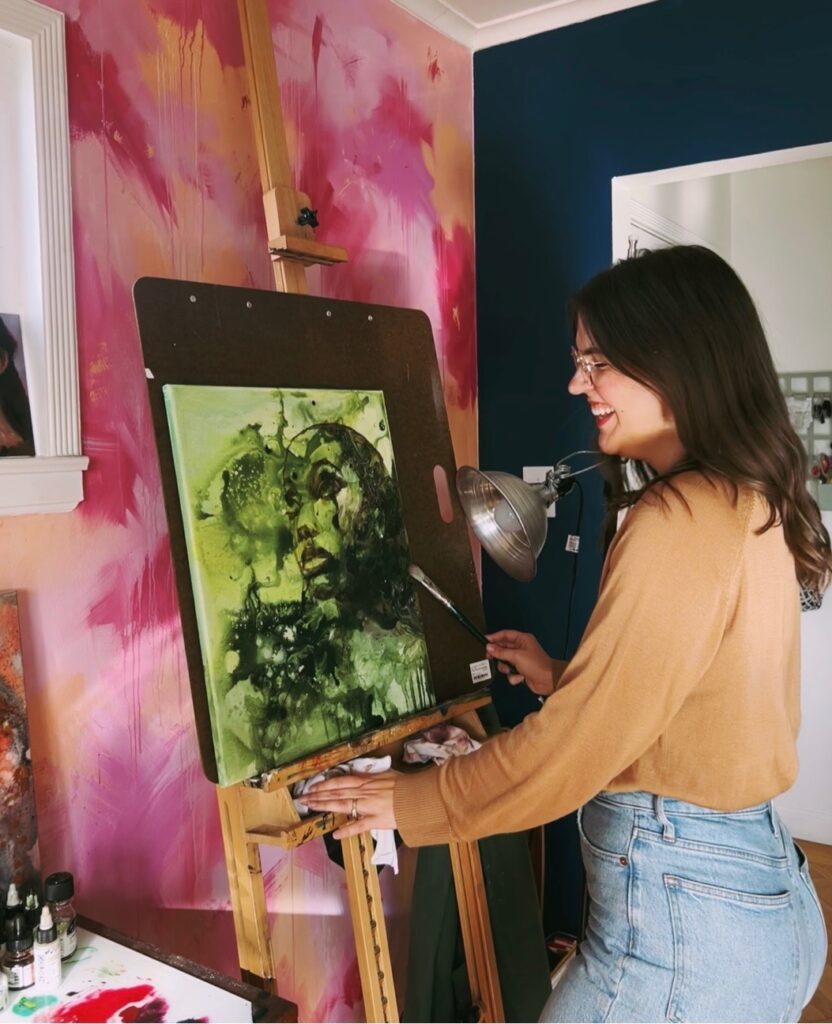
Q6. Your process includes ink, oil, acrylic, palette knives, droppers, and other tools. How much do the materials themselves influence the direction of a work?
The tools and the materials are such a huge part of the direction of the work. Because I’m starting with such an emotional layer, a deeply felt emotional story and experience, it’s in my body.
The connection between my body, my heart, my soul, my emotion, and what I’m trying to express then travels to my hands and my movements, creating this direct line that then communicates to and participates with the ink or the paint, the droppers and the brushes.
We’re all working together, and each medium and tool offers unique languages, bringing form to that emotional story. It becomes an embodied conversation with the materials, and they each have something different to contribute. The choice of what mediums and tools I use and when collaborates with my intuitive ability to read and feel and experience and express those emotions.
Q7. Your Between Worlds collection explores figures moving from invisibility toward a more substantial, fully present existence. Where did this idea come from?
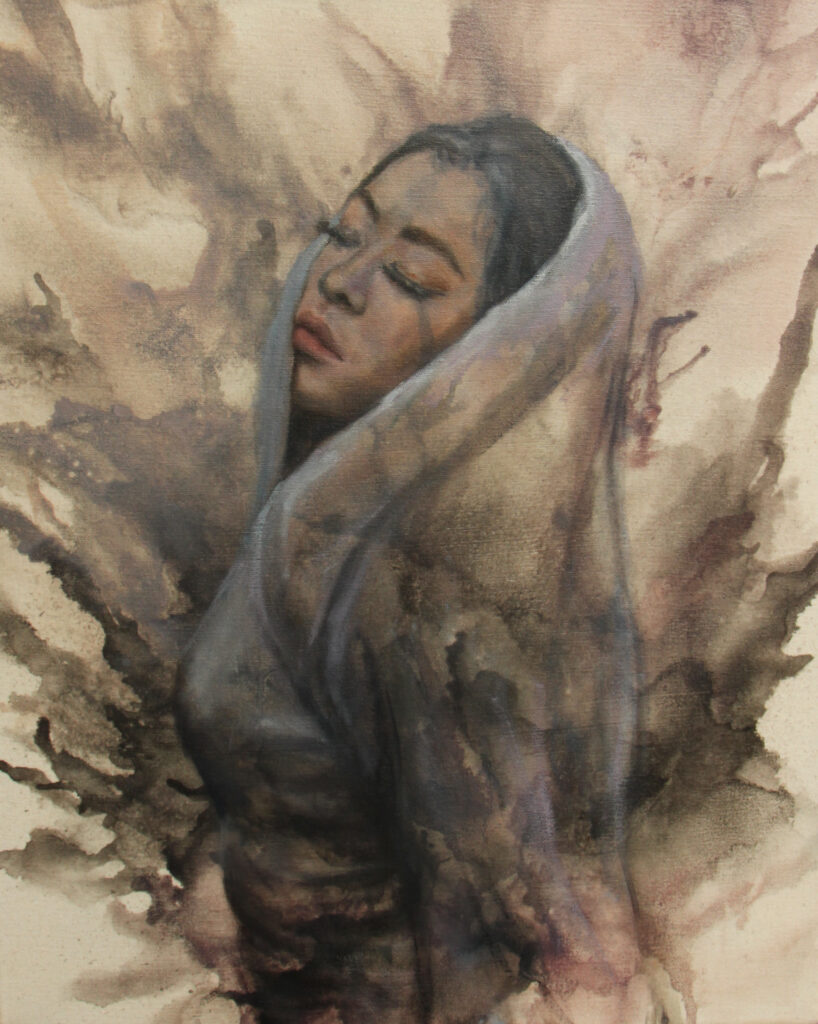
This concept actually came from a book that was very beloved to me as a teenager, by an author named C.S. Lewis, the same author who wrote The Chronicles of Narnia, which maybe people are more familiar with. He wrote a book called The Great Divorce, which is this very magical, mystical allegory about a person who lives in a gray, drab, socially isolated, dry existence, and then travels on a flying bus into what is such an interesting portrayal of heaven. The characters from the gray world are thin and transparent and insubstantial in their body form.
But when they arrive, there’s this color and vibrancy and solidness to the trees and the grass and the people who are there, and these ghost characters have a visceral pain reaction to this new world, where even stepping onto the grass or touching the elements is overwhelming and difficult. Everything is so much more solid and weighty than these people have become over time. They’re fragmented, and they have to choose to lean into that pain in order to regain their substantial form again. That idea really struck me deeply as a teenager. With my limited capacity to understand, I still knew that this was true. I knew this was the journey that we are all invited to walk.
I created the Between Worlds collection by sitting with that allegory again. I would go outside for walks in my neighborhood, touch the trees and their bark and feel the texture of the rocks, and practice being more present to the overwhelming beauty around me. We are living in this distracted, fragmented shell of a way of living that we’ve gotten so accustomed to, where everything stays at a shallow, hurried pace, where we’re chronically self-protecting and isolating, where we’ve got a million layers covering us, and the deeper things are buried so deeply that we struggle to acknowledge or feel them.
Creating this collection was a way to explore what it’s like to really be a participating member of this vibrantly alive world of air and elements and breathing and pain and sorrow and joy and color and texture. I made that collection out of that journey and out of that story that C.S. Lewis told so well.
Q8. You describe letting an “unconscious, soul layer” guide your work. How do you know when that intuitive voice is leading you?
As a rhythm of life, I have to continue making room for my own emotional honesty in the day-to-day. That might sound strange, but really in this world, we can go for days and weeks and months forgetting to reflect. Being disconnected, unaware, and disassociated from our own internal self has become a normal way of living. Sometimes it’s caused by our socially inhuman pace. It’s also driven by our avoidance of pain. It could be patterns of isolation, hidden wounds, or social barriers that disconnect us from the levels of community that we need to thrive.
The growing world of technology and noise and busyness and distraction that’s coming at us is a culture that says we have to keep running and moving and achieving. There are too many reasons why the practice of being aware and being present and feeling what we feel fully is something we must intentionally make space for, something we need to support one another in reclaiming. I recognize that deeper soul voice, that space within myself, because I am learning to remember it as a way of being.
I still have to fight for it. I still have to take time to value it and honor it and prefer it, the going slower, asking for help, feeling the hard feelings. I have to make that my life system and value, in order for me then as an artist to be able to say, “There’s something there that I would like to put to the canvas. There’s something there that needs to be told. I see and feel the beginnings of something here.” I have to live a life that makes room for me to even notice that.
Q9. How has your work as a spiritual director changed the way you understand the emotional stories that appear in your paintings?
When I’m journeying with someone as a spiritual director, I get the honor of hearing the deeper layers of a person’s day, their week or season. I get to hear the questions and the doubts and the fears and the longing that is beneath all our surface-level behaviors and traits. I get to journey with them as they notice these movements going on inside their inner landscape, and also the spiritual movements that are beyond their own self, the things being offered to them, the gifts coming their way, those moments where they feel met by a loving presence.
That bird’s-eye view of what that looks like for different individuals teaches me so much about what it’s like to be human, what it’s like to grow and to heal and to connect deeply with our story. I also think the practice of spiritual direction, which is a historic practice that I feel so honored to be part of, carries a value of surrendering to something outside of yourself. This practice emphasizes surrendering to the mystical or unknown, what lies beyond our full human comprehension.
In a concrete way, that practice of relinquishing control, of relinquishing the frantic search and striving to understand everything and label everything, that valuing of mystery and leaning into mystery, helps me enter the creative process in a similar way. I know I’m not the only force involved in this act of creating. I feel a sense that there’s a conversation happening between me, the Divine, the elements I’m working with, the stories of the women, the people who have shaped me, and with my ancestors. In that mystery, I give up trying to articulate a formula.
I’m not trying to paint something black and white, start to finish. I’m sitting in the mystery and painting that mystery in my own limited way. I’m putting form to something intangible. Painting that way allows me to loosen my grip. It allows me to let what happens happen and not try to overly guide and manipulate and control the outcome, but to trust that even just being there and participating is worthy.

Q10. How do you personally define success when your work aims not only to create something beautiful, but also to invite deeper emotional or spiritual reflection?
There are a lot of metrics recommended to an artist in the art world, or to a business owner in the business world, or to a woman in this world, or to a human in this world. It is a real and valid need to establish stability, to provide for our loved ones. But those metrics are definitely not all that is of value.
I’m learning to define success by staying tethered and grounded in the hope of what I’m creating and why, challenging the typical metrics being suggested as the only or most important thing.
Instead of feeling overcome by striving for accolades or financial excess, I’m learning to savor the conversations I have about what someone is feeling when they see my painting. Hearing what it’s reminding them of or making them more aware of, what gets stirred by the expression on the woman’s face, is such a gift to me. I feel successful when they recognize themselves in my work.
Q11. What would you say to artists who feel that their creative journey has been fragmented or delayed?
I’m 41 years old. I have three kids in their teen/tween years. I’ve worked in nonprofit service work for over 20 years. My journey as an artist has only unfolded over the past few years. There have been a lot of feelings to wrestle through of imposter syndrome, or just feeling like, is this okay, is this responsible? Is it shameful to be a beginner at this stage in my life, when there are voices that say people should be at a place of stability and success and establishment at my age? It is very vulnerable to start something new, and to take a turn in direction. In some ways my work as an artist isn’t a turn in direction, but an expansion of what I’ve always loved in my work with women.
But in other ways it is a huge shift. I’m working in ways that are so different, building new networks and connections and circles of community. I’m having to learn so many new skills as a small business owner. I worked in nonprofit work, and now I’m selling a product. It’s been such a learning curve. I would want to say to others feeling that delay: if you’ve longed to be a creator, or longed to start some new, meaningful shift, but it feels like a countercultural time frame or path, I have realized that there was so much developing in me in those first two decades of adulthood.
Instead of feeling like I missed those years or am “behind” in some ways, I am seeing how all of that inner work was developing in me while growing as a mother, as a mentor to youth, as just a person learning to process her story. All of that time was not wasted. It’s the soil that this creative work and business is now growing from. If your timeline is different than the expected standard, I don’t think there really is a delay.
There is always so much unfolding. What’s unfolding is often what we can’t see, developing down in the soil, but it is just as important as what begins to grow above the ground. It’s all part of the same process. So while I’ve felt intimidated and overwhelmed sometimes, I’ve also felt really grateful for my timeline as an artist. Maybe I needed more time in the soil.
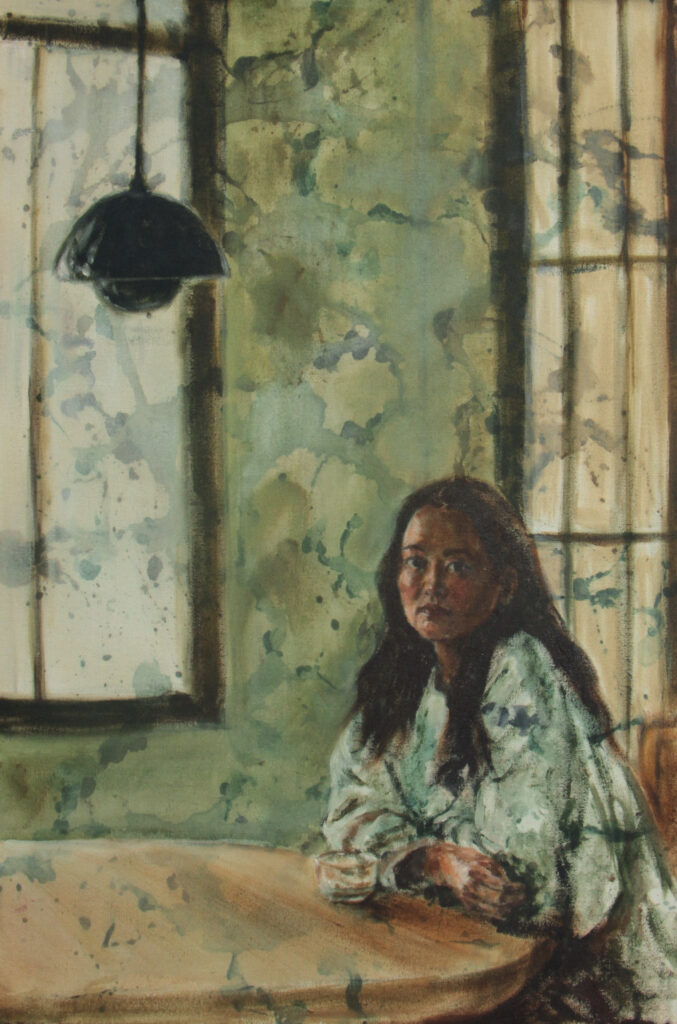
As our conversation with Justine came to a close, we found ourselves returning to a need as old as portraiture itself, and as urgent as ever: the simple human longing to be truly seen. For centuries, to have your portrait painted was to be granted a kind of visibility, a quiet declaration that your face, your presence, your life mattered. Justine’s work takes up that ancient purpose and makes it entirely her own.
Her portraits of women reach past the surface toward the complex, unspoken emotions we so often keep hidden, the tangle of joy and pain, grief and beauty, that holds an entire story. She is not interested in flattery or likeness alone; she is interested in being met. By giving these deep feelings a face and a form, she offers her subjects, and her viewers, the experience of recognition, of seeing something true in themselves reflected back.
There is a larger truth running through her practice, one that reaches far beyond any single painting. The chronic sense of being unseen, she believes, is not women’s alone but something we are all feeling, in a world that moves too quickly to notice its own deeper currents. Her work is a quiet act of resistance against that pace, an invitation to slow down, to look closely, and to honour the stories, especially women’s stories, that carry a wisdom the world is poorer for ignoring.
For art lovers and collectors, work like Justine’s offers far more than something beautiful to hang on a wall. Made through an intuitive, almost spiritual process, her paintings carry a genuine emotional and spiritual weight, and their meaning only deepens the more time you give them. To live with one is to live with a mirror of your own inner life, a reminder that the feelings we rarely speak are worth seeing, and that we are not alone in carrying them.
Perhaps that is the enduring power of a portrait: it insists that a person is worth looking at, worth knowing, worth seeing. Justine may begin with a woman’s face, but what she is really painting is the truth that all of us long to be witnessed, and the quiet grace of finally being met.
Follow Justine Martinez through the links below and explore more of her work and creative journey.
