
This Turkish artist paints ancient symbols in deep greens, teal and black│ Aysun Şentürk
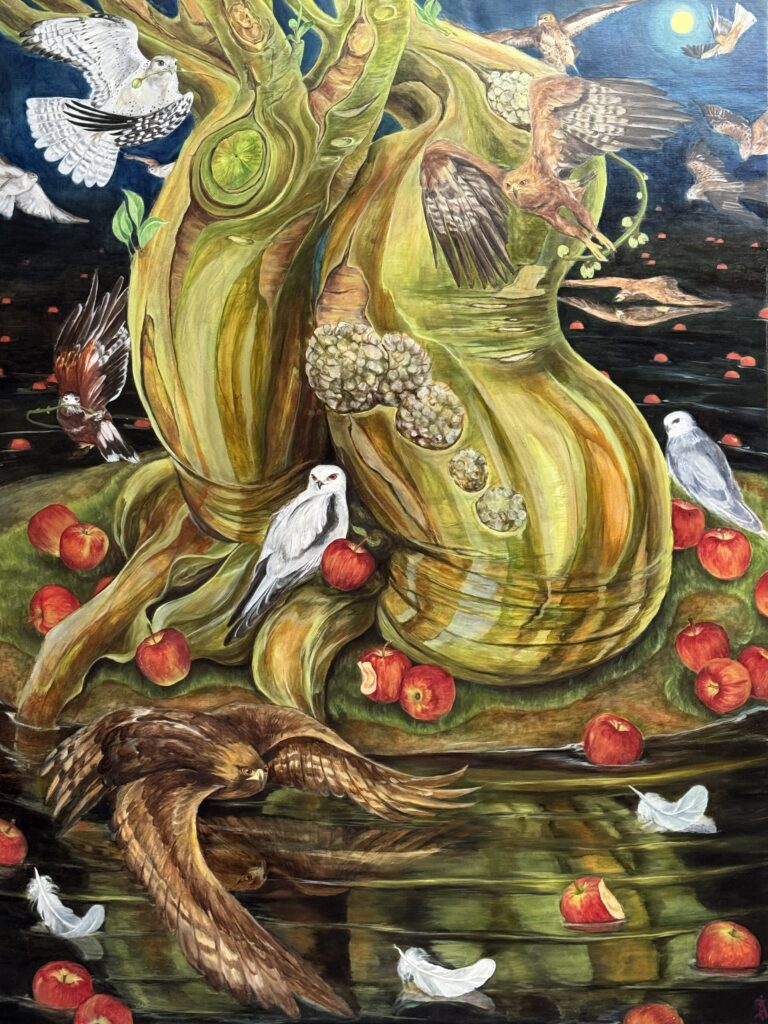
At Women in Arts Network, for our bird-themed exhibition, we received work that approached birds in every possible way. Wings in motion. Detailed feathers. Quiet studies of nature. And then there are artists like Aysun Şentürk, whose work doesn’t really paint birds as subjects at all. It uses them more like symbols. Messengers from an inner world that’s still unfolding while you look at it.
Aysun is a selected artist for the exhibition, and what drew us to her work wasn’t just the imagery. It was the feeling that every piece had come from somewhere deeply personal before it ever became visual.
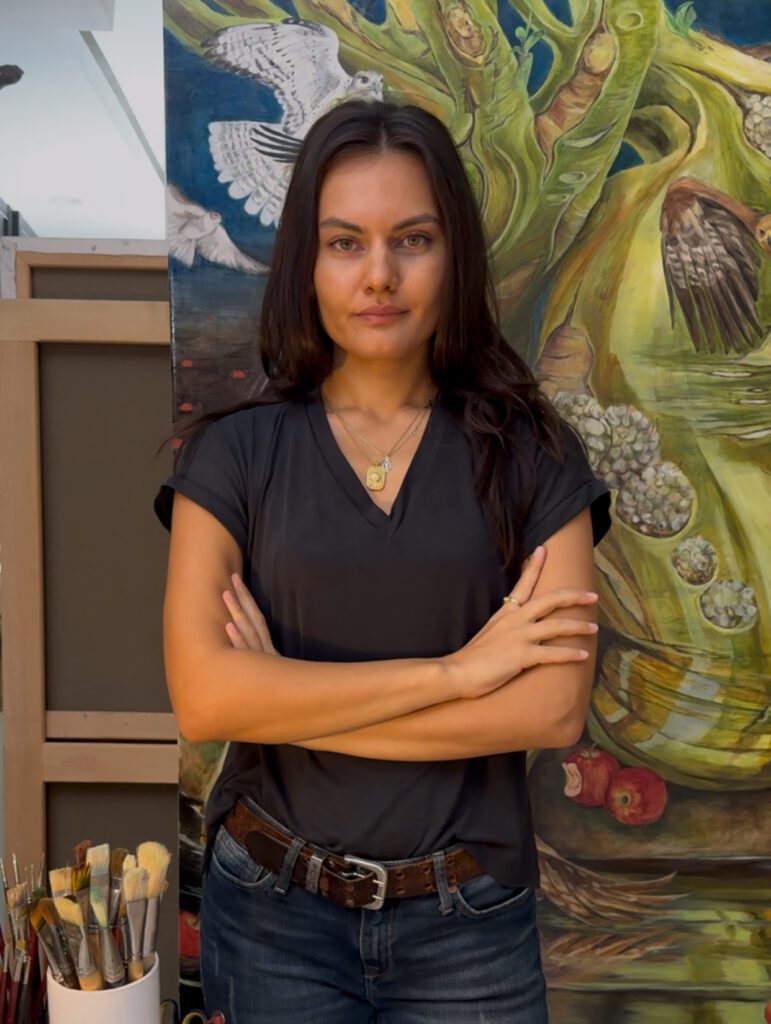
She talks about painting as something tied directly to her inner world. Even as a child, drawing was never simply about what she saw around her. It was a way of processing what she felt. That hasn’t changed with time or training. Even now, after years of artistic development, her work still feels guided by instinct first.
And you can see that instinct moving through everything she makes. Her earlier works were completely abstract, shaped through collage and intuition rather than narrative. But slowly, over time, forms began appearing. Symbols. Figures. Trees. Fragments of stories that felt emotional before they felt literal. Instead of leaving abstraction behind, she brought storytelling into it.
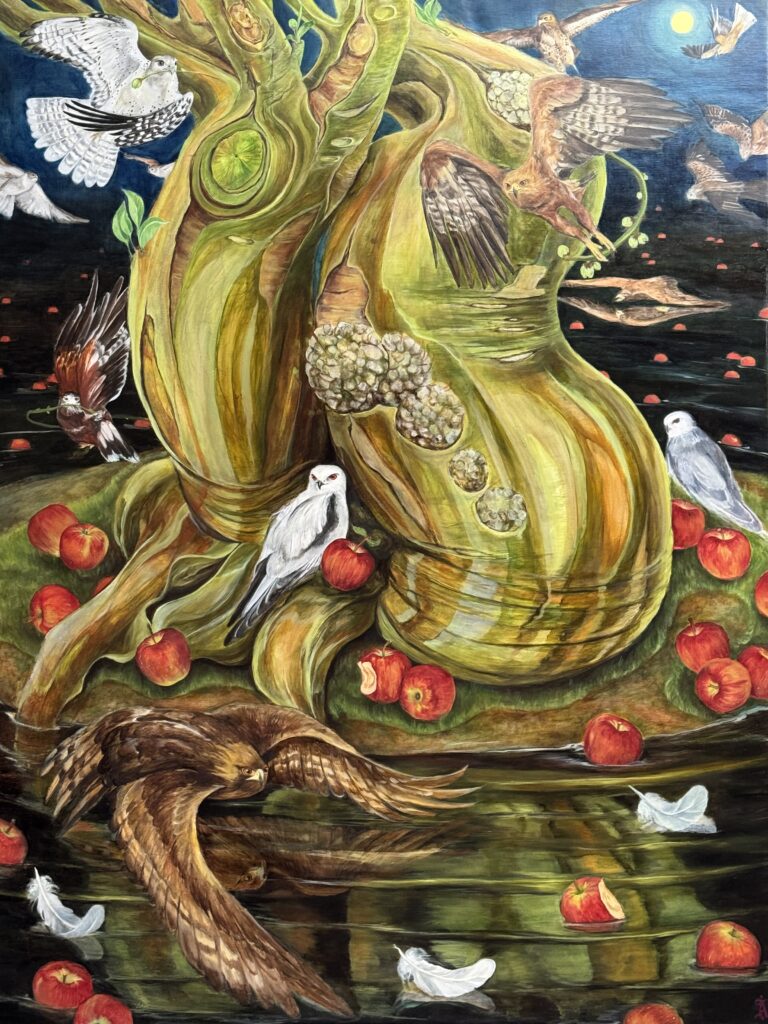
That tension is what makes the work hold your attention. There’s something both beautiful and uneasy happening inside her paintings. A tree that feels alive but also trapped. Figures that seem caught between transformation and stillness. Relationships that feel rooted and tangled at the same time. Even her references to mythology, like Daphne turning into a tree while fleeing Apollo, don’t arrive with clear answers. They arrive as questions.
And that openness matters. Because her work doesn’t tell you exactly what to feel. It leaves room for your own subconscious to enter the painting too.
Within this exhibition, her work reminds us that birds have always meant more than birds. They’ve carried memory, freedom, fear, longing, escape. They move between the physical and symbolic worlds easily. And Aysun understands that language instinctively.
Now let’s hear from Aysun, about intuition and symbolism, about paintings that begin before they can fully be explained, and about following instinct closely enough for it to slowly become a visual language of its own.
Q1. Can you share your background and how your early experiences with drawing, pattern, and image first led you toward the multidisciplinary work you do today?
When I was a child, the drawings I made were entirely a reflection of what was happening in my inner world. Even though I received academic training, this has essentially remained the same as I matured. Painting is still, for me, like a projection of my soul or sometimes simply its guide.
Q2. Your work often balances figuration with abstraction, structure with intuition. When did you realise that this in-between space was where your voice felt most honest?
My earlier works were entirely abstract, shaped by an intuitive approach, and I often arrived at this mode of expression through collage. Over time, this visual language evolved into symbols. In this way, I began to move from an undefined and freely open world toward a more distinct form of storytelling.
Q3. Your recent work explores motifs like tree of life and compositions that feel both organic and conceptually layered how do you develop the visual language and symbols that recur across your pieces, and what do they mean to you emotionally and philosophically?
I’m not sure whether this painting has a happy ending. In mythology, Daphne transforms into a tree while fleeing from Apollo but I wonder if that was truly a form of liberation for her.
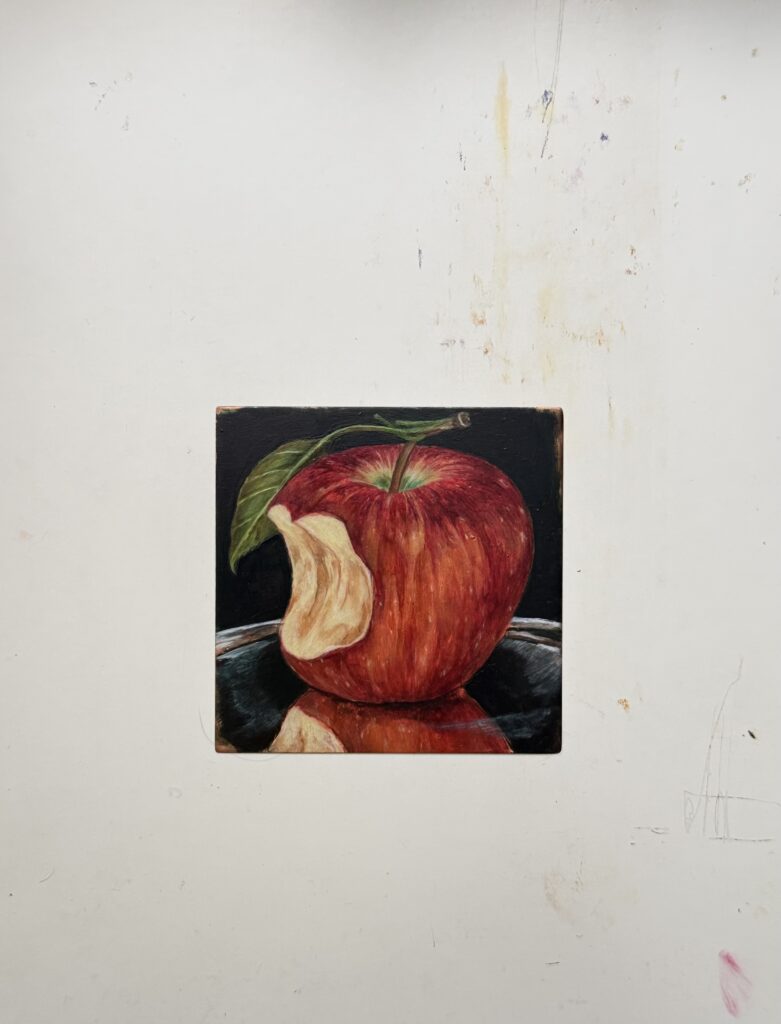
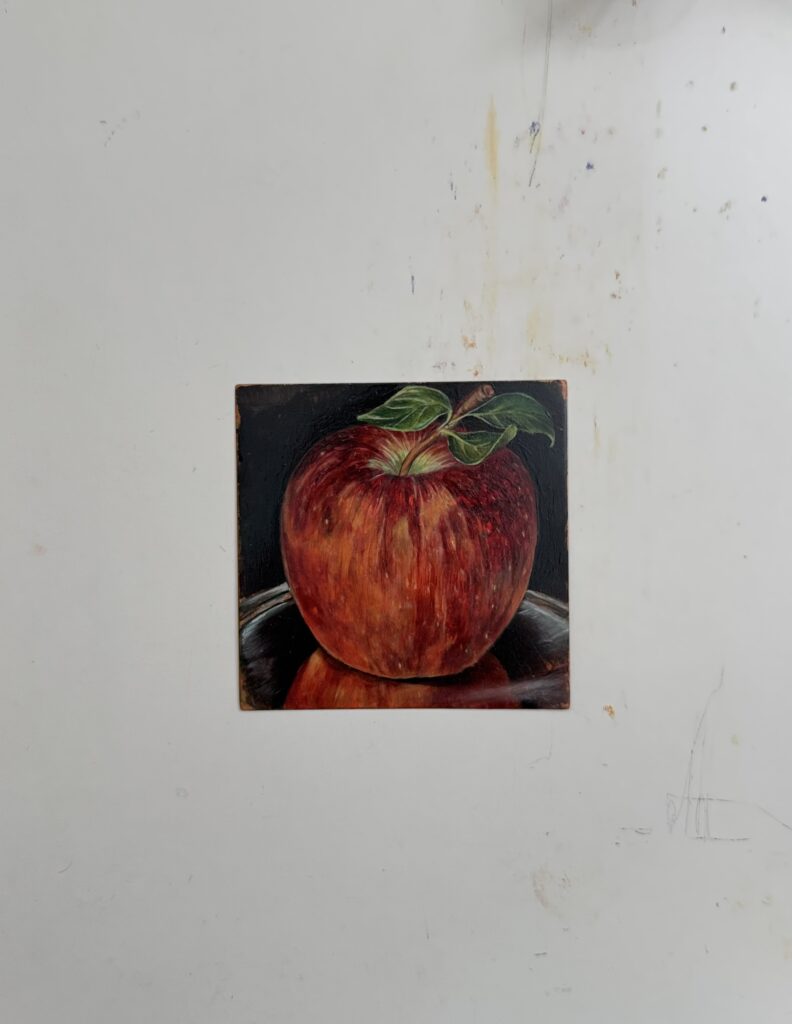
As I was making the piece, the bitten apples and the two intertwined trees led me to reflect on these questions. Rather than suggesting a liberating kind of love, it feels more like a relationship that entraps both sides. Of course, it may evoke entirely different feelings in the viewer.
Q4. Many of your works suggest intuitive, internal worlds rather than external scenes. Do you think of your compositions as documenting emotional states, atmospheres, or something else entirely?
Yes, I’m deeply interested in what’s going on in my inner world.
Q5. People often project stories or personalities onto your figures. How do you feel when interpretations vary widely, do you see that as an extension of the work, or does it create distance between your intent and the viewer’s reading?
I can’t measure the impact of what I feel and convey in my paintings on the viewer, because it can evoke different associations in everyone’s subconscious. Still, it makes me happy when the experience I have with the painting reaches the viewer.
Q6. Are there themes, visual questions, or emotional territories you feel drawn to explore next perhaps ones that feel unfamiliar or risky right now?
My paintings are currently related to what I am experiencing; I don’t know which themes will be on my agenda in the future. That’s why I feel excited about every new painting, because each one represents a new horizon for me.
Q7. Looking back at your early work and where you are now, what do you see as the most significant shift technically, visually, or emotionally?
My former mode of expression—one that I couldn’t define or turn into a narrative—has gradually evolved into a form of storytelling. This is more satisfying for me on a mental level.
Q8. What advice would you give to emerging artists who are learning to blend intuition, abstraction, and personal expression in their visual work?
Just listen to your instincts.
As our conversation with Aysun drew to a close, we kept thinking about how rare it is to see an artist trust instinct this fully. Not everything in her work is easy to explain, and that’s part of what gives it its pull. The paintings don’t feel over-decided. They feel discovered slowly, almost in the same moment they’re being made. You can sense her finding the meaning while moving through it.
And that creates a very different experience for the viewer. Instead of giving you a fixed story, the work leaves space for your own thoughts and emotions to enter. One person might see freedom in the trees and birds. Someone else might see entanglement, longing, or escape. The paintings hold all of those possibilities at once without forcing any of them.
We found ourselves returning to that idea while looking at her work—the idea that some paintings don’t need to explain themselves completely to stay with you. Sometimes the feeling arrives first, and the understanding comes later. That’s what her work does.
It lingers quietly. A shape, a symbol, a gesture sitting somewhere in your mind long after you’ve stopped looking at it. And for people who live with art, those are often the works that become the most meaningful over time. Not the ones that reveal everything immediately, but the ones that continue unfolding slowly depending on who you are when you return to them.
There’s something deeply personal in the way Aysun paints, but also something surprisingly open. She starts from her own inner world, yet somehow leaves enough room for others to find pieces of themselves there too. That balance is difficult to create. And it’s what makes her work feel worth returning to.
To follow Aysun’s journey and see more of her work, find her through the links below.
