
How Joanna Pilarczyk Combines Figurative Art & Graphic Patterns to Explore Human Connection
At Women in Arts Network, we talk a lot about what it means to really see someone. Not just to look at their face, or notice the colours they wear, but to understand something about the life they are living, the relationships they hold close, and the things they may never quite put into words.
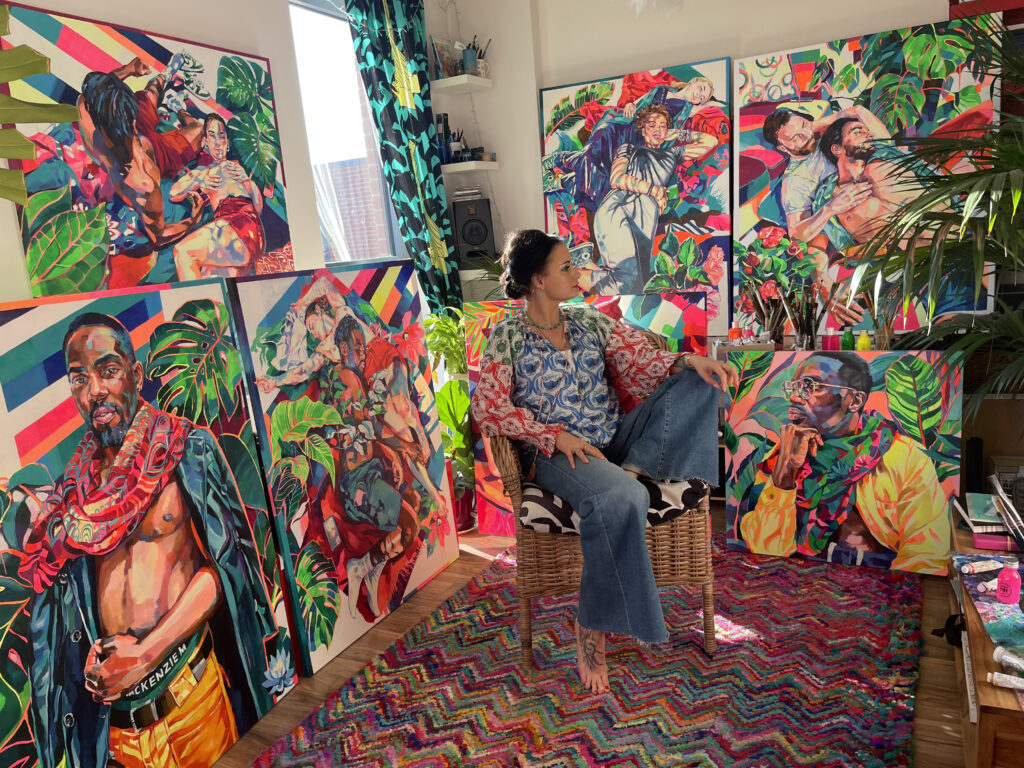
For Portraits, we expected faces. We expected expressions, the familiar act of one person sitting for another, and the many ways an artist might choose to represent someone. What we found in Joanna Pilarczyk’s work was something a little different. Her paintings are full of people, but they are also full of everything around them. The plants growing beside them, the patterns behind them, the light falling across their skin. And somewhere in all those colours and shapes, there are stories about belonging, intimacy, and what it means to be accepted.
Joanna is a selected artist for the Portraits exhibition, and her work immediately caught our attention for the way it brings together such different visual worlds. She paints people surrounded by bold geometric forms and lush greenery, using vivid colours that feel almost electric against the quiet, thoughtful expressions of her figures. There is a lot happening in her paintings, but nothing feels there simply to fill a space. Every element has its place, and somehow, it all comes back to the person at the centre.
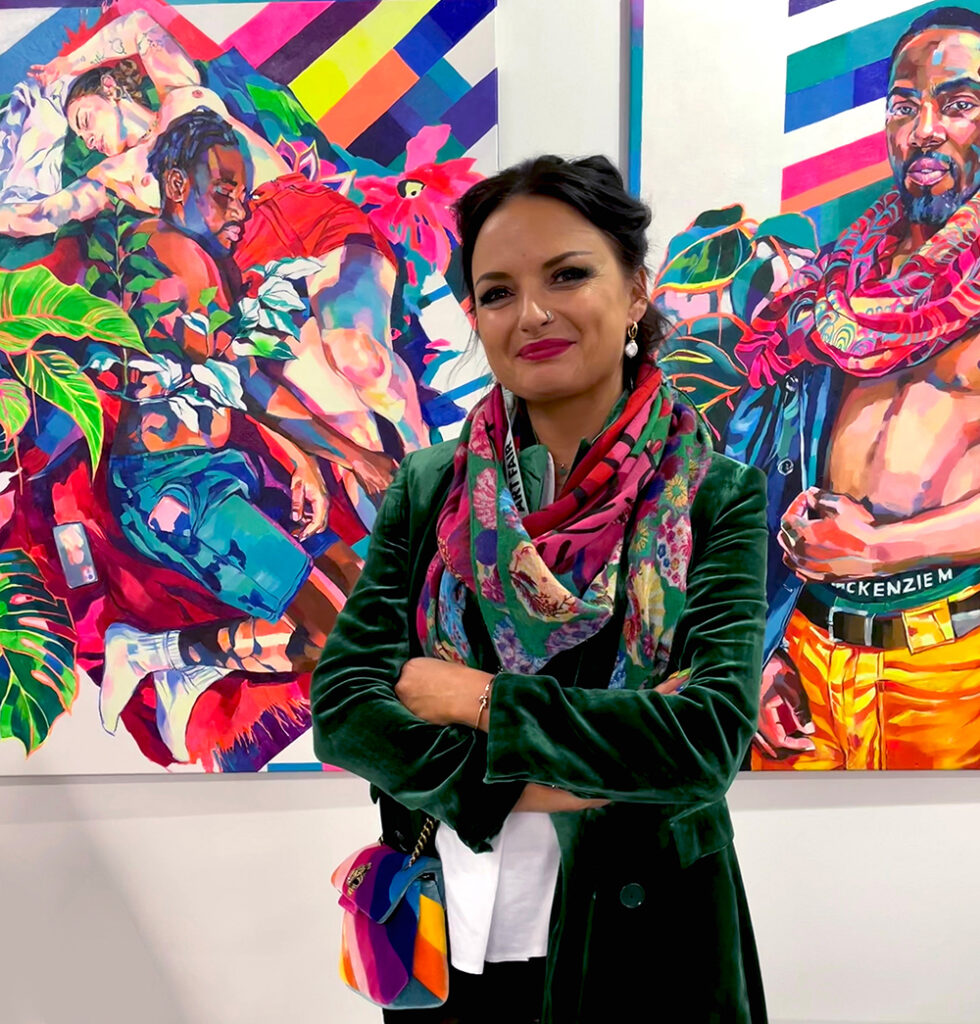
Her relationship with painting began in Poland, where she started seriously practising at fifteen. She spent years studying different techniques, learning from teachers and experimenting with materials before eventually finding her own way of working. Back then, she mostly painted friends and family, the people she knew best. But when she moved to London, her world grew considerably.
She found herself surrounded by people from different cultures and backgrounds, each carrying experiences she had never encountered before. She began teaching local art classes, meeting artists and models whose stories gradually changed the way she thought about portraiture.
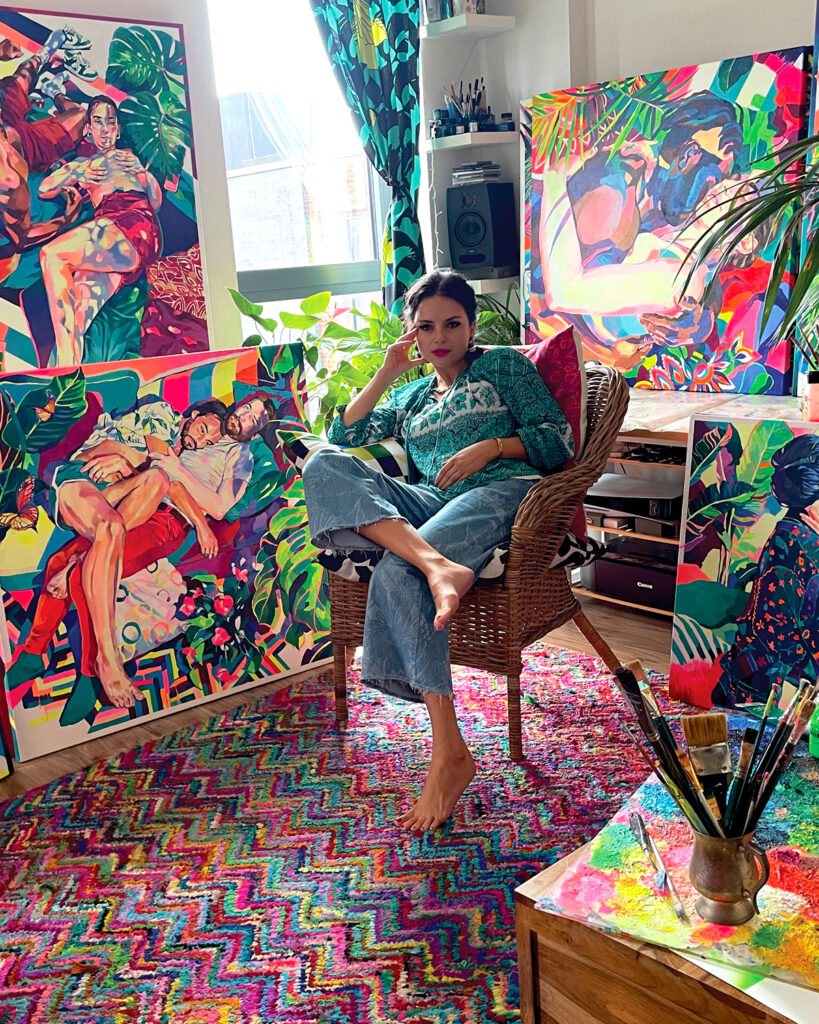
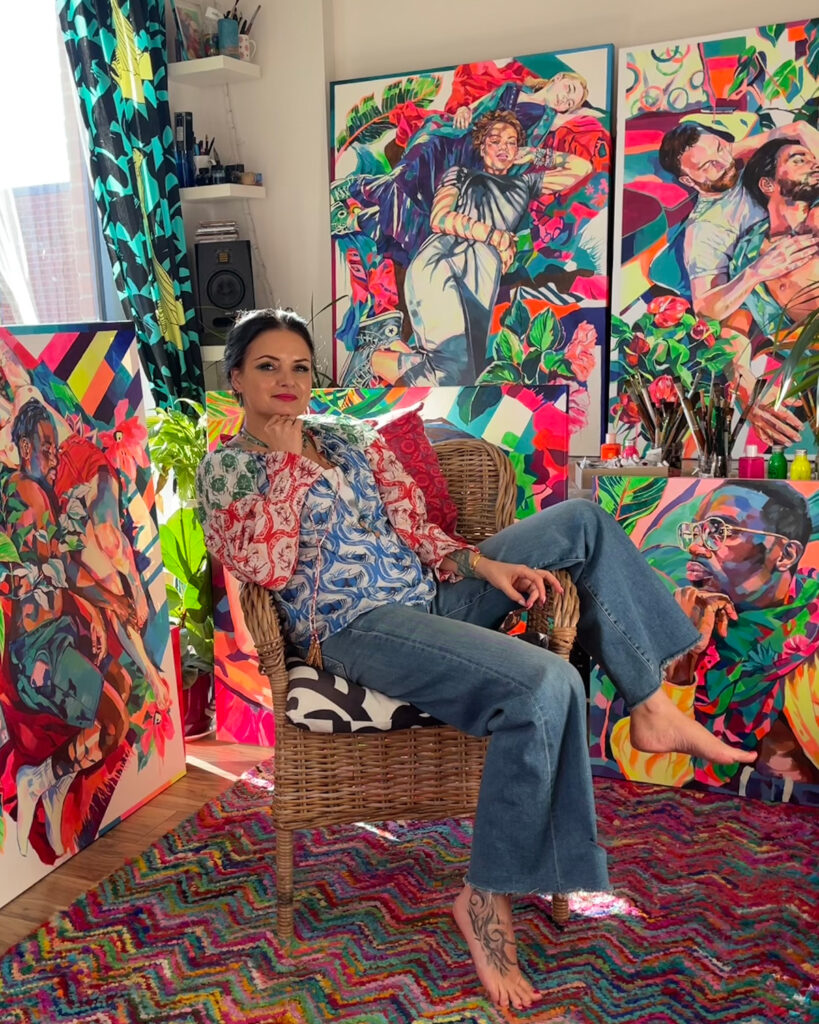
And then there are the plants. Her grandmother had taught her from an early age to care for them as though they were members of the family. That affection never left her. Today, greenery fills her home and studio, and it finds its way into her paintings alongside influences from street art, animation, video games, and old movie posters.
It is an unusual combination, but one that makes complete sense when you look at how Joanna sees the world: as a place where different things can exist together without having to become the same.
Over time, her work has also become a way of speaking about acceptance. Conversations with the people she paints have introduced her to experiences of rejection, discrimination, and the difficulty of finding belonging, sometimes even within one’s own family. Those conversations stayed with her. They made her think about what it means to paint another person, and whether a portrait can do more than show us what someone looks like.
Now, let’s hear from Joanna about the people who have shaped her practice, the unlikely places she finds inspiration, and why painting someone can sometimes be a way of making sure they are truly seen.
Q1. Could you share a little about your beginnings as an artist and what first made painting feel like the right medium for you?
I started painting seriously at around 15, while preparing for art school, and spent most of my evenings practising different painting techniques. Once I was accepted into my first art school in Poland, my teachers quickly noticed my skills, and over the next five years I focused on learning as much as I could about different media. It felt very natural to me, and during this time I developed a strong interest in portraiture and the human body.
I was also lucky to have a wonderful art teacher in my hometown who organised international plein-air events every summer. I had the opportunity to visit different countries, spend time with more established artists and learn from them. I continued my education at the Art University, where working with various professors gave me the opportunity to experiment and deepen my understanding of contemporary art and new approaches to painting.
This was very different from my earlier education and helped me develop a more individual style through experimenting with oils and acrylics, flat, poster-like shapes and unusual perspectives. By the time I completed my diploma, I knew that painting was my main form of expression.
Q2. You grew up in Poland and later moved to London. How did experiencing these two very different environments shape the way you see people and places?
During my years of studying art in Poland, I was mainly inspired by everyday life and the people closest to me. I painted my friends and family, often capturing them in simple, everyday activities. My palette was colourful, but it was much less vibrant than it is today. After moving to London, I was excited and inspired by the possibilities of living in such a multicultural city. My North London community brought together people from African, Asian and many other backgrounds, and I was fascinated by the variety of cultures, stories and experiences around me.
At the same time, being surrounded by one of the world’s most important art scenes opened up a completely new perspective for me. Once I settled into my new life, I started running local art classes. Through them, I met other artists and models from all over the world, each with their own stories and life experiences to share.
Gradually, my focus shifted from simply portraying friends and family in everyday situations to exploring young people, their cultures, experiences and relationships. London gave me a much wider world to observe, and that flow of inspiration has had a strong influence on my work and the way I see people and places.
Q3. Your paintings bring together figures, bold colours, geometric patterns, and lush foliage. How do you decide when these different elements have found the right balance?
I like to think of each painting’s composition as a puzzle that I have to put together. I usually start with a reference photograph of my model, which I take in a natural environment, such as a local park or garden.
I love working with natural sunlight and shadows, so these often become an important part of the initial image.
The geometric shapes, patterns and foliage come later. I build the background gradually as I paint, carefully arranging and adjusting each element until everything feels connected. I don’t always know exactly how the final composition will look when I start, it develops through the painting process, almost like putting the pieces of a puzzle into the right places.
Q4. Your geometric patterns often sit alongside very natural elements like plants and flowers. What interests you about bringing structure and nature together?
As much as I love people and find endless inspiration in studying their faces, I also find enormous joy in the beauty of plants and flowers. I strongly believe that we cannot be fully happy, or even exist, without the company of plants and trees, and I want to emphasise this sense of coexistence in my paintings. My grandmother instilled this love of plants in me from an early age. She always talked about how important it was to have plants in our homes, to talk to them and treat them as members of the family.
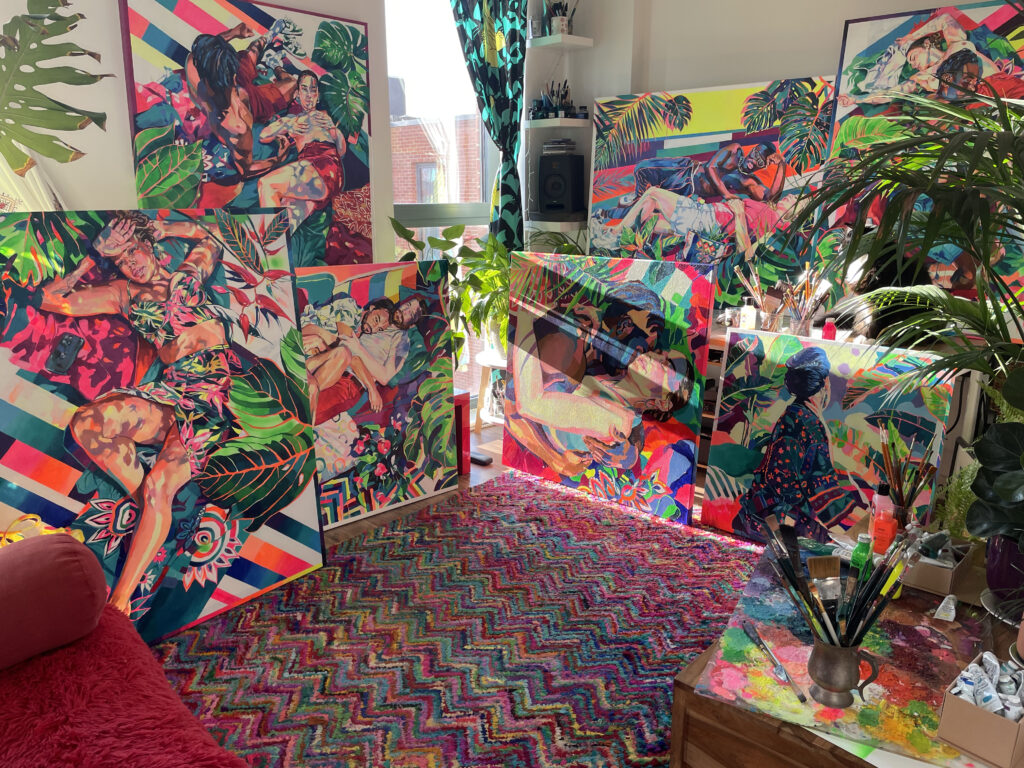
It stayed with me to the point that my flat and studio are now filled with greenery, and many of these plants naturally find their way into my compositions. The geometric elements come from a very different visual world. I am inspired by clean architectural forms, old movie posters, video games and modern animation, particularly their use of neon, clear, contrasting colours. I enjoy bringing these two worlds together, the organic and the structured, the natural and the artificial, and finding a visual harmony between them.
Q5. You combine oil, acrylic, and sometimes spray paint on canvas. What does working across these materials allow you to achieve?
I find inspiration not only in painting, but also in other visual media such as comic-book illustration, posters, animation, video games and street art. When I moved to London, I discovered so many hidden gems, particularly colourful murals around Hoxton, Soho and Shoreditch. The way street artists use spray paint, neon colours and bold shapes encouraged me to experiment with different materials in my own work.
My husband, Jarek, is an artist who works in animation, so through him I have also had the opportunity to discover the work of contemporary motion-graphics designers and animators. One of my favourites is the Spanish artist and animator Alberto Mielgo, whose use of neon and clearly defined colours has definitely influenced me. Oil, however, remains my main medium. I love its richness, texture, smell and durability.
Over time, I discovered that I could combine oil paint with intense neon acrylics, which gave me the freedom to develop a colour palette that feels very much my own. Spray paint and other materials allow me to introduce different textures and visual qualities, while oil brings the depth and richness that remain at the heart of my paintings.
Q6. Between Us places two figures within a vibrant, layered setting. What does the space between people represent for you in this work?
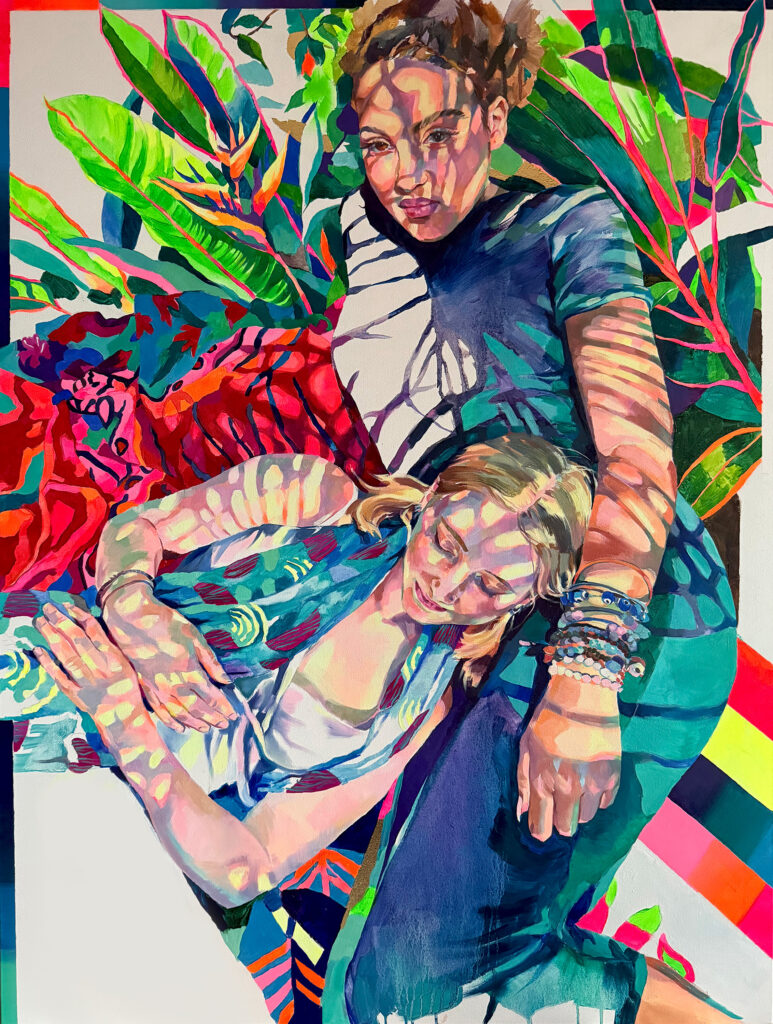
Between Us portrays Alton, a young man of Jamaican heritage whom I met at the local community centre where I teach. I photographed him resting on the ground, holding a small bouquet of flowers and extending it towards the viewer. The composition focuses closely on his face, with his eyes looking directly at us. For me, the space between people in my paintings is a form of dialogue.
In Between Us, it represents the dialogue between me as an artist and my model, Alton — our connection, shared energy and emotions, and my way of communicating his personality to the viewer. In my other paintings, the spaces between the figures, often couples or siblings, also represent this dialogue. They reflect my attempt to understand and capture their unique feelings, shared experiences, closeness, love and vulnerability. The space between them becomes almost as important as the figures themselves.
Q7. Dream of Summer Night has a very different atmosphere from Quiet Resilience. What were you exploring through its dreamlike quality?
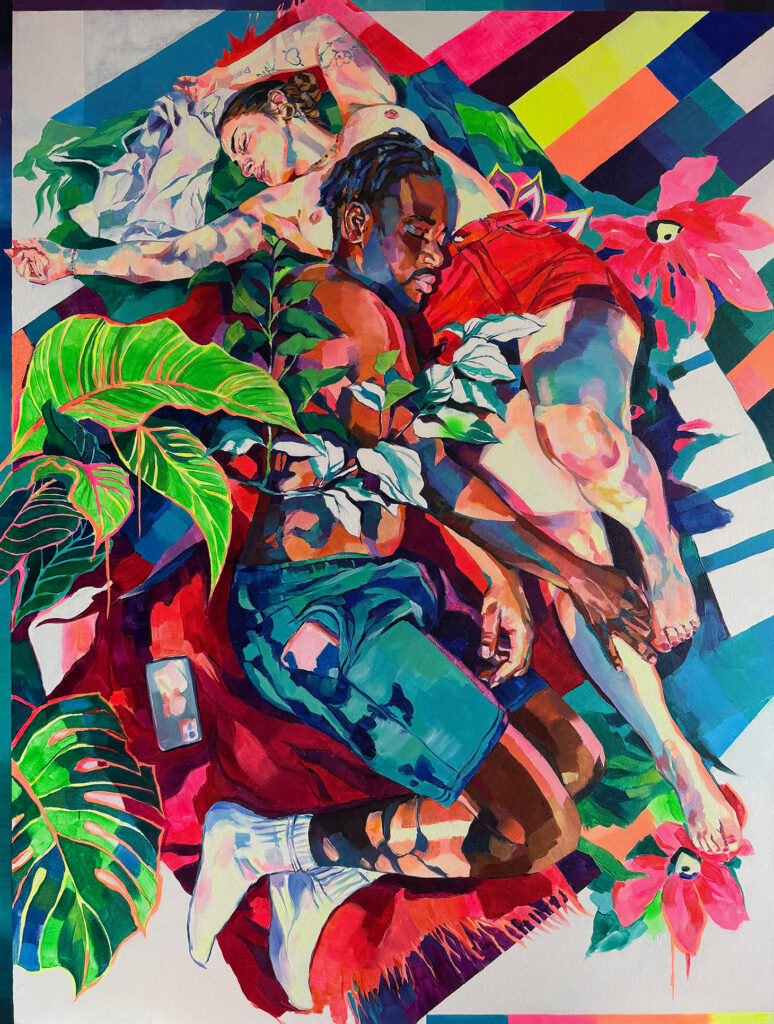
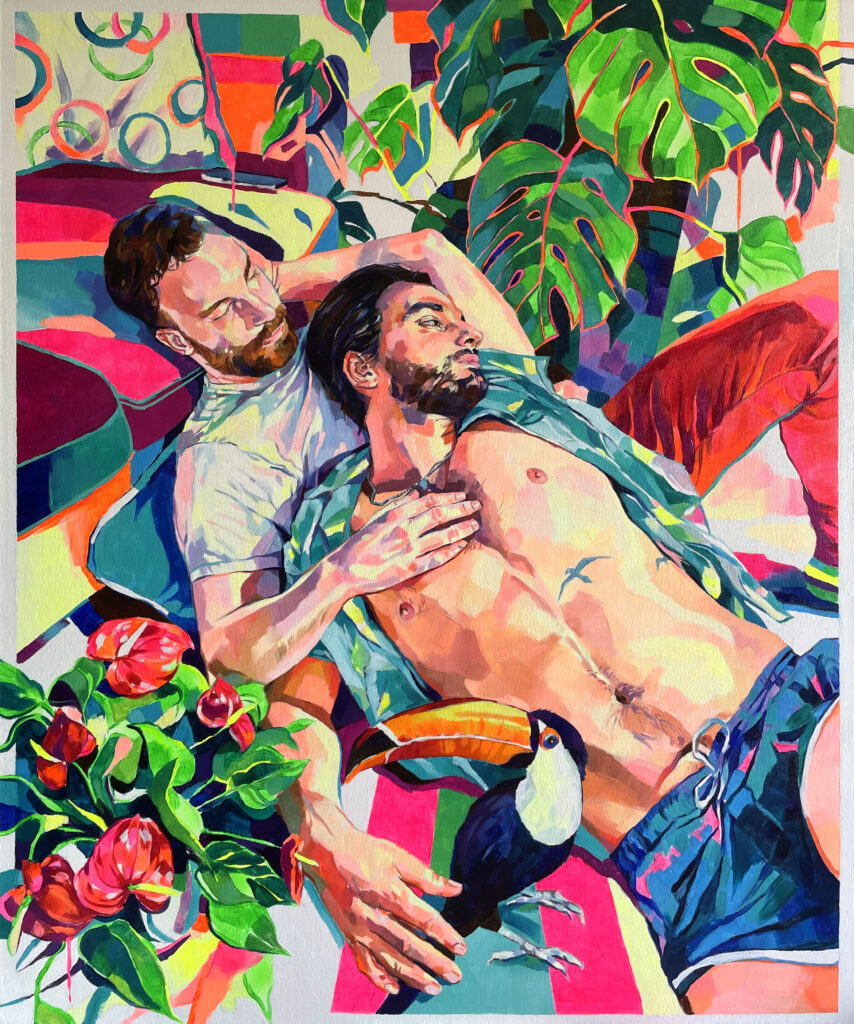
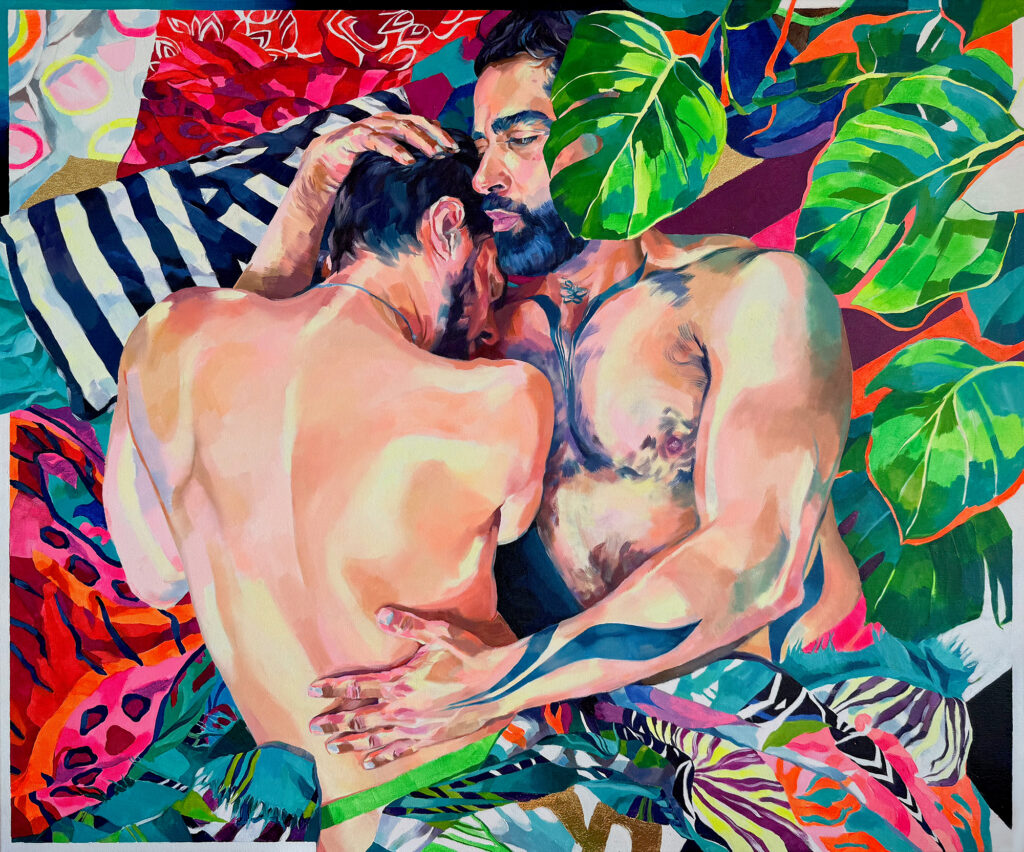
Dream of Summer Night portrays a gay couple sharing a very intimate embrace. One man is shown in profile, with his arm resting gently on his partner, while the other turns towards the viewer, his face partly hidden in his lover’s arms. I wanted to capture his vulnerability and sensitivity, and the quiet intimacy of two people resting together, surrounded by rich patterns and lush green plants. The dreamlike atmosphere reflects something deeper: the hope of finding happiness, love and acceptance within our families and communities.
Through this painting, I also want to advocate for the LGBTQ+ community by celebrating the beauty and tenderness of every relationship. This is quite different from Quiet Resilience, which is a self-portrait exploring quiet moments of meditation, self-awareness and connection with nature. While Dream of Summer Night looks towards the experience of love and acceptance between two people, Quiet Resilience is more about the importance of understanding and connecting with myself.
Q8. You describe your paintings as exploring relationships, self-awareness, and acceptance. Which of these ideas has become more important to you as your practice has developed?
I think acceptance has become the most important aspect of my practice. Living in multicultural London opened my eyes to many social issues, including racism, sexism and homophobia. Through deep conversations with my models and friends, I began to understand their personal struggles and some truly painful experiences of rejection and lack of acceptance, sometimes from the wider community and even from their own families. I was often shocked by the stories people shared with me and found it difficult to understand how these attitudes and experiences could still exist in our society.
These conversations made me realise that painting people and their relationships can also be a way of giving visibility to experiences that are often overlooked or misunderstood. In the political climate of recent years, with the rise of far-right movements and growing challenges to human rights, I feel that speaking about acceptance has become even more important. We are all different in our lifestyles, beliefs and cultures, and I believe that difference should bring curiosity rather than fear. We should learn from one another, respect one another and recognise our shared humanity. For me, painting can be a small but meaningful way of contributing to that conversation.
Q9. Your work often combines melancholy with vibrant colour. What does colour allow you to say about emotions that might otherwise feel difficult to express?
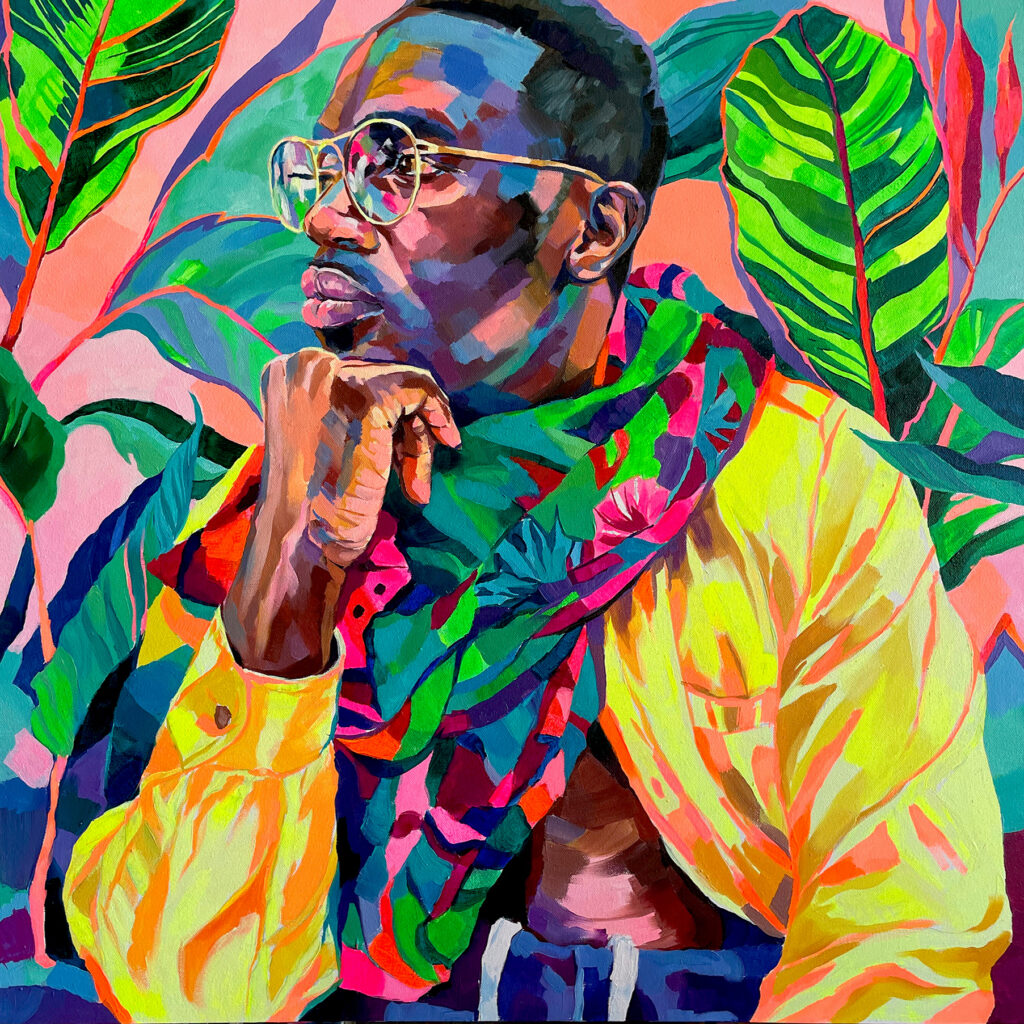
I think the melancholy in my paintings comes mainly from the figures themselves — their relaxed, resting positions, gentle expressions, quiet eyes and moments of contemplation. The colour is not usually chosen intentionally to represent a particular emotion. Instead, it develops from observing the atmosphere of the moment. I am very inspired by sunlight and the way it transforms everything around it: the vivid lemon-green of leaves, the colours of the setting sun, the oranges and neon pinks of fabrics, and the changing tones of light and shadow across the skin.
I often discover colours simply by looking closely at the bodies of my models and observing how the light moves across them. Although the figures may carry a sense of melancholy or introspection, the richness and vibrancy of the colours create a feeling of summer, happiness and warmth. I think this contrast allows the paintings to hold different emotions at the same time, a quiet, contemplative state, but also a sense of comfort, beauty and a safe space within ourselves.
Q10. You recently received the Young Masters Mentorship Award. What are you hoping to take from that experience into the next stage of your career?
Receiving the Young Masters Mentorship Award was a very special moment for me. I felt that my work was being recognised and validated on a different level, and I am truly honoured that Cynthia Corbett and Sadie Clayton chose to support me through their mentorship, valuable critique and advice. I have great admiration for Cynthia, her gallery and the Young Masters programme, which has such an important role in discovering and supporting emerging artists and giving them greater visibility within the art world. I also really appreciate Cynthia and Sadie’s openness to vibrant, distinctive work.
The fact that they see something strong and special in my practice means a great deal to me. At this stage of my career, I hope to use this experience to become more confident in my artistic decisions while also learning how to position my work more effectively within the contemporary art world. Most importantly, I want to keep developing my practice without losing the qualities that make it personal to me.
Q11. What advice would you give to artists who are still searching for a visual language that feels completely their own?
I would say: look for inspiration everywhere — in films, books, the streets around you, different cultures, personal experiences and, especially, the people who are close to you. Pay attention to the things that feel special and meaningful to you. Explore your interests, trust your intuition and allow your practice to develop naturally. Give yourself time to understand what matters most to you and what emotions or ideas you want to express.
Observe other artists and learn from them, but don’t try to copy their style. Everyone has a different path, and your visual language will come from your own experiences and the way you see the world. Most importantly, be consistent and spend time in the studio. Keep experimenting, keep making work, and trust that your own voice will gradually reveal itself.
By the time our conversation with Joanna drew to a close, we kept circling back to the people in her paintings, to the relationships they hold, the worlds that surround them, and the different ways a face can tell us something about the life behind it.
Consider how much of what we understand about another person comes from looking beyond their appearance. We notice the way they sit beside someone they love, the quietness in their expression, or the small gestures that reveal a closeness words cannot quite explain. Joanna paints these moments, but she also builds entire worlds around them. Lush greenery, geometric patterns, and vivid colours come together to create compositions where the surroundings are never simply a backdrop. They become part of the story, revealing something about the people who inhabit them and the emotions they carry.
Her paintings bring together influences from seemingly different places, from the plants her grandmother taught her to love to the bold colours of animation, street art, and graphic design. Yet what makes this combination interesting is how naturally it has become her own.
She begins with a person, often photographed in the sunlight of a local park or garden, and gradually builds the composition around them. The final image emerges through a process of adjustment and discovery, with each element finding its place alongside the next.
It is hard not to think about the importance of this work at a time when questions of representation and acceptance remain so present in the art world. Through the people she meets and the stories they share, Joanna has come to understand that painting someone can mean more than recording their likeness.
Her portraits make room for experiences and relationships that are not always understood or accepted, from the intimacy of a couple resting together to the quiet vulnerability of someone finding their own sense of self. She does not need to turn these moments into grand statements. Sometimes, simply allowing people to be seen as they are is enough.
For anyone who loves or collects art, that is part of what makes Joanna’s paintings worth spending time with. Their vibrant colours and striking compositions may catch your attention first, but it is the people within them who give the work its lasting meaning. Each painting offers a different way of thinking about connection, identity, and the spaces we create for one another. Look a little longer, and what first appears to be a portrait becomes something more: an invitation to consider how we see others, and how much our understanding can change when we take the time to look properly.
Follow Joanna Pilarczyk through the links below and see her work for yourself.
