At Women in Arts Network, Portraits brought together artists who turn to the human face to tell us something true about who we are. A portrait has never been only about getting a likeness right. It’s a way of holding onto a person, a feeling, a moment before it slips away. Each artist in this exhibition reaches for that in her own way.
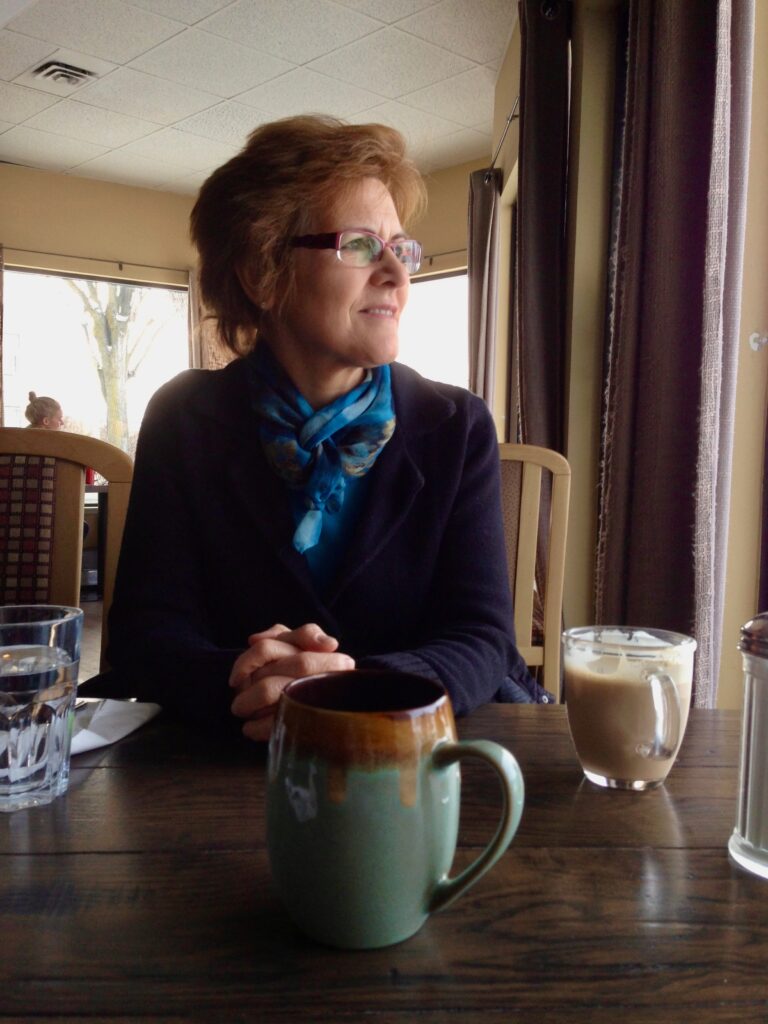
Among the artists chosen for this exhibition is Louise Renée, a Canadian painter whose glowing soft-pastel portraits are, more than anything, acts of love. She paints the people closest to her, so that they might live on forever.
Louise has loved art for as long as she can remember. She describes it as a fire in her heart, a need to express herself that has never gone away. Even as a small child, she was drawn to colour. She once hid the dazzling green head of a duck her father had hunted, simply because it glowed so beautifully in the morning light.
She spent her childhood lost in books and colouring, in a magical world of stories and pictures, and that love never faded. She would go on to study French Literature and only return to painting more seriously later in life, but art was always there, quietly burning underneath.
That love of literature still shapes everything she paints. For Louise, writing and painting have always belonged together. Both ask the big questions about what it means to be human. Like the writers she admires, she sees art as a way of finding beauty in ordinary things, and of turning one person’s fleeting experience into something we can all recognise.
It’s why words go hand in hand with her work. Alongside each painting she writes a short text, listening, as she puts it, to what the painting is trying to tell her. Many people say they love those little texts just as much as the paintings themselves.
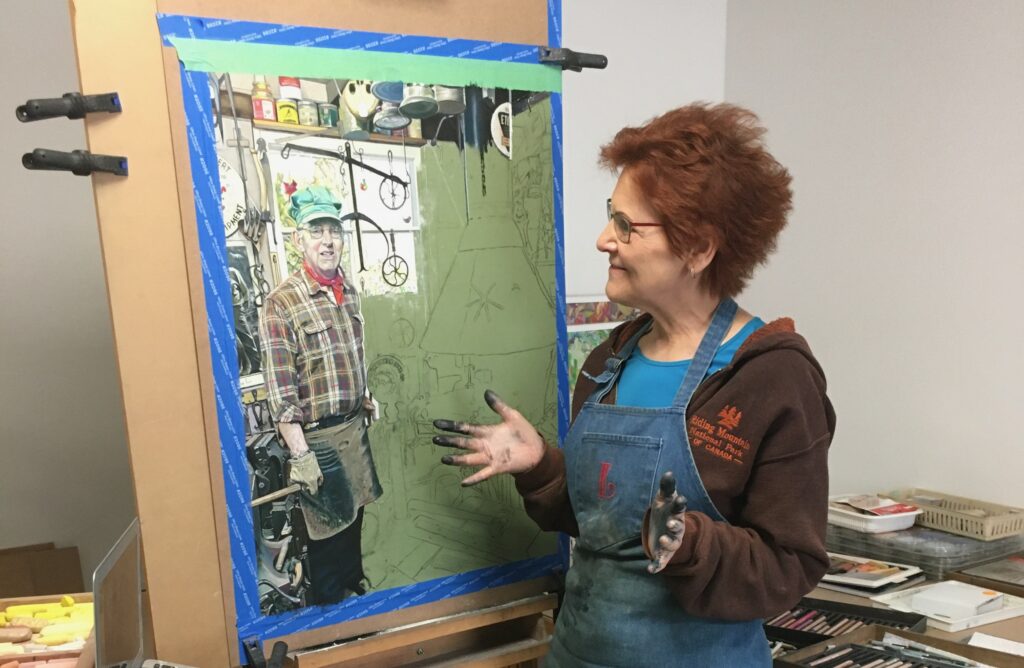
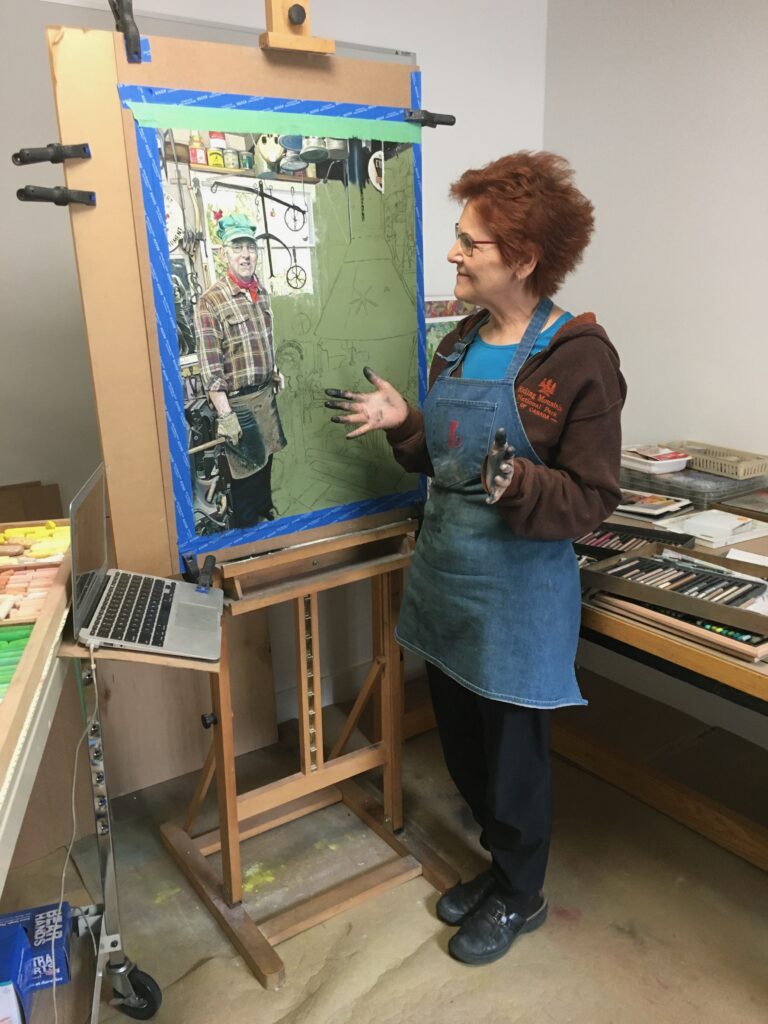
After trying many different mediums, she finally found her home in soft pastel. She loves its buttery texture, its rich colour, and most of all its glow, especially on sanded paper. It’s pure pigment, forgiving and full of life, and she blends it with her fingers almost as if she’s sculpting the image into being. Sometimes she isn’t even sure how she captures a tricky texture. She just lets go, falls into a kind of trance, and her hands find a way.
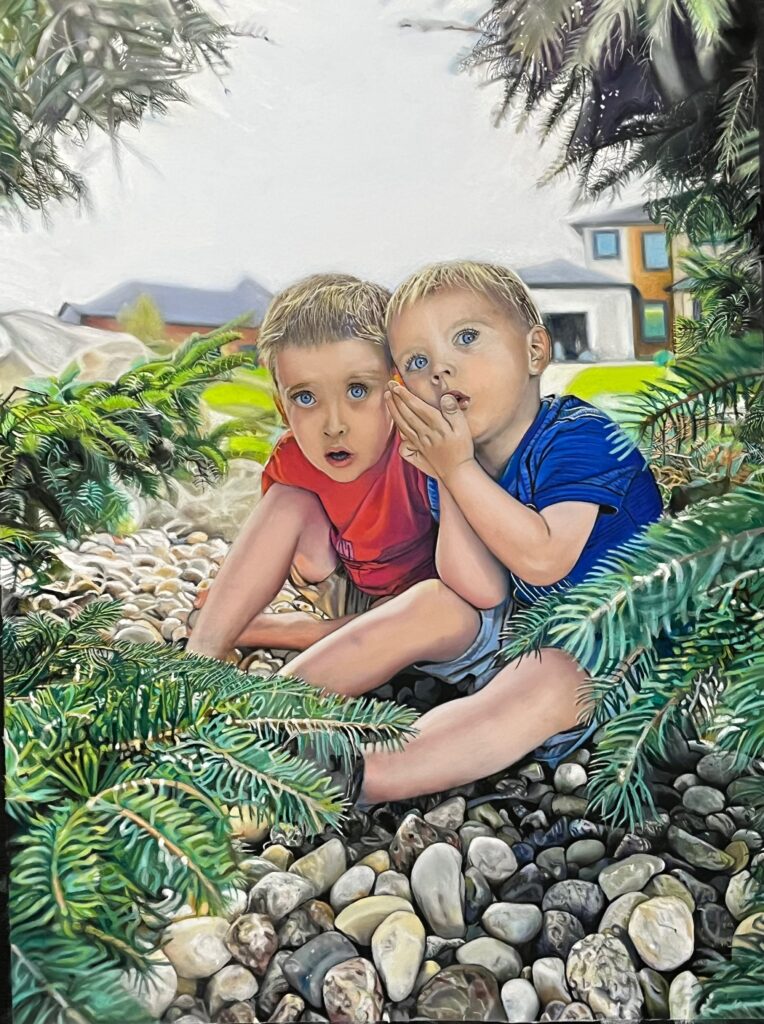
This Magic Moment, 2026, 18 x 25 in. soft pastel
She paints the people she loves, often as they were years ago, her parents, her children, her grandchildren, out of nostalgia, admiration, and love. A face can carry a grandfather’s pride, a soldier’s quiet wish for peace, a mother’s tenderness. A pair of hands can tell a whole story. What makes an image worth painting, for her, is never how perfect it is, but whether something in it moves her, an expression, a colour that makes her happy, or an image that comes to stand for something she holds dear.
Maybe the most moving thing about her work is her belief that the personal can become universal. Her paintings begin with her own life and the people she loves, yet complete strangers see their own feelings in them. They laugh, they tear up, they feel a tug at the heart. Art, she’s found, can be deeply personal and still reach other people at the deepest level, across time, across distance, and sometimes in moments that feel like quiet magic.
Now let’s hear from Louise about the childhood fire that first drew her to art, how literature shaped her eye, why soft pastel feels so natural in her hands, and her belief that it’s never too late to return to your creativity.
Q1. Could you take us back to the beginning of your creative journey and share what first drew you to art?
I think most artists follow a similar path that begins with a love for drawing, colour, and all kinds of artwork from a very young age. Colour was especially important to me. When I was about 4 or 5 years old, my father used to go hunting, and one day, he returned with quite a few Canada geese and mallard ducks. My parents proceeded to chop off the heads and feet and then strip the feathers.
I was about the height of the table, and my eyesight was directly in line with a dazzling green and turquoise head that glowed in the morning sunlight. My parents never noticed me take this precious jewel and store it in my closet. Of course I forgot all about it until a few days later when my mother asked me what that smell was coming from my closet. I explained why I had taken the beautiful green head and she just laughed.
She knew that my favourite things in the whole world were books and colouring because I would get lost in a magical world of stories and pictures. So what was it that “drew” me to art in my childhood? I’m not sure! It might be that I felt a natural affinity for art, like some children who have a gift for music. In grade school, I loved art class, and later on, I would make all the decorations and posters for any school event. All I know is that I’ve always felt a fire in my heart, a passionate need to express myself in art.
Q2. You studied French Literature before returning to art later in life. How did literature shape the way you see and create art?
Good question!
For me, literature and painting have always been two art forms that complement each other.
Literature invites you into a world where you imagine the characters and the setting, as if you’re creating a movie. But more than that, literature asks the big questions in life, taking you to a depth of meaning and inquiry about the human condition. And isn’t that exactly what art does? I’ve also loved particular novels that speak about art, especially Marcel Proust’s masterpiece, “À la recherche du temps perdu” where he explains why art is so important: it not only helps us see beauty in the most mundane things, but it also transposes transient, individual experience into universal truths.
Learning how to draw, honing your technique and creativity, and exploring different media are all very important in your artistic practice. But philosophy, history, science, and especially literature help you deepen your understanding of humanity, and this may add another dimension to your art.
Q3. Your portraits often include expressive faces and hands. What attracts you to these two forms of expression?
I’ve been more interested in faces than in hands, but I do have a few paintings where hands are very important. In “In Good Hands”, a Ukrainian soldier is holding a fragile-looking kitten, as if saying, “My job is to protect life. Why am I wasting this strength on war?” In “Let the Sun Shine In”, my 88-year old mother is still making her own bread, even though her hands are deformed by arthritis. In “Chez Mémère,” a little girl holds a protective hand over her little brother who’s sleeping next to her. I’ve often been asked to paint portraits of people I don’t know at all. I try to capture something about the subject that touches me personally.
For example, “Making Memories in the Prairie Dog Central” shows a grandfather, gleaming with love and pride for his little granddaughter, a feeling all grandparents can relate to. In “Ain’t No Mountain High Enough”, a young mountain climber’s determination clearly comes through in his expression. So faces and hands can help an artist capture what the subject is feeling or even the person’s very essence.
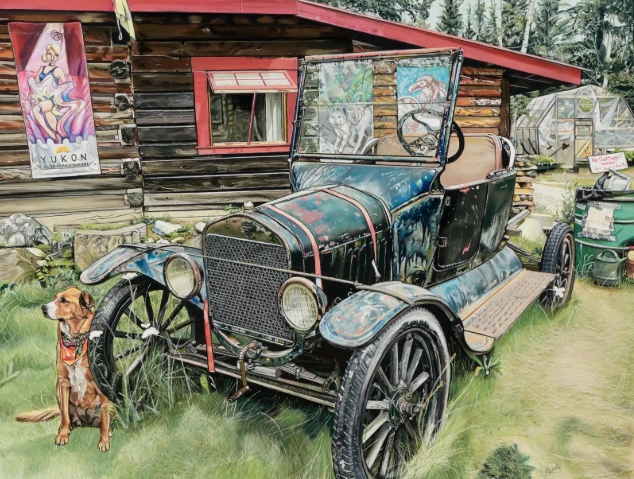
Art in the Driver’s Seat, 2023, 20 x 27 in. soft pastel
Q4. You have explored many mediums but eventually found yourself returning to soft pastel. What is it about pastel that feels so natural to you?
In my youth, a local artist used oil pastels, which I had never heard of. I was intrigued by this medium, and I started to draw Disney cartoons, comic strip characters, portraits, and still lifes in oil pastels. In my early twenties, I took a mixed media course where I was introduced to soft pastels, and I immediately fell in love with them because of their buttery texture and intense colours.
But most of all, I love their luminosity, especially when they’re used on sanded paper. Pastels are also very forgiving – you can easily correct a line, adjust a colour, and even erase a whole area.
Soft pastels are pure pigment. I love blending them with my fingers, almost as if I’m sculpting an object on a flat surface, magically infusing it with life.
Sometimes, I have no idea how to convey complex textures, but I relinquish control and my hands usually find a way. For example, in “I Hate Drywall,” how was I going to convey a black T-shirt and hairy arms caked in drywall dust? I can’t tell you how I did it. I was almost in a trance, and was surprised to see the result when it was done.
Q5. Your paintings often begin with a photograph, memory, or personal experience. What makes an image stay in your mind long enough to become a painting?
You can offer me a prize-winning photo to use as a reference, but it might leave me cold. Something in the photo has to resonate deeply within me, whether it be a person’s expression, vivid colours that make me happy, a balanced composition, or an image that becomes the symbol of something important to me.
Other times, I have no idea why an image feels so compelling. It’s only after I’ve completed the painting, after I’ve written something about it – almost like an echo that I hear from the painting – that’s when I understand why I was driven to capture the image. Sometimes the mystery lingers, and that’s OK too!
Q6. Your portraits often celebrate people close to you. What draws you to painting someone’s story?
Naturally, an artist tries to express the love they feel for people close to them. Often, I’ll paint a family member as they were long ago, especially my parents and children. In “Sitting on Top of the World,” my year and a half son is sitting on a John Deere tractor, beaming with pride.
In “Our French Heritage,” my son and daughter are holding a frog they’ve just caught, their faces glowing with happiness in the sunlight. In “Sewing with Lucille,” my mother is holding a spool of red thread with my little girl beside her. I also paint family members in the present – two grandsons in “This Magic Moment,” and my son and granddaughter in “Peter and Seneca.” So what draws me to painting their stories? Nostalgia, admiration, love.
Perseverance, 2024, 18 x 25 in., soft pastel
Q7. Writing has accompanied your artwork since your early vegetable series. Why do you feel that painting and writing need to exist alongside each other?
As I said earlier, art and literature are natural companions. They both explore what it is to be human. But writing about a specific work of art gives the viewer an insight into what the artist was feeling or why they wanted to paint a particular image. Of course, all artists want their works to stand on their own, but sometimes, knowing the painting’s backstory adds a whole other dimension to the work that the viewer couldn’t possibly have access to.
In many of the texts that I write about each painting, I try not only to say what I felt, but also to listen to what the painting is telling me. I often have no idea what I’m going to say about a work, but as I start to write, inspiration washes over me and I gain an insight that comes as a surprise. Many people have told me that they enjoy the little texts that I write just as much – sometimes more – than the painting! One of my followers wrote, “A beautiful painting! And the text inhabiting this work brings it to light beyond the silence.” (This was written about “Resilience.”)
Q8. Your Individuals Series celebrates people who are personally meaningful to you, including family members. What makes someone’s presence worthy of being preserved in a painting?
As I said earlier, someone you love makes them worthy of being preserved in a painting. You want them to live on forever.
Q9. Your father appears in your Hero Series, inspired by photographs and his experiences as an RAF pilot during WWII. What was it like to revisit his life through painting?
During the Covid years, my siblings and I felt a need to explore our parents’ lives, and we came up with the idea of writing a book about my father’s experiences as a pilot during WWII. He never spoke about the war, probably because it was too painful. All we knew was that he had somehow survived 4 years of flying over the Mediterranean Sea and returning with many medals of honour. In order to fill in the gaps of what these 4 years must have been like, I found a war memoir by Murray Peden, also from Winnipeg, who wrote “And A Thousand Shall Fall.”
We also had my father’s log book, which my brother painstakingly transcribed in graph form and included in the book. Among the things my father had kept from his days as a pilot, there was a box of tiny black and white slides. I made paintings of 4 of them, figuring out what colours his uniform and plane were. As I worked on each one, I felt a strong connection to my father, and I wondered how this young man could have possibly had the courage to go overseas to defend his country.
He came back home, married a wonderful young woman, worked hard to support 5 children, became a respected scout master, a lover of nature, laughter, and life. The integrity and strong values that he displayed during the war carried over into his family life, and we were so blessed to have such a loving father. So yes, I cried when I did these paintings. They’re meant as a deep homage to a man that only his family and community knew, but who deserved to be known by the entire world.
Q10. Your painting Buddy tells a personal story of overcoming your childhood fear of dogs. How did your relationship with him influence the painting?
As you can tell by the painting, Buddy and I became great buddies! The only thing that I was afraid of was getting my nose wet, just like his. So when he died, I wanted to commemorate him in a way that expressed my love for him. As most dog owners certainly know, your attachment to a pet, especially a really good dog, goes very deep. Dogs teach us so much – loyalty, unconditional love, friendship, and even humour – and this is mostly what I hoped to show in the painting.
Q11. What has the response to Buddy taught you about how a very personal story can connect with people who have never met you or your dog?
Even though people don’t know me or my dog, they laugh when they see this painting. Their warm response to the painting reminds me that we all share so many feelings. Art can be very personal but it has the extraordinary power to reach people at a deep level.
Q12. After such a long journey between literature, teaching, family, and art, how do you personally define success?
Success is bringing joy, meaning, and love to other people not only through art, but art has definitely become an important way for me to do this.
Très bien ensemble, 2026, 19 x 27 in. soft pastel
Q13. What does success mean to you at this stage of your creative journey?
At this stage in my artistic journey, success means reaching people through my art. Sometimes, it means just bringing a smile to their face, a tear of joy to their eye, a tug in their heart. Other times, it goes much deeper than that, and this is where the real magic happens. When I finish a painting, I get it photographed professionally, and I get cards made of some of them. I always include a text on the back of the card. Often, people have told me that the card they gave to a particular person ended up being exactly what the person was feeling at the time.
And most surprisingly, sometimes, amazing coincidences happen. For example, a friend of mine recently chose about a dozen of my art cards. She wanted to give one of the cards to a friend of hers who had just gotten married. She had already chosen a card to give her, but at the last minute, she changed her mind and gave her a different card. The young woman didn’t open the card right away. She was so excited to tell my friend what had happened at the outdoor wedding on her grandmother’s farm. In the middle of the service, a blue jay landed on a fence nearby.
She immediately stopped the ceremony because she had always ssociated blue jays with her grandfather. She looked at the blue jay and asked, “Grandpa, is that you coming to my wedding?” My friend couldn’t believe it. The card she had chosen was “Blue Skies Smiling at Me,” a painting of two blue jays.I did this painting because I’ve always associated blue jays with my father.
You can just imagine the young bride’s surprise when she opened the card with blue jays that reminded her of her grandfather! It’s this kind of happy coincidence that makes me feel that art can transcend time and space, and reach us in the deepest way. This means more to me than any kind of material success.
Q14. What would you say to artists who feel it is too late to begin or return to their creative journey?
You can already guess my answer. Your creativity never dies. All you have to do is start up again. As David Bowie said so well, “Aging is an extraordinary process where you become the person you always should have been.” So if you’re reconnecting to your art late in life, or even just starting, think of the advantage you have.
The accumulation of experience, life lessons, and even maybe wisdom – all this will feed your art. Art isn’t just about technique. It’s about bringing your whole heart and soul into your work, and this will come through whether you like it or not. All those years of not being as creative as you would have liked are not lost. They’re a gift that you just haven’t opened yet.
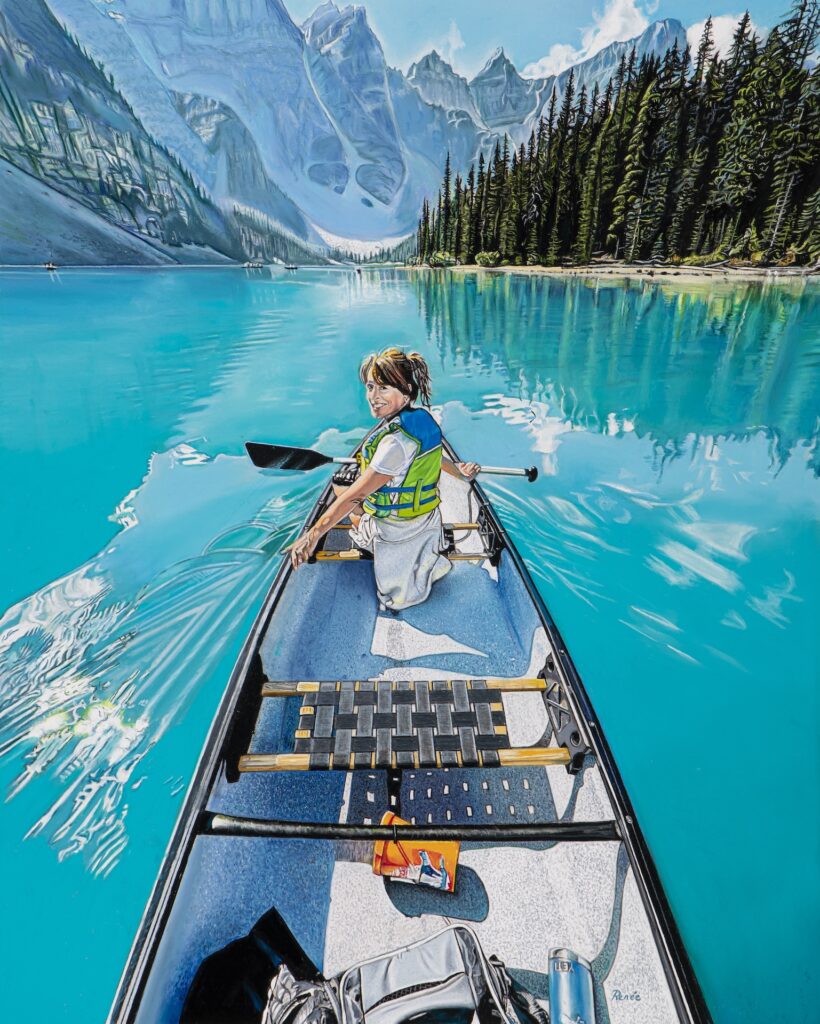
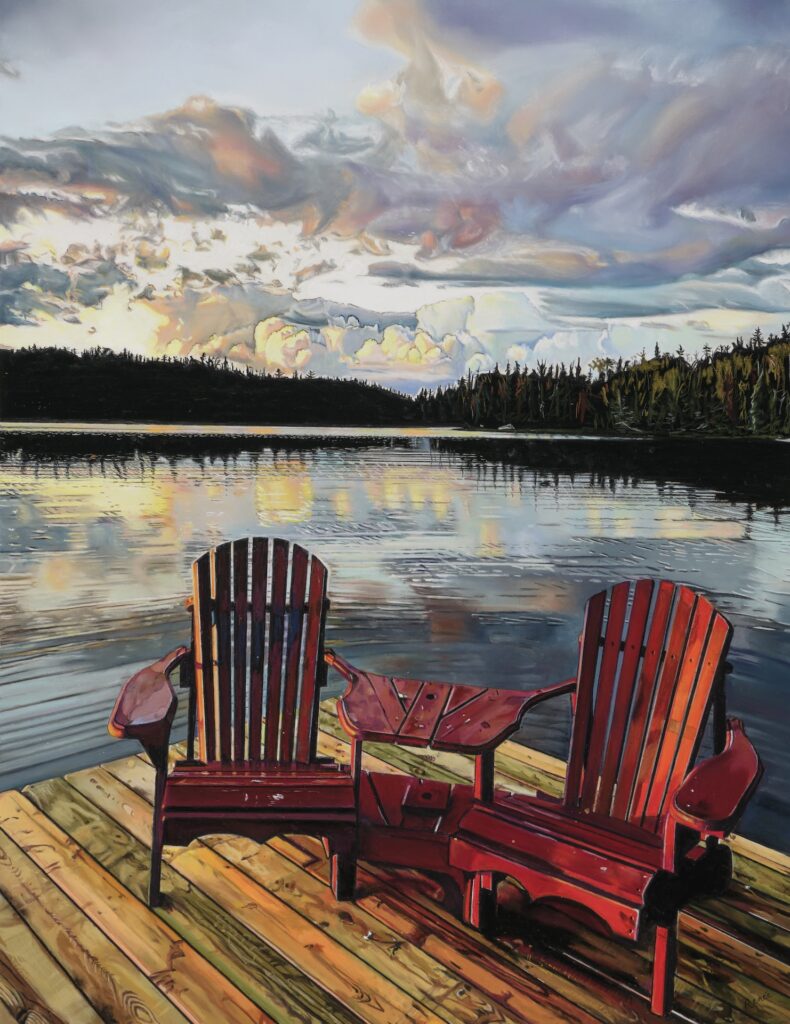
Muskoka Therapy, 2024, 21 x 27 in. soft pastel
As we wrapped up our conversation with Louise, we kept coming back to one of the oldest, most tender reasons anyone paints a portrait: the wish to hold onto the people we love. For centuries, a portrait has been a way to keep someone close, to hold a face still against the passing of time. Louise’s work belongs completely to that tradition. She paints the people dearest to her so that, as she says, they can live on forever.
What makes her portraits special is how openly they’re made of love. She doesn’t paint strangers posing for the camera. She paints her parents and her children as they once were, a grandfather glowing with pride, a mother’s worn hands still busy at work, small everyday moments of devotion. In doing that, she turns a portrait into something deeply human. It becomes a record not just of how someone looked, but of how much they were loved.
There’s a quiet truth running through her work that people have always felt: the most personal art is often the most universal. Louise paints from her own life, and yet strangers see their own grandparents, their own children, their own joys and sorrows looking back at them. With the little texts she writes for each piece, her paintings reach people in a way that surprises even her, proof that a picture can carry a feeling across time and distance and land, somehow, exactly where it’s needed.
For art lovers and collectors, Louise’s work offers something that feels increasingly rare: warmth, honesty, and real human connection. Glowing in soft pastel and full of feeling, her portraits aren’t just made to be looked at, they’re made to be felt, and the stories beside them open a door into the heart behind each one. To live with one of her works is to keep close a reminder of the people and moments that matter most, and of how much we all, in the end, have in common.
Maybe that’s the quiet gift of a portrait: it begins with one beloved face, and ends by reminding us of everyone we hold dear. Louise may paint from her own life, but what she’s really offering is a mirror of the love that connects us all.
Follow Louise Renée through the links below and explore more of her work and creative journey.