
Puja Khanna Uses Embroidery to Make Women’s Invisible Labour Impossible to Ignore
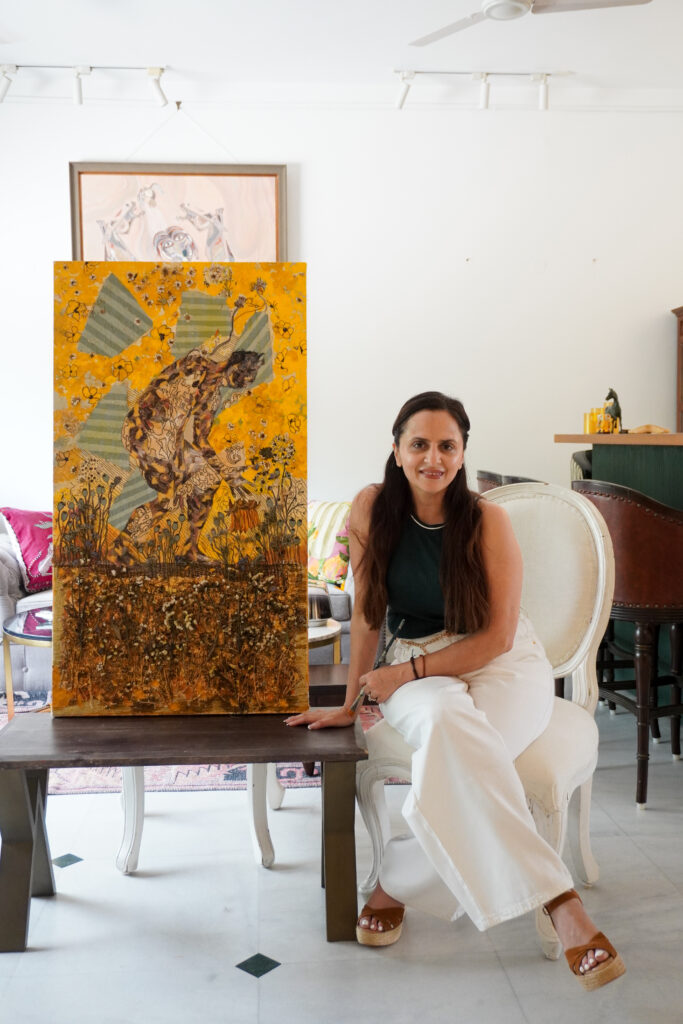
At Women in Arts Network, Portraits brought together artists drawn to the most human subject in all of art: the face, the figure, and everything they can be made to hold. Each of them approaches it in her own way, less interested in a simple likeness than in identity, memory, and the stories a body can carry.
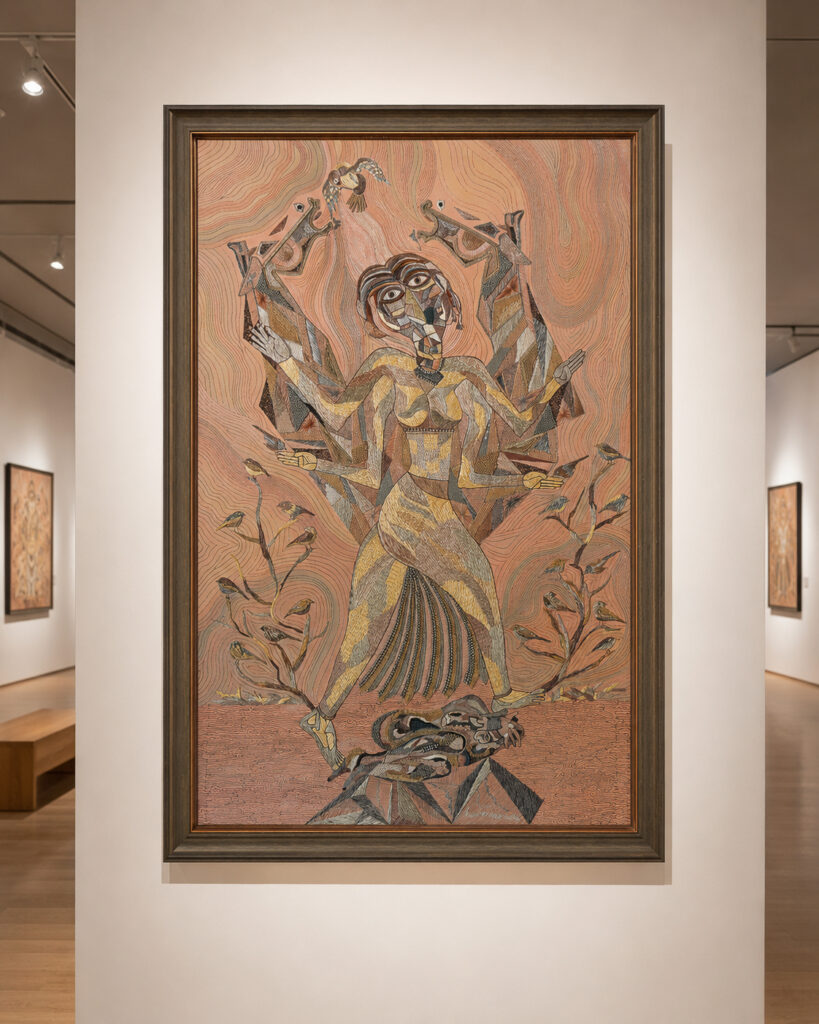
Among them is Puja Khanna Duggal, an Indian artist whose hybrid, armoured women, part human, part bird, part something with no name, turn the figure into myth, memory, and quiet rebellion.
Puja’s story begins with her grandmother. She told stories, never read from a book, as she was not literate, and never the same way twice. A creature might have four arms one night and wings the next, and no one corrected her. Gods took animal form, women became rivers, birds carried messages between worlds. None of it was presented as fiction, and none as fact; it simply existed, the way weather exists. Puja grew up inside that looseness, and has been working in it for twenty-five years since.
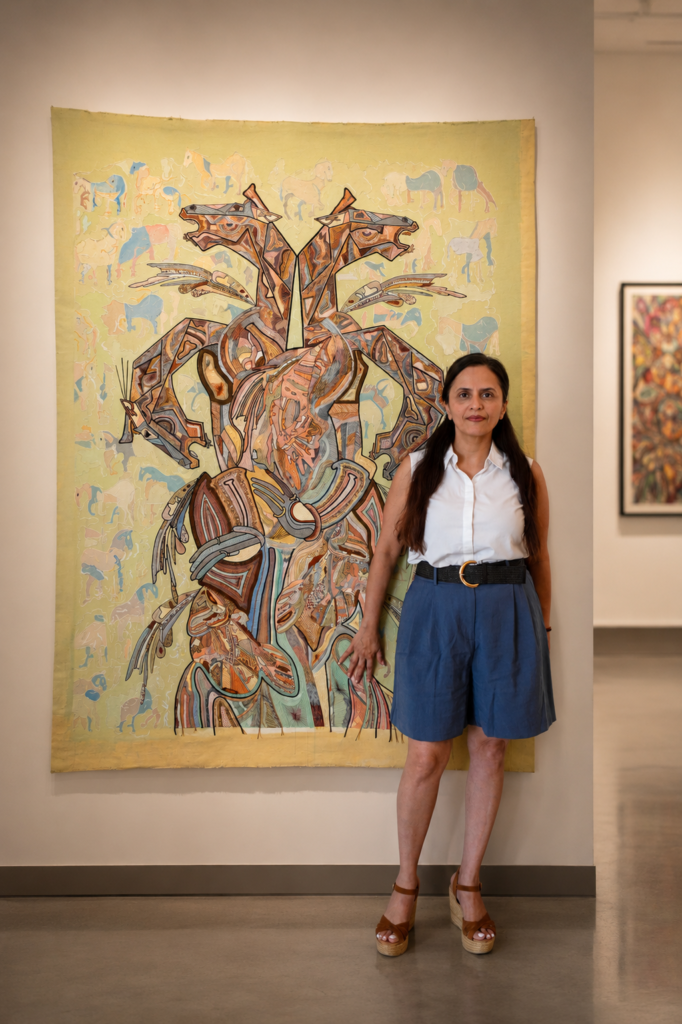
Her hybrid creatures draw on South Asian and East Asian traditions at once, because the stories she inherited were never tidy, they crossed borders, picked things up, and were retold wrong until they became better for it. When she makes a figure that is part woman, part bird, part something unnamed, she is not illustrating a myth. She is continuing her grandmother’s retelling.
Her path to this point has been anything but linear. Alongside her art, she spent years in luxury fashion, working with Japanese and French houses, a training she says she could not have got any other way. But her deepest inspiration has always come from Indian craft, where she learned patience, the kind of hours a piece demands, and how to work with many materials at once, binding them so they hold together as one thing.
She returned to painting more seriously during the pandemic, when long silences and stillness became the very condition the work needed, and a way to survive so much shared loss. The figures had been with her for years; in the quiet, they finally arrived.
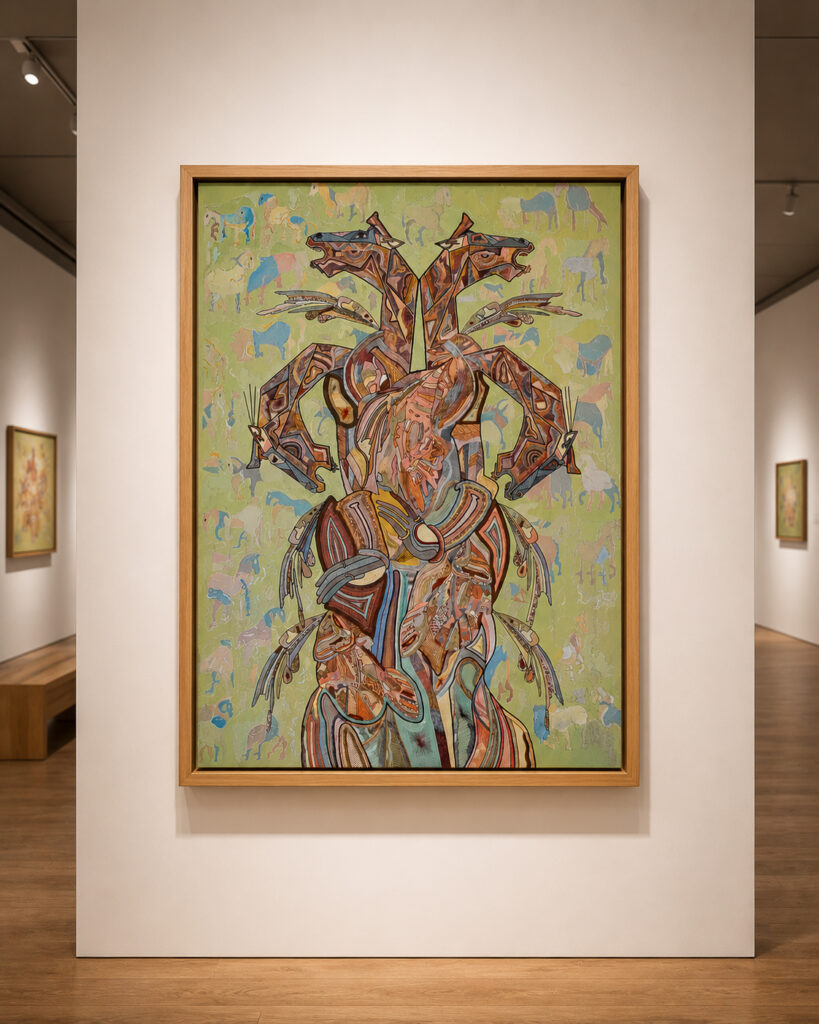
Today her work moves between painting, embroidery, murals, and multimedia installation, though she sees it as one body of work in two speeds. The subject decides the medium: some figures want paint, for its atmosphere and depth; others want thread, for its weight and slowness. She works largely with collected, reused materials, letting a composition build in stages as each piece suggests the next, and she wants every material’s history left visible, because here, as she was taught, nothing is ever wasted.
Beneath all of it runs a quiet insistence. Embroidery has always been women’s labour, and always been dismissed as decorative rather than serious, hours of skilled work left unnamed and uncounted. By placing those hours on a gallery wall, Puja insists they are the work itself, not the ornament around it. It is why her women are never gentle. They are hybrid, armoured, and powerful, which is, she says, closer to what she has actually seen.
Now let’s hear from Puja about the grandmother whose stories she is still telling, what stillness gave back to her work, why she moves between paint and thread, and her belief that craft deserves to be taken as seriously as any painting.
Q1. Puja, could you share how your grandmother’s stories shaped your imagination and artistic practice?
“My grandmother told stories. Not read from a book, as she was not literate, and never the same way twice. A creature would have four arms one night and wings the next, and no one corrected her. Gods took animal form. Women became rivers. Birds carried messages between worlds. She didn’t present any of it as fiction, and she didn’t present it as fact. It simply existed, the way weather exists. I grew up inside that looseness, and I’ve been working in it for twenty-five years since.
My hybrid creatures draw on South Asian and East Asian traditions at once, because the stories I inherited were never tidy, they crossed borders, picked things up, got retold wrong and became better for it. When I make a figure that’s part woman, part bird, part something with no name, I’m not illustrating a myth. I’m continuing her retelling.” Two things would sharpen it: her name or what you called her, and one creature she actually described. Those are the details that make the answer unrepeatable by anyone else.
Q2. You returned to painting more seriously during the pandemic. How did that period change your relationship with art?
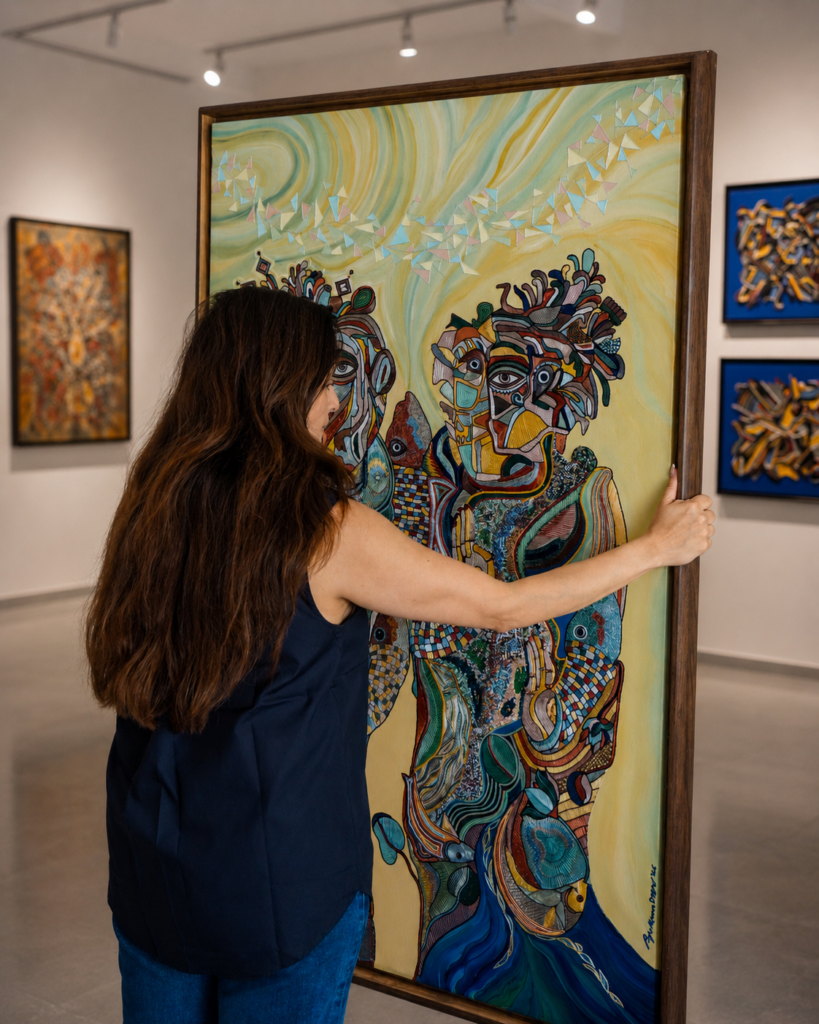
“I went inward during those months. Long silences, meditation, days with no one to answer to. I hadn’t been still like that in years, and stillness turned out to be the condition the work needed. It also became a way to survive. There was so much loss around me , in fact around all of us, and painting was where I could put it. The figures had been with me for a long time; I simply hadn’t made room for them. In the quiet, they arrived. I’ve protected that quiet ever since, spending time in the studio, brings peace and makes me do what I love.
Q3. How has your experience in luxury fashion influenced your approach to materials, composition, and storytelling?
I never stopped designing. Working part-time alongside my practice, with Japanese and French houses, gave me a training I couldn’t have got any other way.
But my inspiration has always come from Indian craft. That’s where I learned patience , the kind of hours a piece demands before it becomes anything. And it’s where I learned materials: how to work with many at once, and how to bind them so they hold together as one thing rather than sitting side by side. The difference is that fashion is made to be worn, and a painting is made to be read , there’s a story in it, and a meaning I’m answerable to. That’s what keeps me exploring. Thread, acrylic, oil, pastel , I use whatever the story needs. The materials have to belong to each other.
Q4. Your practice spans painting, embroidery, murals, and multimedia installation. What guides your choice of medium?
“The subject decides. Some figures & backgrounds want to be painted, they need atmosphere, depth, something you can look into. Others want thread, because thread has weight and a slowness that paint doesn’t have. I don’t think of them as two practices. It’s one body of work in two speeds. The same creatures keep appearing in both; what changes is how close you’re allowed to stand. And moving between them keeps me working. When I’ve been at an embroidery for weeks, painting feels like breathing out.”
Q5. You work with locally sourced and reused materials. How do their histories influence the way you create?
I collect. Materials come to me and I keep them, sometimes for a long time before they’re used. When I begin a work, I go through what I have and take what applies, not what I’d planned for, what actually belongs there. So the composition builds in stages. I put down a part of it, and then I look again, and the next thing suggests itself.
I go with the flow of it rather than executing something I decided in advance. I’d call it reuse rather than recycling. Nothing gets remade into something else, it carries its own history into the piece, and I want that visible. It’s also how craft has always worked here. Nothing is wasted. That isn’t a position I took; it’s what I was taught.”
Q6. In Entangled Mind, you describe a subconscious landscape shaped by childhood memories. How did those memories find their way into the work?
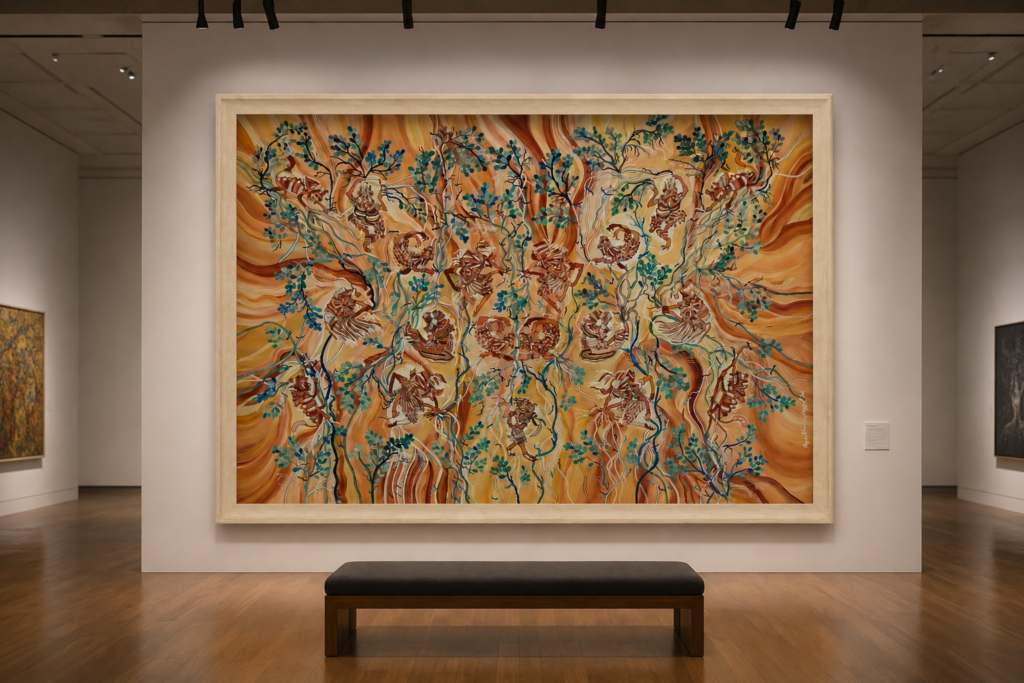
“It’s an abstract work. The memories didn’t arrive as events, they arrived as images. A colour, a texture, the feeling of a place rather than the place itself. I couldn’t tell you a story about most of them. And I don’t always know what I’m drawing from while I’m working. It’s only once a piece is finished that I recognise something in it. That’s why I call it a subconscious landscape. I’m not reconstructing a childhood; I’m finding out what stayed.”
Q7. In Lucid Dreams, you approach layering as a philosophical process. What does each layer represent to you?
“It began with a dream I remembered on waking, vividly for a moment, then very faintly. That’s the state the work came out of. Layering is how a dream behaves. Each layer covers what was under it, and some of it goes on showing through. Nothing is fully erased and nothing stays clear. You’re left with something you can’t quite retrieve but can’t quite lose either. So it isn’t decoration. While I’m working I’m not thinking in words, I’m waiting to see what the last layer left behind, and deciding how much of it to let through.”
Q8. How do you use traditional Indian craft to explore contemporary ideas about labour, identity, and power?
Heritage first, I didn’t choose it, I grew up around it. It became a medium because it’s what my hands know. But it’s the language that matters to me now. Embroidery has always been women’s labour, and it has always been called decorative rather than serious, hours and hours of skilled work that goes unnamed and uncounted.
Working in that medium lets me put those hours on a gallery wall and insist they’re the work, not the ornament around it. It’s also why my figures are what they are. The women in my work aren’t gentle. They’re hybrid, armoured, powerful. That’s closer to what I’ve actually seen.”
Q9. What does success mean to you today, both as an artist and as someone carrying forward a cultural heritage?
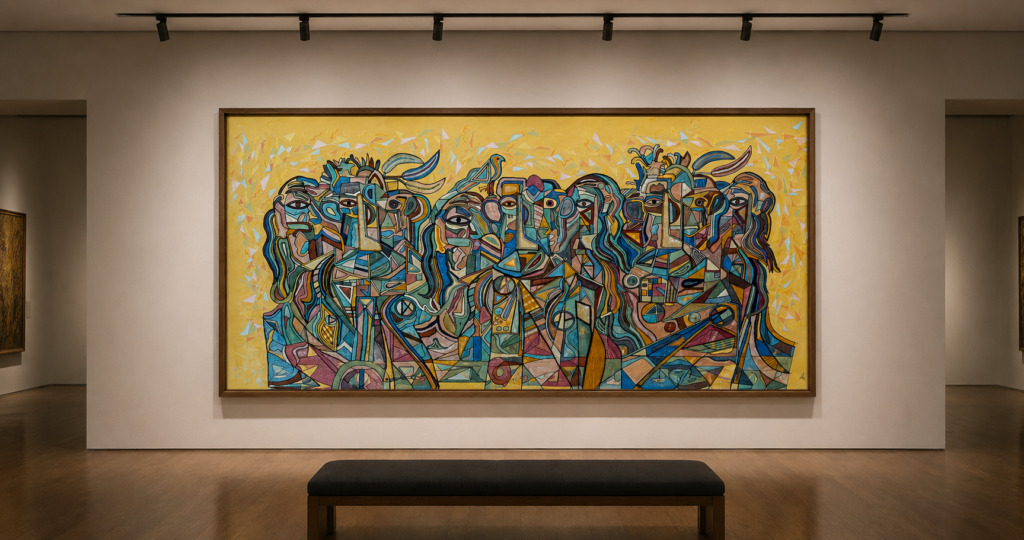
For a long time success would have meant the obvious things — the right galleries, the right rooms. Those matter, and I’ve worked for them. But they’re not what I measure by now. Success is being able to keep making the work at the level it asks for. That’s harder than it sounds, and it’s not guaranteed at any stage.
Beyond that, I want the craft taken seriously. If work like mine sits in the same rooms as painting, without being filed under decorative or traditional, that changes something for the women doing this labour, not just for me. And I’d like my children to see that a life built on making was a serious life to have chosen.”
Q10. Do you think contemporary art gives enough recognition to artists working with traditional craft techniques?
No. It’s improving, but slowly, and mostly at the surface. Craft still gets received as material rather than as thinking. A painter is assumed to have a concept; someone working in thread is assumed to have a technique. The work gets praised for skill and patience, as though the labour were the whole content of it. And the language hasn’t changed either. Craft, folk, traditional, decorative. All of those words place the work somewhere below fine art without ever having to argue the point. It’s shifting. There are more of us in serious rooms than there were ten years ago. But we’re still explaining, it a merger of paint and embroidery.
Q11. Looking back, what has changed most in your work, and what has remained at its core?
I began in oils, then moved through acrylic, charcoal, pastels, usually mixing whatever the surface needed. What changed was realising the work had to carry my own life in it, and that meant bringing in the embroidery I’d trained in and worked with all along.
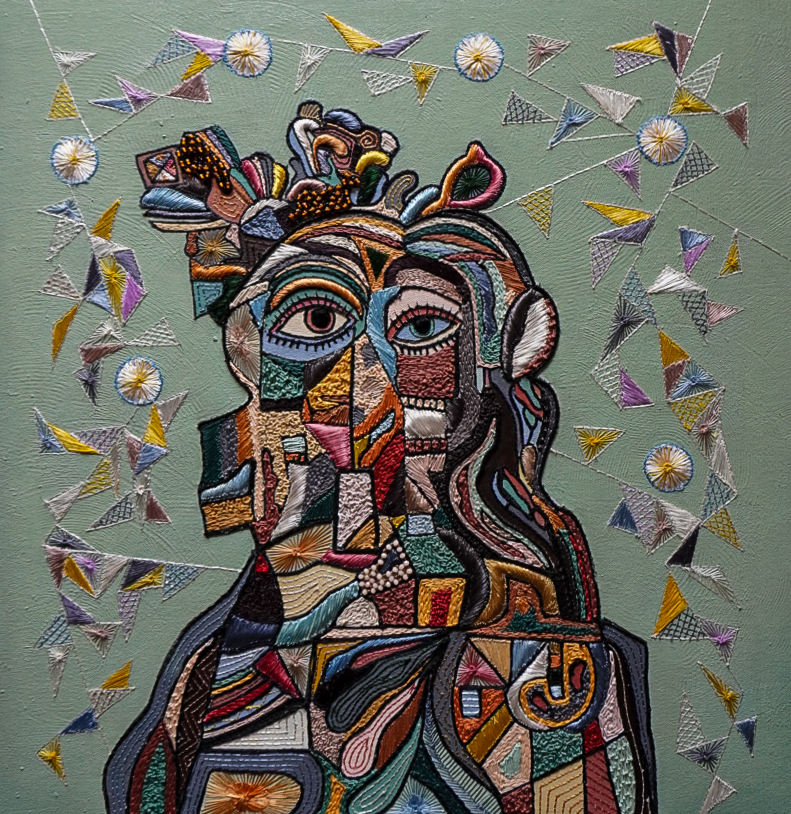
Puja’s work belongs to that wider lineage. Her women are hybrid and armoured, part human, part bird, part something unnamed, figures pulled from stories her grandmother once told and never finished. In refusing to make them gentle or decorative, she offers a different kind of portrait: not of a single person, but of strength, inheritance, and the many-layered selves that women carry.
Her approach also quietly challenges the idea that a figure must be legible to be powerful. Sometimes an image means most when it resists easy explanation.
There is a larger question running through her practice, too, one the art world is only slowly beginning to answer: who gets to decide what counts as serious art? Embroidery and craft have long been received as technique rather than thinking, praised for patience and skill as though the labour were the whole of the content. Puja insists otherwise.
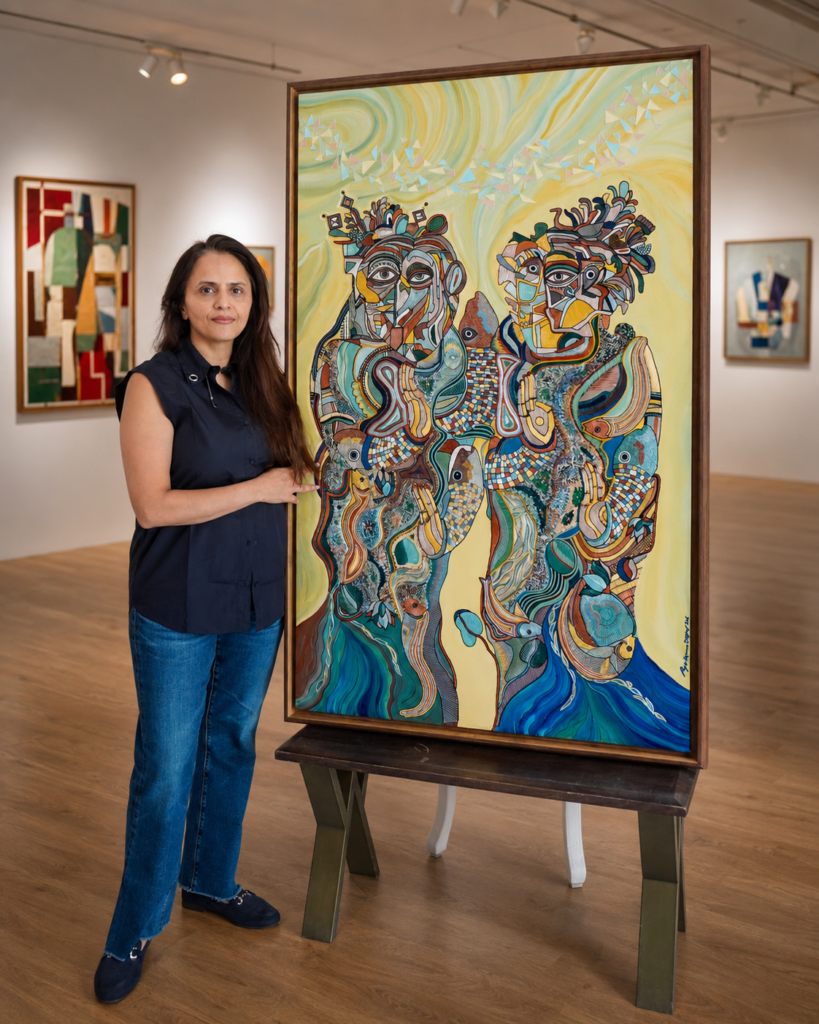
By placing the uncounted hours of women’s work on a gallery wall, she argues that craft is a language, not a lesser one, capable of carrying the most contemporary and urgent ideas. It is a reminder that the hierarchy between “fine art” and “craft” was never fixed, and that it is worth questioning.
For art lovers and collectors, Puja’s work offers something genuinely rare: the discipline and depth of fine art fused with the history and texture of traditional craft. Rooted in Indian making yet alive with influences gathered across cultures, her pieces reward slow looking, each layer of paint or thread carrying its own weight of memory and labour. To live with her work is to live with something that refuses to be only beautiful, a figure that holds a story, a lineage, and a quiet insistence on being taken seriously.
Perhaps that is the enduring power of the figure in art: it begins with a body, but it can hold a whole inheritance. In Puja’s hands, a woman who is part bird, part myth, becomes a way of carrying the past forward, and of insisting that the hands which made her have always mattered.
Follow Puja Khanna Duggal through the links below and explore more of her work and creative journey.
