
This Artist Turns Brush-Cleaning Newsprint into Abstract Landscapes │ Shona Elrick
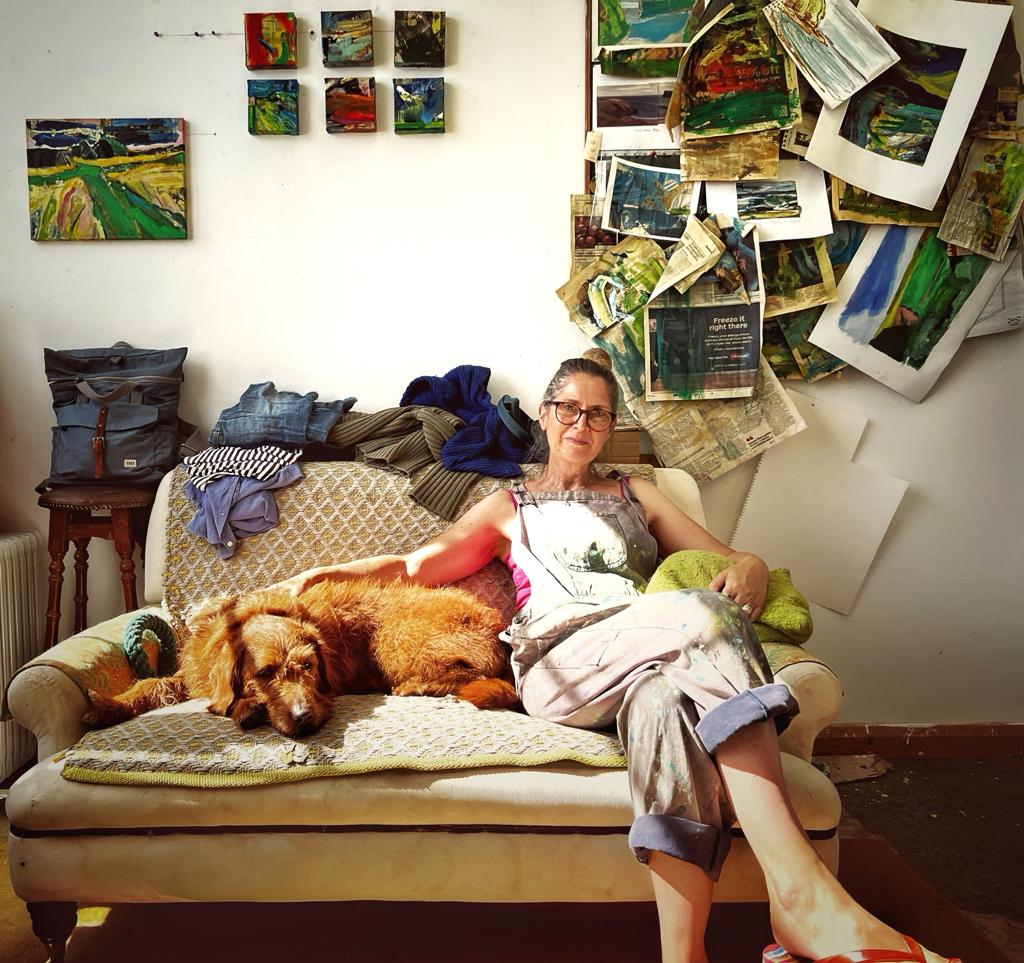
At Women in Arts Network, our Love, Life and Everything She Creates exhibition is built around one belief that the most powerful work comes from artists who create from the full spectrum of who they are. We received hundreds of submissions exploring exactly that.
And then Shona Elrick’s work came through and we just sat with it. Aberdeenshire coastlines and farmland built from layers of painted newsprint, old newspaper text peeking through sea and sky like messages from underneath, colours that feel like Scottish weather and we realised we were looking at something rare. An artist who doesn’t just paint where she’s from. She paints what it means to still be there. To have never left. To belong so deeply to a place that the land and the art have become the same thing.
Shona is a selected artist for the Love, Life and Everything She Creates exhibition and her paintings do something that most landscape work doesn’t even attempt. They don’t show you what a place looks like. They show you what it feels like to walk through it.
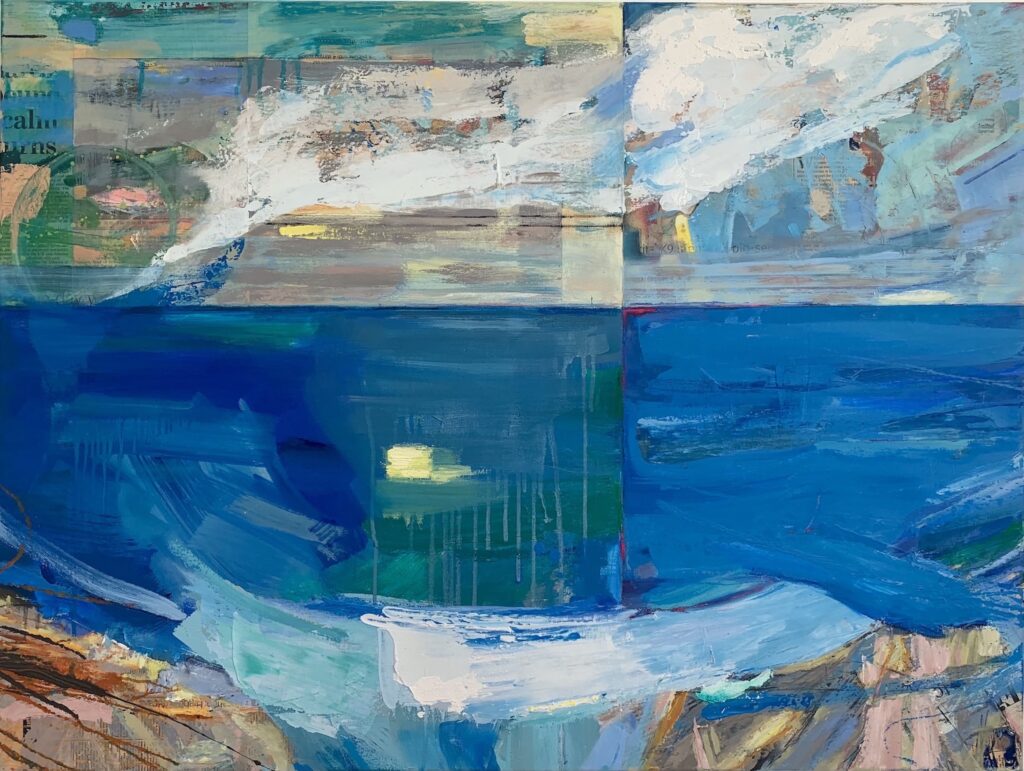
The wind on the coast. The brief rainbow caught in breaking surf. The long slow peach of a winter sunrise hitting frozen ground. These aren’t views. They’re encounters. Built from layers of painted newsprint collage, acrylic, and hidden words that sit underneath the surface waiting for someone to look close enough to find them.
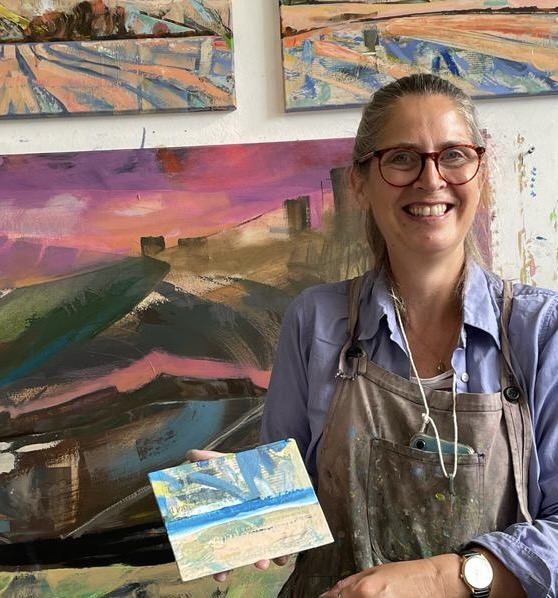
The newsprint is what gets you. She paints on it, over it, tears it, layers it into the canvas until the printed text and the painted marks become part of the same surface. Random words and phrases from old newspapers sit half-buried in coastlines and skies, and sometimes those words say something that changes the whole painting.
Sometimes they say nothing at all and that’s just as good. The process throws up unexpected colours, unexpected marks, unexpected connections and Shona has learned over decades to trust every single one of them. She grew up on a small farm in Aberdeenshire in the 1960s, the kind of childhood where you just wandered off by yourself and nobody worried.
Making mud pies. Staring at wildflowers on the roadside. Drawing enormous pictures in chalk on the school blackboard at five years old.
She studied painting, then moved into ceramics, and it was clay that accidentally taught her the thing that would define her entire practice collage. She was using sheets of clay like paper, pressing them against tree bark and rocks for texture, and realised the collage process excited her more than the finished ceramic ever did.
That discovery led her back to painting. But painting had changed. She had changed. And when she started seeing landscapes in the paint marks left on old newsprint from cleaning her brushes, everything clicked into place. She’s also a practising art psychotherapist, which tells you something about how she understands the relationship between making and healing. But we’ll let Shona tell you about that herself.
Now let’s hear from Shona, about paintsongs and painted newsprint, about why Aberdeenshire’s coastlines still feel like home after all these years, and what the landscape has taught her about herself that she never expected to learn.
Q1. Shona, could you share a little about your background and what first inspired you to become an artist?
I grew up on a small farm in Aberdeenshire in the 60’s and 70’s; a time when children were allowed to roam free, so I was often just pottering off by myself exploring nature, looking closely at roadside flowers or just making mud-pies! I went to a tiny rural school and have a memory of my artistic leanings being recognised and encouraged through freedom to draw huge pictures with chalk on the blackboard from the age of 5yrs. We also, and I think unusually, had a visiting art teacher in primary school – so thank you Mr Ford.
Q2. You studied painting before later exploring ceramics. How did working with clay change the way you approached painting?
Clay is such a tactile media and also works in conjunction with such a spectrum of luminous glazes of many colours. I started using sheets of clay, similar to how one would use collage, gaining textures by slapping it against natural objects, i.e. tree bark, rocks etc. It was completely freeing. However in a roundabout way, I created coloured paper templates prior to the finished ceramic piece – it turns out it was this collage process which really excited me. It also helped unlearn certain beliefs from my initial painting degree (I was young and impressionable then).
Q3. Painted newsprint has become such a distinctive part of your work. What first made you see those discarded sheets from cleaning your brushes as something worth building a painting around?
Marks left on the newsprint in this process are inherently spontaneous and fresh. I started to see ‘landscapes’ in little groupings or passages of marks, often evocative of a familiar place, season etc. I used these as initial sketches for a new way of expressing how I felt within a landscape. However, I became aware that there is a quality and structure of print and line within newsprint which was missing from these earlier paintings, so I started adding pieces of newsprint to the canvas. That was in 1996, that process has changed, grown and developed since then.
Q4. Works like Prism Sea, Banff Bay capture more than a specific location. What do you hope viewers experience when they look at these landscapes?
The inspiration behind Prism Sea, Banff Bay was watching the sunshine through the breaking surf to create brief rainbows. The North Sea on this coast conveys a deep ultramarine blue when the sun shines, so I hope the viewer can share a sense of awe, as well as take the time to look closer at the hidden details and words left uncovered.
Q5. Your solo exhibition Paint songs of the Wild has a memorable title. What inspired this body of work?
PAINTSONGS TO THE WILD was actually a retrospective of my work from 2014 to 2022, so therefore it encompassed all my inspiration from landscape up to that period. We sing songs about love, so PAINTSONGS TO THE WILD are about using paint to communicate my love and connection to nature, landscape and all things wild.
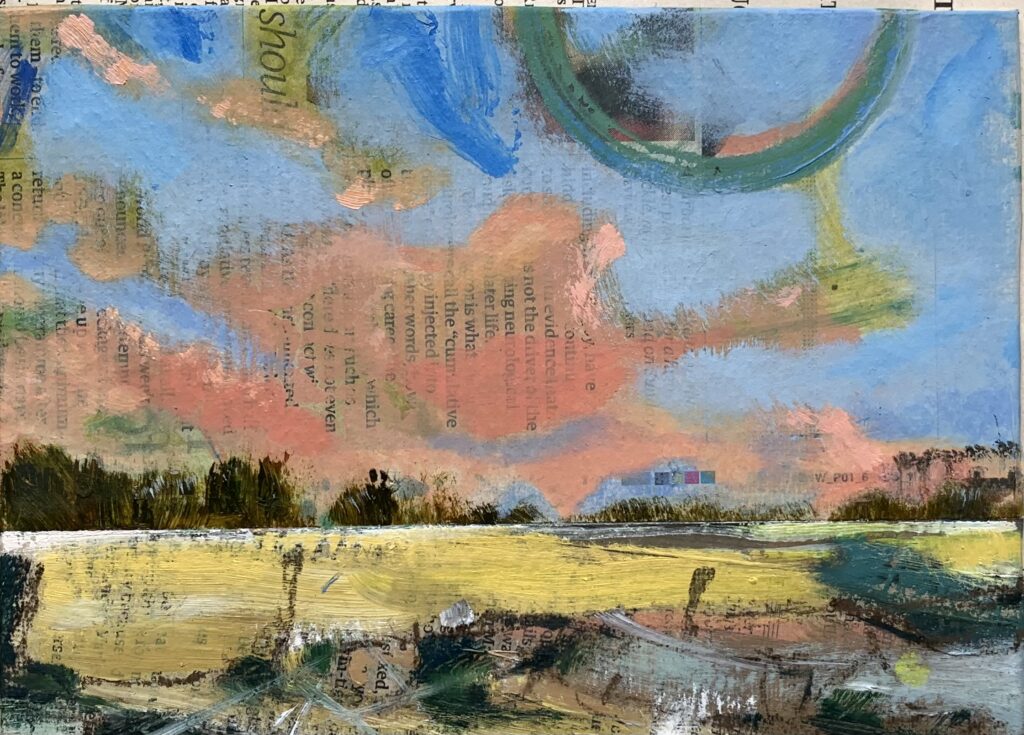
Q6.The skies, coastlines, and farmland of Aberdeenshire appear throughout your work. What is it about those landscapes that continues to inspire you after so many years?
These Aberdeenshire skies, coastlines and farmland are essentially home to me, the same way the body, limbs and outline of my dearest family are home to me. I am so aware that my ancestors walked and worked these lands, and fished in these seas, it feels like a deep connection to time as well as place. Paradoxically, I paint but a moment of light on land or sea.
Q7. You mention finding poetry in the random words that appear within the newsprint. Has there ever been a word or phrase that completely changed the direction of a painting
Good question, I would actually say no and yes! No, as I generally the choice of words or phrases are random, as I choose the newsprint primarily for the colour or quality of mark around the vision of the landscape in mind. Yes, in regard to my what words series, the words came first, so the choice of newsprint dictated the painting.
Q8. Looking back across your career, what has the landscape taught you about yourself that you didn’t expect to learn?
Even landscape changes. So one has to flow with change too.
Q9. Your work celebrates awe, curiosity, and play. Do those qualities become more important as you’ve grown as an artist?
Yes, definitely. Life can be a very serious business, and we can all become a bit jaded or overwhelmed by life, state of the world and fears for the future. These qualities allow one to celebrate this beautiful planet and the gift of being human; I believe these qualities and processes are transformative on an individual level, as well as the viewer.
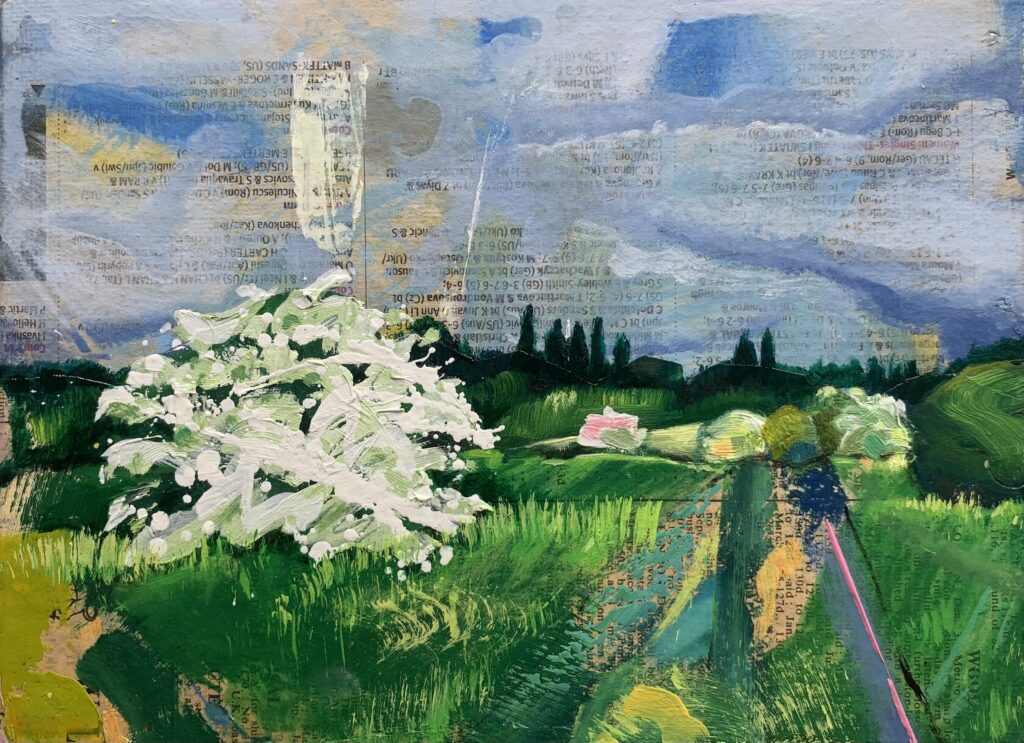
Q10. What influences your colour choices when you begin a new painting?
The landscape I view! More specifically, it’s those seasonal or transitory elements unique to that landscape or influence of light/time of day: whether it is the pale bleached out long grass in a summer meadow, or the long slow peach sunrise hitting the frosted ground in winter.
Q11. Landscape painting has such a long history. How do you keep the subject feeling fresh and personal within your own practice?
I think one has to follow your own instinct and authentic voice regarding the the inspiration driving the work.
Q12. Alongside being an artist, you also work as an art psychotherapist. Has listening to other people’s stories changed the way you approach your own work, even indirectly?
I’m not sure it has changed my approach, but it gives me gratitude for my own creative response when life has thrown me challenges and significant loss. I am grateful for a studio space to paint, but I am also aware that my connection to the natural world is a huge source for healing. Not everyone has that awareness or affinity.
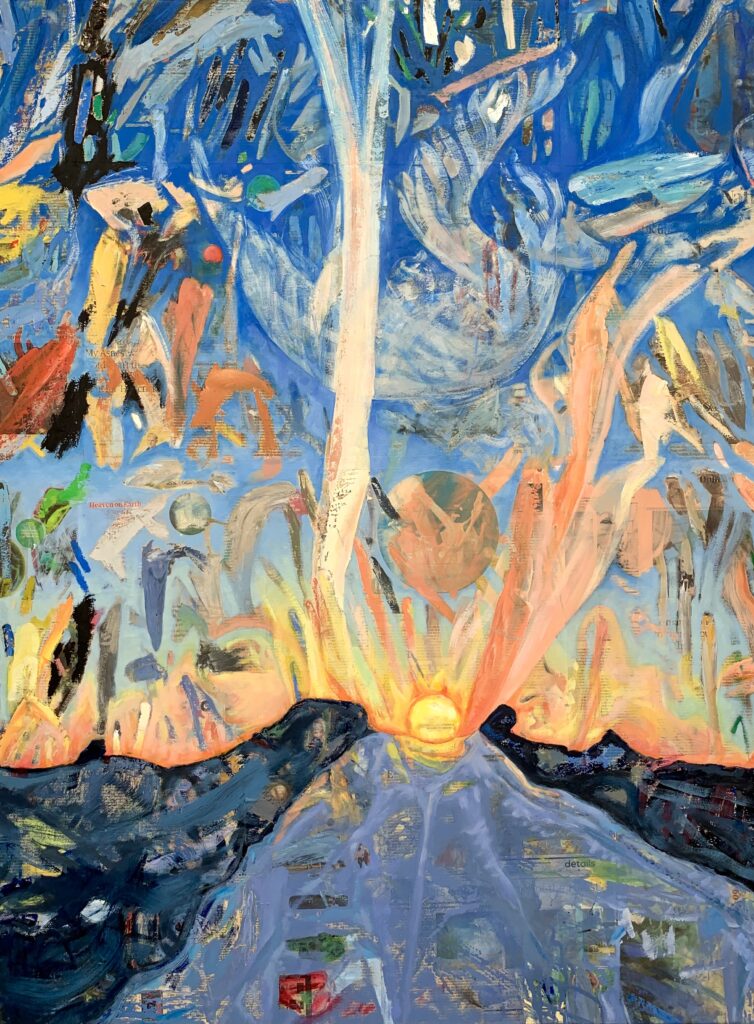
Q13. You often describe your work as expressing the feeling of walking through a landscape rather than recording it. How do you translate those experiences into abstract forms?
It is through the use and process of the painted newsprint collage, as it throws up unexpected colours and marks, which in my mind translate to those unexpected finds and experiences within a landscape, i.e. a found pebble, new flower or bird observed for the first time. But it also how one interacts with larger elements such as wind or sea, these emit feelings that can be conveyed through eh quality of mark.
Q14. What has been the biggest lesson you’ve learned from developing your practice over the years?
Just keep keeping on. Turn up even when the inspiration feels flat, something will evolve that will be useful in the long run.
Q15. What advice would you give to artists who are still learning to trust the unexpected moments that happen during the creative process?
Those are the best moments! Write them up in your sketch book, play with that process a bit more. Finally, listen to how those unexpected moments feel, if it’s exciting, go with it, if it’s yuk, maybe not!
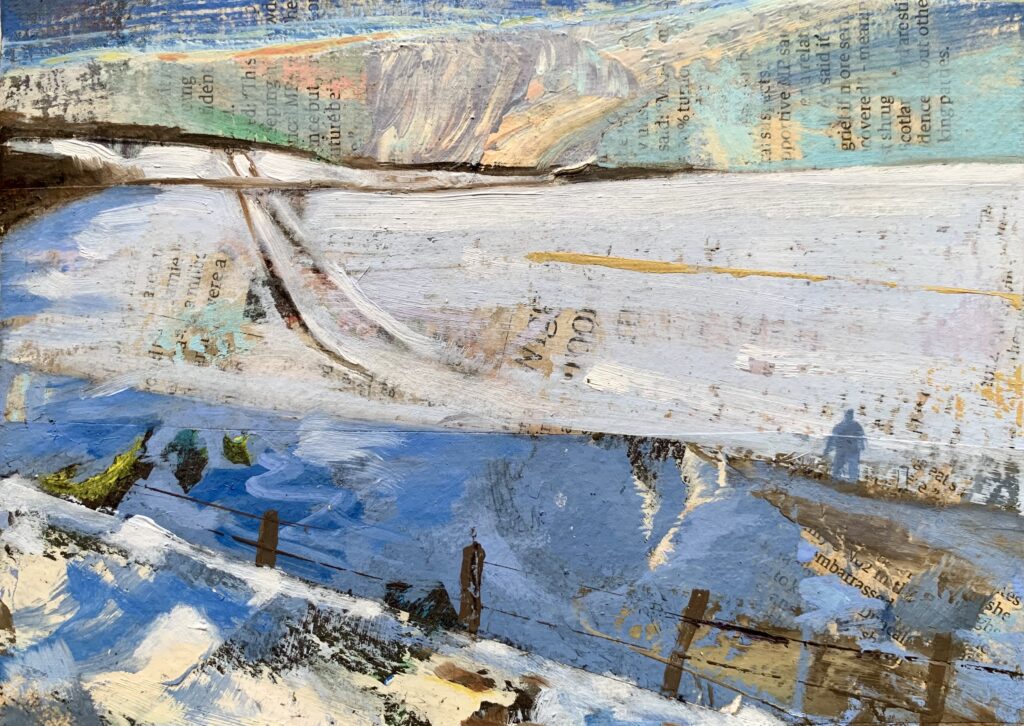
As our conversation with Shona drew to a close, we kept coming back to the idea of how much can be found in the ordinary. A brush-cleaning sheet most people would throw away. A headline in a newspaper nobody finished reading. A landscape you’ve walked past a hundred times without really stopping to see it.
Shona notices all of it. And somehow, she turns these overlooked things into work that makes you wonder what you might have been walking past your whole life.
What makes her process especially interesting is the way she lets the unexpected in. She doesn’t begin a painting knowing exactly where it will end. She starts with layers, with newsprint pressed into paint and colour left behind from previous brushwork and then responds to whatever begins to appear. A word might surface through the paint. A mark she never planned might become the most interesting part of the piece.
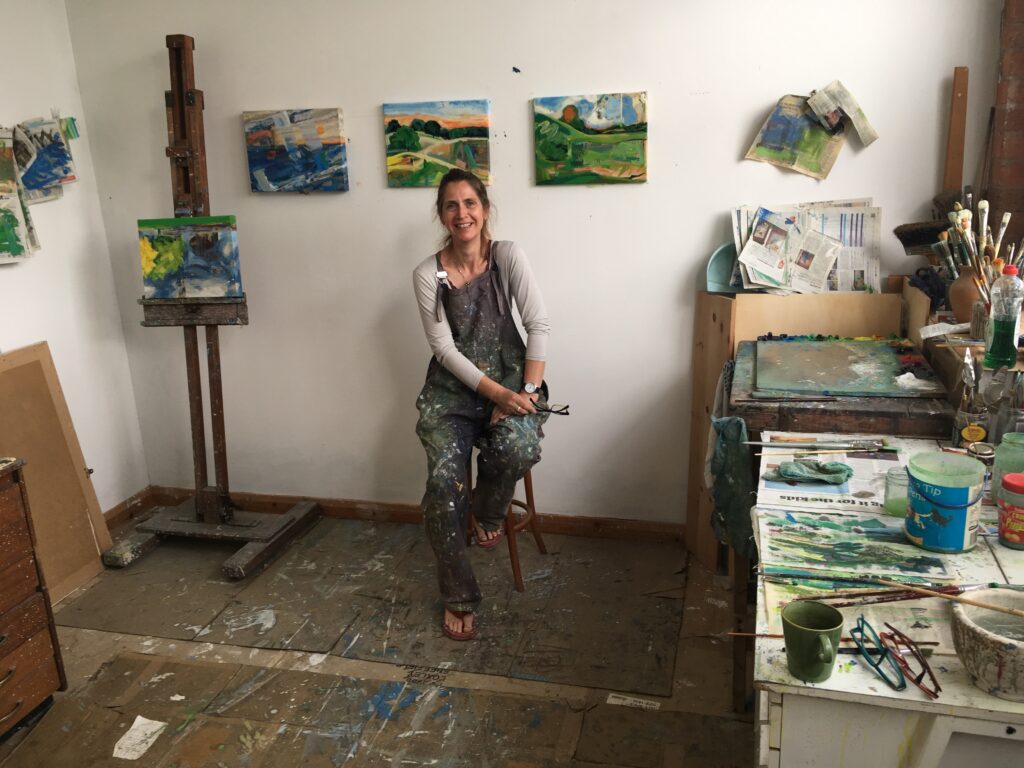
Rather than covering these moments up, she works with them. That willingness to trust what arrives uninvited gives her paintings a quality that feels difficult to manufacture. They feel discovered, as though something was already there and she simply found a way to bring it forward.
There is also a quiet sense of movement throughout her practice. Light changes. Seasons shift. Familiar surroundings can look completely different from one day to the next. Shona’s paintings hold onto that feeling that a landscape is never completely still or finished, but always changing. She gives these fleeting impressions a lasting form without making them feel frozen.
Perhaps that is what makes her work so inviting to spend time with. The longer you look, the more you begin to notice the layers, the fragments of text, the marks and colours that weren’t immediately visible. These are paintings that reward patience. The kind of work that reveals something new when you return to it.
And maybe that is the beauty of using materials that already carry their own history. Something that was once used simply to clean a brush or carry a piece of news can take on an entirely different life through an artist’s hands. Shona reminds us that there can be stories, textures, and possibilities hiding inside the things we usually overlook. You just have to slow down enough to see them.
To see more of Shona’s work and follow her journey, find her through the links below.
