
5 Things Worth Spending Money on as an Artist
Artists are often told to be careful with spending money. And honestly, that makes sense. When you are building a creative career, there is always another canvas to buy, another software subscription to consider, another exhibition fee, and about a hundred things that feel more exciting than upgrading your workspace.
But not every expense is just an expense.
Some purchases can save you time, protect years of work, make your art look significantly better online, or simply make it easier to keep creating consistently. Those are the purchases worth paying attention to.
So, instead of another list of things artists could buy, here are five areas of your art practice where spending a little more can actually have a very good return on investment.
1. A Professional Artist Website + Your Own Domain
Instagram is useful. So are Behance, TikTok, Pinterest, online galleries, and every other platform where artists can put their work in front of people.
But none of them should be the only place your professional identity exists.
A personal website gives you one permanent place to send a gallery, curator, collector, client, journalist, or potential collaborator. More importantly, it lets you control how your work is presented instead of having your portfolio sit between ads, reels, unrelated posts, and an algorithm.
And yes, your own domain matters.
yourname.com looks a lot more professional than a free website address, especially when you are putting yourself forward for opportunities.
If you’ve been wanting to build your artist website, our guide on How to Create an Artist Website can be a good place to begin your research.
What to spend on
You do not need a custom-designed $5,000 website when you are starting out. A clean portfolio with your best work, biography, CV, contact information, and links to your social platforms can be enough.
Good options include:
- Squarespace — particularly strong for beautiful, minimal artist portfolios and easy customization. It is frequently recommended for artists because of its visual templates and straightforward editor.
- Wix — useful if you want more flexibility, SEO tools, and the option to add more functionality later.
- Shopify — worth considering if selling originals, prints, or products is going to be a major part of your business.
- Adobe Portfolio — a simple option if you already have an Adobe Creative Cloud subscription and mainly need a portfolio rather than an online shop.
Best investment: Your domain + a polished, simple website that you actually keep updated.
You do not need 15 pages. You need a website that makes someone think, I want to know more about this artist.
2. Studio Lighting That Actually Shows Your Work Properly
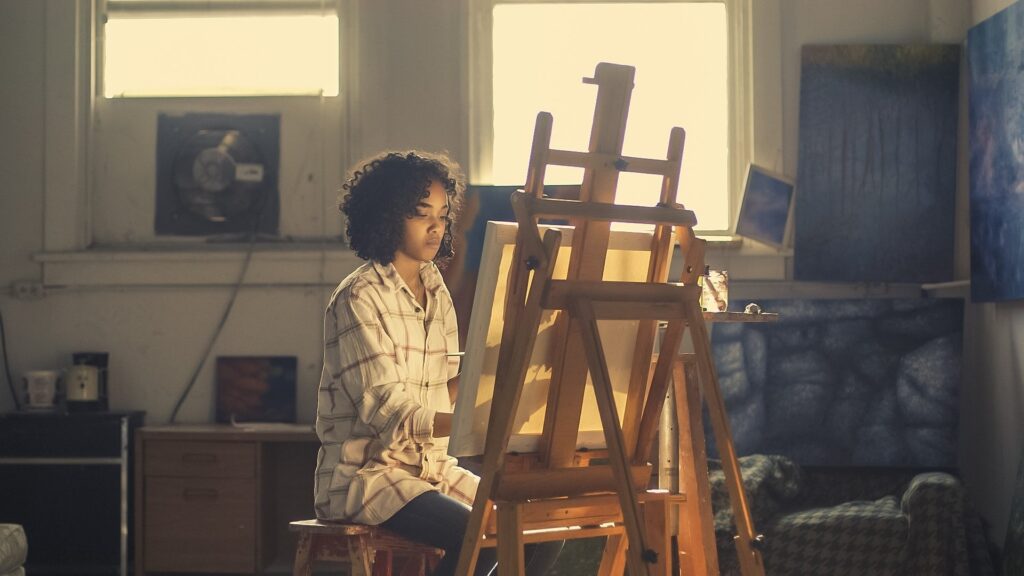
Lighting is one of those things artists tend to improvise. A window. A random desk lamp. The ceiling light. Maybe a ring light borrowed from somewhere.
And then the colors in the photograph look completely different from the original.
If you regularly photograph your paintings, drawings, ceramics, textiles, sculptures, or products, good lighting is not a luxury. It is documentation equipment.
The key thing to look for is high color rendering, usually expressed as CRI. For photographing artwork, look for a light with CRI 95+, ideally around 96 or higher, and a daylight-balanced setting around 5,500–5,600K if you want neutral-looking color.
Good options to look at
Godox SL60IID
A strong option if you want a more serious studio light. It is daylight-balanced at around 5600K and has a CRI of ≥96 and TLCI of ≥97. It also accepts Bowens-mount modifiers, so you can add softboxes and other light-shaping accessories later.
Godox SL60IIBi
If you want more flexibility, the bi-color version ranges from 2800K–6500K while maintaining a CRI of ≥96 and TLCI of ≥97.
NEEWER NL660
A more affordable panel-style option. It offers 3200K–5600K adjustment, 0–100% dimming and CRI 96+. It also comes with a diffuser and can be mounted on a light stand.
One more thing: how you position it matters
For photographing flat artwork:
- Put the light at roughly a 45-degree angle to the artwork.
- If possible, use two lights at opposite 45-degree angles for more even illumination.
- Avoid mixing window light with artificial light.
- Use a diffuser or softbox to reduce harsh reflections.
- Keep the artwork and camera parallel to each other.
You do not necessarily need the most expensive light in the store. You need consistent, color-accurate light that you can recreate every time you photograph your work.
That consistency alone can make your portfolio look dramatically more professional.
3. A Proper Backup System
This is probably the least exciting purchase on this list. It is also the one you will be very glad you made when your laptop suddenly decides it has had enough.
Think about everything stored digitally:
- High-resolution photographs of your work
- Videos and studio footage
- Portfolio files
- Exhibition submissions
- Artist statements
- CVs
- Design files
- Client files
- Social media content
- Years of creative experiments
Losing that because of a failed drive, stolen laptop, corrupted file, or accidental deletion is not just inconvenient. Some of it may be impossible to recreate.
The simple artist-friendly setup
Think 3-2-1 backup:
3 copies of important files
2 different types of storage
1 copy stored somewhere else
A practical setup could be:
Your computer → External SSD → Cloud backup
For the external drive, the Samsung T9 Portable SSD is one option worth looking at. The 4TB model offers up to 2,000MB/s read and write speeds, USB 3.2 Gen 2×2 connectivity, AES 256-bit hardware encryption, and up to 3-meter drop resistance.
You can also use services such as Dropbox, Google Drive, or iCloud for working files and sharing, but remember that syncing is not exactly the same thing as having an independent backup.
The goal is simple: if your laptop disappears tomorrow, you should still have your art.
4. Upgrade Your Studio Ergonomics
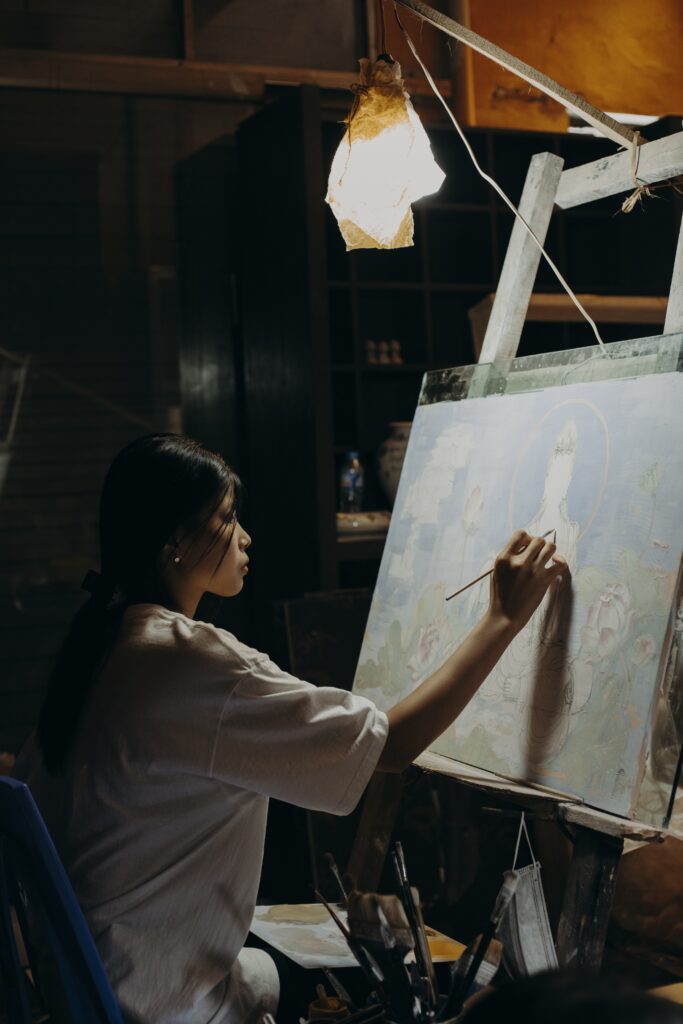
You can spend hundreds of dollars on better brushes and still create while sitting in a terrible chair. That makes very little sense.
Artists spend hours drawing, editing, painting, photographing, stitching, sculpting, designing and answering emails. Your body is part of your studio setup, so investing in it can have a surprisingly good return. And you do not necessarily have to replace everything.
Start with the biggest problem
If you sit for hours, look at:
- An adjustable chair
- Lumbar support
- Adjustable armrests
- A footrest if your feet do not sit comfortably on the floor
- A monitor or laptop stand
- A desk height that allows your shoulders to stay relaxed
- A separate keyboard/mouse setup if working on a laptop for long periods
If you want a premium chair, the Herman Miller Aeron is the obvious high-end reference point. It comes in three sizes and offers adjustable PostureFit SL support, adjustable arms and different tilt configurations.
But here is the important part: you do not need a $2,000 chair to have an ergonomic studio.
A good mid-range adjustable chair plus a footrest and a monitor/laptop riser can make a much bigger difference than buying an expensive chair and keeping everything else at an awkward height.
Your goal is not to make your studio look like a tech office. It is to make it easier to spend three hours creating without feeling like your spine has personally filed a complaint.
5. A Phone Tripod + Overhead Mount
If you want people to see your work, you need to be able to show your work easily.
And no, you do not need a professional camera for every Instagram Reel, process video, studio update, or behind-the-scenes clip.
Your phone is already a surprisingly capable documentation tool. What usually makes the bigger difference is where you put it.
A small tripod can help you photograph finished work straight-on. An overhead mount can capture:
- Drawing processes
- Painting sessions
- Sketchbook pages
- Printmaking
- Embroidery and textile work
- Jewelry making
- Clay work
- Packaging orders
- Studio tours
- Process videos
- Time-lapses
This is one of those purchases that can quietly change how consistently you create content.
A simple setup
Look for:
Phone clamp + adjustable tripod + overhead/arm mount + small light
One affordable option is the Ulanzi MT-44 Extendable Vlog Tripod, which has a built-in phone holder and extends to around 146.5 cm. It can also accommodate other small accessories and cameras.
For a more compact setup, Ulanzi also makes several dedicated phone tripods, including the MT-44B, which extends to around 1.5m and includes a phone clamp with a cold shoe for adding a small light.
If most of your content involves working flat on a table, prioritize an overhead arm or overhead phone mount rather than simply buying a taller tripod. The angle is what makes process footage much easier to film.
And suddenly, that “I should really post more process videos” thought becomes something you can actually do.
And while you’re thinking about smart investments in your creative practice, AI can be another useful one, without costing you anything. Here are 5 free AI tools worth trying to help you brainstorm, organize ideas, experiment, and work through creative blocks.
The Real Rule: Spending Where It Removes Friction
You do not need to buy every product mentioned here. In fact, please don’t.
The point of spending money on your art practice is not to accumulate increasingly expensive equipment. It is to identify the things that repeatedly slow you down, compromise your work, or make professional opportunities harder to pursue, and fix those problems.
The best artist purchases are rarely the most glamorous ones.
Sometimes the smartest investment is not another beautiful material sitting on your shelf. It is the thing that protects your work, presents it better, saves you time, or makes it easier to keep doing the work in the first place.
And those are the purchases with the kind of return-on-investment that actually matters.
Editor’s Note:
We’ve extended the deadline for The Beauty of Still Life virtual exhibition to August 30! If you’ve been meaning to submit, now is your chance to share your work and be considered for the exhibition. Don’t wait until the last minute, submit your piece before the new deadline.
