
This Pennsylvania sculptor uses crackle and crawl glazes to camouflage flaws ┃ Constance McBride
At Women in Arts Network, every now and then someone enters Faces with work that doesn’t give you a face right away, and somehow ends up saying more about the human experience than the ones that do.
Constance McBride did that with clay. She is a selected artist for the Faces exhibition, and before we get into the work, it helps to understand how long she’s been in conversation with the material she’s using.
She didn’t come to this recently. This started early. Growing up in the Northeastern United States, she was the kind of kid who picked things up from the ground bits from the woods, fragments from the shoreline, things most people would walk past. That instinct stayed. Not as a hobby, but as a way of seeing.
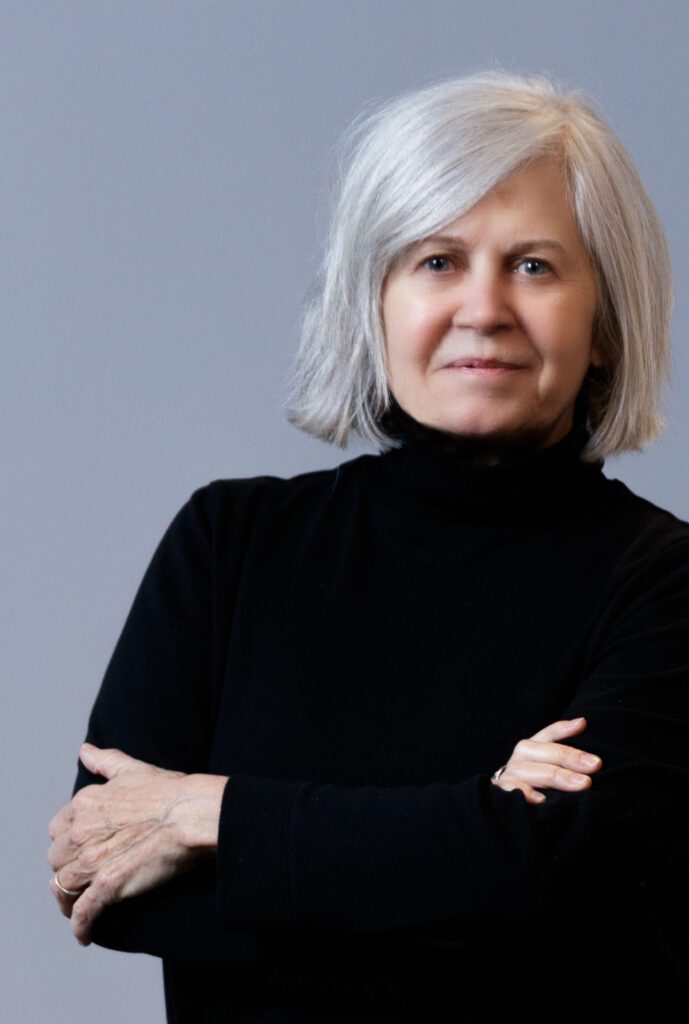
She spent over 25 years working in healthcare technology, building a career outside the arts, before eventually returning to her creative practice. Earlier in her journey, she had explored art through a brief period as a freelance illustrator, designing logos and visual pieces for small businesses, but it wasn’t until later that clay became central to her work.
After moving to Arizona, that connection deepened. She started taking ceramic classes, studying with figurative sculptors, and by 2008 she was already exhibiting her work. Two decades in, she’s still working with the same material but the conversation has gotten heavier.
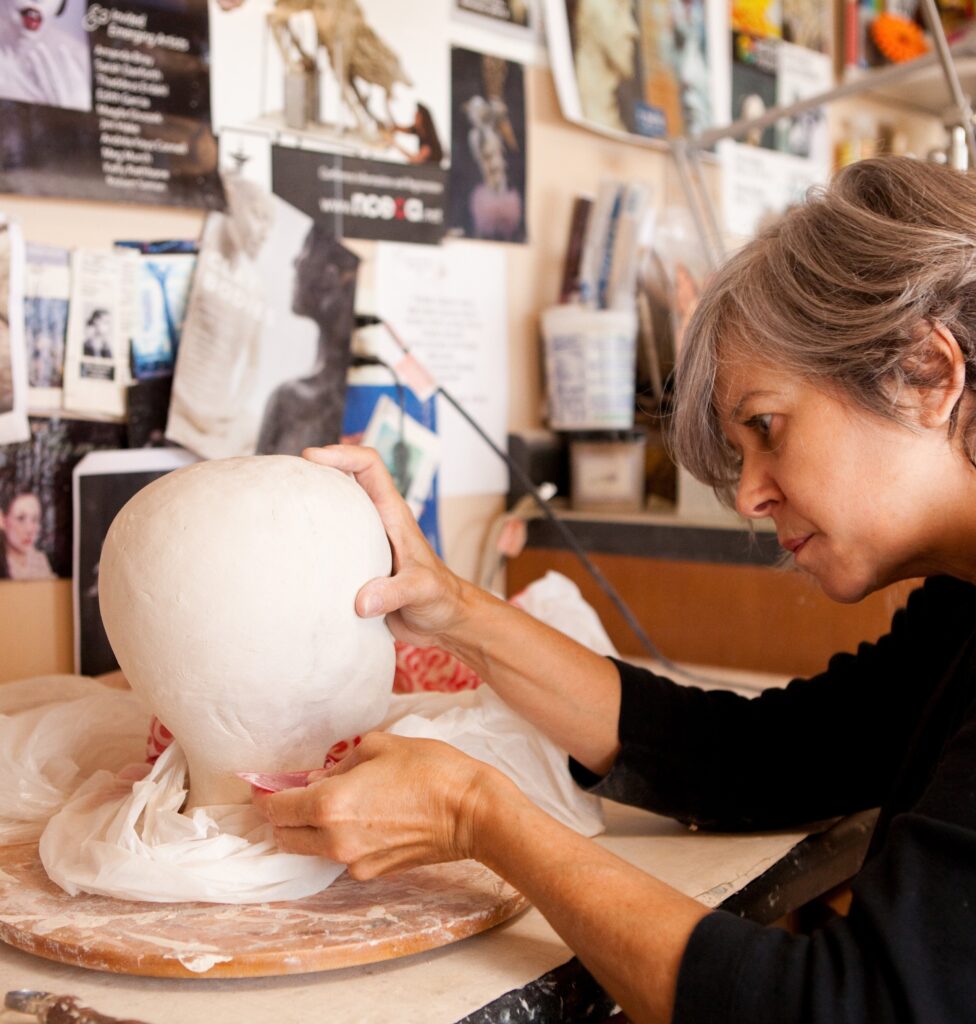
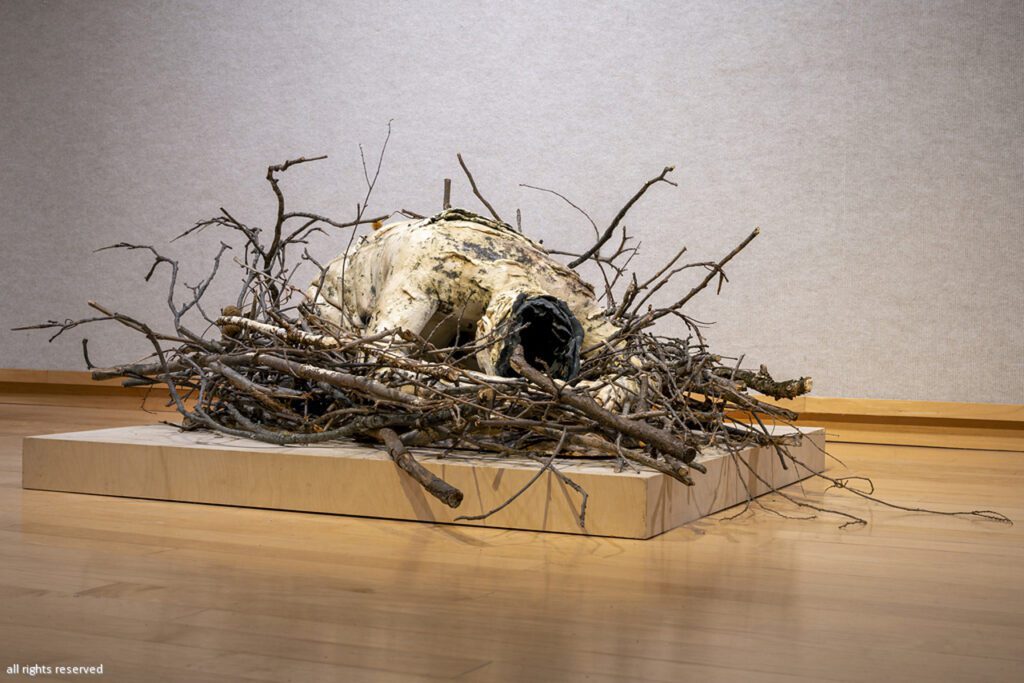
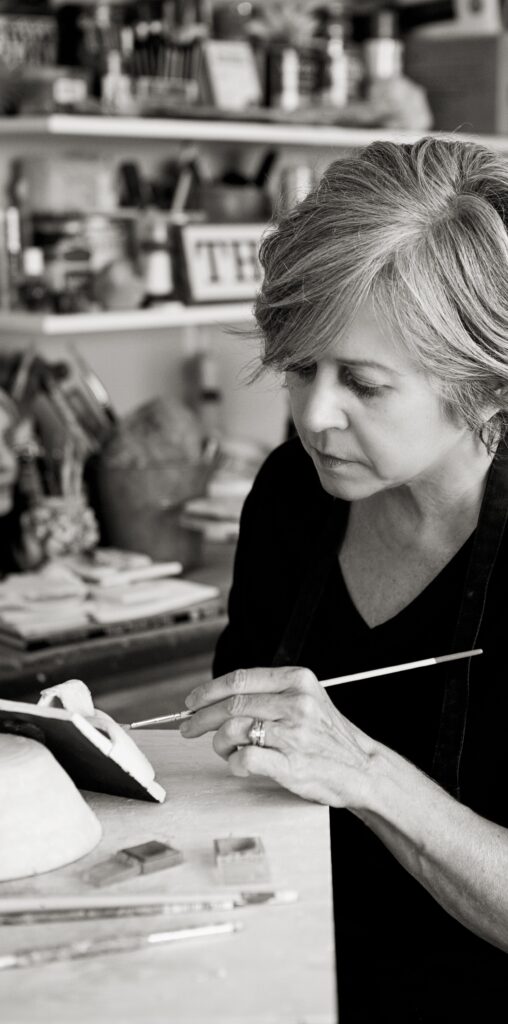
Because for Constance, clay isn’t just a medium. It’s earth. It’s memory. It’s something that records pressure. She works with stoneware paper clay, building her figures slowly by hand—rolling slabs, forming coils, wrapping them around armatures, shaping them piece by piece. You can see every decision. Nothing is erased. The surface holds everything.
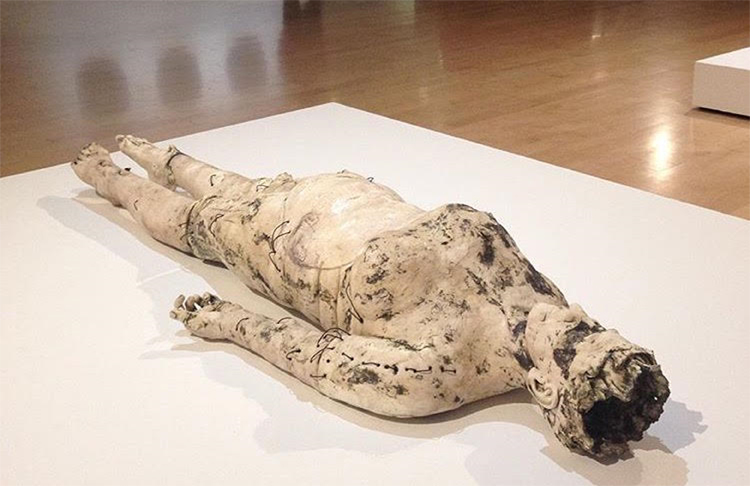
And the figures themselves don’t try to look comfortable. They fold. They compress. They hold tension. Sometimes they sit in poses that feel strong at first, and then you notice something else underneath. A weight. A pressure. A sense of being contained.
Her work deals with the body, but not in a straightforward way. She talks about it as a “dwelling place”—something that can feel like safety, or like confinement, depending on how you exist inside it. That idea runs through everything she makes.
Within Faces, her work shifts the question. It’s not asking, “who is this?” It’s asking “what does it feel like to be inside this?”
Now let’s hear from Constance, about clay as something that holds memory, about bodies that carry both strength and strain, and about why sometimes the most powerful portrait isn’t in the face at all.
Q1. Can you share with how you first drew toward the tactile language of clay and sculpture, and how did your artistic focus shift from drawing to three-dimensional form?
Early on, like many children, I was drawn to nature for inspiration. I’ve been collecting debris since I was a kid roaming nearby woods and beaches in the Northeastern part of the United States. Later, I became intrigued by the human form and the cycles of life. The depth of our connection to nature was what I was after and it’s what I always looked to for ideas. I drew and painted privately while working for a time as a freelance illustrator doing logos and other pieces for small businesses. I became intrigued by clay while taking a tile making class in 2001. After a move to Arizona, I began taking local ceramic classes and signing up for workshops with prominent figurative sculptors. I was hooked and by 2008 I was exhibiting my ceramic sculpture.
Q2. Working primarily with clay allows for a direct physical connection between your hands and the medium. How does this physicality influence the types of forms you pursue?
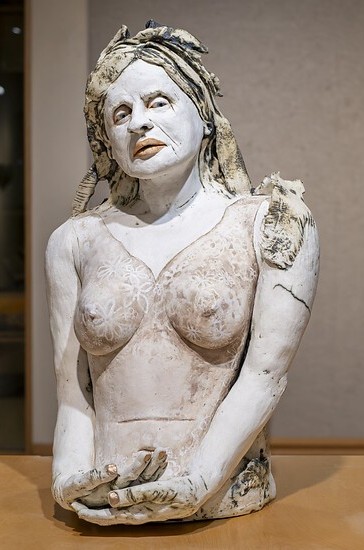
I use stoneware paper clay, known for its versatility and adaptability during the building process. I hand build my figurative pieces by rolling out slabs and coils, wrapping them around makeshift armatures and sculpting the details. As I work, I feel the direct connection between me and the clay. It is made from minerals of the earth and it holds memories. It’s malleable and I like to think we are too; not without conviction but flexible enough to ride the waves of change. I think about the layers we add to our lives while investigating the changes our bodies experience over time. Living in Arizona’s Sonoran Desert made it an ever-present influence on me and I found myself harkening back to childhood inspirations. Bits and pieces were picked up and saved there much like the bits I’ve been collecting from woods and shorelines since childhood. These bits share aspects of us: both individually transient and collectively existing for thousands of years. Landforms are continually expanding, contracting, and redefining themselves; so are we. My crumpled figures may seem to be in ruins, yet they still exist.
Q3. Many of your pieces address gender-based issues and the human body. How do you translate these complex ideas into physical form without overly literal narrative?
My work with clay represents the precariousness of bodily autonomy. I am exploring how gendered bodies navigate the world. Rather than just sculpting a body part, I want to communicate issues of liberation and constraint. My figures are reframing the body as a “dwelling place,” which can be interpreted as a place of safety or a confined space. I create fragmented and somewhat distorted forms. For me, fragmenting the body represents how societies often objectify a person.
Q4. Your assemblages often feel like stories in space collecting shards, gestures, and marks. How do you think about narrative arc within a single piece of sculpture?
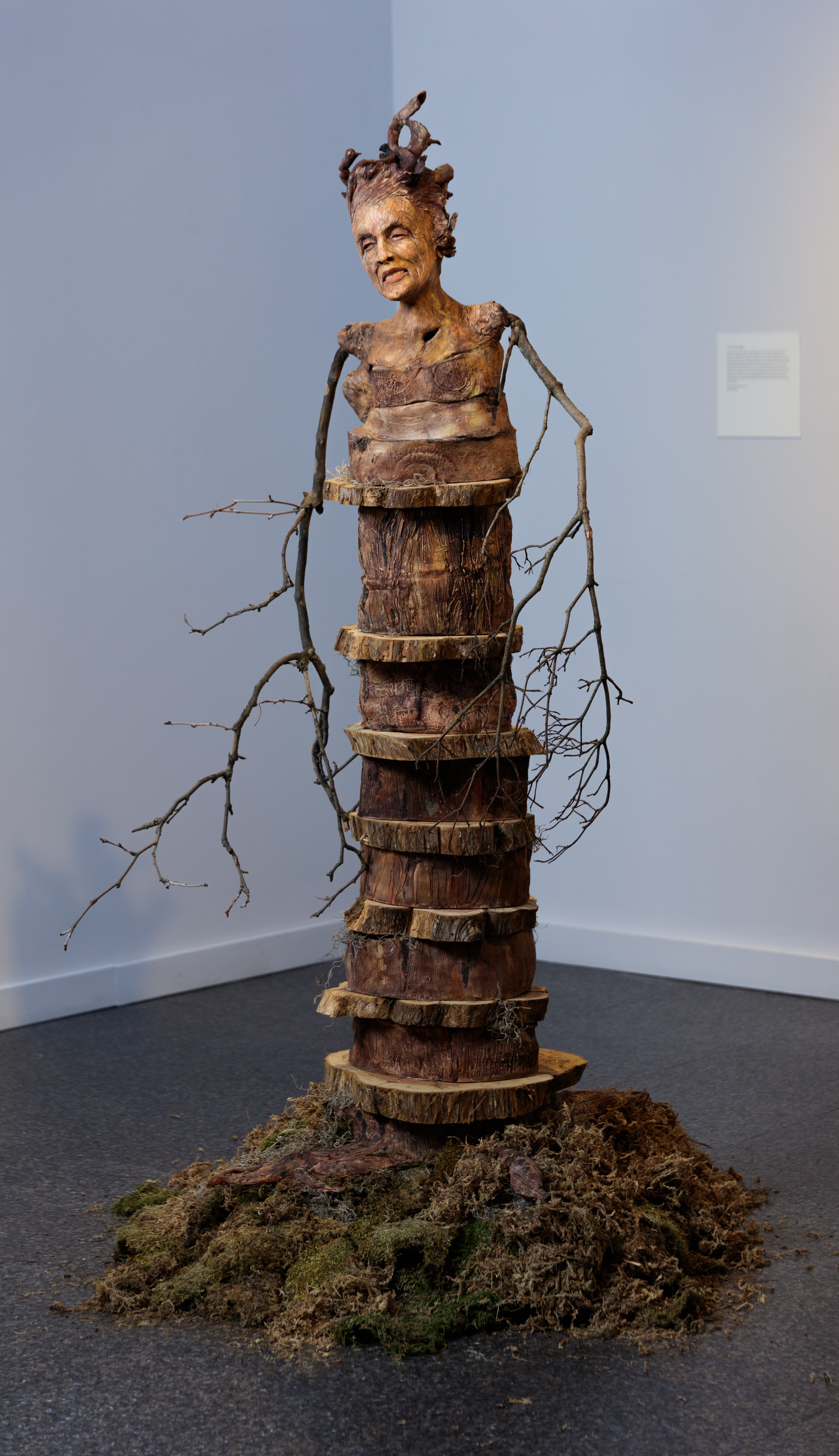
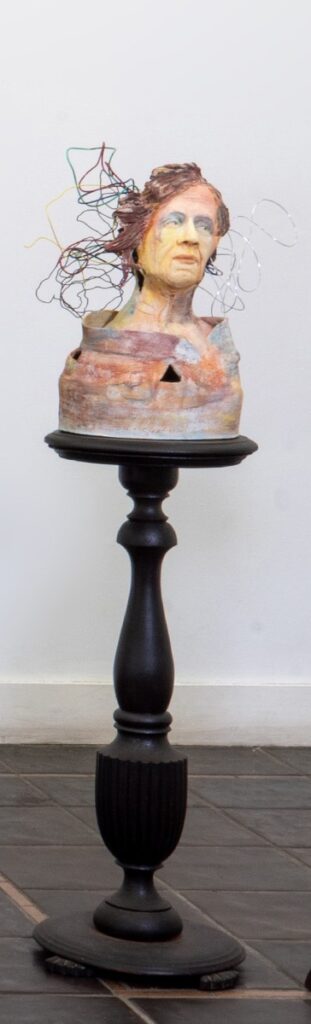
I often put my figures in yoga poses, which are innately expressive. They should immediately convey an internal state of balance and strength. When one of my figures stands alone, I view it as a momentary stillness. I am relying on the gesture, the textures and expression in the face to communicate an intimate narrative and I am relying on the viewer’s imagination to complete the story. When viewed in the round, my figures offer a different part of the narrative from every angle. As long as it is displayed properly, a 3D work of art should always encourage the viewer to move around it to understand the full “moment”.
Q5. Can you describe a moment in your studio where a material surprises a crack, gesture, or unexpected mark altered the direction of a piece?
I have been working with clay for 20 years now so I am well past the phase of getting upset when something goes wrong. And something can always go wrong, whether it’s in the building process or firing process. I tend to look at it is an opportunity to collaborate with the clay. I will turn a scratch or crack into part of an intentional surface texture. Or I will turn it into a natural feature like a split in a bit of tree bark. I sometimes take a cue from my collage process and cover a flaw with another material, such as fabric or wire allowing it to add depth. Crackle and crawl glazes are great at helping to camouflage a flaw and unify the piece.
Q6. You’ve led workshops and held roles like Sculptors’ Group Chair. How have teaching and community engagement influenced the way you think about your own work?
My path to art was circuitous and it took a long time to get to now. My 25plus years in business helped me in defining the roles I wanted to take on in my art career. I had worked in teams, collaborated with people and directed others when in management roles. All of it translated well to what I do today. I cherish my time in the studio, but I enjoy working with other people. I’m inspired by teaching art. Researching artists and techniques to share with adult students often leads me to discover new sources of inspiration for my own work. Listening to a student’s critique of another’s work helps me to look at my own work from a different perspective. Working on a variety of projects forces me to move beyond my solitary studio. It helps to form relationships with other artists and stakeholders in the community, we discover a shared language and that is energizing. My process becomes a tool for social dialogue and empowerment. Teaching and community engagement has shifted my mindset. I see my work differently; I can use it as a tool to connect people while strengthening ties with my community. Engaging in these areas of my practice reaffirms why I chose to be an artist. It’s a most rewarding way to live life.
Q7. In shows like Still Here: Aging in America, your work sat alongside other artists exploring similar themes. How do you think exhibitions of that nature help viewers contextualize your work?
When my work is shown alongside others addressing aging, it reinforces the shared human experience of getting older. An exhibition can showcase aging from a variety of perspectives; mainstream medical, sociological, psychological, and personal. My work contributes one piece to this larger puzzle, illustrating the complexity of the subject matter.
Q8. Much of your work has been part of group exhibitions exploring identity, body, and space. How does dialogue with other artists shape what you bring to the studio next?
Participating in group exhibitions encourages me to articulate the “why” behind my explorations, in response to seeing my work alongside others. It’s seen in a new context and may prompt me to engage with new directions in the studio. I may try experimenting with different techniques and push the envelope a bit further in my work. I often come away from a show charged by other artists interpretations of a theme and will want to “up my game”.
Q9. When a viewer reads your work very differently from your intention, how do you reconcile that with your sense of the piece?
Once a piece is released, it takes on a life of its own, and the viewer brings their own experiences and context to it. it no longer belongs to me. I won’t always be at a museum or gallery to explain my intent and that’s as it should be, the work should stand on its own. The fact that it evokes a reaction at all is a success, even if it isn’t the reaction I expected.
Q10. What advice would you give to artists working in material-intensive practices especially those exploring vulnerability and identity through form about sustaining long-term creative growth?
I define success by how well I am doing in the studio; for me it’s about when I have a breakthrough moment and when the idea in my head manifests into a valid piece. It’s also about time management but it’s never about how much money I am making. If I fell into that trap, I’d be making widgets and not the serious art I want to make. That is not what I want to do with my precious time. My advice is to understand it is all about discipline, stamina, perseverance, and mastery of craft. They are all essential to a successful career. You have to keep chipping away at it in order to get better at what you do. You need to understand it’s a marathon, not a sprint. And, you need to build up a thick skin… rejection is unavoidable if you are putting yourself out there so you need to get used to it.
As we wrapped our conversation with Constance, we kept coming back to how long this relationship has been building. Not just with art, but with the material itself. The years of collecting fragments as a child. The time spent working as an illustrator. The class that introduced her to clay and quietly changed everything. And then two decades of staying with it.
Because working with clay like this doesn’t happen quickly. It takes time to understand how it moves. How it resists. How it holds. And somewhere along the way, that understanding starts to shift into something else. Into a kind of trust. Where you’re no longer trying to control the material completely but learning when to follow it instead.
Constance has been in that space for a long time. And you can feel it in the work. In the way nothing is rushed. In the way the figures hold themselves—sometimes steady, sometimes compressed, sometimes carrying more weight than they seem to at first. These aren’t decorative bodies. They feel like they’ve been shaped slowly, the way a life is shaped. Layer by layer. Change by change.
We kept thinking about how rare that kind of patience is. Because a lot of work today is made to be seen quickly. Understood quickly. Moved past quickly. But her work doesn’t do that. It asks you to stay. To move around it. To notice how it shifts depending on where you stand.
And that changes the experience. It stops being something you look at and becomes something you spend time with.
For anyone living with art, or thinking about bringing it into their space, this kind of work offers something different. It doesn’t sit quietly in the background. It keeps asking for your attention in small ways. The surface catches the light differently. A detail you didn’t notice before suddenly stands out. The posture of a figure starts to feel more familiar the longer you live with it.
It grows on you. And artists who have spent this long with a material, who understand it this deeply, who are still pushing it further that’s something worth paying attention to.
Because this isn’t someone just starting out. This is someone who has put in the years, found the language, and is still building on it. And the people who are paying attention now are the ones who’ll understand where this work is heading next.
To follow Constance’s journey and see more of her work, find her through the links below.
